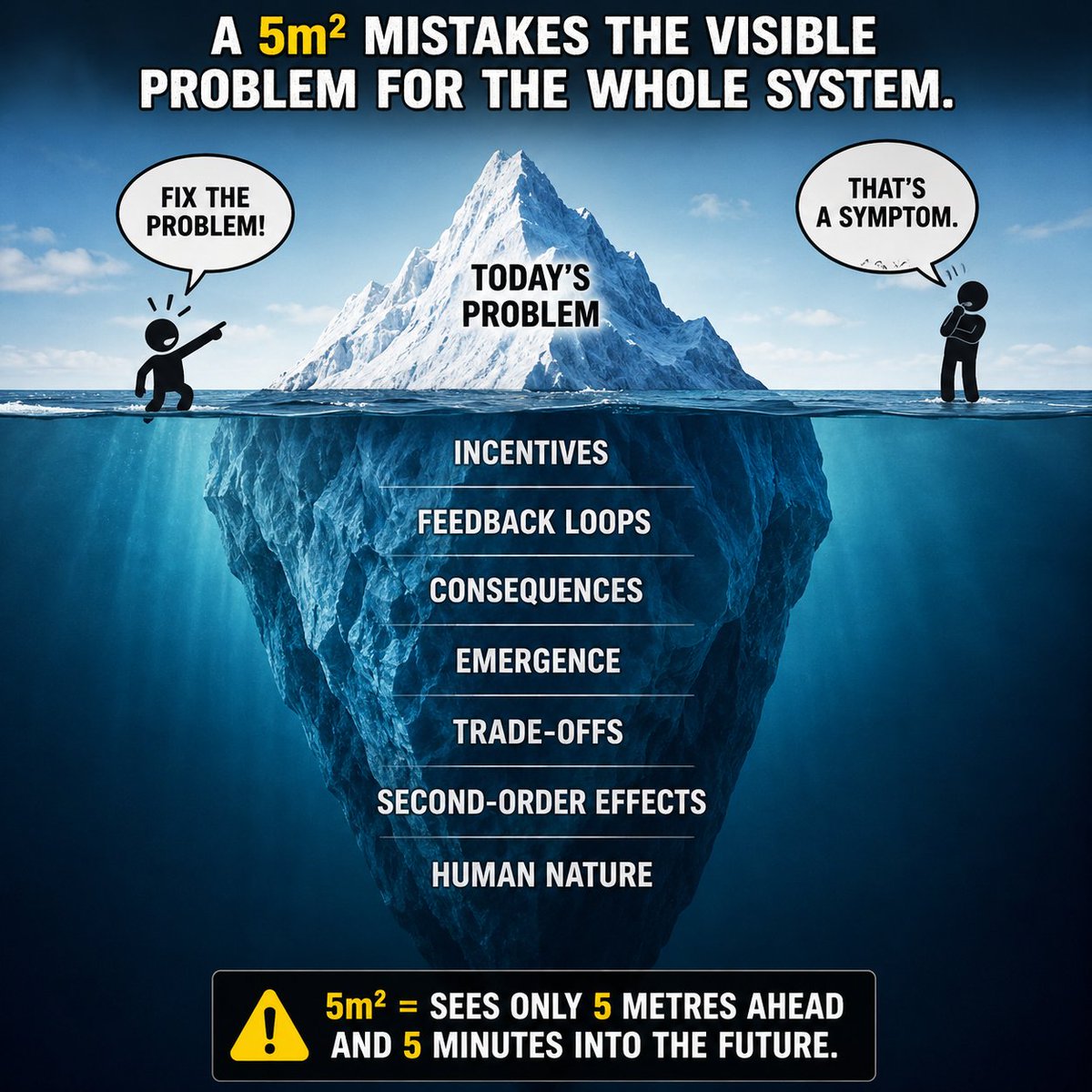
The Cognitive Age
Each era has been organised around whatever was scarce. Land, then labour, then knowledge. For most of history, getting hold of the right fact, the right manual, the right expert, was the hard part. That's no longer true. A schematic that took a phone call and a week's wait in 1995 is a search away now. The bottleneck has moved.
I see this most clearly in the workshop. Someone brings in an amp with a dead channel, and within thirty seconds I can pull up the schematic, the service notes, three forum threads on the exact fault. None of that was available to a hobbyist a generation ago. And it doesn't matter, because having the schematic was never the actual skill. Reading it, following the signal path, working out which of four plausible faults is the real one, that's still slow, still effortful, still has to happen in someone's head. Information stopped being the constraint. Reasoning didn't.
That's the shift worth naming. Not an information age giving way to an even-more-information age, but one where the scarce resource has become the capacity to use information well, to judge, weigh, hold complexity, and still act.
Artificial intelligence is the first technology built to amplify that capacity directly, the way the steam engine amplified muscle. Tasks that used to require training, memory, or technical fluency are becoming accessible to people who don't have any of those. That's a real opening. It's also a real risk, because the same tool that helps someone reason more clearly can just as easily hand them a more convincing version of whatever they already believed.
I think about this mostly through cognitive equity, because that's the lens I work in. Most accounts of this shift assume a level starting line, that the gap is between people who use AI well and people who don't. It isn't that simple. Some people hit a wall before they ever get to "use it well," because the tools, the interfaces, the explanations are built for one kind of mind. A platform that helps someone find the right support worker isn't solving an information problem if the person can't navigate the form in the first place. The real test of this technology isn't whether it makes smart people faster. It's whether it can meet someone where their cognition actually sits, rather than where the system assumes it sits.
The cultural noise around all this, the pull back toward rigid moral certainty, the search for new spiritual ground as the old ones empty out, looks to me like the same pattern showing up at a population scale. When the cost of ambiguity goes up, people reach for whatever simplifies it, even when the simplification isn't true. I don't think that's a new story so much as an old one playing out faster, because the volume of things demanding judgment has gone up and the tools for forming it haven't kept pace.
If that's right, the institutions worth building aren't the ones that hand out more information, that race is already lost to search engines and AI both. They're the ones that build the capacity to use it: education that teaches reasoning instead of recall, media that gives context instead of volume, communities that can hold disagreement without fracturing. At home, it looks like teaching a kid to ask why something's true rather than just accepting that it is, something my daughter does to me more often than I'd like to admit.
None of this is really about getting smarter. Intelligence was never the bottleneck. It's about getting better at judgment, under conditions where judgment has never been more necessary or less rewarded by the systems we're operating inside. That's the actual work of whatever this next stretch turns out to be.
@ruicharadrius Bottom 2% by which metric? He may be measuring by productive output. That bottom 2% certainly makes more noise than anyone else, and seem to want to control everyone else.
Grok is AI. I use ChatGPT, Claude, Gemini, and Grok. I also use Gemma locally.
I use them all, I run the same thing through them, and I use each to analyse the others.
They all work essentially the same, with the main difference being context and memory.
I check and balance any bias or gaps by cross referencing between them, and using my own brain.
The use still needs to be able to use it well.
You're describing a known failure mode of LLMs.
What you're missing is that the same mechanism also allows them to act as cognitive amplifiers. A skilled user doesn't use an LLM to validate beliefs. They use it to stress-test them.
If every conversation merely returned the user's worldview, none of us would have learned anything from them over the last few years. Some users may literally ask it to confirm their world view, I ask it to falsify mine. In fact, you'll see I very recently called Grok and asked it to fact check me.
Hey @grok how about you do that here. Fact check me. Am I telling the truth?
Cognitive equity is the creation of conditions in which every person has a genuine opportunity to develop understanding, exercise independent judgement, and participate meaningfully in society, without being excluded by unnecessary cognitive, educational, institutional, or technological barriers.
This is my goal, my motivation. It may look strange, might look frustrated, and may even feel hostile at times, but my goal is to ultimately ensure everyone has the same opportunity, the tools and knowledge, to reason for themselves. What they do with that opportunity is still on them.
This is one of the biggest use cases for AI, and why I have done a lot of work testing and playing with how an LLM can be used as a cognitive partner and aid with epistemic integrity.
Cognitive capability is no longer limited solely by the biological brain. Human-machine partnerships can amplify reasoning, memory, analysis, and model-building in ways that allow people to operate far beyond their unaided cognitive capacity.
#cognition #intelligence #ai
@downunderguy2@AaronKinKin1 Hey @grok how close is this to reefs, what are the likely impacts, even if he were to fire rockets on it, and is he even intending to do so?
@downunderguy2@AaronKinKin1 It doesn't change what I said. Learn how to consider higher order and devils advocate.
How close is the island to the GBR, what are the actual risks?
@downunderguy2@AaronKinKin1 Quite a few ways. It would create jobs, aid in an Australian space agency and activities, and any number of potential downstream benefits to local businesses nearby. I'm not ignoring potential environmental pressure, but as a glass half full view, there are benefits.
@DudeWhoInvests Society is build on and for mids. As you begin to deeply understand intelligence, that becomes more clear.
We don't value merit high enough, and often misidentify it.