Nathaniel Parish Flannery. Latin America analyst & writer. ✏️📰: The Guardian, Fortune & New York Times. 🎙️Host: @ModernMexico Podcast. @ColumbiaSIPA. 🚲🇲🇽
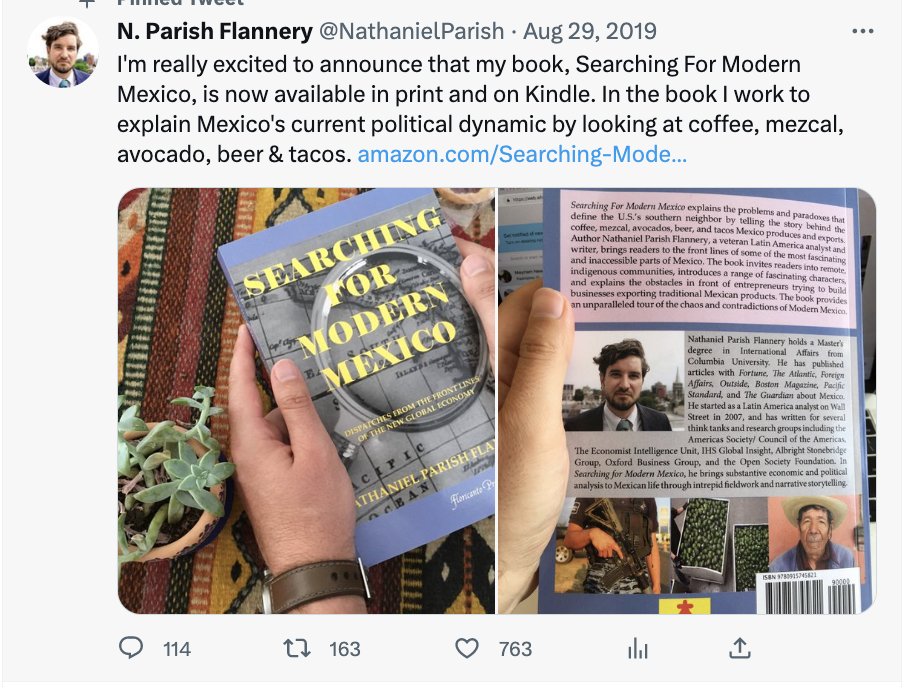
🇲🇽📗: My book, SEARCHING FOR MODERN MEXICO, is available on Amazon.
I traveled to remote villages in Chiapas, Oaxaca, & Michoacan, & also to the emerging nearshoring hubs of Guadalajara & Tijuana to explain the obstacles that entrepreneurs in Mexico face. https://t.co/CVSkajobXP
🇲🇽💡My thoughts: Yes, Mexico just took down another cartel capo. But, Mexico's narco politicians, especially those from Sheinbaum's Morena party, who have been accused of facilitating cartel activity aren't likely to be punished. The names at the top of the criminal hierarchies will change. The business will keep operating. The cycle repeats.
👀 Two scenarios now loom: El Chapo Isidro could designate a successor from prison, or a succession war could erupt within the cartel. Same story. New chapter.
🇲🇽👮🚨Three key takeaways from @David_Saucedo_'s latest column for @El_Universal_Mx on the action movie-style arrest of Fausto Isidro Meza Flores, alias “El Chapo Isidro,” leader of the Guasave Cartel:
1. The arrest benefits Los Chapitos
The Guasave Cartel had been allied with the Mayiza faction in Sinaloa’s ongoing cartel war. Taking out its leader indirectly helps Los Chapitos by relieving pressure on their rear positions. An elite group of Mexican soldiers attacked cartel gunmen with a minigun from a Blackhawk helicopter. Several cartel henchmen were killed. Saucedo argues, “The blow to El Chapo Isidro’s organization gives Los Chapitos some breathing room.”
2. Mexico captured the kingpin but failed to protect the population.
The operation successfully located, captured and extracted Meza Flores, with U.S. assistance. But authorities yet again failed to contain the retaliation that followed, allowing attacks against civilians. Saucedo argues that a military deployment in Guasave could have helped prevent the violence. Instead, residents experienced another “mini Culiacanazo”—a predictable and potentially avoidable episode of cartel retaliation.
The government also left an information vacuum for hours, allowing social media to fill the gap with real-time footage of military helicopters firing on cartel gunmen. The episode exposed the continuing divide between the civilian and military wings of President Claudia Sheinbaum’s security cabinet.
3. A major arrest doesn't dismantle a criminal organization.
The capture is a political and media victory for both the Mexican and U.S. governments, but the Guasave Cartel's criminal, political, police and business networks remain intact. Saucedo explains, “The organization will continue operating and survive its leader.”
👀 Two scenarios now loom: El Chapo Isidro could designate a successor from prison, or a succession war could erupt within the cartel. Either way, its alliance with the Mayiza is likely to remain in place, at least for now.
💡My thoughts: But, Mexico's narco politicians, especially those from Sheinbaum's Morena party, who have been accused of facilitating cartel activity aren't likely to be punished. The names at the top will change. The business will keep operating.
🇲🇽☕️🏆I recently stopped by Camino a Comala in Santa Maria La Ribera in Mexico City. Cool cafe, very good coffee. 🤖❌But they use a super-automatic (fully automated) espresso machine and I don’t think the robot made espresso is as good as the machines at BUNA or Cucurucho. Where should I go next? #mexicotravel #mexicocity #espresso #mexicanfood #CoffeeTime
🇲🇽 For more on the history of organized crime in Mexico-- check out my conversation with historian Ben Smith on the Modern Mexico Podcast https://t.co/Ulib506WcE
🇲🇽☕️I'm sure Elon Musk and other AI-evangelists think that in the future most coffee shops will use AI-powered robots to make espressos and other drinks. But, the future isn't here yet. On the upcoming episode of the @ModernMexico podcast (which drops tomorrow morning) I talked to coffee scholar @JordanBuch_anan about the role of the barista in the specialty coffee sector in Mexico City. I was a bit surprised to see that the Camino a Comala coffee shop in Mexico City uses fully-automatic coffee machines. The coffee was very good, great flavor-- but i think it was held back a bit by the machine-- it was not quite on par with the truly exceptional espressos I've had recently-- ☕️ made by expert baristas on machines that cost tens of thousand of dollars. 🤖❌The robot dystopia future may be coming, but it's not here yet.
🇲🇽☕️🏆I recently stopped by Camino a Comala in Santa Maria La Ribera in Mexico City. Cool cafe, very good coffee. 🤖❌But they use a super-automatic (fully automated) espresso machine and I don’t think the robot made espresso is as good as the machines at BUNA or Cucurucho. Where should I go next? #mexicotravel #mexicocity #espresso #mexicanfood #CoffeeTime
I need to make 1-- I think i'll make a map to track the project-- the new episode of the Modern Mexico podcast comes out on Tuesday-- it's all about the coffee scene in Mexico City. I mention some of my favorites during the conversation. I'll need to finally make some "top 5" and "top 10" videos soon, too.
🇲🇽👮🚨Three key takeaways from @David_Saucedo_'s latest column for @El_Universal_Mx on the action movie-style arrest of Fausto Isidro Meza Flores, alias “El Chapo Isidro,” leader of the Guasave Cartel:
1. The arrest benefits Los Chapitos
The Guasave Cartel had been allied with the Mayiza faction in Sinaloa’s ongoing cartel war. Taking out its leader indirectly helps Los Chapitos by relieving pressure on their rear positions. An elite group of Mexican soldiers attacked cartel gunmen with a minigun from a Blackhawk helicopter. Several cartel henchmen were killed. Saucedo argues, “The blow to El Chapo Isidro’s organization gives Los Chapitos some breathing room.”
2. Mexico captured the kingpin but failed to protect the population.
The operation successfully located, captured and extracted Meza Flores, with U.S. assistance. But authorities yet again failed to contain the retaliation that followed, allowing attacks against civilians. Saucedo argues that a military deployment in Guasave could have helped prevent the violence. Instead, residents experienced another “mini Culiacanazo”—a predictable and potentially avoidable episode of cartel retaliation.
The government also left an information vacuum for hours, allowing social media to fill the gap with real-time footage of military helicopters firing on cartel gunmen. The episode exposed the continuing divide between the civilian and military wings of President Claudia Sheinbaum’s security cabinet.
3. A major arrest doesn't dismantle a criminal organization.
The capture is a political and media victory for both the Mexican and U.S. governments, but the Guasave Cartel's criminal, political, police and business networks remain intact. Saucedo explains, “The organization will continue operating and survive its leader.”
👀 Two scenarios now loom: El Chapo Isidro could designate a successor from prison, or a succession war could erupt within the cartel. Either way, its alliance with the Mayiza is likely to remain in place, at least for now.
💡My thoughts: But, Mexico's narco politicians, especially those from Sheinbaum's Morena party, who have been accused of facilitating cartel activity aren't likely to be punished. The names at the top will change. The business will keep operating.
New book by @Eliseirena looks incredible.
"..Since the 1950s, the Mexican state has been split between a formal structure that upholds the rule of law and an extralegal parallel state.. that produce(s) illicit commodities for the transnational market."
I'd add: not just Mexico.
🇲🇽1 of the highlights of my visit to San Luis Potosi last weekend was getting a chance to stay in the 400+ year old hacienda in Peotillos. Stunning. https://t.co/e4fhH6O2Rv
🇲🇽🚓👮♀️The NYT’s new investigation into how the CIA quietly operated in the state of Chihuahua is worth reading closely, because it says a lot about how Mexico’s fight against organized crime actually works.
The story, briefly: according to the Times, the CIA partnered with Guillermo Zuany Portillo, a Chihuahua prosecutor and former police commander, who paired CIA officers with state police units on counter-cartel operations. For more than six months, officers allegedly trained state forces, rode along on missions, and provided direction during raids. Then in April, a truck carrying two CIA officers went off a cliff, killing all four people inside. That blew the cover and set off a national scandal.
Here are three takeaways--
1. The public red line and the behind-closed-doors reality are not the same thing.
President Sheinbaum has said almost daily that U.S. forces operating on Mexican soil would be a grave violation of sovereignty. But the Times reports that privately she has deepened security cooperation, including with the CIA, partly to defuse Trump’s threats of unilateral military action. Both things can be true at once. The sovereignty rhetoric is real politics, and so is the quiet accommodation.
2. Partisan divides are a genuine fault line.
The CIA allegedly found a partner at the state level, bypassing the federal government’s authorization. Now Sheinbaum, from Morena, is in a public fight with Chihuahua’s PAN governor, Maru Campos. The governor says she knew nothing, and a former state attorney general has been charged with treason. Whatever the legal merits, the case is also a story about who controls security policy in a country where states, parties, and the federal government compete for authority and for blame.
3. "Good guys" are in short supply in Mexico. Access to cartel targets often comes from compromised partners.
The Times reports that the U.S. had revoked Zuany’s visa over suspected cartel ties, that he was under FBI investigation, and that his visa was reinstated after he began helping the CIA. State prosecutors and witnesses describe him as powerful and suspected of corruption. This is the recurring dilemma in U.S.-Mexico security work: the people best positioned to deliver operations are frequently the ones closest to the networks being targeted. Several operations reportedly ended with targets slipping away, which raised suspicions of tip-offs. The on-the-ground reality in Mexico undermines the simple "war on cartels" rhetoric coming from Trump & other U.S. politicians.