Born-again Pagan. Banned broadcaster. Proud Mission School reject. Fighting the 2nd Scramble for Africa. Restoring Native Thought for Africa and all Humanity.
They used guns to take the land, then law to keep it. Now they tell you: “Use law to get it back. Go to court. Follow due process.”
But the court sits on stolen land. The judge is the thief’s son. The law they want you to use is the fake law they wrote to steal it.
Why use their law to recover what they took without law? This is why “State Land” is a crime scene.
East Africa's most notorious slaver, Tippu Tip hated being told he looked more African than Arab. He believed Africans were sub human and he duly overcompensated.
An 1887 report in The Times described him as contemptuous of Black Africans and said he referred to white men as his “European brothers.”
Tip was actually a product of the Arab slave trade, as he a mixed Arab person in Zanzibar. Both his paternal and maternal grandmother's were enslaved African women from the interior who had been used as sex slaves.
He was born in Zanzibar as Hamad ibn Muhammad. Some say he earned the nickname Tippu Tip, because that’s how the guns that he used sounded, while others
believe it’s because of the prominent, involuntary nervous twitch in his eyes.
While he was born at the peak of the the East African slave trade run by Omani Arabs, he took slave raiding and trading to a whole new level. He led caravans all the way to what is now DRC because by the 1860s, the Tanzanian coast was already depleted of people to enslave.
One of his methods would be to burn down entire villages then kidnap women and children and use the captives to make the men lose the will to fight.
He was a crafty man. When the European colonialist came, he adapted. In 1887, through Henry Morton Stanley, Tippu Tip became governor of the Stanley Falls district in King Leopold II’s Congo Free State. A major slave trader was given an official position in a colonial administration that claimed to oppose slavery.
So when the British abolished slavery in their territories, he went on to supply King Leopold of Belgium with 'labour' for his mines and plantations.
Tip knew the interior if Africa so well, He apparently helped European explorers like David Livingstone and Henry Morton Stanley to map out the interior of Africa. This was consequential during the Scramble for Africa, because then they had a map of Africa to use during the divison
So you went to all these places except but never went to Kasubi Tombs where our republic's founding president lies? They say charity begins at home. If we all could, we would rewrite history, but guess what? We cannot!
@sejudav Nabudere and his party produced many studies and analyses about our economic/political/historical realities.
Some even came out as books.
You were the ones who used to mock that intellectual strategic depth (whose absence you are now lamenting) saying we were “reading in trees”.
@belguinprosper By the late 2000s, the bulk of rural-facing radio stations were owned by persons leaning towards the ruling party.
It was one big decentralized propaganda machine.
This will be now re-building a private-sector Radio Uganda but like the others, still hogging state media budgets.
@kmbasajjabaka I saw @BugunguHeritage saying that Bunyoro imposed itself on Bugungu.
Should we apply what you are saying about Buganda, to Bunyoro too?
We need to look at history with sober minds.
Facts, not emotions.
So many books have been written about this. The plan is to kill local industry so that American and European companies can fill the gap. The global PR side was 'open your economies, globalisation is good' etc, the local enforcer was always World Bank & IMF. It started with the big commodities: grains, steel, cotton, coffee, and so on. Ultimately, once a country is entirely dependent on foreign manufacturing, it is much easier to control. All they would have to say is, “Do ‘x’ or else.”
Again, Uganda is perhaps one of the few countries left in the world where a person can be cash poor but asset rich (not even our neighbours —Kenya — have it that good. In Kenya, if you're poor, you're POOR). The question was once raised: who is worse off, the middle-class American with a 30-year mortgage and student loans who is barely keeping up with expenses, or the African villager on his small plot with his two cows, whose farm provides enough food for his family?
A boda guy once told me how happy he was to have completed his house and was now building small rentals. His income was supplemented by small farming he was doing in his village. You can count the places in the world where that is possible, even for middle-income folks.
Apparently, we are on the fast track to becoming a developed nation, chasing the glitter of the first world and fashioning our once-beautiful spaces into soulless, knockoff high-rise jungles. Let us not be surprised when we get there and realize that it was all a smokescreen.
@maximozza02@jamesonen@OgbeniDemola Sure?
Here’s a collection of early 1900s slums in Europe.
You can choose the ones you don’t want to see.
https://t.co/qSwjkWnFIB
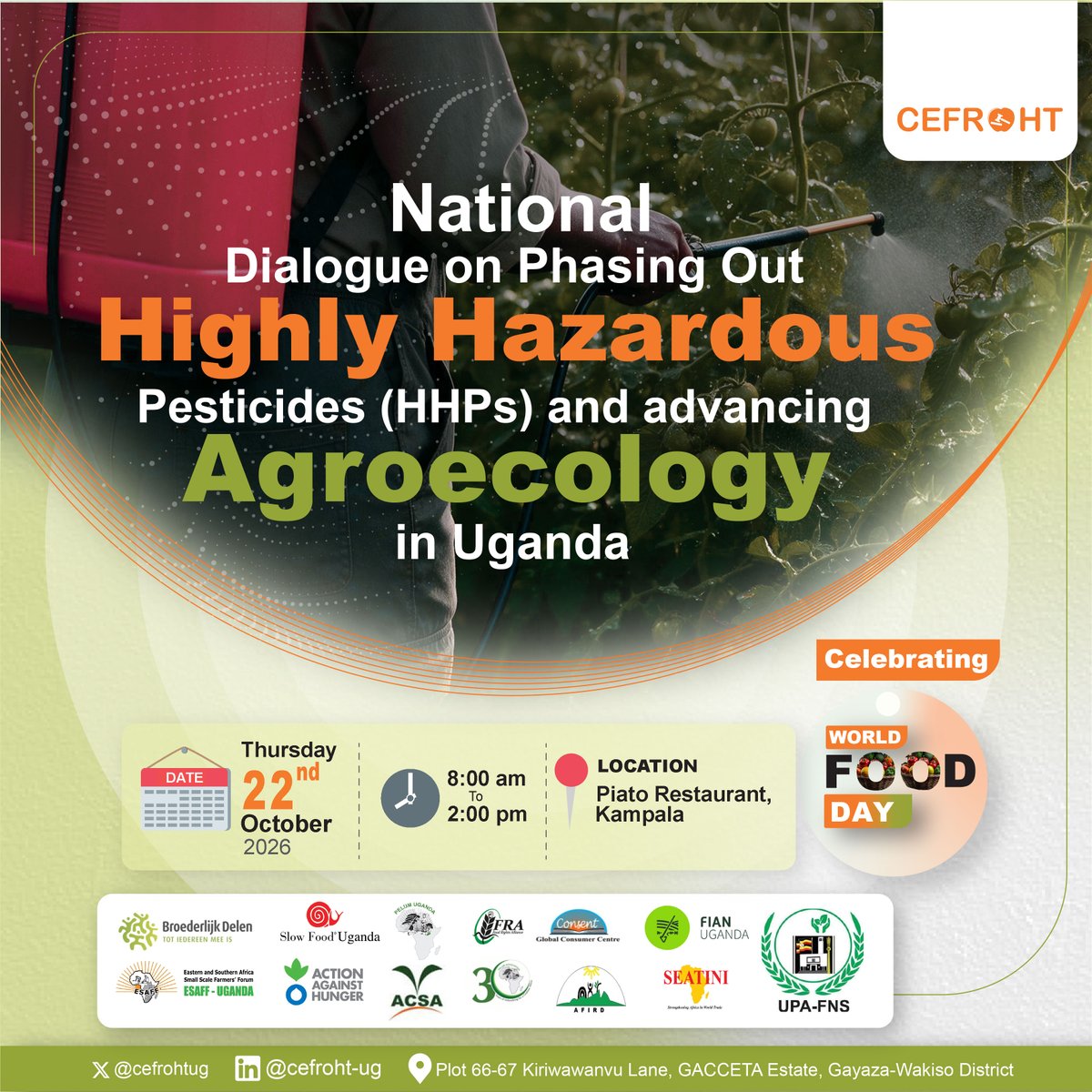
Would you spray your farm with a chemical Europe has banned? 🤔 Many Ugandan farmers do, without knowing it.
Of the 115 pesticide active ingredients registered in Uganda, 55 are highly hazardous, and most of those are not approved in the EU countries that export them ☠️ Only 31% of our farmers have ever been trained to handle them safely.
Tomorrow, 22 October, the Agroecology Collaborative, convened by CEFROHT, hosts a National Dialogue on phasing out highly hazardous pesticides and launches the Joint National HHPs Strategy for Uganda 🌱
Safe food is a right ⚖️
#BanHHPs #Agroecology #WorldFoodDay #CefrohtUG