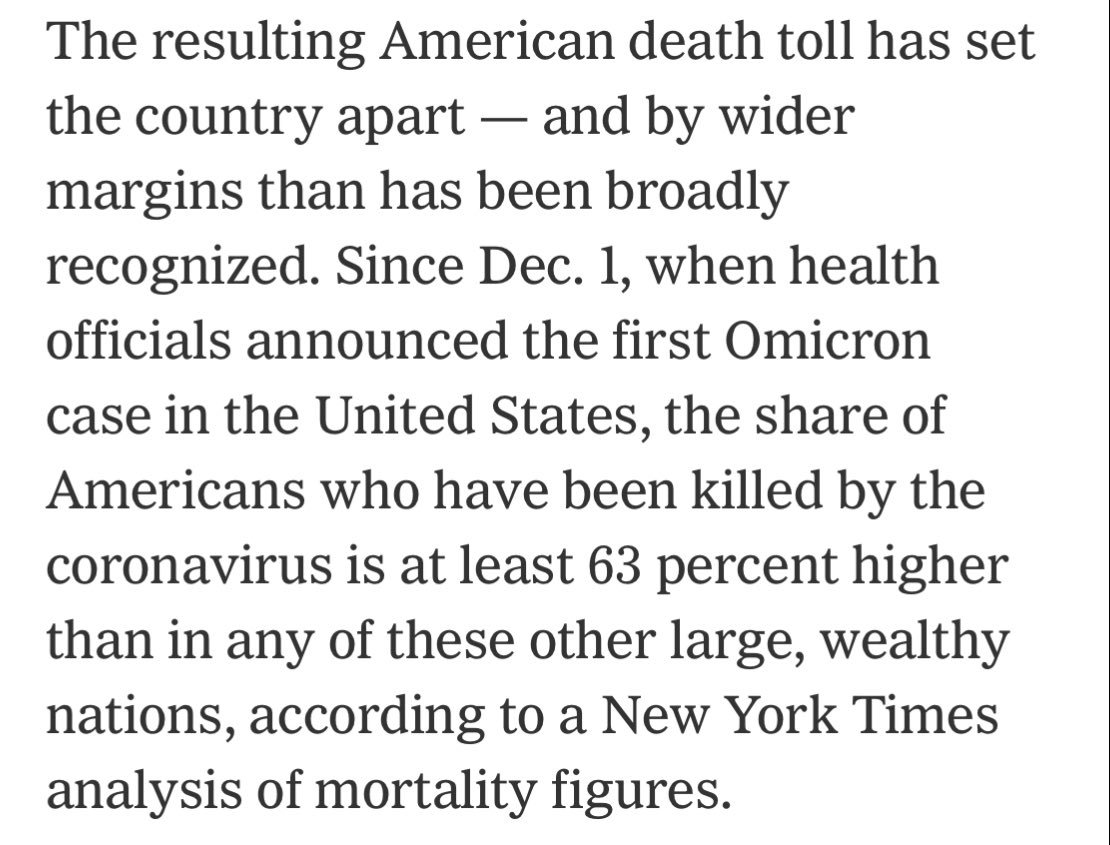
The American people deserve the truth.
FDA, do you remember Covaxin? The traditional whole-virion vaccine that you forced to jump through every bureaucratic hoop, while you were fast-tracking mRNA boosters based on trials conducted on just 8 mice? You urged the company to seek approval through a U.S. BLA trial, and they did—spending over $100 million on a massive Phase 3 trial that yielded top-line data showing broad protection against all variants of concern. Yet, despite this, you never approved an alternative traditional vaccine option after they successfully navigated your obstacle course. Why? Because just months after those results were published, you changed the rules to block any vaccine built on the original virus. This effectively killed the market for traditional vaccines based on the whole coronavirus. Meanwhile, you rolled out the next set of mRNA boosters, designed to mimic just a tiny piece of the spike protein on a virus that’s famously studied for its high mutation rates.
It’s been four long years, and you still haven’t approved any competitor vaccines. The government collects royalties from mRNA sales, with companies like Moderna paying over $400 million in a single year. But those profits wouldn’t roll in from a traditional vaccine sale, would they? How has this financial entanglement influenced your decision-making during the pandemic?
Your job is to serve the public—to prioritize science and protect the American people. But you’ve failed in that duty. Instead, you’ve used taxpayer dollars to accelerate only the development of “vaccines” that you own patents on, blocking all competitor vaccines for over four years. Do you really think the American people will trust that this next round of mRNA boosters will finally work, after six previous rounds failed to deliver?
Your actions have severely damaged your credibility. Government entities should never receive kickbacks from the sales of drugs they’re responsible for approving. This is an egregious conflict of interest, and we’re living with the consequences. The amount of blood on your hands is staggering. Next-generation vaccines that have been proven to stop transmission are approved overseas, yet Americans have no choice but to take this mRNA snake oil.
This is the biggest scam our country has ever seen. It’s time for real journalism to uncover the truth. There must be accountability, and the American people deserve to know who the main perpetrators are.
Rest in peace to all those lost in this pandemic due to this corruption.
@FiddleyF@CarlosNegr7277 2022: Jessica Crespo
2023: Quan Vu
2023: Michael Breininger
Sept 2024: Ramesh Ramachandran
2026: Rita Johnson Greene
Yeah sure like nobody had Ramesh leaving on their bingo card 🤭
$OCGN I get comments questioning price and people’s ability to pay because they don’t understand the why’s, who’s and where’s of drug pricing.
Insurance and payers don’t cover gene therapy because they’re generous, they cover it because the math makes sense.
$1.3 million sounds like a lot, but blindness is not just an eye problem. It becomes a lifelong cost burden. Doctors, specialists, disability, lost income, caregivers, falls, depression, assisted living, benefits, lost productivity, and decades of medical and social costs all tied to vision loss.
When a one time gene therapy like OCU400 can stop someone from going blind, payers are not just paying for a drug. They are paying to avoid the lifetime burden blindness creates.
That’s why these treatments look expensive upfront but still make financial sense. Pay once or keep paying for decades.
This is why approved gene therapies in rare retinal diseases get covered. The burden of blindness is massive, and stopping it is worth billions.🍻
This isn’t remotely a fair comparison, CASGEVY’s problem is tied to the complexity of that specific treatment.
CASGEVY isn’t a simple one time injection like OCU400, CASGEVY is a whole procedure that takes many steps and time. A person needs to get their blood stem cells out, those are then taken and gene edited in a lab, then the patient has to go through high dose chemo to clear space in the bone marrow before the edited cells are infused back like a stem cell transplant.
OCU400 is a one time retinal AAV gene therapy delivered by a single subretinal injection… There’s no chemo, stem cell collection, ex vivo editing, transplant, patient hesitancy, chemo risk, fertility concerns and engraftment bottleneck problems they’ll have to deal with like CASGEVY is.
If you want a fair comparison why wouldn’t you just compare with Luxturna the same one injection treatment and targets the same RP market. Luxturna already proved the retinal gene therapy reimbursement model. The main difference in this comparison is Luxturna is a gene specific therapy targeting only .5%-1.5% of RP patients instead of 99% of them like OCU400 will.
Reality shows that Ocugen is looking at several billion a year in revenue even if they only snag a tiny 1% to 2% yearly treatment rate. 🍻
@Kk18kkkk You have these conversations well before approval, so when data holds you’ll be covered once approved. Coverage case for OCU400 is pretty straight forward. Pay once to avoid a lifetime of burden costs. These convos happen during meeting like this 👇 🍻
There’s a difference between the price of a drug and what a patient personally pays. Nobody said RP patients are writing a $1.3M check. Do you think Luxturna patients personally paid the full $1M, or people getting $2M to $3M gene therapies are just swiping their debit cards? Ocugen's own deck shows the assumed price, and insurance/payers reimburse these treatments. 🍻
$OCGN Here’s the conservative math for OCU400, 50% target market, modestly low market penetration.
Ocu400 with “broad RP indication” as a gene agnostic therapy for retinitis pigmentosa:
Total amount of people with broad RP(51%+) in USA and EU:
191,250+ people
Total USA and EU market for Broad RP at $1,350,000 per patient= $258,187,500,000 USD
Total conservative market to catch yearly:
1.5%
Total yearly Revenue for broad RP in USA/EU Markets = $3,872,812,500
5 year revenue projected:
$19,364,062,500 USD
Reasonable market cap valuation for a company with a drug bringing in these numbers = $40b on the bearish side $80b on the bullish side. 🍻
it’s a cure for RP.
OCU400 is designed to stop the disease at the source. RP destroys the retina over time. If you stop that process, you cured the disease.
Once a cell is completely gone, it’s gone, no drug is bringing back the dead(yet). But sick, damaged, barely functioning cells can start working again, which is why patients are gaining 4+ lines on the eye chart.
So early stage RP, OCU400 stops any damage before it happens.
Late stage RP, it cures the disease and can restore whatever vision is still recoverable.
One shot cure for life, incredible biological breakthrough. 🍻
100,000+ people with #Stargardtdisease have no FDA approved treatment. #OCU410ST aims to slow or stop disease progression, with early promising data.
Follow Ocugen and be part of something groundbreaking. #Biotech#Genetherapy $OCGN
Yeah, and Pfizer has 5.7 billion shares outstanding..
One could easily argue that a gene agnostic platform targeting near term massive unaddressed markets worth many billions, with huge unmet needs, starting with inherited retinal diseases like RP, Stargardt, then GA, and later expanding into neurodegenerative diseases like Alzheimer’s, Parkinson’s, and broader CNS conditions, will be worth far more than Pfizer’s pipeline.
Inherited retinal diseases alone are estimated to cost over $33B per year in economic burden across the U.S. and Canada.
338 million shares is not the problem. That is tiny considering the markets Ocugen is aiming to take over.
The problem is people trying to value a gene agnostic platform like it is just any other drug or vaccine going to market. 🍻
$OCGN Hello fam, I want to show you a real example of what happens when biotech speculation turns into reality.
The chart below is Celcuity, ticker CELC, over a little more than a year. CELC is a strong comparison to Ocugen in terms of market setup.
Pre revenue biotech + ignored asset + Phase 3 derisking event + regulatory filing path + huge commercial story = violent rerate.
CELC had its major move after the VIKTORIA 1 Phase 3 trial showed gedatolisib produced a 76% reduction in risk of progression or death in the triplet arm and a 67% reduction in the doublet arm versus fulvestrant. After that, the story moved from clinical speculation into NDA submission and FDA review territory.
That is what the market does in biotech.
It waits.
It doubts.
It discounts.
It suppresses.
Then pivotal data hits, the filing path becomes real, and the entire valuation framework changes almost overnight.
CELC went from being valued like a risky clinical biotech to being valued like a near commercial oncology company once the data proved the drug worked.
Ocugen will go from being valued like a beaten down speculative microcap to being valued like a near commercial gene therapy platform as soon as OCU400 data proves the drug works.
There is one exception though, and it is pretty massive.
Ocugen has something CELC does not have in the same way: platform stacking.
CELC is largely a gedatolisib story.
Ocugen has OCU400 as the first major validation point, then OCU410ST behind it, then OCU410 for GA, which both have already shown statistical superiority.
OCU400’s pivotal win won’t just cause the market to price in the one drug. It would force the market to reprice the entire modifier gene therapy platform.
One product moves toward approval.
The platform gets validated.
The follow on programs become impossible to discount.
Our commercial story becomes reality.
🍻 🐂
Idk 🤷♂️ I’d say a gene agnostic therapy, a master regulator that brings homeostasis back to cells, that’s curing blindness diseases currently, but regulates the same networks that effect countless other diseases like Parkinson’s, Alzheimer’s, Autism ect, is sort of in a league of their own.
Share count mechanics has nothing to do with the point of my post about market rerating mechanics.
I said CELC was a comparison in terms of market setup.
I’m not saying Ocugen should trade at CELC’s stock price. I’m not comparing the drugs. I’m not saying the value is the same.
I’m saying this is what it looks like when a pre revenue biotech value goes from being ignored to being validated.
I would not have followed this company since its public inception, or still be here today, if I believed the end game was to someday become a $6B company like CELC.
In my eyes the OCU400 line alone will be 26x more valuable than that when factoring in label, global reach, pricing and an agnostic platform set for growth.
The platform is the value. This is one of the very few biological discoveries that can completely change an industry forever.
CELC was my example of when validation hits and when value can no longer be ignored. 🍻
They will release it all together, trial is set up in a way to allow filing for one label then expanding the label to broad later but the incentive is gone now.
I don’t think anyone expected the broad arm to be dosed this quickly, considering how rare some of the mutations are and needing a wide spectrum to support a broad label.
Word must of spread globally and people flew in from all over to be part of this trial.
It was smart to separate the two arms from a risk and optionality perspective. But now there’s no real incentive to spend millions filing for the small piece of the market, only to spend millions more filing for the other 80% a few months later. 🍻
$OCGN Institutional ownership is rising fast, and this is before the 2026 Russell reconstitution cycle even hits.
Russell finalizes after market close June 26, with the newly reconstituted indexes live June 29.
Ocugen has the cash now, and they’re have 3 BLA filings over the next 2 years.
Where this stock is going is obvious to me. The whole reason I’m here is to bring retail awareness to what I believe will become the next big pharma before the market recognizes the value.
Good news, and lots of it, comes next. When this starts getting crazy, it won’t move in a nice straight line. We’ll stair step up. There will be stop loss raids after jumps, emotional decisions, and regret.
If you’ve been here with me on this journey, remember the big picture.
Know what you own. Have a plan in place. Let that plan dictate future decisions, not volatility, fear, or big money shake outs and stop losses.
We’re approaching the moment where speculation meets reality.
Js 🍻
$OCGN #OCUGEN
Retail investors get scared and sell, institutional investors are buying it out right under us. Get smart guys!
OCGN - Ocugen, Inc. Stock - Stock Price, Institutional Ownership, Shareholders (NasdaqCM) https://t.co/yvYixZHFGb
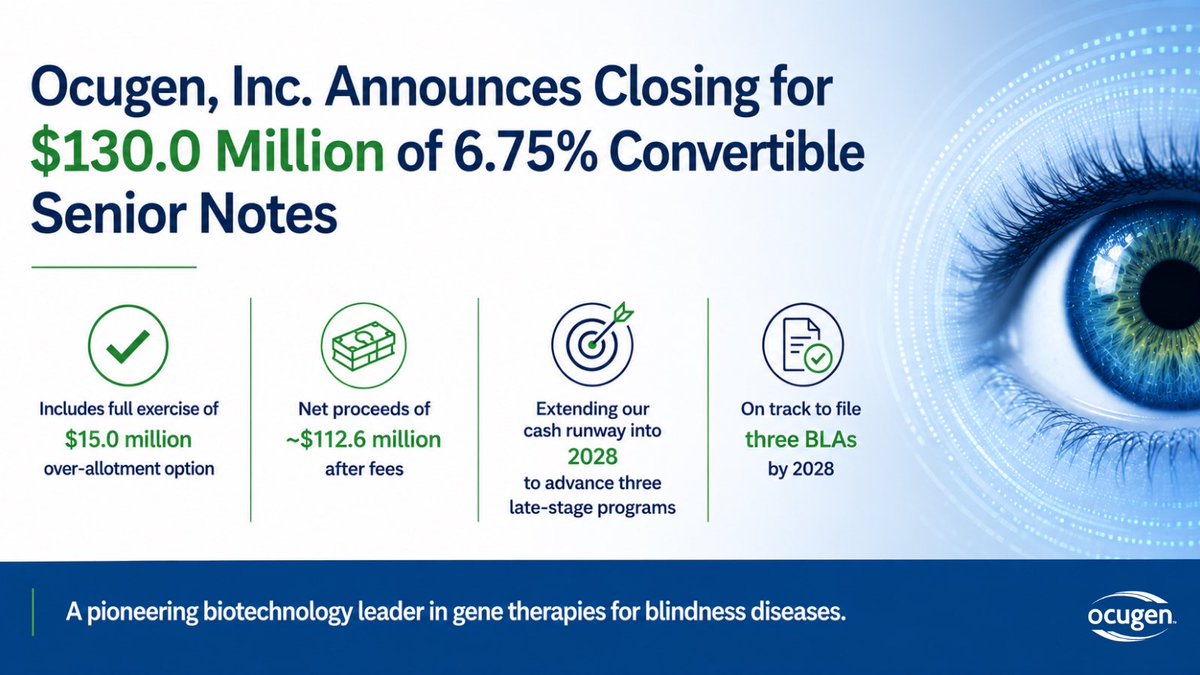
Momentum continues at Ocugen. With $130 million in financing secured, we are well-positioned to advance our three late-stage
programs as we work toward filing three BLAs by 2028.
Learn more: https://t.co/7nSj5EJkPZ
#GeneTherapy#Biotech#FinancialUpdate $OCGN
Nothing to think about, she joined a team with decades of experience bringing drugs from development to market with a CEO who developed and lead the launch of the most successful vaccine in history, she’s leaving with 3 successful trials under her belt and Ocugen won’t miss a beat 🍻
One might first see all this pressure to force Marty Makary out of power and think, why would BP want Marty out if he’s the one making it easier for drugs to get approved?
Then you start realizing something deeper. That all these hoops, hurdles, delays, and red tape that everyone complains about are the same barriers that make it nearly impossible for smaller companies to navigate alone.
You start to wonder if these absurdities are really just overlooked flaws, or if they purposely became part of the design.
Then you start noticing that Big Pharma is thriving in a broken system where small companies take all the scientific risk for innovation, spending years bleeding through cash and fighting through constantly changing regulatory uncertainty, only to end up getting forced into partnerships and undervalued buyouts once the data finally proves value.
Then a question dawns on you, why would BP take all the early R&D risks themselves when the system allows them to wait, watch and then buy innovations at a great discount off the companies who were courageous enough to attempt to survive their gauntlet?
Marty’s FDA changes to the system is a massive direct threat to the most powerful companies in the world. The fact that BP hasn’t already kicked Marty out of power is impressive imo.