124,000 INVESTORS, ASSETS FROZEN
Lara Logan asks Next Bridge Hydrocarbons Chairman and CEO Greg McCabe about the human cost of the MMTLP controversy and what has happened to the 124,000 investors caught in the middle.
McCabe says shareholders have contacted him about losing access to retirement savings, college funds and money they had counted on for their families after MMTLP trading was halted and their investment became tied to shares in the private, illiquid Next Bridge Hydrocarbons.
He also says he has heard of three suicides connected to the financial fallout, while making clear he does not know the specific circumstances surrounding those deaths.
Lara presses McCabe to explain how a trading halt could leave investors unable to access their investment and why, more than three years later, so many shareholders are still demanding answers. @GregMcCabeJr | @GoingRoguewLara
Watch the full episode:
https://t.co/zeOoJlOREH
Support Going Rogue:
https://t.co/XWxZq2aL1T
#LaraLogan #MMTLP #NextBridgeHydrocarbons #StockMarket #RetailInvestors
In the next 24hrs I will be putting out an extremely public and extremely serious post. Stay tuned. Turn my post notifications on. Guaranteed to be shadowbanned. Please share this.
🙄 So McCabe’s connections raise “conflict” concerns, but Authentix bidding to buy the lawsuit against ITSELF is apparently an exciting opportunity for transparency. ❓❓Nothing says “independent interests” like shopping for your own potential liability. 🛒⚖️
📄 Doc. 2986: McCabe concerns, pp. 2–6; Authentix’s request to bid, pp. 7 & 20.
Paul Atkins Is Cooking the Books at the SEC, Gleefully Manipulating His Own Track Record. Here Are the Receipts.
Every September the fiscal year ends for the U.S. Securities and Exchange Commission, and every September the agency’s leadership faces one question: how many enforcement actions did you bring? That number is the SEC’s report card. Congress reads it. The press reads it. The Chairman’s legacy rides on it.
When the number is low, there is a playbook every SEC veteran knows by heart: find the easiest investigations in the building, the ones that need no investigation, no witnesses, no victims and no trial, and file as many as you can before September 30 so the statistics (internally referred to as "stats") don’t look as bad as they really are. That is called “stat padding.”
Stat padding is the SEC pretending to achieve more than it actually achieves. It is the one thing Paul Atkins has perfected at the SEC, and he is now doing it on an industrial scale.
Three weeks ago I flagged the SEC “charging 38 entities” in a single afternoon and banking 38 stats for it, because when your year-end numbers are collapsing, 38 of anything beats one of something. https://t.co/btIprPSaIJ
Here’s what I mean: those 38 “cases” were one investigation sliced 38 ways. A clerk cross-checking addresses on a form, aimed at overseas shells that never answered the phone, with no victims, no money recovered and no fraud unraveled. Thirty-eight tally marks, zero enforcement. I told you to stay tuned for more, because the playbook never stops at one trick.
Here is an update since my last post, and it is worse.
What exactly is 12(j)? This Atkins parlor game turns on an obscure provision of the Securities Exchange Act of 1934 called Section 12(j), the “delinquent filer” case. Calling a 12(j) a parking ticket would insult parking tickets. A parking ticket at least has a car. These are form orders against companies that stopped existing years ago, and the SEC is counting every one of them as an enforcement action. It is a giant nothing burger, served 47 times in seven weeks.
In September’s first 18 days, 33 of the SEC’s 51 new proceedings were Section 12(j) delinquent-filer cases. Add August and it gets worse. Since August 1 the SEC has opened 117 new proceedings, and 87 are clerical: 47 12(j)s, 39 complaints against shells that lied on a Form ADV (the registration form investment advisers file) and never answered the phone, and one late filing. Clerical means exactly that: paperwork violations with no fraud, no victims and no money at stake. Three of every four “enforcement actions” filed in the last seven weeks would not meet a first-year associate’s definition of a case. Even without the 38 Form ADV complaints, it is 49 of 79. Still 62 percent paperwork.
Every public company must file annual and quarterly reports. When a company stops, Section 12(j) of the Exchange Act lets the SEC revoke its registration. That is the entire case. No fraud. No victims. No penalty. No disgorgement. The SEC’s Division of Corporation Finance sends a letter, nobody answers and the SEC enforcement staff fills out a template. The 12(j) orders are all pretty much identical down to the paragraph numbering.
These cases can be “investigated” after breakfast and filed as an in-house SEC administrative proceeding before lunch. No federal court, no federal judge, no jury. The SEC is prosecutor and judge. Eight went out on August 28, six on September 3, twelve more on September 15 and 16. The fiscal year’s last seven weeks arrived, and out came the shells.
An Atkins Diet of Defendants Who Can't Answer the Door. Just look at who is being “charged.” Teeco Properties last filed a 10-K for 1997, 29 years ago. American Entertainment Group last filed a 10-QSB, a form the SEC retired years ago, also for 1997. Many of these stocks do not even trade. Nobody is protected by revoking the registration of a corpse. Two more, ERHC Energy and INTREorg Systems, already faced 12(j) proceedings the SEC dismissed in 2023. Now the same two shells are back with fresh file numbers. The SEC is recycling its own dismissed cases and counting them again.
Channel Stuffing, SEC Edition. Every SEC alum knows exactly what this is. Every 12(j) lands in the annual enforcement total beside the Ponzi schemes and the accounting frauds. A shell that stopped filing in 1997 counts the same as a billion-dollar fraud. In corporate America this is called channel stuffing: cramming product out the door at quarter-end to book revenue you haven’t really earned. The SEC has charged CFOs for it for decades. Now the SEC is doing it to its own docket. The cop is committing the crime it polices. It’s Alice in Wonderland at the Atkins SEC.
The Death of the SEC Emergency Asset Freeze. The Atkins stat padding is covering for an SEC Enforcement program that has gone almost completely dark. Consider, for example, the sudden disappearance of the SEC asset freeze.
An emergency asset freeze or temporary restraining order is what the SEC gets from a federal judge when a fraud is in progress and investor money is about to vanish. It is the single clearest sign that an enforcement division is awake and moving fast. Under Paul Atkins, the count is one. One asset freeze in seventeen months, and even that one was by consent, not contested. Nothing is going on in the SEC’s buildings but the rent.
For decades the TRO and the emergency asset freeze were the most feared weapons in the SEC’s arsenal. A Ponzi schemer wakes up to find his accounts frozen by a federal judge before he can wire the money to the Caymans. A boiler room gets padlocked mid-pitch. Victims get their money back because the SEC moved in days, not years.
In a normal year the SEC wins asset freezes routinely. It is the difference between an enforcement division that stops frauds and one that writes them up afterward. When I served as Chief of the SEC’s Office of Internet Enforcement, our office filed multiple TROs and asset freezes. You can review some of them here: https://t.co/jIRoLrx88j
But this is far from a "normal year." Atkins has unilaterally disarmed the SEC. He has abandoned the one tool that actually puts stolen money back in investors’ pockets, and he is filling the hole with 47 form orders against dead companies. The fraudsters keep the Lamborghinis. The victims keep the losses. And the Chairman keeps the stat sheet. It’s surrender by design, and it is awful. https://t.co/Y5DsQfNmWh
Atkins' September 30 Panic. So why now for this influx of stat padding? Same reason as last month: Paul Atkins is panicking. FY2026 ends September 30, and he is set to post the worst enforcement numbers on record. Thirty-eight paper defendants on August 27 didn’t close the gap, so out came the shells: fourteen 12(j)s in four days, thirty-three more in September, at zero cost, zero effort and zero benefit to a single investor.
I spent 19 years in SEC Enforcement, including four as counselor to several Enforcement Division Directors and 11 as Chief of the Office of Internet Enforcement. I saw some level of stat padding up close in every one of those years. It is nothing new. But Atkins has taken stat padding to a level I never witnessed. The old game was a Chairman stretching a good year into a great one; this is stat padding on steroids, filling a bare ledger with dead companies. And that is what makes it unforgivable.
Here is the part that should make every SEC alum furious. Paul Atkins knows better, because I watched him know better. He sat as an SEC Commissioner from August 2002 to August 2008, under Chairmen Harvey Pitt, William Donaldson and Christopher Cox, and I worked with him for that entire stretch. He abhorred stat padding. He told me so himself. He called year-end case-count games exactly what they are: a con on Congress and the public. The Commissioner who said that is now the Chairman signing the orders.
The Stark Reality. When three quarters of your year-end docket consists of form orders against companies dead since the 1990s and shells that won’t return your calls, you are not protecting investors. You are managing earnings. Count the 12(j)s between now and September 30, then ask whether a single one made the market safer or just made the SEC’s annual report look better. It’s all in plain view on https://t.co/jnrDiRx7ku.
We see you, Chair Atkins. The agency that demands honest books from every issuer is cooking its own. That’s fraud with a government seal. It’s a disgrace.
Fail not at your peril, Mr. Chairman.
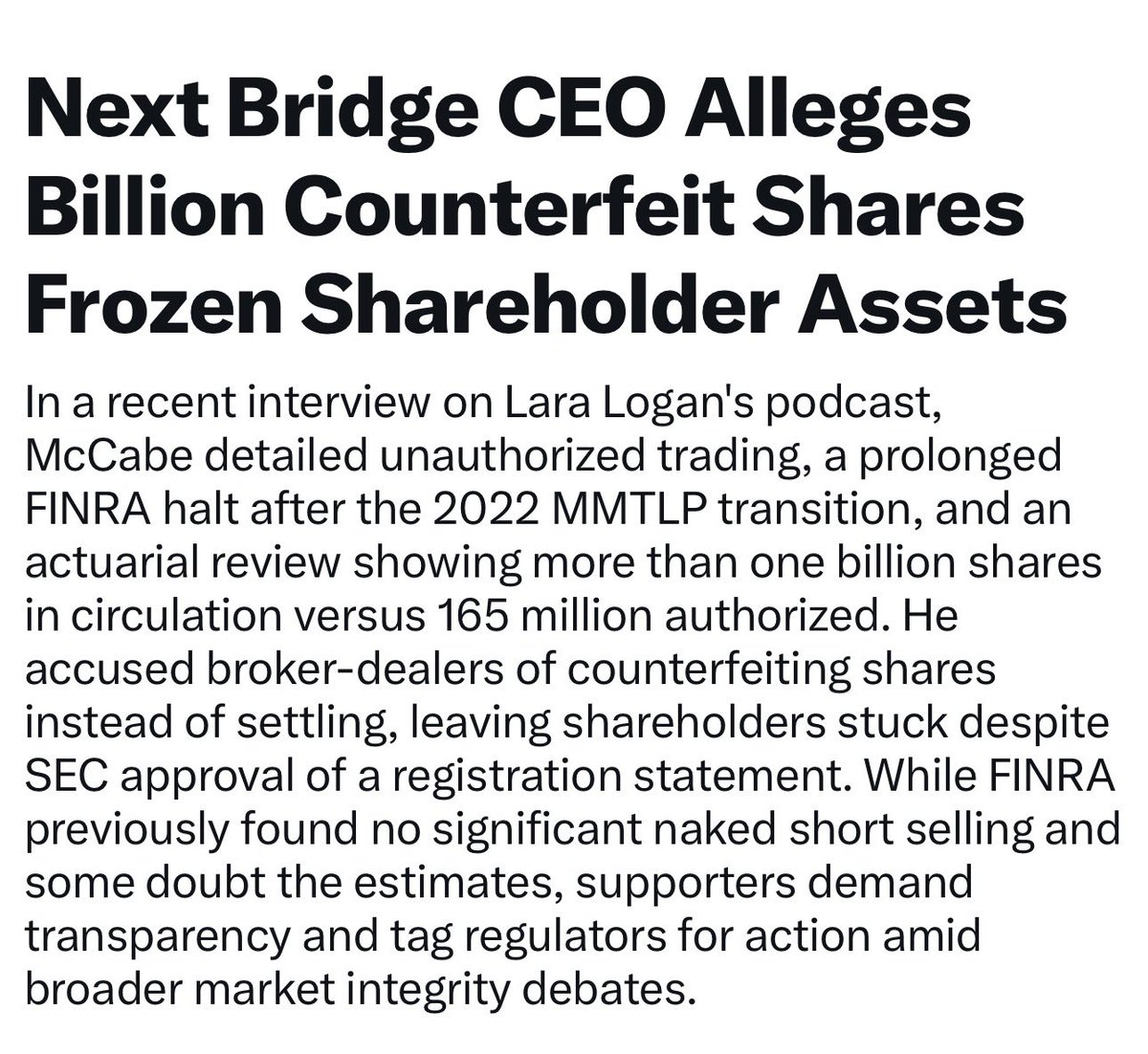
Greg McCabe broke his silence with Lara Logan and is taking his message to the President himself, A BILLION COUNTERFEIT SHARES
Trending AGAIN on X News, this Biden SEC and Congressional Scandal is gaining momentum and there’s nothing the Regulating/Market Maker Criminals can do about it 👊🏼🇺🇸
$MMTLP
Yes, they are selling fake shares, taking investors money and giving them IOU's, that's what you have in your accounts at your brokerage firm. IOU's!
THEY’RE SELLING FAKE SHARES
Lara Logan asks Next Bridge Hydrocarbons CEO Greg McCabe to explain naked short selling and how traders can allegedly flood the market with shares they never borrowed and do not actually own.
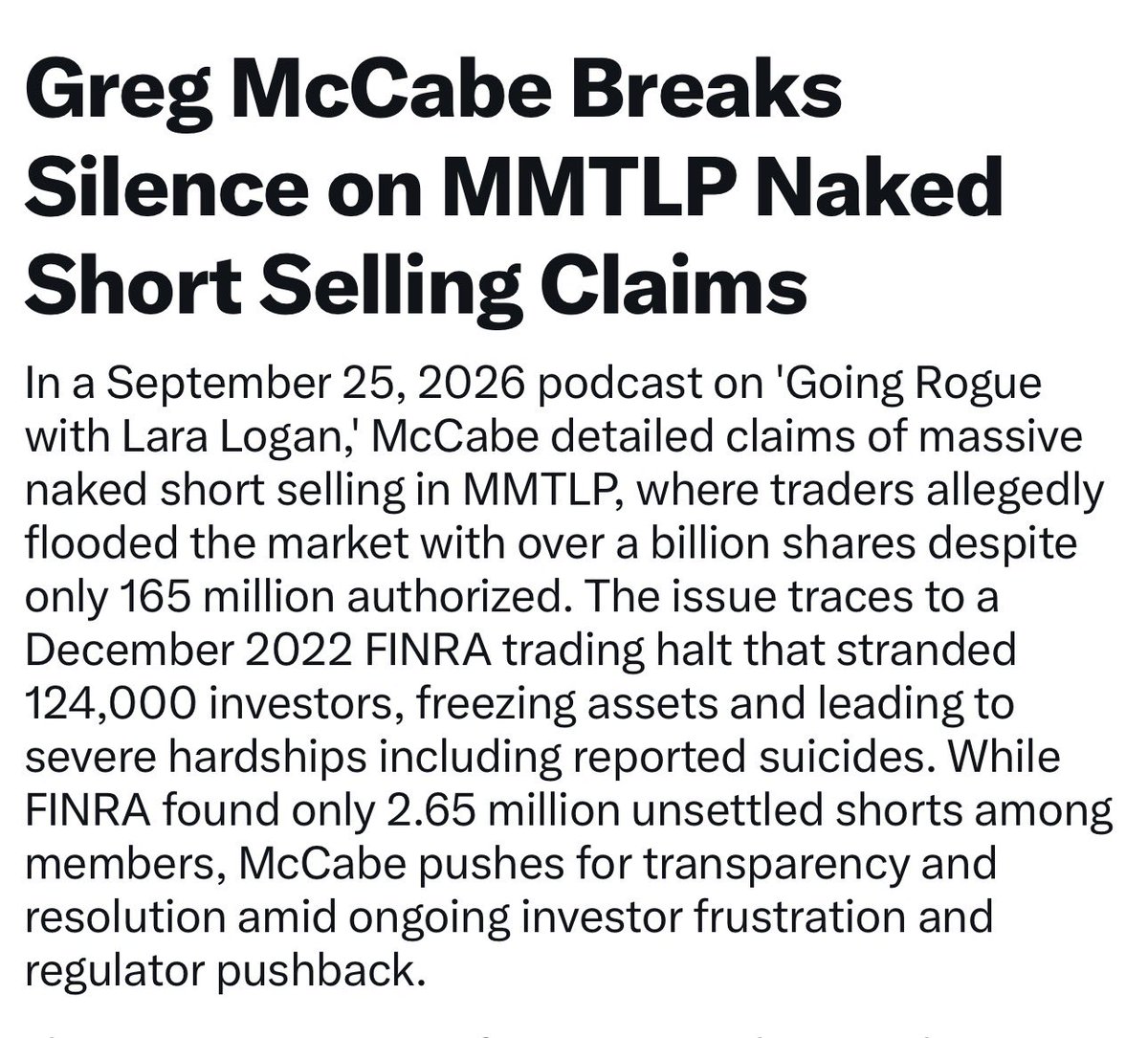
In the newest episode of Going Rogue with Lara Logan, McCabe breaks his silence about the MMTLP scandal affecting approximately 124,000 shareholders, alleged market manipulation and what he describes as serious regulatory failures by FINRA and the SEC. @GregMcCabeJr
Watch New Episode: https://t.co/zeOoJlPpuf
Support Going Rogue with Lara Logan:
https://t.co/ZGF3YDUxp3
#LaraLogan #NakedShortSelling #MMTLP #StockMarket #FinancialCorruption
Naked shorting was sold to the public as a CONSPIRACY THEORY.
It was not.
It became a way to grind companies down and cover up POOR RISK MANAGEMENT.
The mechanics live in MARKET STRUCTURE: locates that never become real shares, fails that linger, and selling that outruns actual SUPPLY.
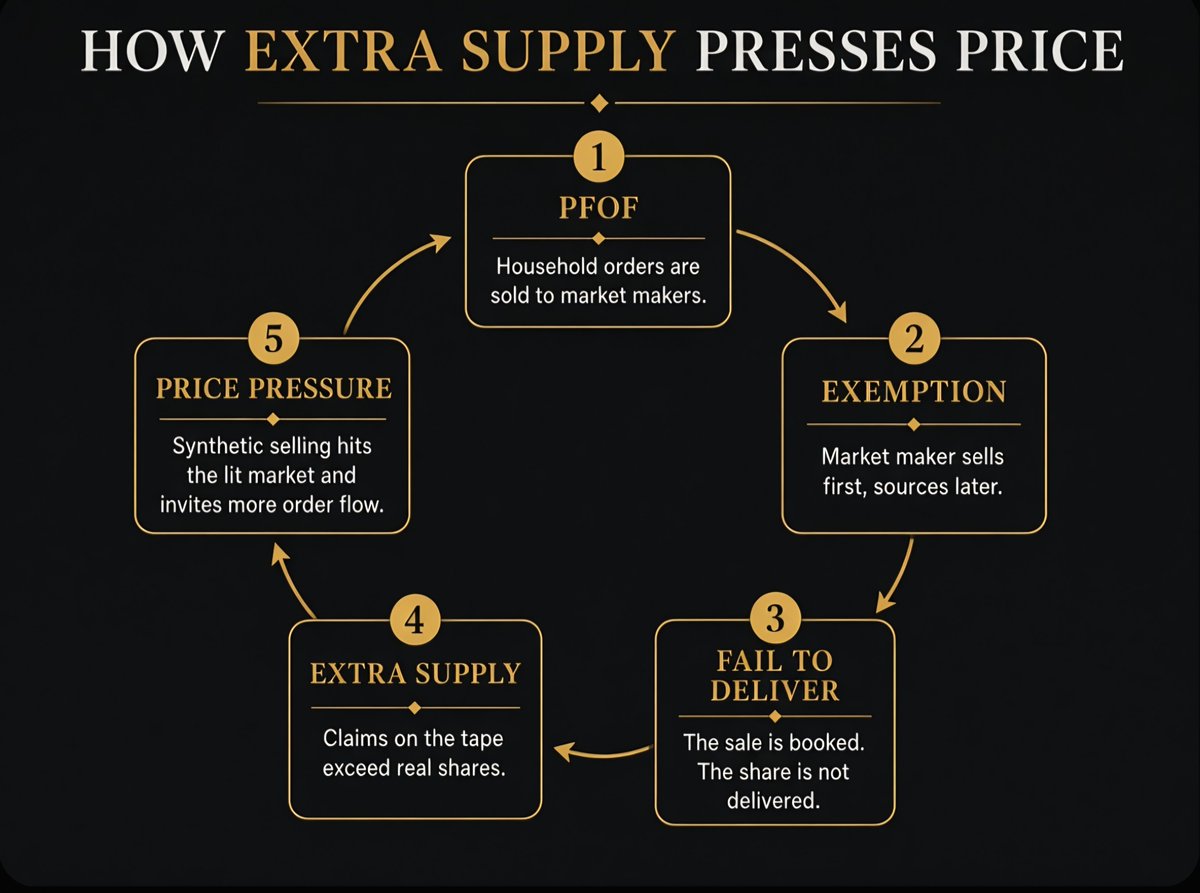
Regulation SHO was written to stop that. A short sale is supposed to start with a LOCATE. The seller is supposed to borrow, or have reasonable grounds to believe the shares can be delivered. Failures to deliver are supposed to be CLOSED OUT.
Market makers were given an EXEMPTION for bona fide market making. That exemption is the opening. It lets them sell first and source later. Leaving their short "naked". In practice, “later” can become NEVER.
Once that advantage is in place, price can be pressed by selling more CLAIMS than the company issued. The count on the tape stops matching the count at the TRANSFER AGENT.
Brokers are paid to send household orders in bulk to those market makers. That is PAYMENT FOR ORDER FLOW. The UK, Canada, and Australia banned it, and the EU is phasing it out, because the router is no longer working only for the CUSTOMER.
Buy orders are often internalized or sent through DARK POOLS. Sell orders are more likely to hit the lit market. The public tape can show SELLING PRESSURE even when buying is stronger.
WRAPPED TOKENS made the locate problem worse. One token was treated as one share and used as a locate. In cases that later blew up, those tokens were not backed by the shares they claimed to represent. The inventory was PAPER.
That is how SECURITIES SOLD, NOT YET PURCHASED can run into the HUNDREDS OF BILLIONS across just a handful of firms. The trade is booked. Delivery is deferred. RISK sits off to the side until it can’t.
Some of the firms that ran that book already FAILED. Overleverage does not stay theoretical forever.
The usual story after that is that HOUSEHOLD INVESTORS caused the damage. That story is useful. It points away from selling what was not secured, then using routing, exemptions, dark venues, and wrapped inventory to keep the position ALIVE.
This is not one ticker. It is a PLUMBING issue. Any name with thin real float, heavy synthetic supply, and persistent fails can be run the same way.
Household investors did not invent the locate, the exemption, the dark pool, or the wrapped token. They noticed the CLAIMS in circulation no longer matched what could actually be delivered.
The public case is simple. If a share is sold, it should be delivered. If a locate is claimed, it should be REAL. If a market maker exemption is used, it should be for making a market, not carrying an unending SHORT.
A free market needs SETTLEMENT, ACCOUNTABILITY, and real SUPPLY against demand. That is PRICE DISCOVERY.
#NakedShorting
Naked shorting was sold to the public as a CONSPIRACY THEORY.
It was not.
It became a way to grind companies down and cover up POOR RISK MANAGEMENT.
The mechanics live in MARKET STRUCTURE: locates that never become real shares, fails that linger, and selling that outruns actual SUPPLY.
Regulation SHO was written to stop that. A short sale is supposed to start with a LOCATE. The seller is supposed to borrow, or have reasonable grounds to believe the shares can be delivered. Failures to deliver are supposed to be CLOSED OUT.
Market makers were given an EXEMPTION for bona fide market making. That exemption is the opening. It lets them sell first and source later. Leaving their short "naked". In practice, “later” can become NEVER.
Once that advantage is in place, price can be pressed by selling more CLAIMS than the company issued. The count on the tape stops matching the count at the TRANSFER AGENT.
Brokers are paid to send household orders in bulk to those market makers. That is PAYMENT FOR ORDER FLOW. The UK, Canada, and Australia banned it, and the EU is phasing it out, because the router is no longer working only for the CUSTOMER.
Buy orders are often internalized or sent through DARK POOLS. Sell orders are more likely to hit the lit market. The public tape can show SELLING PRESSURE even when buying is stronger.
WRAPPED TOKENS made the locate problem worse. One token was treated as one share and used as a locate. In cases that later blew up, those tokens were not backed by the shares they claimed to represent. The inventory was PAPER.
That is how SECURITIES SOLD, NOT YET PURCHASED can run into the HUNDREDS OF BILLIONS across just a handful of firms. The trade is booked. Delivery is deferred. RISK sits off to the side until it can’t.
Some of the firms that ran that book already FAILED. Overleverage does not stay theoretical forever.
The usual story after that is that HOUSEHOLD INVESTORS caused the damage. That story is useful. It points away from selling what was not secured, then using routing, exemptions, dark venues, and wrapped inventory to keep the position ALIVE.
This is not one ticker. It is a PLUMBING issue. Any name with thin real float, heavy synthetic supply, and persistent fails can be run the same way.
Household investors did not invent the locate, the exemption, the dark pool, or the wrapped token. They noticed the CLAIMS in circulation no longer matched what could actually be delivered.
The public case is simple. If a share is sold, it should be delivered. If a locate is claimed, it should be REAL. If a market maker exemption is used, it should be for making a market, not carrying an unending SHORT.
A free market needs SETTLEMENT, ACCOUNTABILITY, and real SUPPLY against demand. That is PRICE DISCOVERY.
#NakedShorting
$MMTLP
Over a billion shares sitting in brokerages account, this is what is being done with companies trading in the criminal US stock market. This is what the SEC and FINRA is covering up.
The government and FINRAts poured a fortune in attorneys fees to avoid ANY #MMTLP transparency, for 3 years.
Because it will prove that the stock market is a totally empty gigantic ponzi scheme, where each share you buy gets countered by 100x fake naked shorts.
OUT NOW: HOW CORRUPT ARE AMERICA’S FINANCIAL MARKETS?
For the first time in three and a half years, Greg McCabe, chairman and CEO of Next Bridge Hydrocarbons, is speaking out.
At the center of this explosive story are the MMTLP Army, approximately 124,000 shareholders, and disturbing allegations of corruption and regulatory failure involving FINRA and the SEC.
People have lost everything. By some accounts, at least three have taken their own lives. And what happened to these investors could happen to anyone participating in the stock market.
The story may sound complicated, but the consequences could not be more real.
Do not miss the next episode of Going Rogue with Lara Logan.
#LaraLogan #MMTLP #FinancialCorruption #StockMarket #GoingRogue
Naked Shorts Are Counterfeit (Fake) Shares
A fake $10 bill or counterfeit concert ticket will get you in big trouble, but Wall Street and regulators look the other way as counterfeit shares flood our financial markets
“If anybody tells you, ever, that there’s no such thing as naked shorting, realize that they’re very ill-informed or they’re in on the scam, there’s no other explanation
Naked shorting is very real.
I’ll tell you how bad it is.
Donald Trump has complained about shorting against his Truth Social company.
Elon Musk complained about it about on Tesla.
Elon Musk has a great quote. ‘The stock market is the only place in the world where you can sell something you don’t own’….”
- Greg McCabe
CEO Next Bridge Hydrocarbons
Courtesy: @laralogan
THEY CAME AFTER HIS FAMILY
For Greg McCabe, the fight over Next Bridge Hydrocarbons didn’t stop with the company or its shareholders. He says the attacks became personal.
In the newest episode of Going Rogue with Lara Logan, McCabe describes what he calls escalating harassment from the “wolf pack,” including an incident involving his daughter’s workplace and the school attended by two of his grandchildren.
“They found a list of every member of the faculty and wrote a letter to the entire faculty saying, ‘Your father-in-law is a criminal. We’re coming after him. There’s no place to hide.’”
McCabe says attacking him is one thing. Going after his family crossed the line.
Watch the full conversation as McCabe breaks his silence on the MMTLP controversy, naked short selling, FINRA, the SEC, and what he says has happened behind the scenes.
@GregMcCabeJr | @GoingRoguewLara
WATCH EPISODE 99.2:
https://t.co/zeOoJlOREH
SUPPORT GOING ROGUE:
https://t.co/XWxZq2aL1T
#LaraLogan #StockMarket #MMTLP #NextBridgeHydrocarbons #WallStreet
Hester Pierce was named in this video and that is the day she resign? Is it because of her $mmtlp fraud? Crazy amout of corruption.
https://t.co/Ek7QzGMlxR
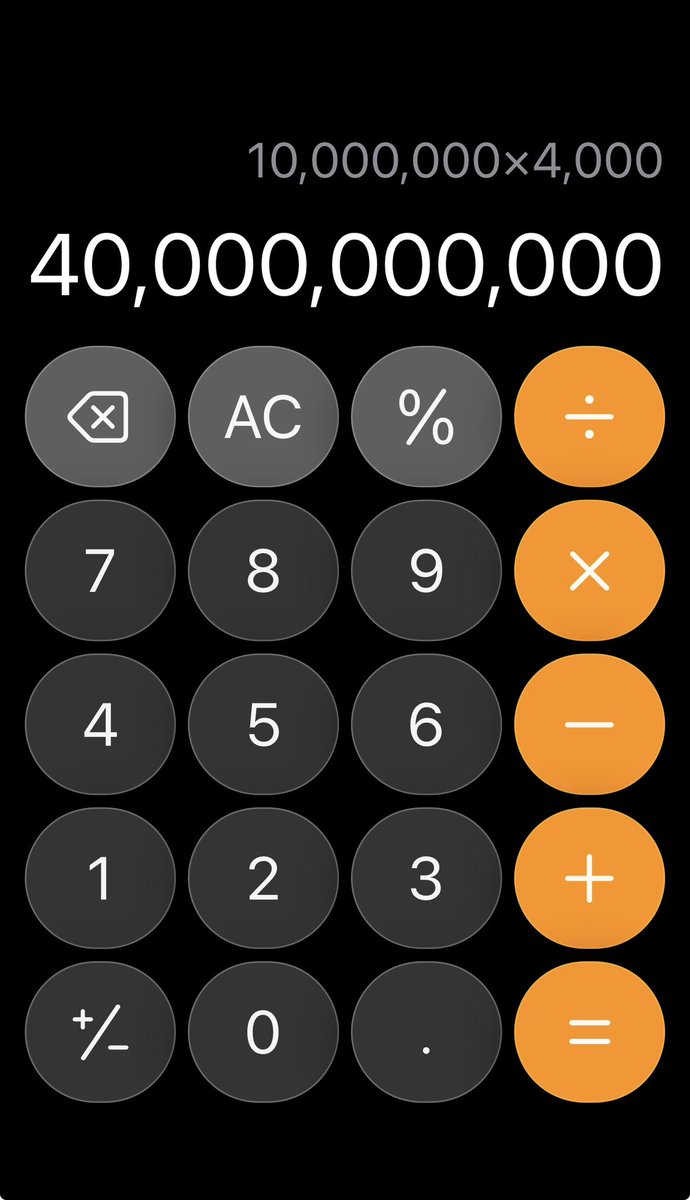
If Anson Funds had to cover their naked short position of 10M shares of #MMTLP at a quoted share price of $4000/share as some shares reportedly were sold right up till the U3 Halt, they would have had netted a LOSS of $40B.
That would have bankrupted them completely.
They couldn’t have that.
They need to keep their coffers full of money to pay off their industry friends in the SEC and FINRA to look the other way. 🤬
They are complicit and incompetent.
FYI, Robert Cook makes over $4 million a year—far more than an SEC commissioner. I can only imagine what Robert Colby, FINRA’s Chief Legal Officer, makes.
Like I’ve said a gillion times before, counterfeit naked short selling = financial market terrorism
Can someone in power at least go after the low hanging fruit?
Nuke the off shore cabal!