📕Some personal news!📕
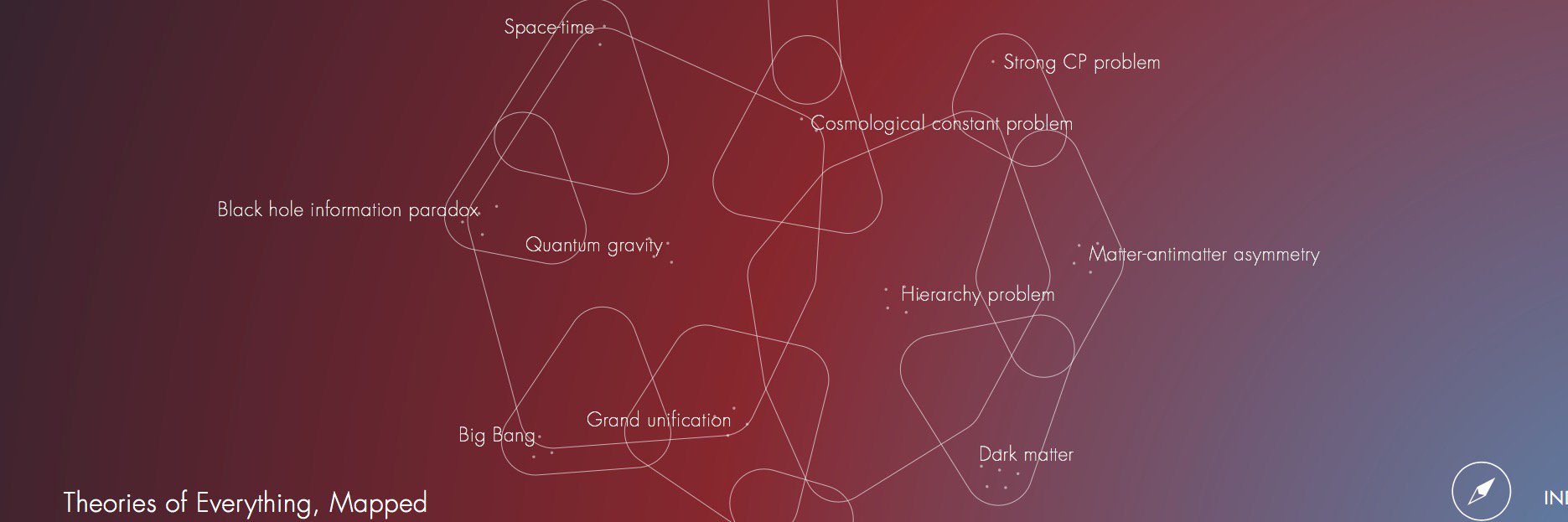
This will be my first book, an attempt to weave together the ideas and controversies of fundamental physics into a coherent narrative. Wish me luck!
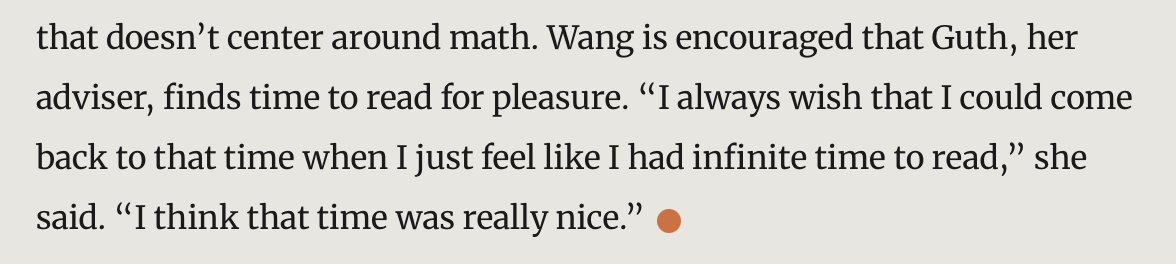
My profile of new Fields Medalist Hong Wang, who proved the 3D Kakeya set conjecture last year, among other blockbuster results. Interesting person and math. https://t.co/rLHjWZ6Lmf
Every four years, the math world’s preeminent awards are given to the finest minds of a generation. The young Fields and Abacus Medal winners — all under 40 on the first day of the year — have reshaped mathematics and theoretical computer science.
Here are the #ICM2026 winners:
My profile of new Fields Medalist Hong Wang, who proved the 3D Kakeya set conjecture last year, among other blockbuster results. Interesting person and math. https://t.co/rLHjWZ6Lmf
I do like this one too.
And there’s much to be said for “a man of many turns,” because it’s literally what polytropos means and that wasn’t a word with any baggage
I also like when translators just collapse the wave function and interpret it as referring solely to his travels.
@nattyover I know it's extremely not literal but "skilled in all ways of contending" is the one that really stuck out to me when I read it in high school because that really is the thing about him that is so extreme, and for someone struggling to make way in life it's so inspiring
@kevinobriencha1 That's a very one-note definition. I see: "subject to sudden, rapid, or unpredictable changes in mood, behavior, or state." And more detail on that last one: "Capable of changing rapidly or easily (like fluid weather or fluctuating plans)." Not unlike "man of many turns."
Re: the first line of The Odyssey, I’d go with
Sing to me, Muse, of a mercurial man.
It captures more of polytropos than “complicated” or “cunning.” Plus Mercury was the god of travel, so it means a travelin’ man, too.
I know: Mercury is the Roman name. Who cares.
@AdkHomeroom Thanks!
Yes to be honest I agree it's jarring. I suppose that's why I was being so defensive about it. If only "hermetic" didn't mean airtight.
But also, "hermetic" would be a more overt departure from the original text. Odysseus wasn't being compared to Hermes.
I know what you’re all thinking: If Homer wanted to compare Odysseus to Mercury/Hermes, he would have. And he didn’t. Ugh, good point.
OK fine
Sing to me, Muse, about a ramblin’ man
Re: the first line of The Odyssey, I’d go with
Sing to me, Muse, of a mercurial man.
It captures more of polytropos than “complicated” or “cunning.” Plus Mercury was the god of travel, so it means a travelin’ man, too.
I know: Mercury is the Roman name. Who cares.
@riemannzeta Thanks, glad you liked it! I more question whether the elevated chance of fatal injuries on the left side would be enough to reduce left-handedness to 10%. (Because I totally agree LH is a big combat/sports advantage otherwise.) So, maybe some extra effect augmented the RH bias?
Why is @nattyover (and about 10% of the human population, including one of my sons) left-handed? Why indeed. Fun fact I learned: "Ultrasound studies indicate that a fetus’s dominant hand is decided before its brain even connects to its limbs."
Scientists are beginning to crack the mystery of left- (and right-) handedness, a fascinating and distinctly human phenomenon. I wrote about the recent findings and reflected on life as a left-hander: https://t.co/9DyWemrTG6
Starting in early 2025, Elon Musk and the Trump administration began terminating USAID's programs and firing its staff — with Musk himself boasting about "feeding it into the woodchipper." One year ago today, USAID was officially dissolved, its remaining programs haphazardly folded into the State Department. Amid all the lies and misinformation that have followed, some facts about what has actually been lost:
• USAID saved more than 3 million lives a year at a cost of less than $10/month per American. That is what was destroyed. On purpose.
• According to Boston University's Global Impact Counter — which tracked deaths attributable to the cuts until it stopped operations in February 2026 — an estimated 781,000 people died preventable deaths in the first year, including 518,000 children.
• Global child mortality (the number of children who die before their fifth birthday) rose in 2025 for the first time in 35+ years — by 200,000 additional deaths.
• USAID's 50-country disease surveillance network — the system that cut outbreak response times from 2 weeks to 48 hours — is gone. We are now watching an unprecedented Ebola outbreak unfold in real time — with the highest first-month caseload and death rate in modern history.
• Programs reaching 93 million women and children were cut 92%. TB programs cut 56%. Water and sanitation cut 86%. Over 2,000 health facilities permanently closed.
• 25 million fewer people received humanitarian assistance in 2025. The overall humanitarian budget was slashed 74% — from $14.1 billion to $3.7 billion.
• 363 million people face acute hunger in 2026. The famine early-warning system that would have seen it coming went dark for five months.
• $1.7 billion in democracy and governance funding (election monitoring, anti-corruption work, support for independent media and civil society) was terminated.
• 360+ independent media outlets lost funding. Hundreds of legal clinics closed.
• Far from saving money, the Trump administration itself has already said the dismantlement will cost taxpayers at least $19.2 billion in cancellation fees, severance, and penalties. That's more than half of USAID's annual budget — spent on destruction and closeout, not support for vulnerable people.
• American farmers, universities, and businesses are among the casualties too. USAID partnered with more than 3,500 U.S. companies and maintained 17 university-based research labs. Its work with U.S.-based contractors and the private sector generated hundreds of thousands of American jobs and multiplied the return on every dollar spent. Those markets and partnerships are gone.
Every time I write about particle physics, I encounter a moment of uncertainty about how many kinds of elementary particles to say there are. Turns out to be an even harder and deeper question than I anticipated. Let me know where you come down:
https://t.co/NiPnq54uoV
Another major problem, this time in additive combinatorics, has fallen, this time to humans rather than AI, but using methods related to the AI solution to the unit distance conjecture.
This may be obvious, but my impression is that the best mathematicians often remember ~forever and in astonishing detail what they’ve already learned and can therefore invoke facts and techniques as needed in new contexts. And LLMs sure do remember what they’ve learned!
@nearyd Both, but IMO, memory is really important. I deeply understand lots of things I write about and then within months am hazy on the details. These people never forget.