Twenty miles above the North Pole, something is breaking that almost never breaks in November.
The polar vortex, the ring of winds that keeps Arctic air locked up north, is coming apart weeks earlier than it ever should. Its winds at 60°N dropped from 22 m/s to 5 m/s in eight days. The forecast is for a full reversal, the earliest since records began in 1958.
MIT’s Judah Cohen called it almost undoubtedly the largest, earliest disruption on record.
Here’s what that means for you. When the vortex collapses, cold air escapes. NOAA says the event should peak in late November, with colder than average weather likely across 35 states through December. Right around Thanksgiving.
Grab the heavy coat. Winter’s showing up uninvited.
A Harvard astrophysicist says the universe has a designer, and the proof is hiding in antimatter.
Dr. Willie Soon made the case on the Tucker Carlson Network. His argument starts with Paul Dirac.
In 1928, Dirac’s equations predicted antimatter before anyone had seen it. Four years later, it turned up in the lab exactly as the math said it would.
Then Soon takes it further. The Big Bang created matter and antimatter, and if they’d been equal, they would have wiped each other out. Nothing would exist, including us. Somehow, matter came out ahead.
Soon reads that imbalance as deliberate.
Dirac himself once called God “a mathematician of a very high order.” Soon thinks the universe proves him right.
Every living creature on Earth plays a role in maintaining the delicate balance of our planet. 🌍
Worms enrich the soil, bees pollinate plants, forests absorb carbon dioxide, and countless tiny organisms keep entire ecosystems alive.
Nature operates through an extraordinary system of cooperation. Every species, no matter how small, contributes to something much bigger than itself.
Yet humans, despite having extraordinary intelligence and technology, are rapidly destroying the very ecosystems that sustain our existence.
Deforestation, pollution, climate change, and the destruction of natural habitats are pushing countless species toward extinction.
The truth is simple: We are not separate from nature. We are part of it.
Perhaps the greatest measure of human intelligence isn't how much technology we create, but how well we protect the planet that makes our existence possible.
Earth doesn't need humans to survive. Humans need Earth to survive. 🌱
A distant planet located nearly 1,000 light-years away has seemingly vanished from the view of astronomers, leaving scientists puzzled. But the truth behind its disappearance is even more fascinating.
The planet, known as TOI-2535 b, is a massive gas giant that completes an orbit around its star in just 8.25 days. NASA's TESS space telescope tracked it for seven years before its familiar signals suddenly disappeared in March 2026.
Scientists now believe the planet hasn't vanished at all. Instead, an unseen neighboring planet may be gravitationally pulling on it, causing its orbit to wobble and gradually tilt out of alignment with its host star.
As a result, the planet no longer passes in front of its star from Earth's perspective, making it invisible to the transit-detection method astronomers used to observe it.
Even more astonishingly, researchers estimate that TOI-2535 b may remain hidden from view for at least 30 years.
This discovery offers a remarkable glimpse into the gravitational interactions between distant worlds and reminds us that sometimes, objects don't disappear from the universe — they simply disappear from our view.
Source: Research published in The Astrophysical Journal Letters, November 9, 2026.
We just witnessed a solar system take its first breath.
For the first time ever, astronomers have captured the precise moment when planets begin forming around a star other than our Sun.
The young star is HOPS-315, located about 1,300 light-years away in the constellation Orion. It looks remarkably similar to what our Sun may have looked like in its early days.
Using the James Webb Space Telescope and the ALMA telescope in Chile, researchers detected hot minerals rich in silicon monoxide beginning to solidify within the star’s disc. These tiny grains gradually clump together, forming pebbles, then kilometre-sized planetesimals, and eventually full-fledged planets.
The very same types of minerals are preserved inside ancient meteorites from our own solar system.
In a way, we're looking at a baby picture of the very process that gave birth to Earth.
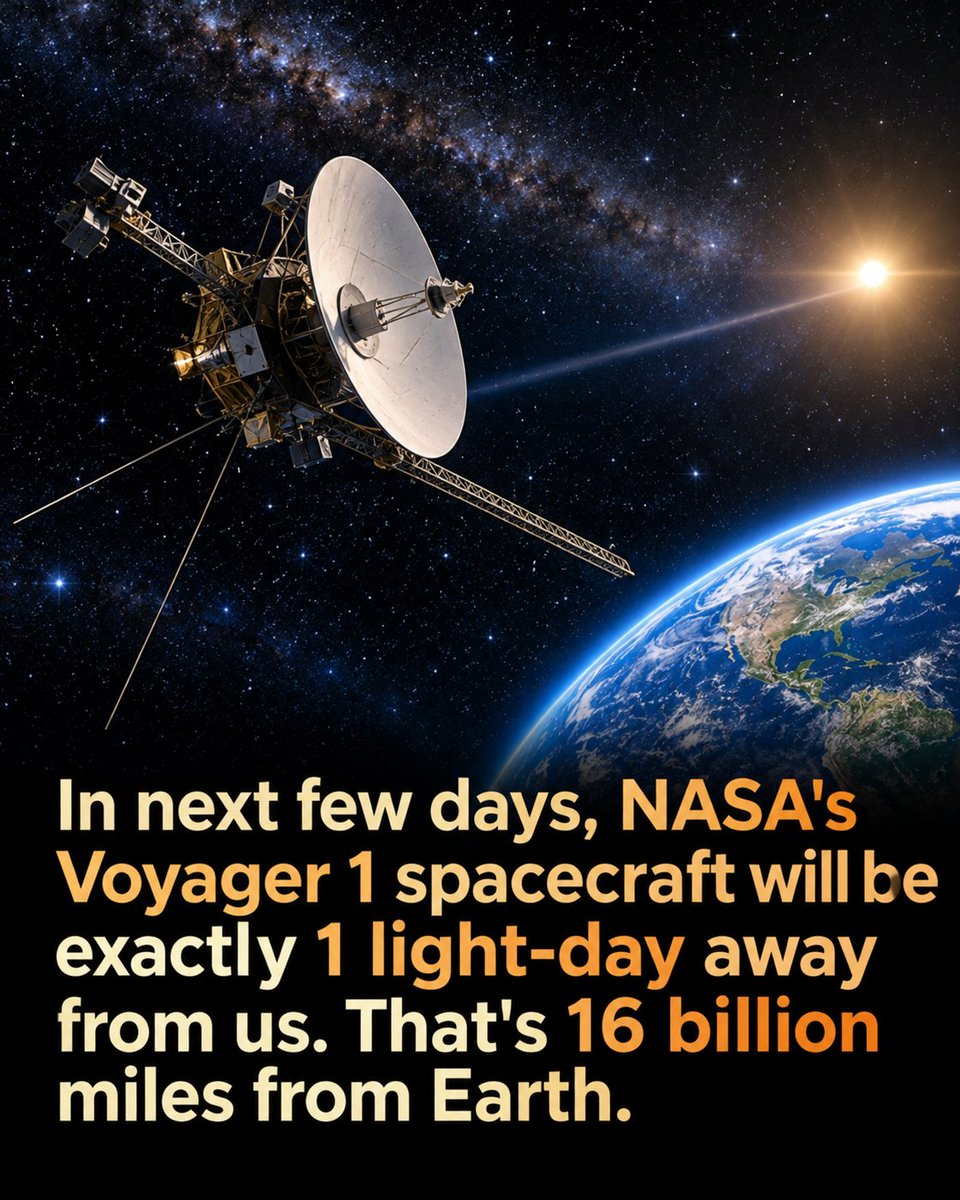
Voyager 1, launched in 1977, is nearing the milestone of one light-day from Earth – roughly 16 billion miles – making it the first human-made object to reach this distance after nearly 50 years of travel through the solar system and into interstellar space.
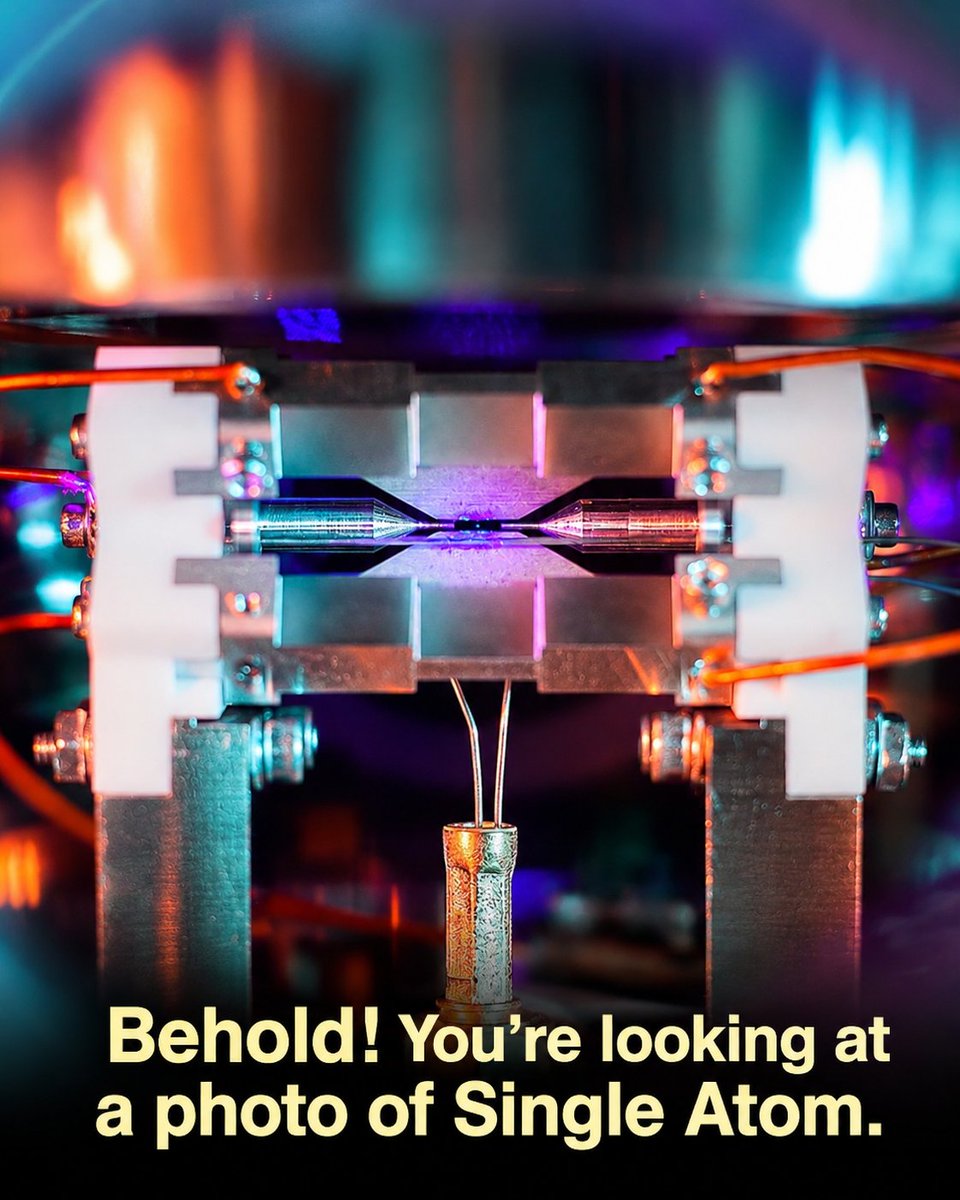
That tiny purple dot is one atom, and you’re seeing it with your own eyes.
There’s no electron microscope or imaging trick involved. Oxford physicist David Nadlinger shot it on an ordinary digital camera.
The atom is strontium. It floats between two needle-tipped electrodes about 2mm apart, and electric fields hold it almost perfectly still. A blue-violet laser hits it, the atom absorbs the light and fires it back out, and a long exposure caught enough of that glow to register.
The shot won the top prize in the EPSRC’s 2018 science photography competition.
You were told atoms were too small to ever see. Look again.
Astronomers have discovered a cosmic giant with a mass roughly 30 billion times greater than our Sun. 🌌
Located in a distant galaxy within the Abell 1201 galaxy cluster, this ultramassive black hole is so enormous that its gravity can dramatically bend the light travelling around it.
But here's what makes the discovery fascinating: scientists didn't need to see the black hole directly.
Instead, they used a phenomenon called gravitational lensing. Its immense gravity bends and distorts light from a galaxy behind it, creating clues that reveal the black hole's hidden mass.
Researchers then used powerful supercomputer simulations to recreate how light travels around objects of different masses until they found a model that matched the observations.
The result? Evidence of a black hole weighing approximately 30 billion Suns.
Even more fascinating, this technique could help astronomers discover many more enormous black holes that would otherwise remain hidden in the darkness of space.
Sometimes, the universe reveals its darkest objects by showing us how they bend the light. 🔭
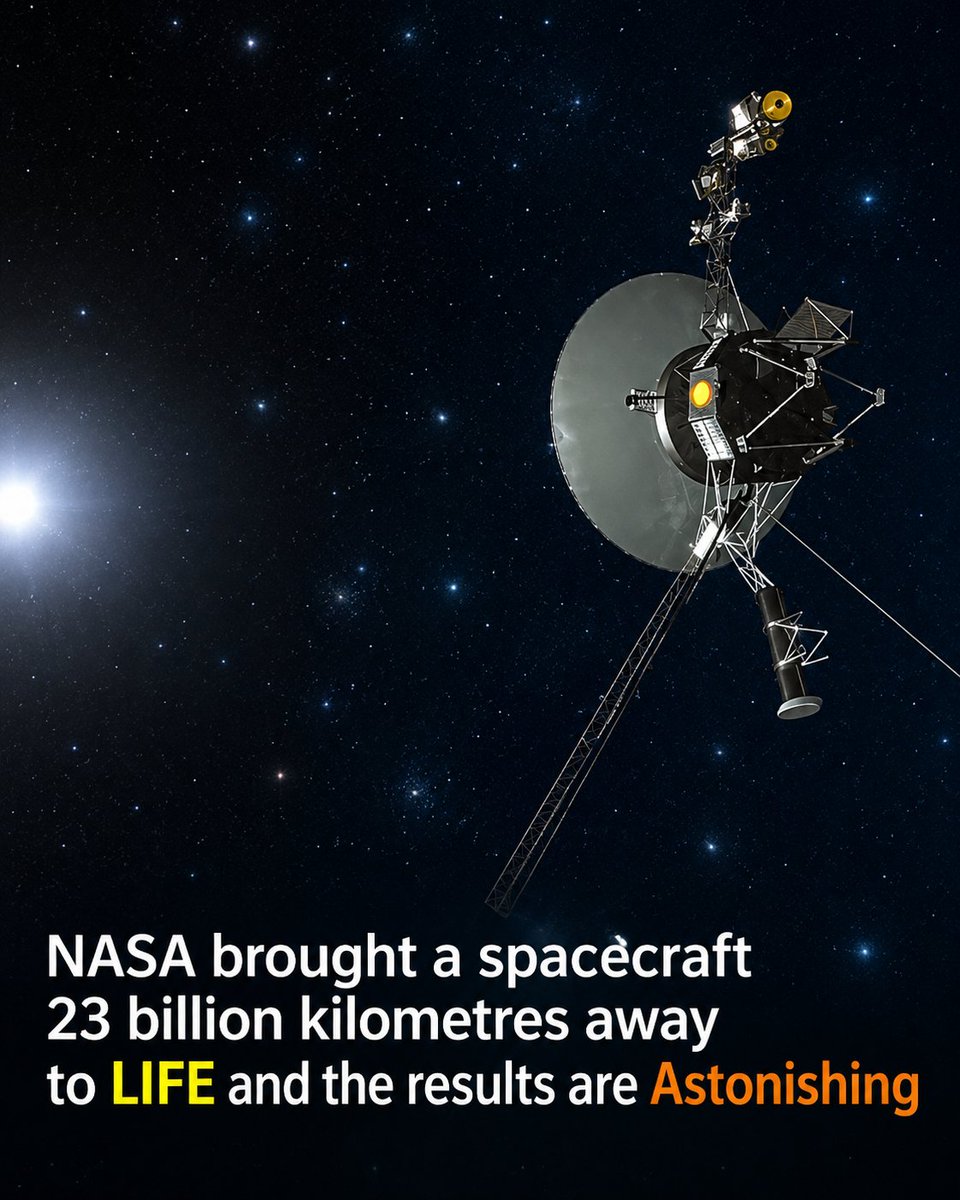
A spacecraft launched nearly five decades ago was given a second chance at life, billions of kilometres from Earth. 🚀
NASA engineers faced a serious challenge when Voyager 1 began sending back corrupted data from its onboard systems. At more than 23 billion kilometres away, repairing it was anything but easy.
After carefully studying the spacecraft's computer systems, engineers discovered that an old onboard computer was interfering with the information being transmitted to Earth.
They sent a command across interstellar space, redirecting the spacecraft's data through the correct computer.
The fix worked. Voyager 1 began transmitting meaningful information again, proving that even a spacecraft built in the 1970s can still surprise us.
Think about it: a machine launched in 1977, operating billions of kilometres away, can still receive commands from Earth.
A remarkable achievement of human engineering and one of the greatest stories of space exploration. 🌌
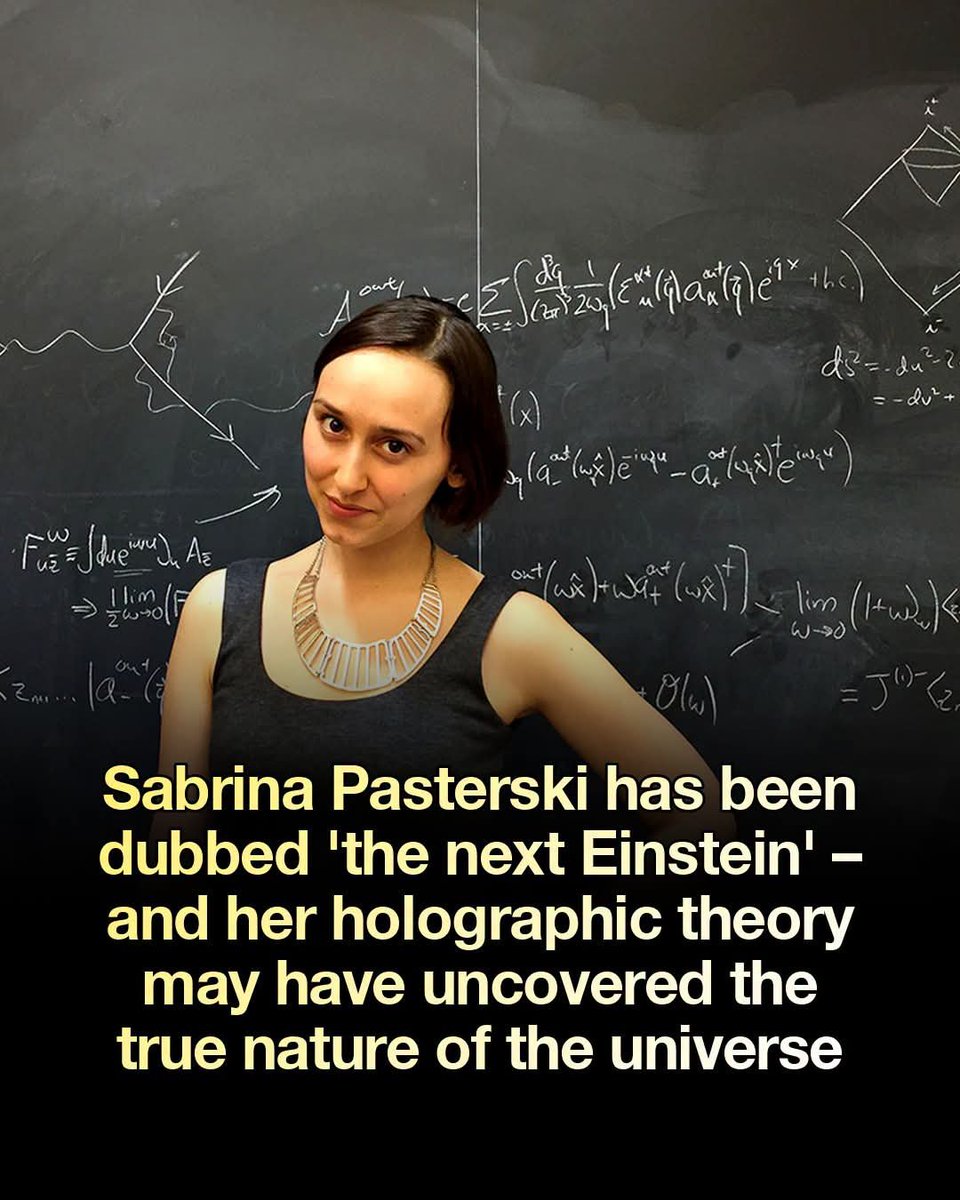
They’re calling Sabrina Pasterski the next Einstein, and her theory could change what “real” even means.
Her work is in holography. Not the sci-fi hologram kind.
The idea sounds unhinged until you sit with it. Everything in our 3D universe might be information stored on a flat 2D surface, with the depth we feel being more like a projection than a place.
If Pasterski’s holographic theory holds up, it may have uncovered the true nature of the universe itself.
“The next Einstein” isn’t a label anyone hands out casually.
She got it anyway.
NASA astronaut Christina Koch has officially reached the end of her spaceflight career. 🚀
After making history aboard the Artemis II mission, which carried four astronauts around the Moon in April 2026, Koch is moving into a completely different role at NASA.
On October 13, NASA announced that she would become the agency's Acting Deputy Chief Engineer, beginning November 1.
The new position means she will transition to management astronaut status and will no longer be eligible for future spaceflight assignments.
Koch previously spent 328 consecutive days aboard the International Space Station, set a record for the longest single spaceflight by a woman, and participated in the first all-female spacewalks.
Her journey from exploring space to helping shape NASA's future marks the end of an extraordinary chapter.
Sometimes, even the greatest explorers must leave the spacecraft behind. 🌍
The footage is an optical illusion: bright, sunlit snow from a high vantage point mimics clouds perfectly, so the short tumble into a snowdrift looks like a dangerous freefall.
This is a long-circulating viral clip of Karma the Corgi, which reliably tricks viewers into momentary panic before revealing the safe, playful landing.
Humanity is approaching a remarkable milestone in deep-space exploration. 🚀
Launched on September 5, 1977, NASA's Voyager 1 has spent decades travelling farther from Earth than any other human-made spacecraft.
Imagine sending a message across space and having it take an entire day just to reach the spacecraft. That's the extraordinary scale of this mission.
On November 18, 2026, Voyager 1 is expected to make history by becoming the first human-made object to reach a distance of one light-day from Earth — approximately 16.1 billion miles away.
At that distance, radio signals travelling at the speed of light will need 24 hours just to reach the spacecraft. A reply from Voyager 1 will take another 24 hours to return.
Launched in 1977, this remarkable spacecraft has travelled for more than 49 years, crossed into interstellar space, and continues sending scientific data back to Earth.
Think about it: a tiny machine built by humans nearly half a century ago is still exploring a region of space no human has ever visited.
Humanity's farthest messenger is still travelling into the unknown.
Source: NASA – Voyager 1: What Is a Light-Day?
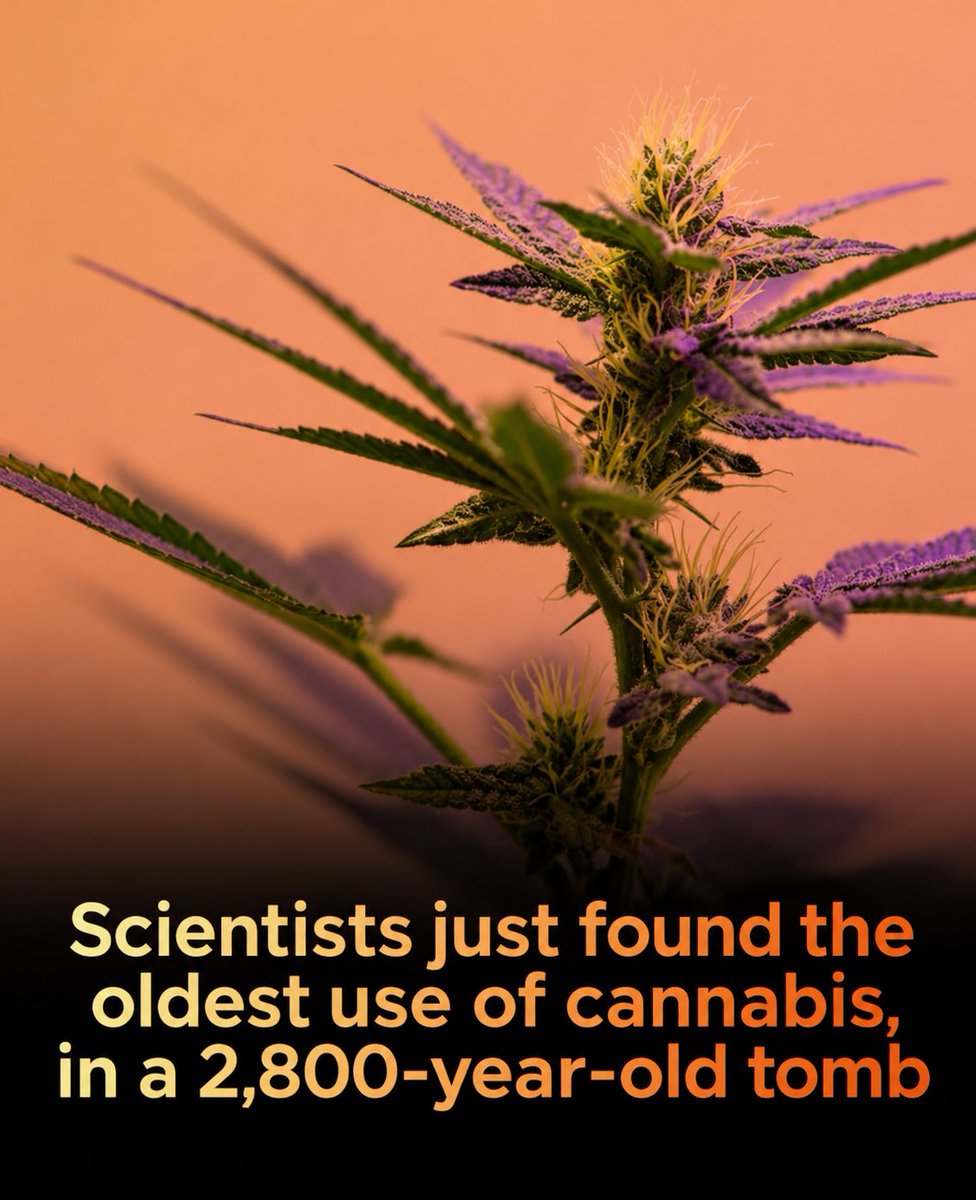
Scientists have uncovered remarkable evidence that humans were using cannabis nearly 2,800 years ago! 🌿
Inside an ancient Scythian royal tomb in southern Siberia, archaeologists discovered more than 1,000 cannabis seeds alongside preserved human hair containing chemical traces consistent with THC, the psychoactive compound found in cannabis.
The burial dates back to around 800–760 BC, suggesting cannabis may have been used for its mind-altering effects much earlier than previously documented.
Researchers believe it may have played a role in ancient funeral ceremonies and rituals. Some even suggest it could have been used to calm individuals involved in sacrificial ceremonies, although this theory remains unproven.
The discovery offers a fascinating glimpse into ancient human traditions and pushes the archaeological evidence of cannabis use further back in history.
Humanity's relationship with cannabis is much older than we imagined. 🔬
Source: Reuters 2800 year old siberian burial discovery.
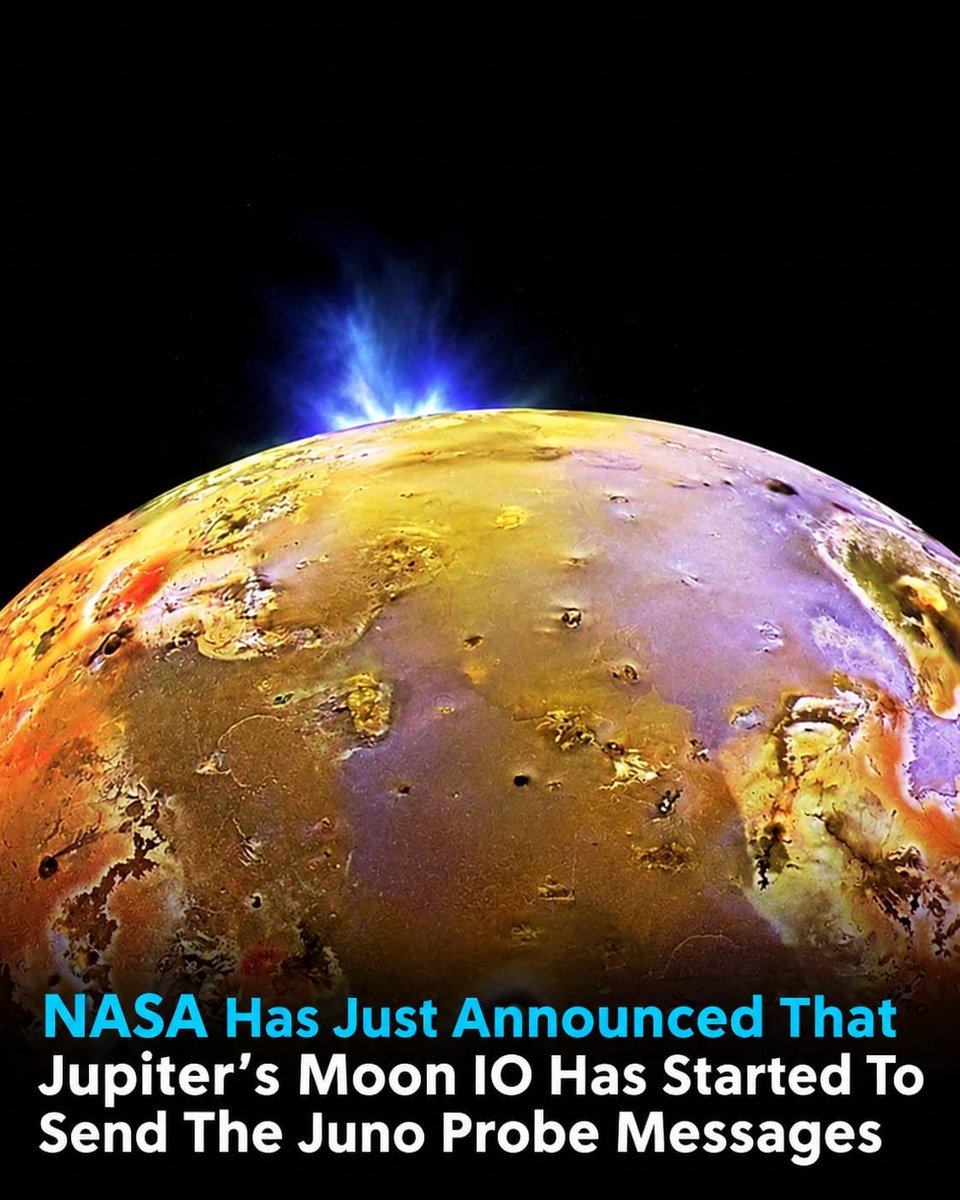
🌋 Jupiter’s volcanic moon Io is sending signals that NASA’s Juno spacecraft can detect!
During its close encounters with Io, Juno has captured radio emissions and studied the moon’s intense volcanic activity and interaction with Jupiter’s powerful magnetic field. These signals are not messages in the literal sense, but they are revealing fascinating details about one of the most volcanically active worlds in our Solar System.
🤯 Imagine a distant moon producing mysterious signals that a spacecraft millions of kilometers away can detect!
Every signal brings us closer to understanding the strange and violent world of Io.
📚 Source: NASA — Juno Mission
Close-up view of Atlas's irregular, ridge-encircled form against space before showing it in orbit near Saturn's rings.
Saturn's moon Atlas features a distinctive flying saucer shape formed by a prominent equatorial ridge of accumulated ring particles, as confirmed by Cassini mission data.