The industry is waking up to the sustainability of options yield.
Unlike traditional yield farming, it's more nuanced; selling vol, managing delta, hedging.
If you've wanted to run options yield strategies onchain, our partners at @NautilusTrader just put together a guide that handles the hard parts:
https://t.co/iWgOXCVXIa
Derive is integrating with @NautilusTrader.
Systematic traders can now access Derive markets through an open-source trading engine built for research, backtesting and live execution.
Spot, perps and options are supported from the initial integration.
On-chain volume attributed to NautilusTrader across @HyperliquidX and @Polymarket now over $100 million.
$56 million in the past two weeks.
These are 2 of the 15 venues we support. Two more DEX venues land soon.
Live stats: https://t.co/p96H8sgYhm
The engine is open source by design. You and your auditors can read its logic and trace what it does, rather than trust a black box. The higher the stakes, the more transparency matters.
https://t.co/TaPG3Gd4mk
When an engine touches live capital, you should be able to prove what you're running, not take it on trust.
NautilusTrader ships reproducible, signed builds with SLSA Build Level 3 provenance. Verify any release yourself.
https://t.co/EP5LBzeV9s
Information-driven bars sample by content rather than clock time. A quiet hour might generate no new bars; a burst at the London open can generate many. @lopezdeprado spent chapters on why it gives better-behaved inputs for systematic work.
Information-driven De Prado bars, VPIN, and Hurst on Kraken. End-to-end out of the box available now, and the same code runs in backtest and live: https://t.co/GbNw23W3Is
Open-source algo trading on Kraken Futures keeps leveling up 🚀
@NautilusTrader just dropped a full Rust walkthrough: Hurst/VPIN on our BTC perp, from sim to live 👀
The @krakenpro adapter used in the tutorial is first-class in the engine and implemented in @rustlang, same interface as every other venue adapter: https://t.co/Fxi4DSLxW3
The clock in NautilusTrader does more than return timestamps. It defines how time enters the engine: as monotonic nanosecond timestamps, as scheduled events, and as a dependency shared across backtesting and live trading.
This allows timer-driven logic to run against historical data and real markets through the same interface and execution model.
https://t.co/bPUKJ68JG3
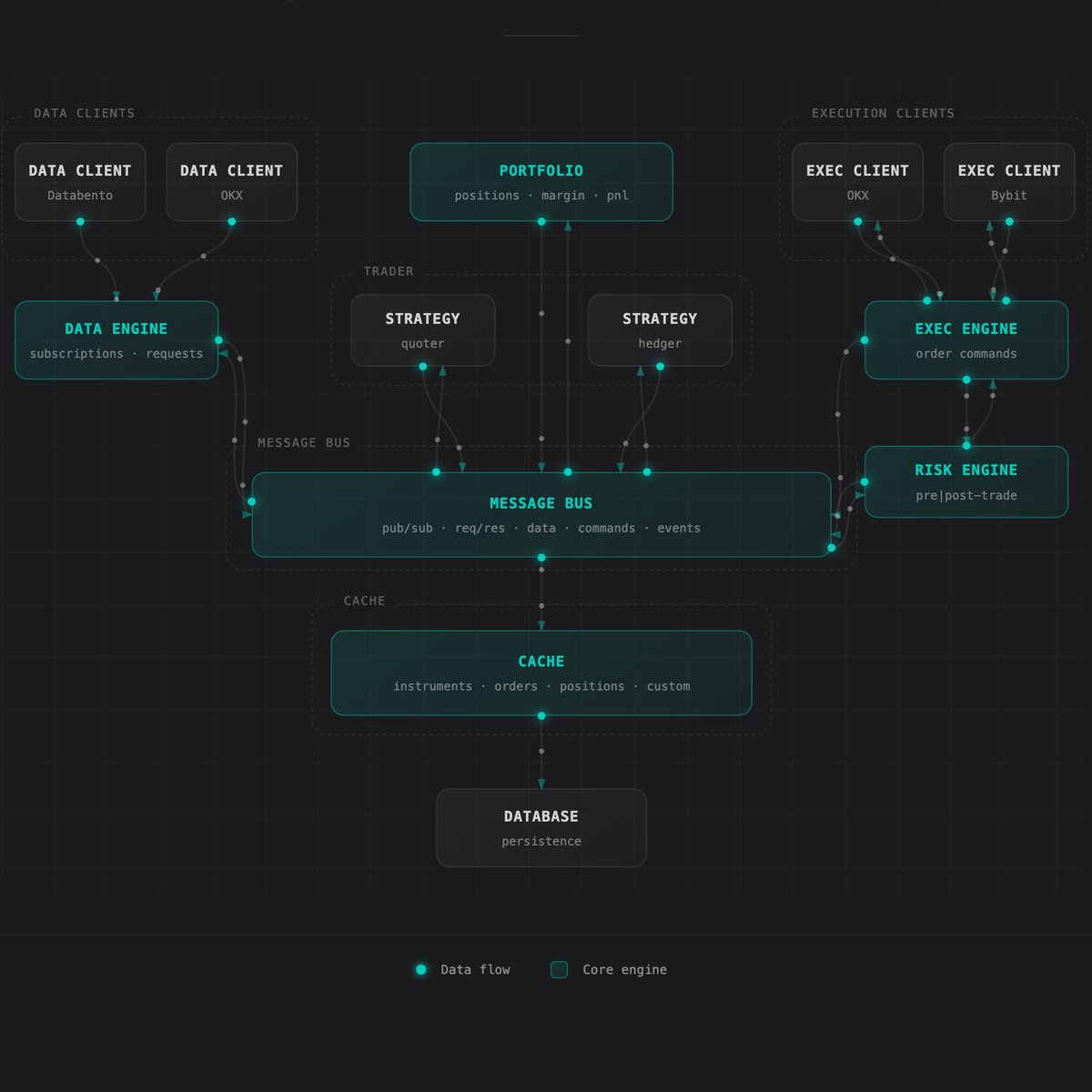
NautilusTrader is a deterministic, event-driven trading engine that runs one execution model across research and production.
Why NautilusTrader exists, the architectural decisions behind it, and why that matters in practice: https://t.co/x0D83FYTJh
The system is designed for multi-venue deployment.
Venue adapters operate at the edge of the core runtime.
The execution model remains consistent across venues.
Architect is partnering with @NautilusTrader, the open-source trading suite with 20.3k stars and 850k downloads on Github, to offer AX’s traditional asset perpetuals on the Nautilus platform. This is a major step forward for AX’s distribution. Thank you Nautilus team! Live now.
Underlying everything is the event-driven core — every order, trade, and quote is just an event on the same bus.
That’s how NautilusTrader achieves true parity between simulation and live.
https://t.co/Fi2U0cbDSB
Under the hood, we’ve been rebuilding trading infrastructure from first principles.
Rust at the core 🦀. Python at the edge 🐍.
Zero copy, nanosecond precision, and one event-driven engine for backtests and live trading — no code rewrites.
This is what real parity between research and production looks like.
https://t.co/BW1TFL82Lm