Rome handed out free grain to 40,000 citizens in 73 BC. By 46 BC, Julius Caesar found 320,000 people lining up for their monthly ration. That eight-fold expansion happened in under three decades, and it shows you how welfare states actually grow.
No Roman senator stood up and announced a plan to addict a third of the city to government bread. It happened incrementally, through political competition. Each magistrate who wanted votes expanded eligibility. Each expansion normalized the next one. The citizen who once considered the dole shameful eventually expected it, then demanded it, then organized politically to protect it.
This is the core mechanism free market thinkers have identified across every era: once you create a transfer program, you create a constituency for that program. Recipients vote. Administrators build careers. Grain merchants who supply the state develop a stake in keeping the contracts flowing. The political economy locks in.
Caesar, to his credit, actually cut the rolls back to 150,000 through verification audits. It was one of his more economically coherent moves, though the Senate still murdered him. His successors quietly let the numbers climb again.
What did the dole require? Massive grain imports from Sicily, Sardinia, and Egypt, organized through state logistics at state expense, funded by taxation and conquest. When the conquest revenue dried up, the obligation remained. Rome had written a check against future military success, and future military success eventually failed to arrive.
The lesson is not complicated. Distribute a benefit and you distribute dependency. Distribute dependency and you distribute political power to whoever controls the distribution. The grain dole didn't weaken Rome overnight, but it made every subsequent reform politically impossible.
I watched my coworker get promoted 3 times in 2 years.
Same company. Same starting role. Same manager.
I worked longer hours. Delivered more projects. Got better reviews.
Then I noticed what he was doing differently.
Here are the 7 behaviors that actually move careers forward:
A hedge fund manager put a jar of 1,776 jelly beans in front of a room at Google and proved in two rounds why most investors will always lose money. for free.
His name is Joel Greenblatt. Gotham Capital. 50% a year for a decade. he asked the room to guess how many jelly beans were in the jar.
First round: everyone wrote their guess silently. no talking. no looking around. the average was 1,771. five off. almost perfect.
Second round: people said their guesses out loud. heard each other. adjusted. the average collapsed to 850. same room. same jar. the only thing that changed was influence.
He told the room: the second guess is the stock market. everyone knows what they just read in the paper. what the guy next to them said. what they saw in the news. the cold independent guess was better. that is not how the market works. but that is where the opportunity is.
Then he showed 20 years of data. the cheapest 20% of stocks averaged 38% a year. the most expensive averaged the least. the strategy is simple. the reason it still works is that people are still crazy. and they always will be.
55 minutes. one jar. still free.
Rick Santelli gets it.
If rates go this high it will destroy the gold market like the 1980s & cause a debt collapse outside of the US, securing the Dollar's position as the global reserve currency.
Labels 101
QE is federal reserve purchase of long term assets, regardless of yield, paid for with bank reserves and both increases bank reserves AND decreases duration in the private sector
YCC is similar but only buys bonds when the rate is at the cap level duration is removed and reserves increase when cap is hit
Fed twist is when Fed buys duration and sells short term bonds it reduces duration held by private sector and is reserves neutral.
Treasury actions to change the composition of the treasuries outstanding via issuance amount changes or buyback changes are a twist and impact duration held by the private sector
Fed providing repo programs to bond buyers (like BTFP) doesn't change what assets the private sector holds but increases bank reserves and reduces the need for certain distressed treasury holders from forced liquidation so is supportive of long term bonds
Regulatory changes that impact the cost and amount that the regulated pays and can hold impacts demand for treasuries but doesn't change reserves or duration amounts held by the private sector
Reserve amounts in a zero required reserves regime have very little impact on monetary conditions
Duration held by the private sector has meaningful impact on financial conditions
Repo programs slow down liquidations and backstop liquidity but don't force demand for treasuries it's a push not a pull force
Regulatory changes are also a push to the regulated entity and doesn't force them to buy.
Hope that helps
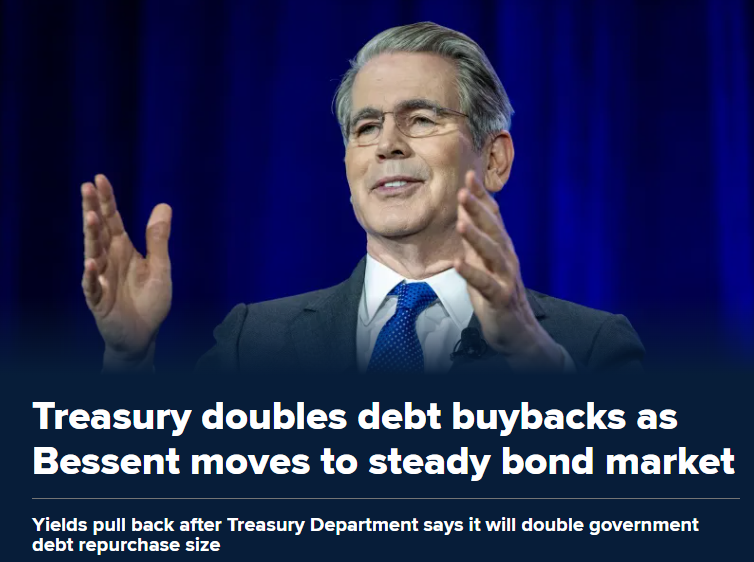
The Treasury Department is calling this a “debt buyback.”
But they’re not reducing the debt.
They’re running huge deficits, buying back old bonds, and issuing even more new ones.
This is debt reshuffling, not debt reduction.
Whatever you think about this yield curve operation from Bessent, it is not QE. No reserves are being created. The good news is anyone trying to call it QE is basically confessing that they don’t understand anything about this issue area and can be crossed off your list of people to listen to.
Apollo's internal presentation on First Brands has surfaced, the same deck that led to a bespoke short position on the Term Loan.
What did Apollo catch before anyone else: cash flow never matched claimed margins, 20% operating margins were unbelievable for the business and its many acquisitions, and the CEO had a long trail of failed entities with almost zero public footprint. Apollo then declined to buy Katsumi’s factored invoice exposure, shorted the debt, and made money. Katsumi allegedly saw massive invoice fraud in 2023 samples yet kept funding billions more.
Sometimes, the edge is just reading the financial statements and looking up the CEO on Google.
Shoutout to the Financial Times for obtaining the deck.
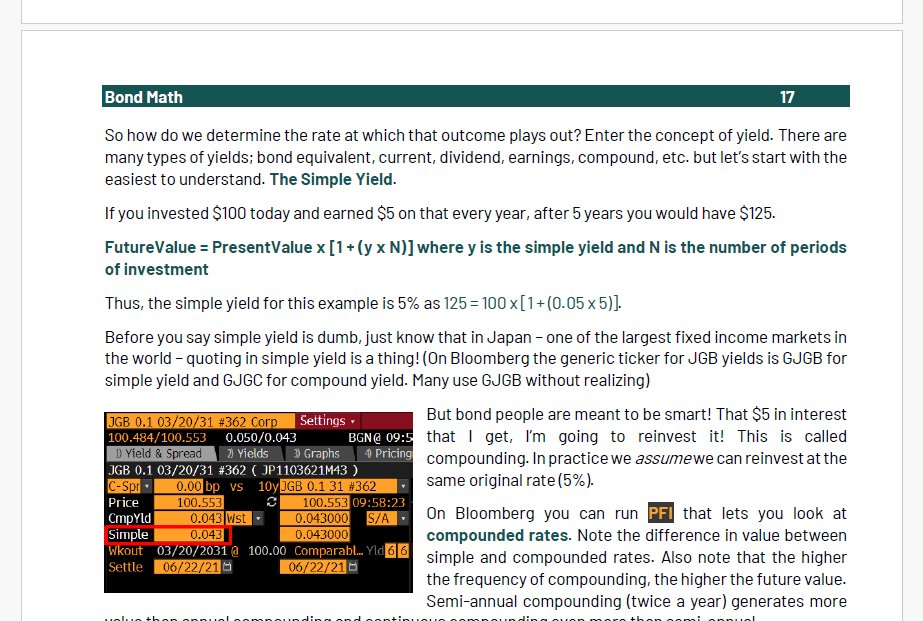
One final thing on JGB/Yen related content for today - I notice that a lot of people post JGB charts with bloomberg's GJGB tickers alongside USTs or Bunds, etc.
It's worthwhile to point out that GJGB is the simple yield ticker (that's quoting convention in Japan) while GJGC is the compound yield ticker. That's actually the appropriate one to use if comparing to global yields FYI, as minor the difference may be.
The global bond market is quietly signaling a systemic shift. 🚨
Japan's long-end is breaking. While everyone watches the Fed, the 30-year JGB has surged from 0.5% → 2.5%+ - the most violent repricing in the world's largest creditor nation.
Robin Brooks' 9-country chart shows the real story:
• Long-end yields exploding simultaneously across US, UK, France, Italy
• 10y10y forwards pricing structural regime change everywhere
• Japan's curve distortion is extreme, but no one is spared
When the global cost of capital resets this fast, something breaks.
Which market snaps first: US housing at 5.3%, Japanese fiscal dominance, or European periphery spreads? Drop your thesis below. Who will break first? 👇
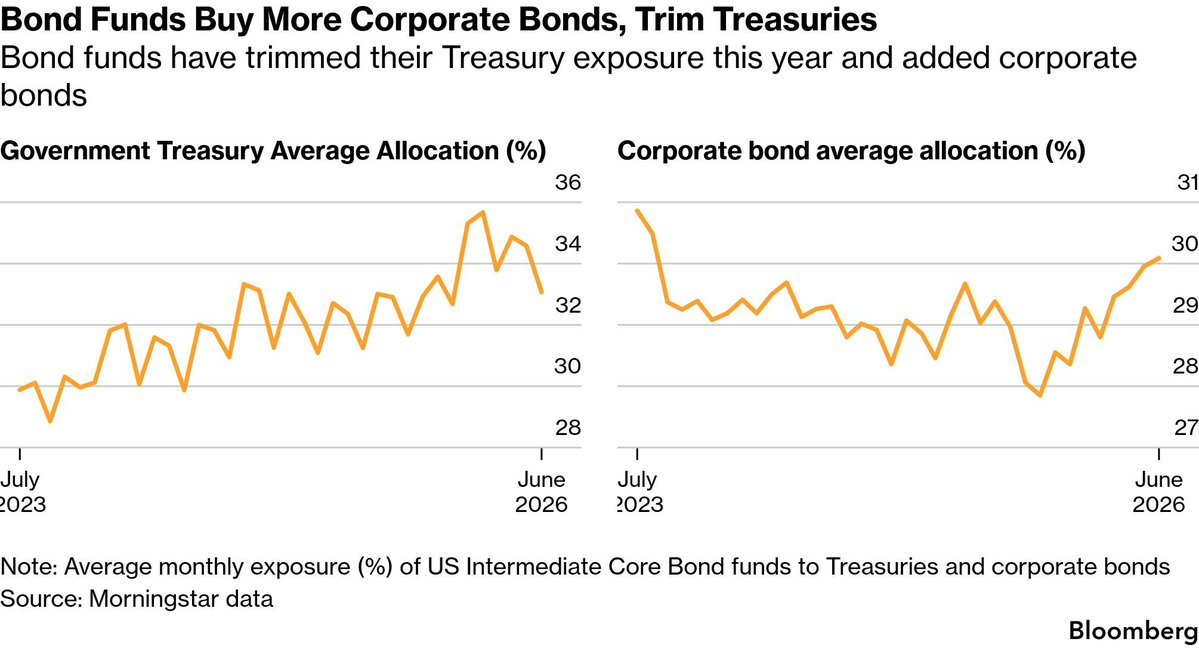
🦔AI companies have borrowed so much money this year that they're pushing up interest rates for the entire economy. Nomura estimates tech borrowing alone now equals 25% of what the US Treasury issues in bonds, five times more than last year. Bank of America says the surge has added about 0.3 percentage points to the 10-year yield. Bond managers are selling Treasuries to buy AI corporate debt instead because it pays more.
My Take
AI companies are now competing with the US government for the same pool of lenders, and the lenders are picking the corporate bonds. Alphabet's 30-year pays 6.4%. A Meta data center bond pays over 7.5%. At those rates, a 5.2% Treasury loses the fight for capital every time. That's one of the reasons long-term rates have stayed so stubborn even as the Fed tries to bring them down.
JPMorgan expects $5.5 trillion in AI infrastructure spending through 2030, and most of it will be borrowed. That borrowing raises the cost of money for everyone, the government, your mortgage, small businesses trying to get a loan. The AI buildout has reached the scale where it moves rates for the whole economy, and most people paying higher borrowing costs have no idea that a data center arms race is one of the reasons why.
Hedgie🤗
AI debt doesn't seem to be crowding out Treasuries. If that were they case you'd expect dealers to warehouse more Treasuries. But you don't see an increase in dealer coupon holdings and swap spreads have been stable. Higher yields seem to be kevin creating policy uncertainty.
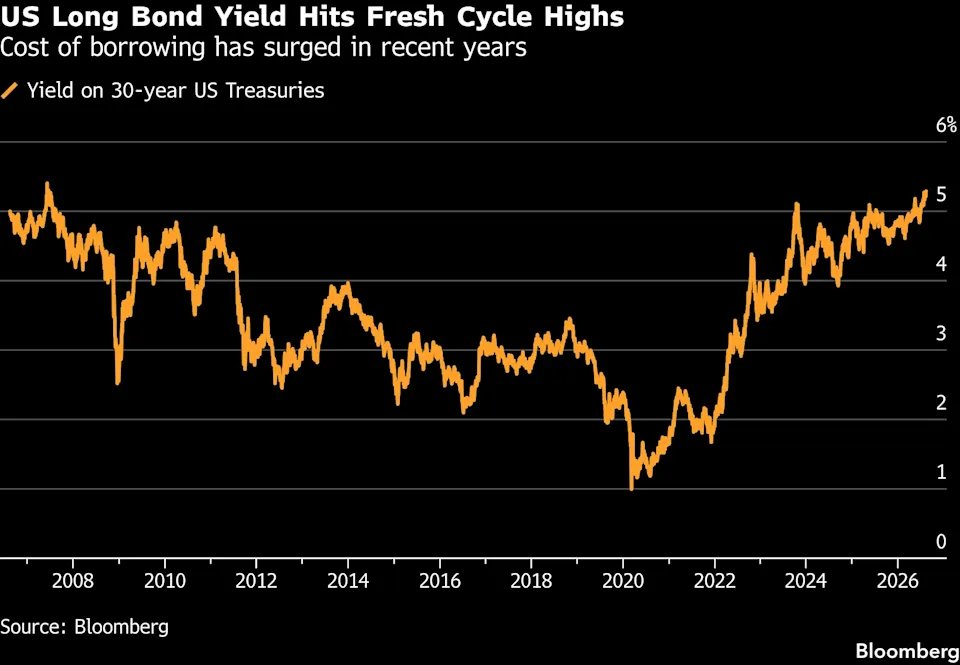
🦔The 30-year Treasury yield hit 5.29% today, the highest since 2007. Borrowing costs hit crisis-era highs across France, Germany, the UK, and Japan at the same time. Oil jumped 6% last week on the Iran war. And this is happening while the economy is weakening, July jobs came in soft, retail sales fell the most in over a year, and inflation moderated slightly. The long end of the bond market is rising anyway.
My Take
The economy is cooling and long-term rates are still climbing. Normally weaker data brings yields down because the market expects rate cuts. Instead the short end is falling while the long end pushes higher, which means bond investors see weaker growth ahead but don't believe inflation or the borrowing is going away. That's a bad combination for anyone with a mortgage or a car loan, because the Fed can cut all it wants and your borrowing costs still go up.
Barclays laid out what it would take for long-term rates to come down: slower AI borrowing, a fiscal surprise, a shift in how Treasury issues debt, and sustained weak data, all at once. That's a high bar, and I don't see any of those happening soon. AI companies are still flooding the bond market. The deficit is running 6% of GDP. And the Iran war keeps pushing oil higher, which feeds straight into inflation. I think rates are stuck here or going higher, and the people who built their plans around cheap money coming back are running out of time to be right.
Hedgie🤗
The yield on the 30-year Treasury is above 5.3% for the first time since April 2007. At the time the U.S. national debt was still under $8.8 trillion. Now it's over $39.9 trillion, over 4.5x as large. Plus, in 2007 bond yields were still trending down. Now they are trending up.