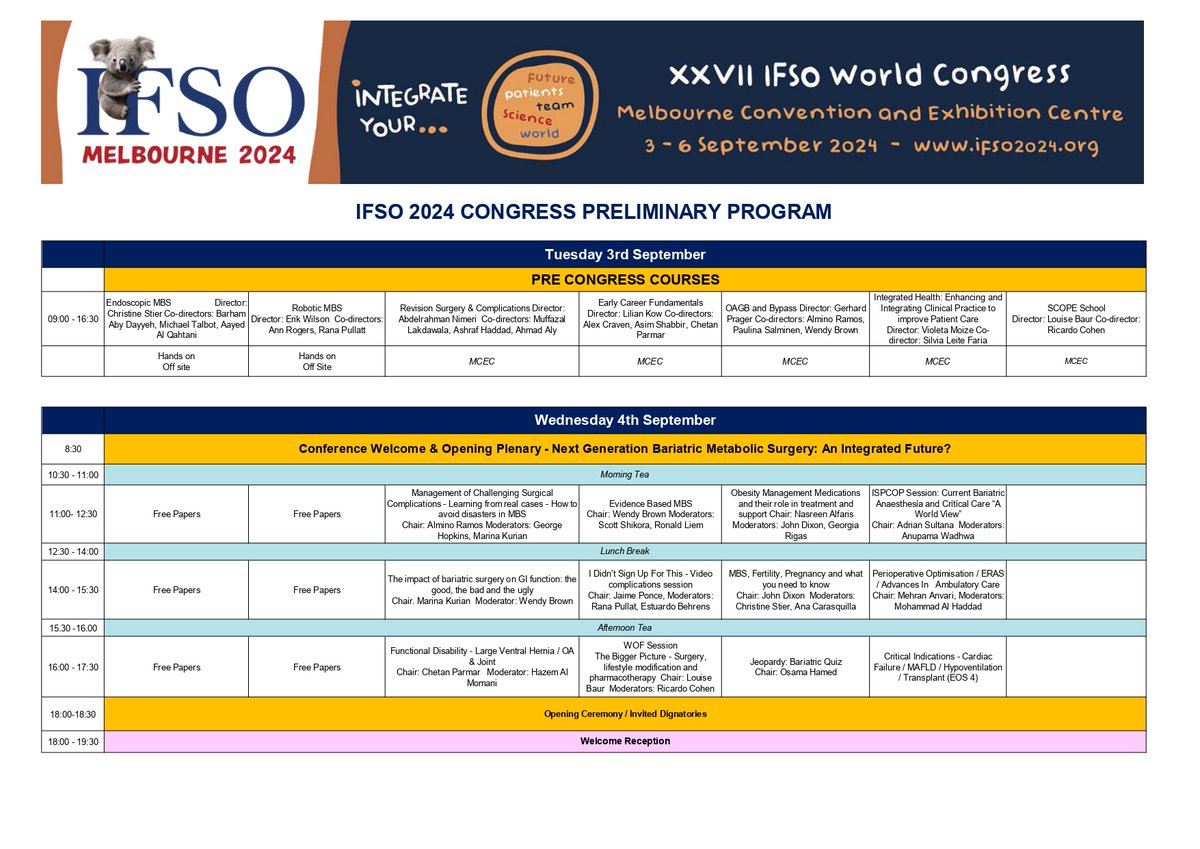
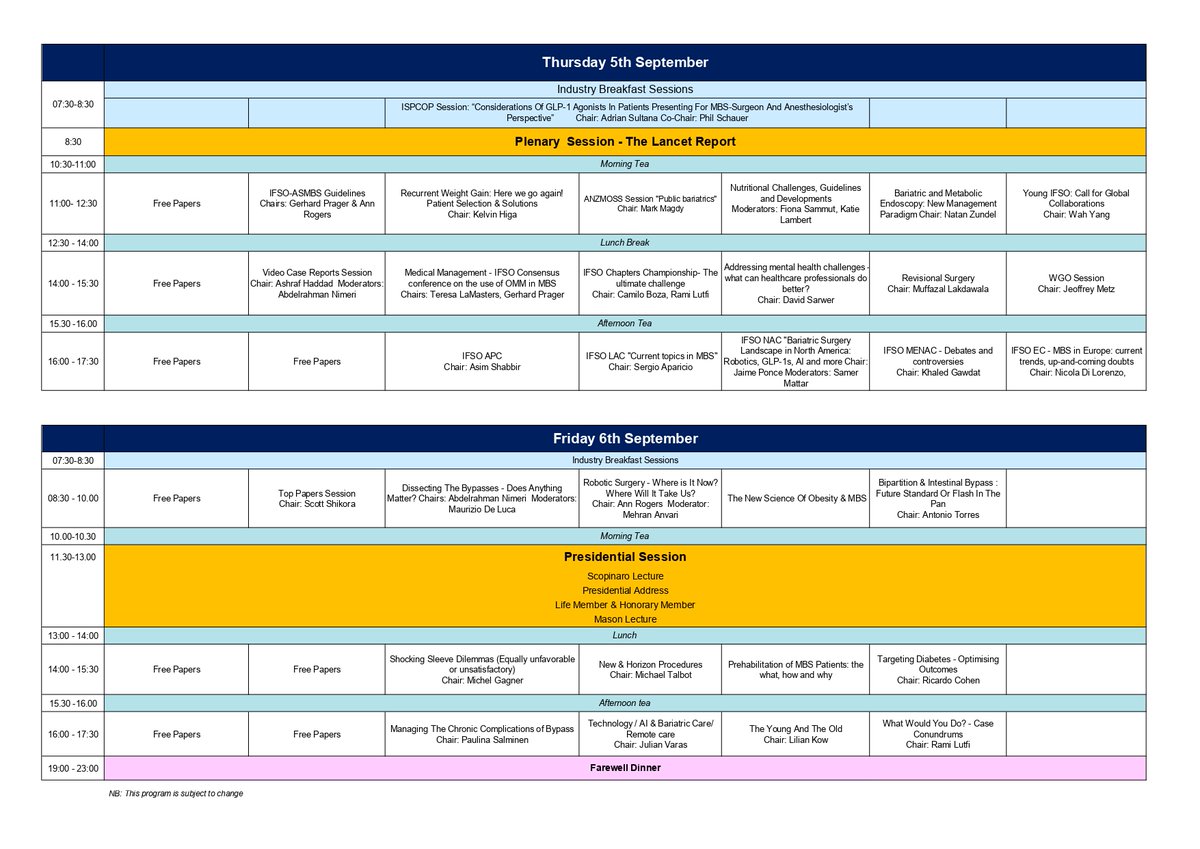
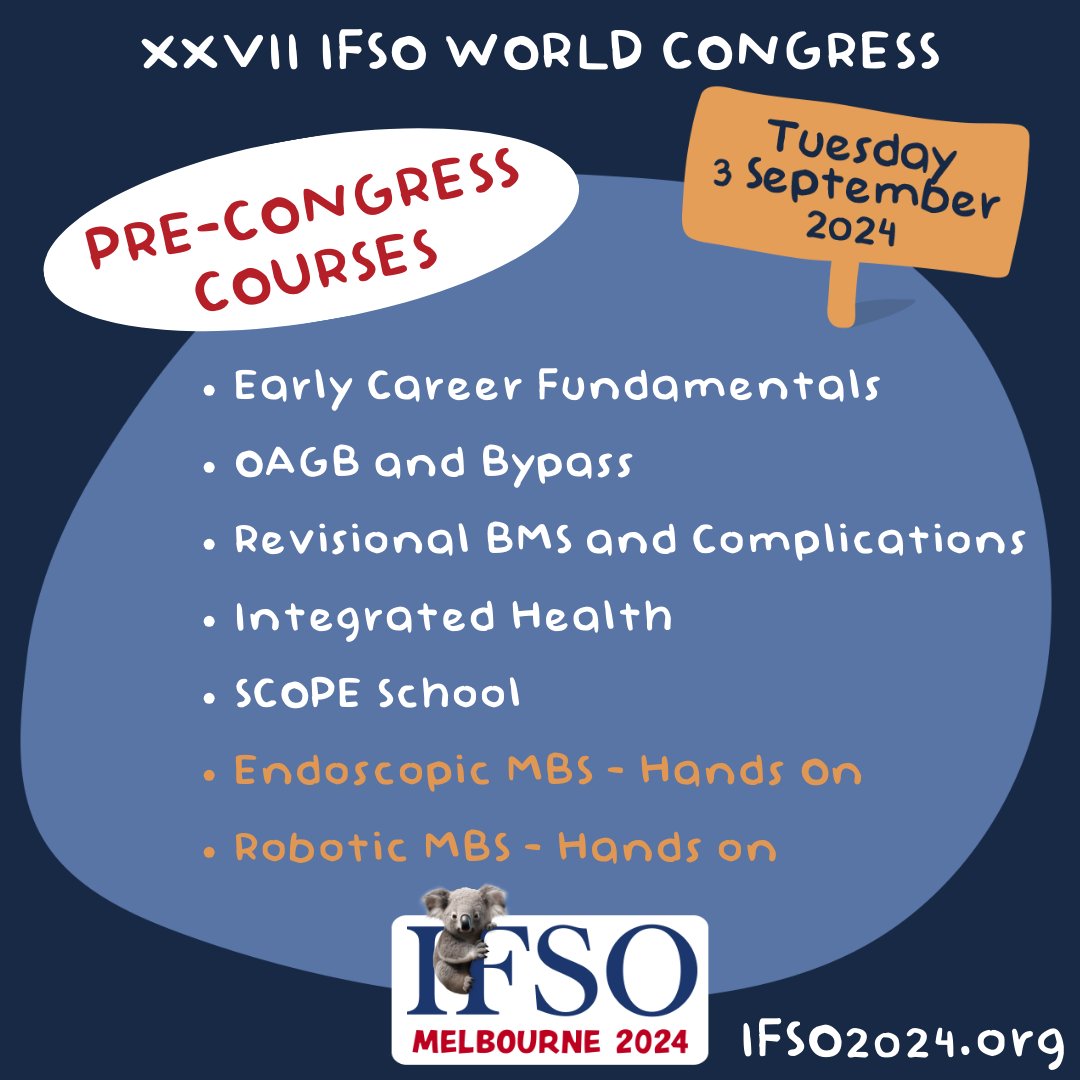
Attention integrated health - if you are a speaker or have an abstract at IFSO 2024 in Melbourne then you are eligible to apply for an IFSO IH scholarship (no age restriction). Closing date 31st March. Full details in the links.
Attention integrated health - if you are a speaker or have an abstract at IFSO 2024 in Melbourne then you are eligible to apply for an IFSO IH scholarship (no age restriction). Closing date 31st March. Full details in the links.
Thank you colleagues for sending this through to me! I must have totally missed it!
It’s been a busy time but excited that the last paper for my thesis is published and submitted to @ifso in Melbourne! Hope to see you all there !
BEST PAPERS OBSU NOVEMBER ISSUE
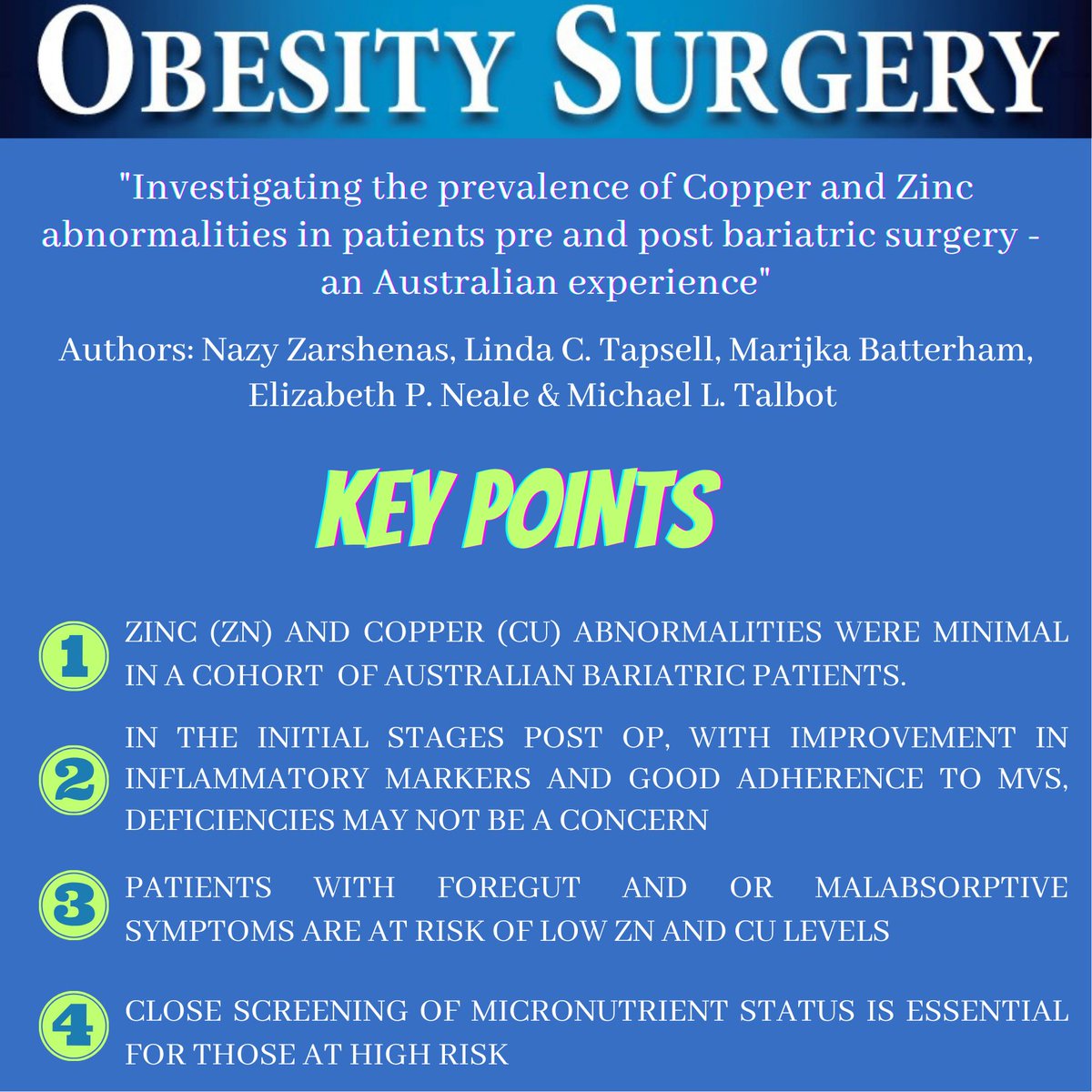
"Investigating the Prevalence of Copper and Zinc Abnormalities in Patients Pre and Post bariatric Surgery—an Australian Experience"
DOI: https://t.co/4zhoO4DstP
FREE DOWNLOAD: https://t.co/76LeKAymcp
Currently watching this @IfsoSecretariat webinar with tips on how to write abstracts. It will be available in the IFSO academy and YouTube channel in the next few days. Very helpful for getting ready for IFSO 2024 and BOMSS 2024 and other #obesity related conferences
🧠 My first PhD study has just been published!
1. Let's move away from viewing brain health and its recommendations through a medical lens and start talking about it as a biopsychosocial construct. @YasmineProbst https://t.co/aOAXN2oKXu
Melbourne is waiting for you! 🇦🇺
Have a look at the wide range of activities and trips that can be arranged during your stay in Melbourne:
https://t.co/5y0LkkjItF
@IFSO2024
@IFSOmelbourne2024
*MEMORIAL FOR KEN LOI*
Live streaming from Sydney Town Hall: https://t.co/jq3ZHot25P
Thursday November 16
5.30 pm Mexico City
6.30 pm New York
8.30 pm São Paulo
Friday November 17
0.30 am Central European Time
7.30 am Beijing
8.30 am Tokyo
10.30 am Sydney
Malnutrition Following One‑Anastomosis Gastric Bypass. Dietetic support, appropriate nutritional supplements & monitoring essential. Often fat-soluble vitamins A, E and K, plus trace minerals not measured, are deficiencies underreported? https://t.co/WoiVPZy331 @bariatricBOMSS
The world lost an amazing person. I had the pleasure to work with Ken for over a decade. It is with heavy heart that I send my deepest condolences to family & friends who knew Ken. He shall never be forgotten & will live in our heart and thoughts. Rest in peace my dear friend 😓
It is with heavy hearts and profound sadness that we announce the passing of our beloved friend, Ken Loi who peacefully left this world yesterday.
Ken's legacy will continue to live on through the memories shared and the lives he has touched.
Rest in peace, dear friend
@IfsoSecretariat The world lost an amazing person. I had the pleasure to work with Ken for over a decade. It is with heavy heart that I send my deepest condolences to family & friends who knew Ken. He shall never be forgotten & will live in our heart and thoughts. Rest in peace my dear friend 😓
Our latest paper investigating long term micronutrient abnormalities post bariatric surgery. Final PhD paper for Nazy 👏 https://t.co/gN91FGjm4j @DrLizNeale @LindaTapsell
🔥🔥🔥👇👇👇
"IFSO CONSENSUS ON DEFINITIONS AND CLINICAL PRACTICE GUIDELINES"
Together WE can make a difference in the lives of millions of individuals affected by obesity and help shape a healthier future for generations.
Download it HERE:
https://t.co/nu9J8eozcn
I was explaining to a student recently how we did literature searches in the 1980s and 1990s.
We had to look up articles in a printed copy of Index Medicus, and then pushed a trolley around the library to collect the journals so we could photocopy the articles.
We also had to pay for the photocopies, which made us very selective about the articles we used in our literature reviews. There was an incredulous look in her eyes.
And when we got to the photocopier, we had to hope that it had not broken down or that the queue to use it was too long. Arriving well before library closing time was also important. Online articles did not exist then and sometimes we had to wait for weeks for articles to arrive using the Inter-Library Loan Service if they were not in the library’s own collection.
Eventually, printed copies of Index Medicus were replaced by a CD-ROM version (which you have to book a slot in advance to use) and then eventually by online bibliographic databases. And now, we have immediate access to online journal articles.
I then went onto explain that the terms 'cut' and 'paste' in modern computer programs are there because that is once what we had to do. We cut out graphs and diagrams with scissors and then pasted them into documents using glue. More incredulous looks followed.
When we presented our work, we used hand written acetates on an overhead projector. Moving to printed acetates was a big step forwards (or so it seemed at the time). Presenting at professional conferences meant using (expensive) slides. Errors that you couldn't correct were common. Eventually acetates and slides were replaced by PowerPoint projectors.
When I was a student in the 1980s, all our course work was hand-written. Most of us did not have typewriters and very few of us could type. When word processing software became common later in the decade, it meant no more Tippex or retyping whole documents to correct errors.
My first printer was a 9-pin dot matrix. It was noisy, slow and the quality of the print was poor. But it produced much more legible output than hand-written documents. Moving to 24 pin dot matrix printers was a big advance in the quality of printed documents. Eventually, affordable ink jet and laser printers became common.
Moving from cassettes to floppy disks and then hard disks for storage were big advances. My first hard disk was 20MB in capacity. Such was the small size of computer programs and their data files in the 1980s, I couldn’t come close to filling it. Now a word document with some embedded images can often be larger than 20MB.
My student clearly thought I had grown up in a technological stone age. In many ways, her reaction was like mine when older people used to tell me what life was like in the 1930s and 1940s during the Great Depression and World War Two.
But although the 1980s and early 1990s were a more technologically-backwards era than now, there were benefits in being a student then. We had our course fees paid and received a grant to cover our living costs, so we did not graduate with the vast debts that current students have.