The 1982 Tylenol recall, which likely reduced acetaminophen use in pregnant women and fetal exposure, was not associated with changes in autism or ADHD among affected cohorts, from @ChrisWorsham, Charles Bray, Joshua Rothman, Brian Kwan, and @AnupamBJena https://t.co/HUN639abLI
Using a randomized controlled trial to identify heterogeneous impacts in the presence of noncompliance, from @orazio_at, Lina Cardona-Sosa, and Ziqian Liu https://t.co/zIyr4R3rIo
Long-term air pollution exposure increases chronic disease, especially hypertension, even among young, healthy adults. New evidence from US Army personnel, from Joshua S. Graff Zivin, Johnny Huynh, Timothy Frank Justicz, Adriana Lleras-Muney, and Matthew J. Neidell https://t.co/aSxvRXdZIZ
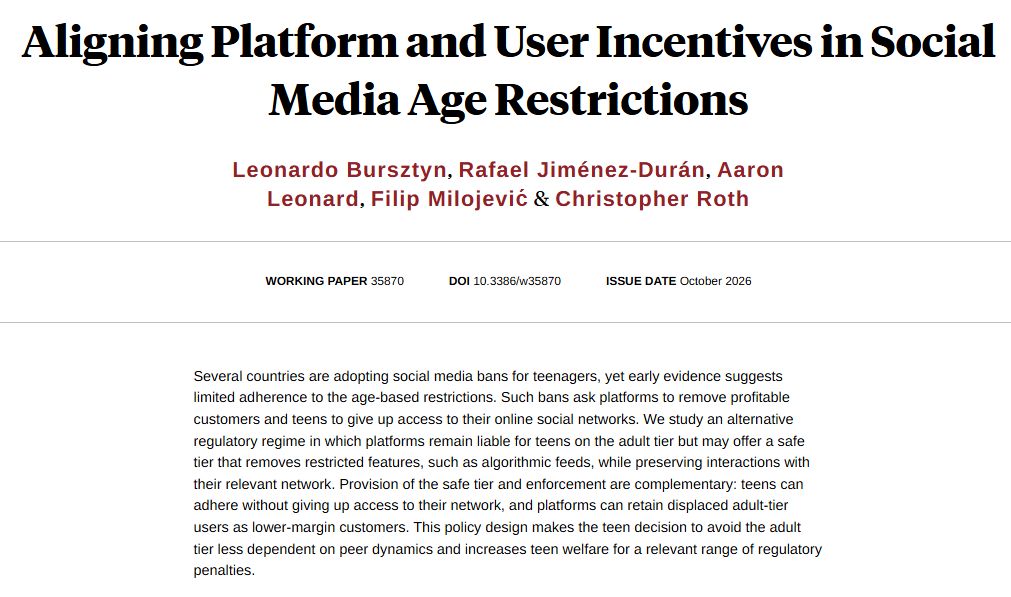
A safe tier of social media usage lets teens keep their friends without the harmful features, aligning platform and user incentives to enforce age limits on social media, from Leonardo Bursztyn, Rafael Jiménez-Durán, Aaron Leonard, Filip Milojević, and @cp_roth https://t.co/yUFHHmoPTE
Novel database of Russell 3000 corporate climate targets over 25 years enables new research of how voluntary commitments interact with carbon pricing, regulations, and subsidies, from @josephaldy, Michael W. Toffel, Alison J. Ong, and Lavender Yang https://t.co/wl0HaxAF69
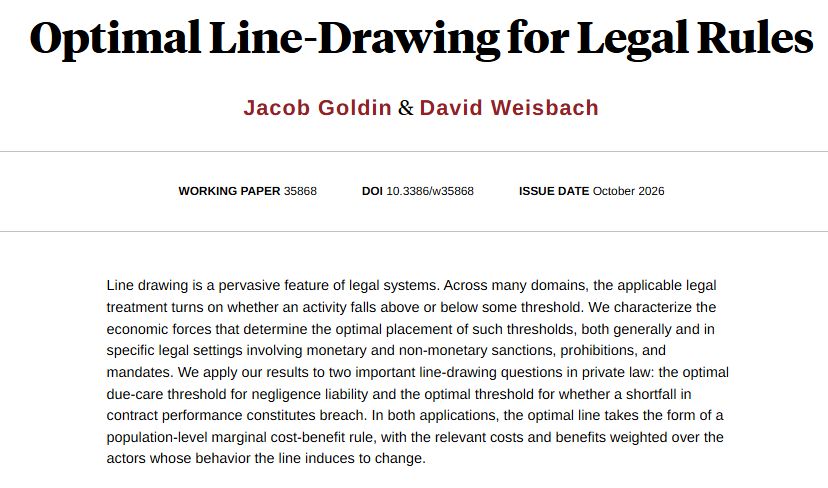
Line drawing is a pervasive feature of legal design. The considerations that shape the optimal line placement share a common structure across a surprisingly large number of legal domains, from @jacobsgoldin and David Weisbach https://t.co/8lkUnsCIKu
How does monetary policy affect firm investment? Estimating the full response distribution finds that only 5 percent of firm-time observations respond strongly; most heterogeneity remains unexplained, from @td_econ, @THEdanjlewis, Davide Melcangi, and @pilossopher https://t.co/d8c33WTOnN
Studying how El Salvador’s 2022 State of Exception, which ended two decades of gang territorial control, reshaped Salvadoran society, from Carlos Schmidt-Padilla, @melnikov_n_v, and @micasviatschi https://t.co/UGvdpnIxak
The AI buildout is historically large and financially consequential. As financing migrates off hyperscalers' balance sheets, leverage and opacity grow, from @SVNieuwerburgh https://t.co/Gw0CYq00sj
As the US shifted from petroleum importer to net exporter, oil supply shocks became less contractionary and eventually expansionary, reflecting broader income and wealth effects, from @drkaenzig, James H. Stock, and Luca Zanotti https://t.co/4jCGPVISlO
What have we learned from two decades of research about the 2000s housing boom? Arguing that the cycle was a perfect storm that involved all the usual suspects, from Adam Guren https://t.co/HG2HlSBxPG
Examining why rising powers survive periods in which established states can still suppress them, from Johann Caro-Burnett, @SFGaliani, and Gustavo Torrens https://t.co/0kfc1jz3JA
Showing how labor supply, wages, health, and disability claims have evolved in the UK, and examining how reforms have changed work incentives over this period, from Richard Blundell, Monica Costa-Dias, @gmazeine, @CostasMeghir, and Tom Waters https://t.co/YKxEJN2q9f
Textual discussions of portfolio companies by private equity managers in the first years after the investment convey substantial information about their ultimate performance, from Josh Lerner, Fiona Paine, and Antoinette Schoar https://t.co/gEBvIbitSS
Open call for papers, Japan Project Meeting, 2027. Conference to be held in Tokyo, Japan on August 3–4, 2027. Submit papers by 11:59pm EDT on December 1, 2026. More information: https://t.co/stIGXWWXeW
Nearly one-third of US STEM PhD students now write their dissertations with AI. Rarer at top programs, more common for non-native English speakers. AI users are more likely to enter industry, from @daniel_p_gross, @DShvadron, and @HansenZhang13 https://t.co/1M3LhTSbIa
Exposure to large-scale stressors reduces levels of FT3, a thyroid hormone, altering relationships between FT3, body composition, and cortisol and increasing cardiometabolic risk, from Ralph I. Lawton, Duncan Thomas, Elizabeth Frankenberg, Cecep Sumantri, Teresa Seeman, Eileen Crimmins, and Daniel Hochbaum https://t.co/v7uKOyhnu3
New machines do raise demand for skilled workers, just not at the firms that buy them. New data show the skill bias arises at suppliers that install and run them, from Gert Bijnens, Anders Humlum, and Stijn Vanormelingen https://t.co/FIxkshKri9
COVID-19 labor force exit is persistent particularly for low skilled workers and low-skill unmarried men, from Andrew C. Barr, Laura Kawano, Bruce Sacerdote, and Michael Stevens https://t.co/68TghdLt6h
More physicians and higher physician quality, measured by licensing exam scores, reduce patient mortality in Chilean public hospitals, from Juan Pablo Atal, @tlarroucau, Pablo Muñoz, and @cristobalotero https://t.co/z6tzr6Be9o