RESPONSE TO ISSUES RAISED BY AIR MARSHAL (RTD) HENRY MUCHENA AND OTHER RETIRED SENIOR OFFICERS ON CONSTITUTIONAL AMENDMENT (NO. 3) BILL
3 JUNE 2026
Introduction
1.1. The issues raised by Air Marshal (Rtd) Henry Muchena and other retired senior officers regarding Constitutional Amendment (No. 3) Bill deserve engagement based on facts, constitutional reasoning and respect for the institutions that define Zimbabwe as a Sovereign Republic.
1.2. National debate must therefore move beyond personalities and answer three fundamental questions;
a) Is the process provided for in the Constitution? b) Are the responsible institutions exercising authority given to them by law? c) Were citizens given an opportunity to participate?
1.3. These are the standards upon which constitutional democracy must be measured.
Engagement between His Excellency the President Cde. Dr. E.D. Mnangagwa and the Retired Senior Officers
2.1. Since assuming office, His Excellency President Cde Dr E.D. Mnangagwa has maintained an open-door leadership philosophy anchored on dialogue, engagement and accessibility.
2.2. The President has consistently demonstrated that citizens do not need to agree with Government in order to be heard by Government.
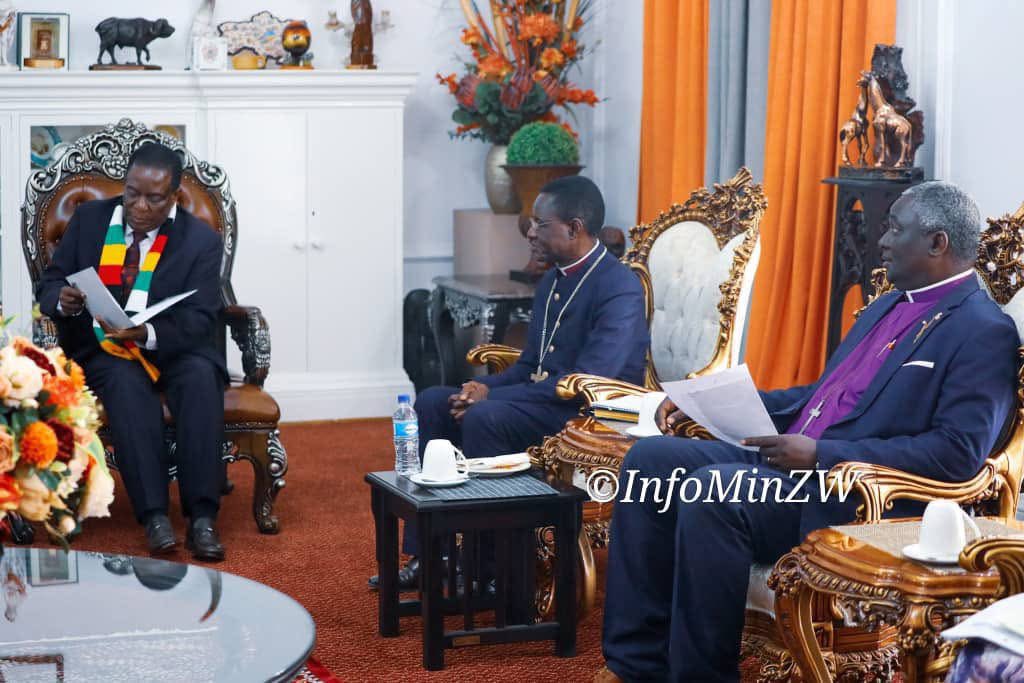
2.3. It is in this spirit that His Excellency met Air Marshal (Rtd) Muchena and eight other retired senior officers to listen to the concerns they raised regarding Constitutional Amendment (No. 3) Bill.
2.4. Given the constitutional nature of the discussion, His Excellency invited the Minister of Justice, Legal and Parliamentary Affairs, Hon. Ziyambi Ziyambi, the Attorney-General Ms. Virginia Mabhiza, and the Chief Secretary to the President and Cabinet, Dr. Martin Rushwaya, to provide legal clarity.
2.5. The intention was simple: constitutional questions must be answered through constitutional interpretation.
2.6. The fact that such a meeting occurred demonstrates that the Second Republic believes national differences must be resolved through engagement rather than confrontation.
Democracy Is Not Defined by One Electoral Model
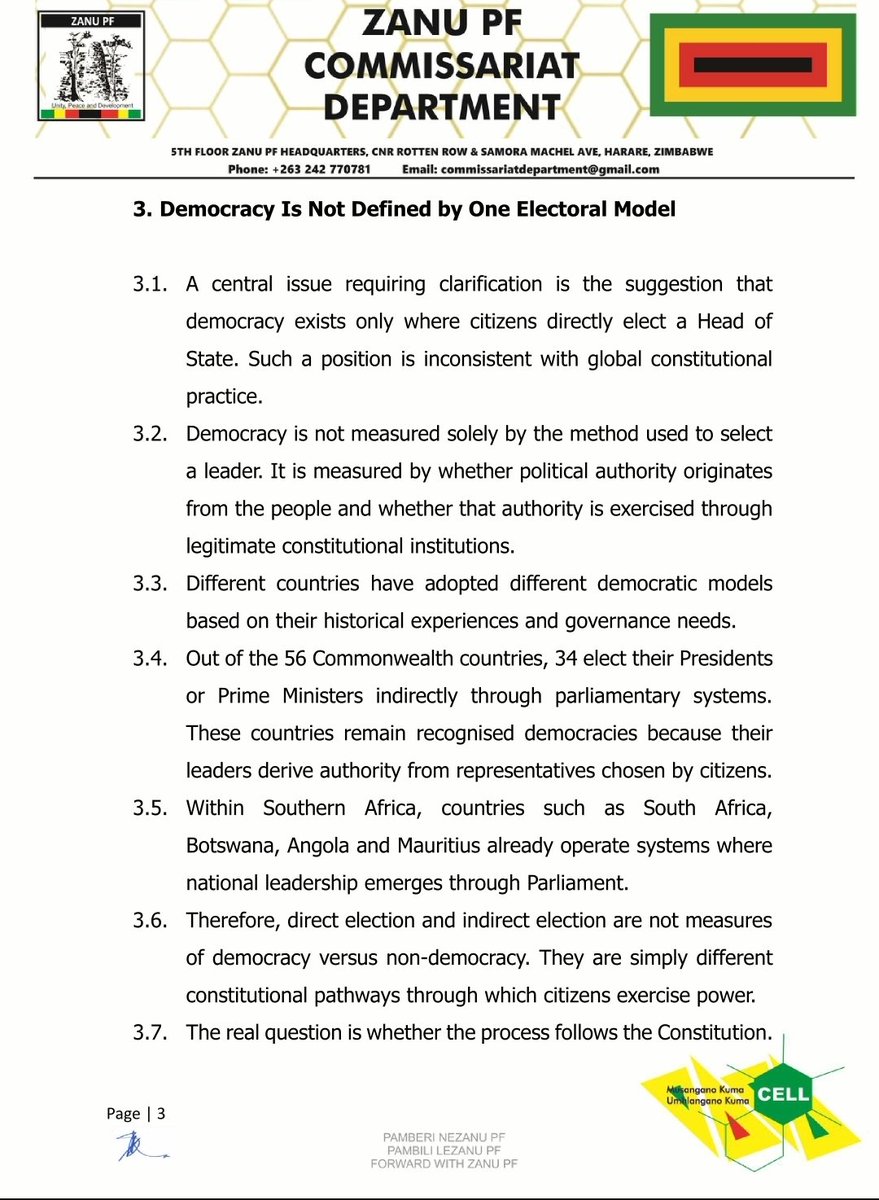
3.1. A central issue requiring clarification is the suggestion that democracy exists only where citizens directly elect a Head of State. Such a position is inconsistent with global constitutional practice.
3.2. Democracy is not measured solely by the method used to select a leader. It is measured by whether political authority originates from the people and whether that authority is exercised through legitimate constitutional institutions.
3.3. Different countries have adopted different democratic models based on their historical experiences and governance needs.
3.4. Out of the 56 Commonwealth countries, 34 elect their Presidents or Prime Ministers indirectly through parliamentary systems. These countries remain recognised democracies because their leaders derive authority from representatives chosen by citizens.
3.5. Within Southern Africa, countries such as South Africa, Botswana, Angola and Mauritius already operate systems where national leadership emerges through Parliament.
3.6. Therefore, direct election and indirect election are not measures of democracy versus non-democracy. They are simply different constitutional pathways through which citizens exercise power.
3.7. The real question is whether the process follows the Constitution.
Zimbabwe's Own Constitutional Experience
4.1. Currently, Zimbabwe itself is not purely a direct electoral system. The country already operates a hybrid model.
4.2. Members of the National Assembly are elected directly by citizens, while Senators, Women's Quota representatives and Youth Quota representatives assume office through proportional representation.
4.3. Yet all these representatives exercise constitutional authority. Their legitimacy does not come from the dissimilarity of their election method, but from the Constitutional mandate.
4.4. Zimbabwe's own independence history demonstrates this reality. The 1980 election, conducted under the historic theme "Gore reMasimba eVanhu", was not a direct presidential election. Citizens did not vote for an individual to become Head of State or Head of Government; rather, they voted for political parties through a parliamentary electoral system which granted seats according to the proportion won by each Party. It is the elected MPs who went to elect the Prime Minister and Ceremonial President.
4.5. The will of the people was expressed through their elected representatives, and the party that secured the majority in Parliament was entrusted with forming Government. It was through this process that executive authority was established, demonstrating that democratic legitimacy can be derived through representative institutions and not only through direct election of an individual leader.
4.6. However, no one argues that the 1980 election was not an expression of the people's will. This confirms an important principle: the people's authority can be exercised directly or through representatives.
4.7. Both are democratic when recognised by the Constitution.
Parliament as the Voice of the People
5.1. The Constitution does not treat Parliament as an outsider to democracy.
5.2. Parliament exists because citizens cannot all physically participate in every Government decision. Through elections, they delegate authority to representatives.
5.3. This is the foundation of representative democracy. The Constitution already gives Parliament significant authority over the Presidency.
5.4. For example, Parliament has the constitutional power to impeach and remove a sitting President. This means Parliament can lawfully terminate the mandate of a President elected by millions of citizens.
5.5. It therefore creates a constitutional inconsistency to argue that Parliament possesses enough democratic authority to remove a President but lacks democratic authority to participate in selecting a President if the Constitution allows such a process.
5.6. The same people who give authority to the President are the same people who give authority to Parliament.
The Liberation Struggle and Respect for Parliament
6.1. It is therefore unfortunate when the institution of Parliament is portrayed as separate from the people.
6.2. The liberation struggle was fought precisely because the majority wanted representation in institutions of national decision-making.
6.3. The objective was never that every citizen would personally participate in every decision. The objective was that citizens would choose representatives who would carry their interests into Government.
6.4. Parliament therefore represents one of the victories of the liberation struggle. A Parliamentarian does not speak as an isolated individual but as a constitutional representative of citizens.
6.5. For ZANU PF Parliamentarians, that mandate also carries a responsibility to the Party platform on which they were elected.
6.6. They entered Parliament through the confidence citizens placed in the Party's manifesto, ideology and development programme.
6.7. The call regarding the extension of His Excellency President Mnangagwa's term was processed through recognised Party structures, including the 2024 National People's Conference in Bulawayo and the 2025 National People's Conference in Mutare.
6.8. These platforms represent the internal democratic processes through which the Party determines its policy direction.
Constitutional Amendment Is Part of Constitutionalism
7.1. A Constitution must provide stability, but it must also provide a mechanism for adaptation. That is why the Constitution contains its own amendment procedures.
7.2. The power to amend the Constitution is therefore not a violation of constitutionalism; it is a function created by constitutionalism itself. The Constitution specifically identifies provisions requiring a referendum before amendment.
7.3. These include:
a) Chapter 4: Declaration of Rights; b) Chapter 16: Agricultural Land; and, c) Section 328 particularly where an amendment to a term limit provision.
7.4. It must be emphasised that the Bill does not seek to confer an additional term on the President. Rather, it proposes an extension of the existing electoral cycle by two years. In terms of Section 91, a presidential term is defined as a period of three years or more. On that basis, the proposed two-year extension on the electoral cycle does not amount to the creation of a third presidential term.
7.5. Where a referendum is required, the Constitution must be followed. Equally, where the Constitution vests authority in Parliament, Parliament must be allowed to exercise that authority. In the present circumstances, a referendum is not a Constitutional requirement.
7.6. Respecting the Constitution means respecting all its provisions, including those that permit amendment.
Public Consultation and Citizens' Participation
8.1. Although a referendum was not required, Parliament still opened the process for public participation.
8.2. The Constitutional Amendment (No. 3) Bill consultation process became one of the largest constitutional engagement exercises conducted in Zimbabwe. Citizens participated through public hearings and written submissions.
8.3. More than 300 000 written submissions were presented to Parliament. Some submissions represented large collective positions rather than individual submissions. For example, the submission coordinated by the Christian community under Bishop Nehemiah Mutendi represented approximately 8.7 million congregants from different denominations.
8.4. At the same time, the Zimbabwe Catholic Bishops' Conference, representing 3 million congregants, also submitted its views opposing the Bill. This demonstrates that the process was open, inclusive and democratic, as every voice, including that of Air Marshall (Rtd) Muchena, was given an opportunity to be heard.
8.5. Therefore, the argument cannot be that citizens were not allowed to participate.
8.6. Democracy guarantees the right to be heard. It does not guarantee that every submitted position becomes the final outcome.
#CAB 3 and Zimbabwe's Development Agenda
9.1. Air Marshal (Rtd) Muchena, having previously served within ZANU PF as a Director, cannot today pretend not to understand the realities of political mobilisation, elections and governance.
9.2. Elections remain important democratic processes. However, Zimbabwe must equally acknowledge that election periods have often created prolonged political contestation which affects national focus, economic confidence and development momentum.
9.3. Every election carries financial and social costs. Resources committed towards continuous political processes are resources competing with other national priorities such as infrastructure, healthcare, education and industrialisation.
9.4. The Second Republic under his Excellency the President, and First Secretary of ZANU PF Cde. Dr. E.D. Mnangagwa, has consistently emphasised a transition from permanent political mobilisation towards economic mobilisation.
9.5. The national conversation must increasingly become about production, jobs, infrastructure and improving people's lives.
9.6. #CAB 3 must therefore be understood within this broader conversation of stability, continuity and development.
Allegations of Private Financing
10.1. Claims that the #CAB 3 process is being financed by ZANU PF Central Committee Member Cde. Dr. K. Tagwireyi or any private individual have no factual foundation.
10.2. Parliament is a constitutional institution funded through legally recognised public financing mechanisms. Its processes, including public consultations, operate under institutional accountability procedures.
10.3. Constitutional debates should not be redirected from issues of law into speculation about individuals.
10.4. The focus must remain on institutions, procedures and constitutional principles.
On Allegations of Personal Benefit to the President
11.1. The claim that this process represents a personal pursuit by His Excellency the President and First Secretary of ZANU PF, Cde. Dr. E.D. Mnangagwa is not supported by the facts.
11.2. The President has repeatedly affirmed that he respects the Constitution and will act within its provisions. It is precisely because of this position that the people of Zimbabwe through their Party ZANU PF pursued a constitutional route.
11.3. The People of Zimbabwe understand that His Excellency the President will never operate outside the supreme law of the country.
11.4. Therefore, to the people of Zimbabwe, any conversation around continuity must happen through lawful constitutional mechanisms. This is not a President imposing his will on institutions or on the people. This is the people recognizing the immense developmental milestones that the President has championed since his assumption to office.
11.5. It is the people of Zimbabwe expressing their position through institutions such as Parliament and political parties created for that purpose.
Conclusion
12.1. Air Marshal (Rtd) Muchena and those who share his views have every constitutional right to express themselves.
12.2. However, ZANU PF equally retains the right to present its position, defend its resolutions and engage citizens.
12.3. The liberation struggle gave Zimbabwe sovereignty. The Constitution provides the framework through which that sovereignty is exercised.
12.4. Our responsibility as Zimbabweans is to protect our democratic institutions, including Parliament, from intimidation and undue interference, as these institutions represent the collective will of the people and remain central to constitutional democracy and national governance.
12.5. Equally the Judiciary cannot be petitioned to grant any interested party a ruling in their favor. This is not only irresponsible and mischievous but a direct attack on the independence of the Judiciary.
Cde M. Machacha NATIONAL POLITICAL COMMISSAR
The Constitutional Amendment Bill No. 3 (CAB3) process exemplifies one of the most notable demonstrations of participatory democracy in Zimbabwe's recent history. Citizens from all 64 districts actively participated in the parliamentary public hearings, voicing their opinions on matters that directly impact the nation's governance and future trajectory.
Throughout the 90-day public consultation phase, parliament received over 530,000 submissions from individuals, churches, community organizations, traditional leaders, professionals, youth groups, and civic formations. This unprecedented level of engagement underscores that the Constitutional Amendment Bill No. 3 is a people-driven constitution founded on the voices of citizens.
#CAB3bhoo
His Excellency President Emmerson Mnangagwa received a courtesy call from the Zimbabwe Heads of Christian Denominations (ZHOCD) at State House in Harare today.
The citizens of Zimbabwe have maintained a calm, resolute, and confident stance as the Constitutional Amendment Bill No. 3 progresses through Parliament, aligning with the expectations of citizens who overwhelmingly supported the bill during nationwide public consultations.
Across all provinces, communities demonstrated a clear desire for constitutional continuity anchored on national stability, development, and the consolidation of gains realized under the country's reform trajectory. Contrary to alarmist narratives, the national mood remains measured, peaceful, and focused on the democratic processes unfolding within Parliament.
#CAB3theWayToGo
June 27 marks ZANUPF National Cell Day, a celebration of the fundamental unit that forms the backbone of the party's structure. The cell, which played a pivotal role in the liberation struggle from its grassroots level, continues to drive the revolution forward.
Every village, street, and ward is integral to this framework. It is here that policy translates into people and ideology into tangible action.
The party's strength has consistently stemmed from its grassroots support, not from the top echelons. Your participation is crucial. Familiarize yourself with your cell and attend its meetings. Observe this important day.
@Varakashi4ED Mat-North Province
The commitment and ambition of H.E President Dr. Emmerson Dambudzo Mnangagwa for a better Zimbabwe are truly commendable.
His vision to transform Zimbabwe into a prosperous, empowered, and upper-middle-income society by 2030 is yielding tangible results, as evidenced by notable developments across the country, including the construction of the Gwayi-Shangani Dam, rehabilitation of the Bulawayo-Victoria Falls highway, procurement and installation of new radiotherapy machines at Parirenyatwa Group of Hospitals and Mpilo Hospital, construction of AI-Powered Mhangura Grain Silos with a storage capacity of 58,000 tonnes, construction of the Mabvuku-Tafara Interchange, and construction of a 153-kilowatt solar plant at Nzimbe Business Centre in Ward 31, among others. Indeed, a nation is built by its people.
#Vision2030AReality
The youth are the modernisers of our economy and the inheritors of the Fourth Chimurenga. The future is yours, ZANU-PF is not a club of talkers, we demand meticulous thinkers and action. @edmnangagwa
Zimbabwe has received 90 new high-tech tractors from Belarus as part of the third phase of the Agricultural Mechanization Programme. The equipment, delivered this Monday, will be distributed nationwide to farmers to enhance productivity, facilitate timely farming operations, and bolster food security, as the Government persists in modernizing the agricultural sector through strategic international partnerships.
#EDworks