The magistrate commended our (the defence) submissions. He said they were very nice and that he loved reading them then went ahead to convict our client. Litigation wewe.
🚨 Court of Appeal restates when a judgment entered against you in your absence can be undone, and when you are simply stuck with it.
The case is Onesmus Ngunjiri Njenga & another v Captain Suleiman Amir Hamud [2026] KECA. It concerns ex parte judgment, a judgment entered against a defendant who did not appear or file a defence. The Court set out three governing principles.
✅ First, the court's discretion is wide, but not a rescue for the deliberate. A court has unfettered discretion to set aside a regular ex parte judgment, so as to avoid injustice or hardship caused by an excusable mistake, such as inadvertence or genuine error. But that discretion exists to help the honestly mistaken, not the party who deliberately dodged or delayed the case. Discretion is a shield for the careless, not the cunning.
✅ Second, the applicant must show two things. To set aside a regular default judgment, it is not enough to explain your absence. You must demonstrate both a valid reason for failing to file a defence, and that you have a reasonable defence raising triable issues, genuine questions that deserve a trial. A good excuse with no defence fails; a good defence with no excuse for the absence struggles. You need both.
✅ Third, and this is the crux, everything turns on regular versus irregular. If a judgment is irregular, meaning it was entered in breach of procedure, for example, where the defendant was never properly served, it must be set aside ex debito justitiae, as a matter of right. The court has no discretion to refuse; an irregular judgment is simply void. But if the judgment is regular, meaning the defendant was duly served and the procedure was correct, setting it aside is a matter of discretion, and the applicant must earn it by satisfying the two-part test above. Here, because the appellants had been duly served with the pleadings but took no action, the judgment was regular, and they were left to persuade the court, not entitled to relief as of right.
This area holds two competing values in balance. On one side is the right to be heard, the deep principle that no one should lose a case without a chance to defend it, which pulls toward reopening default judgments generously. On the other is finality and the integrity of court process, which cannot function if judgments are freely undone by defendants who ignored proper service and now want a second chance. The regular/irregular distinction is precisely how the law reconciles the two: where the process failed the defendant (irregular), the right to be heard prevails absolutely; where the defendant failed the process (regular), finality holds unless the defendant shows genuine cause and a real defence.
The practical takeaway. If you are served with court papers, act, because a regular judgment entered after proper service is hard to undo, and inaction is not an excusable mistake. If you do find a default judgment against you, your prospects turn first on how you were served: an irregular judgment falls as of right, but a regular one requires you to show both a credible reason for your absence and a defense with real triable issues. And for those enforcing a judgment: proper, provable service is what makes your judgment regular, and therefore durable. In default judgments, service is the hinge on which everything turns.
👉 Follow @Lexken_EMSLaw for practical legal insights on civil procedure, litigation and dispute resolution.
One day you’re “your Honour, Hon. Mutegi” and another day you’re the accused person.
The dark humour of Life. Judicial officers need to learn some lessons out of this.
✅✅
Hiyo Diani ni ya mostly sole proprietors, wale wa generational wealth na Big Law.
Huku Onyalo Obiro & Kinyanjui LLP hakuna any difference, hakuna hata leave.
Justice H. Chemitei on Section 3(5) of the LSA; a spouse in a subsequent marriage, though void under law due to an existing monogamous marriage, is still a wife for purposes of succession. Succession rights prevail despite the marriage's legal invalidity.
https://t.co/gJzaPsWTAM
The Supreme Court has redrawn the jurisdictional map on challenges to public appointments.
For years, courts asked one question: Was there an employer–employee relationship?
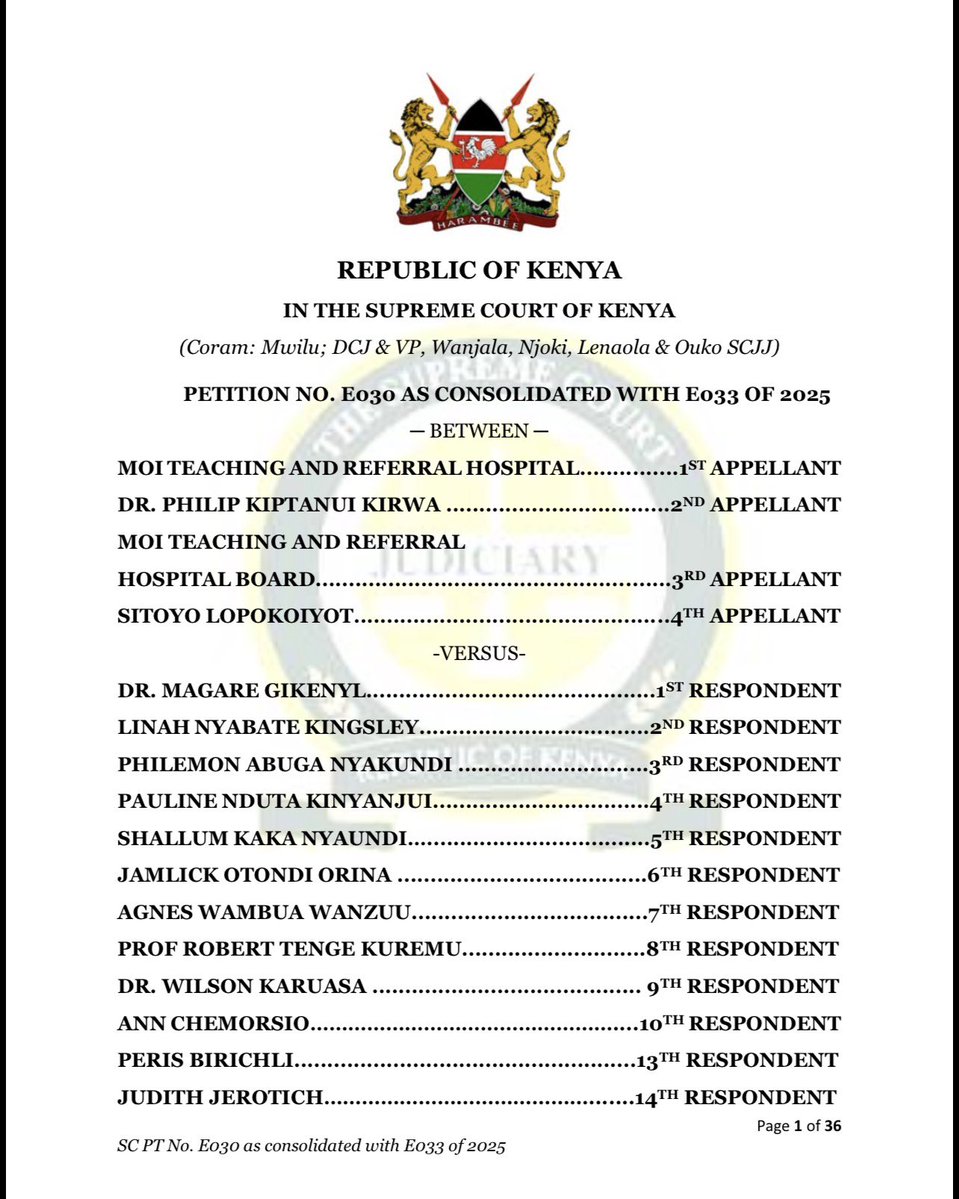
In Moi Teaching & Referral Hospital v Dr. Magare Gikenyi & 76 Others, the Supreme Court says that was the wrong test.
The real inquiry is who is suing and in what capacity?
• A job applicant challenging recruitment, shortlisting or selection belongs in the ELRC.
• A citizen challenging the constitutionality or legality of a public appointment, acting under Articles 3 and 22 of the Constitution, belongs in the High Court.
Jurisdiction now turns on the nature of the dispute and the claimant's capacity, not merely the existence of an employment relationship.
O sonho continua. E agora vale ainda mais.
Domingo é dia de vestir a nossa camisa, acreditar até o fim e empurrar a Seleção rumo às oitavas.
Vamos juntos! 🇧🇷
#BateNoPeito
ISSO É BRASIL! 🇧🇷
Constitutional Division of our High Court holds that the Constitutional Rights of Gachagua were violated but proceeds to compensate him for the violation instead of annulling the process. The High Court has given the Court of Appeal an easy bifurcated choice: affirm the violation & nullify the impeachment or set aside the alleged violation & confirm the impeachment.
The decision of the High Court is a judicial absurdity: REDUCTIO AD ABSURDUM!


![Lexken_EMSLaw's tweet photo. 🚨 Court of Appeal restates when a judgment entered against you in your absence can be undone, and when you are simply stuck with it.
The case is Onesmus Ngunjiri Njenga & another v Captain Suleiman Amir Hamud [2026] KECA. It concerns ex parte judgment, a judgment entered against a defendant who did not appear or file a defence. The Court set out three governing principles.
✅ First, the court's discretion is wide, but not a rescue for the deliberate. A court has unfettered discretion to set aside a regular ex parte judgment, so as to avoid injustice or hardship caused by an excusable mistake, such as inadvertence or genuine error. But that discretion exists to help the honestly mistaken, not the party who deliberately dodged or delayed the case. Discretion is a shield for the careless, not the cunning.
✅ Second, the applicant must show two things. To set aside a regular default judgment, it is not enough to explain your absence. You must demonstrate both a valid reason for failing to file a defence, and that you have a reasonable defence raising triable issues, genuine questions that deserve a trial. A good excuse with no defence fails; a good defence with no excuse for the absence struggles. You need both.
✅ Third, and this is the crux, everything turns on regular versus irregular. If a judgment is irregular, meaning it was entered in breach of procedure, for example, where the defendant was never properly served, it must be set aside ex debito justitiae, as a matter of right. The court has no discretion to refuse; an irregular judgment is simply void. But if the judgment is regular, meaning the defendant was duly served and the procedure was correct, setting it aside is a matter of discretion, and the applicant must earn it by satisfying the two-part test above. Here, because the appellants had been duly served with the pleadings but took no action, the judgment was regular, and they were left to persuade the court, not entitled to relief as of right.
This area holds two competing values in balance. On one side is the right to be heard, the deep principle that no one should lose a case without a chance to defend it, which pulls toward reopening default judgments generously. On the other is finality and the integrity of court process, which cannot function if judgments are freely undone by defendants who ignored proper service and now want a second chance. The regular/irregular distinction is precisely how the law reconciles the two: where the process failed the defendant (irregular), the right to be heard prevails absolutely; where the defendant failed the process (regular), finality holds unless the defendant shows genuine cause and a real defence.
The practical takeaway. If you are served with court papers, act, because a regular judgment entered after proper service is hard to undo, and inaction is not an excusable mistake. If you do find a default judgment against you, your prospects turn first on how you were served: an irregular judgment falls as of right, but a regular one requires you to show both a credible reason for your absence and a defense with real triable issues. And for those enforcing a judgment: proper, provable service is what makes your judgment regular, and therefore durable. In default judgments, service is the hinge on which everything turns.
👉 Follow @Lexken_EMSLaw for practical legal insights on civil procedure, litigation and dispute resolution.](https://pbs.twimg.com/media/HSZrtbTWYAA2g7q.jpg)
![Lexken_EMSLaw's tweet photo. 🚨 Court of Appeal restates when a judgment entered against you in your absence can be undone, and when you are simply stuck with it.
The case is Onesmus Ngunjiri Njenga & another v Captain Suleiman Amir Hamud [2026] KECA. It concerns ex parte judgment, a judgment entered against a defendant who did not appear or file a defence. The Court set out three governing principles.
✅ First, the court's discretion is wide, but not a rescue for the deliberate. A court has unfettered discretion to set aside a regular ex parte judgment, so as to avoid injustice or hardship caused by an excusable mistake, such as inadvertence or genuine error. But that discretion exists to help the honestly mistaken, not the party who deliberately dodged or delayed the case. Discretion is a shield for the careless, not the cunning.
✅ Second, the applicant must show two things. To set aside a regular default judgment, it is not enough to explain your absence. You must demonstrate both a valid reason for failing to file a defence, and that you have a reasonable defence raising triable issues, genuine questions that deserve a trial. A good excuse with no defence fails; a good defence with no excuse for the absence struggles. You need both.
✅ Third, and this is the crux, everything turns on regular versus irregular. If a judgment is irregular, meaning it was entered in breach of procedure, for example, where the defendant was never properly served, it must be set aside ex debito justitiae, as a matter of right. The court has no discretion to refuse; an irregular judgment is simply void. But if the judgment is regular, meaning the defendant was duly served and the procedure was correct, setting it aside is a matter of discretion, and the applicant must earn it by satisfying the two-part test above. Here, because the appellants had been duly served with the pleadings but took no action, the judgment was regular, and they were left to persuade the court, not entitled to relief as of right.
This area holds two competing values in balance. On one side is the right to be heard, the deep principle that no one should lose a case without a chance to defend it, which pulls toward reopening default judgments generously. On the other is finality and the integrity of court process, which cannot function if judgments are freely undone by defendants who ignored proper service and now want a second chance. The regular/irregular distinction is precisely how the law reconciles the two: where the process failed the defendant (irregular), the right to be heard prevails absolutely; where the defendant failed the process (regular), finality holds unless the defendant shows genuine cause and a real defence.
The practical takeaway. If you are served with court papers, act, because a regular judgment entered after proper service is hard to undo, and inaction is not an excusable mistake. If you do find a default judgment against you, your prospects turn first on how you were served: an irregular judgment falls as of right, but a regular one requires you to show both a credible reason for your absence and a defense with real triable issues. And for those enforcing a judgment: proper, provable service is what makes your judgment regular, and therefore durable. In default judgments, service is the hinge on which everything turns.
👉 Follow @Lexken_EMSLaw for practical legal insights on civil procedure, litigation and dispute resolution.](https://pbs.twimg.com/media/HSZrtbSXoAAM6di.jpg)



![Lexken_EMSLaw's tweet photo. 🚨 Court of Appeal restates when a judgment entered against you in your absence can be undone, and when you are simply stuck with it.
The case is Onesmus Ngunjiri Njenga & another v Captain Suleiman Amir Hamud [2026] KECA. It concerns ex parte judgment, a judgment entered against a defendant who did not appear or file a defence. The Court set out three governing principles.
✅ First, the court's discretion is wide, but not a rescue for the deliberate. A court has unfettered discretion to set aside a regular ex parte judgment, so as to avoid injustice or hardship caused by an excusable mistake, such as inadvertence or genuine error. But that discretion exists to help the honestly mistaken, not the party who deliberately dodged or delayed the case. Discretion is a shield for the careless, not the cunning.
✅ Second, the applicant must show two things. To set aside a regular default judgment, it is not enough to explain your absence. You must demonstrate both a valid reason for failing to file a defence, and that you have a reasonable defence raising triable issues, genuine questions that deserve a trial. A good excuse with no defence fails; a good defence with no excuse for the absence struggles. You need both.
✅ Third, and this is the crux, everything turns on regular versus irregular. If a judgment is irregular, meaning it was entered in breach of procedure, for example, where the defendant was never properly served, it must be set aside ex debito justitiae, as a matter of right. The court has no discretion to refuse; an irregular judgment is simply void. But if the judgment is regular, meaning the defendant was duly served and the procedure was correct, setting it aside is a matter of discretion, and the applicant must earn it by satisfying the two-part test above. Here, because the appellants had been duly served with the pleadings but took no action, the judgment was regular, and they were left to persuade the court, not entitled to relief as of right.
This area holds two competing values in balance. On one side is the right to be heard, the deep principle that no one should lose a case without a chance to defend it, which pulls toward reopening default judgments generously. On the other is finality and the integrity of court process, which cannot function if judgments are freely undone by defendants who ignored proper service and now want a second chance. The regular/irregular distinction is precisely how the law reconciles the two: where the process failed the defendant (irregular), the right to be heard prevails absolutely; where the defendant failed the process (regular), finality holds unless the defendant shows genuine cause and a real defence.
The practical takeaway. If you are served with court papers, act, because a regular judgment entered after proper service is hard to undo, and inaction is not an excusable mistake. If you do find a default judgment against you, your prospects turn first on how you were served: an irregular judgment falls as of right, but a regular one requires you to show both a credible reason for your absence and a defense with real triable issues. And for those enforcing a judgment: proper, provable service is what makes your judgment regular, and therefore durable. In default judgments, service is the hinge on which everything turns.
👉 Follow @Lexken_EMSLaw for practical legal insights on civil procedure, litigation and dispute resolution.](https://pbs.twimg.com/media/HSZrtbWW8AAJaZv.jpg)