The Human and Machine Learning (HaML) Lab is recruiting a PhD student to start in Fall 2024. If you’re interested in human learning, machine learning, and neuroimaging, apply to work with me at UWM! See https://t.co/ksRbrLBfVw for details about research and training in the lab.
Interested in cognitive psychology and neuroimaging? The Human and Machine Learning Lab at UWM is hiring a full-time Research Coordinator to facilitate cutting-edge behavioral, imaging, and simulation studies of human learning! See here for details:
https://t.co/zTiajt9PYs
Just 2 more days left to apply to do your PhD with me and my fantastic colleagues in the Neuroscience area of the Dept of Psychology at UW-Milwaukee! Apply by Dec. 1! @FrickNeuroUWM@PolymniaG@JlopezYaime@NealWMorton https://t.co/OaKYBgy9KQ
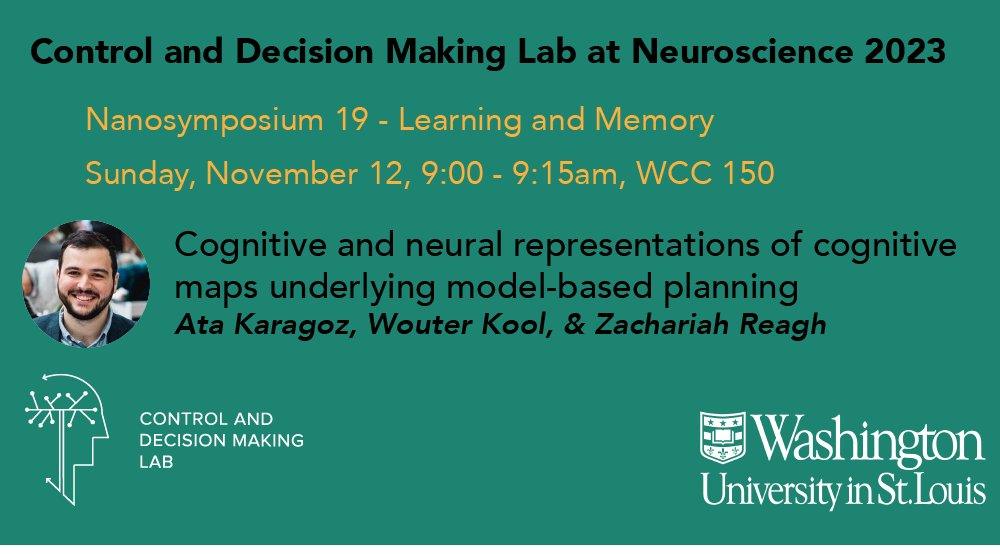
It's been a while, but our lab has an @SfNtweets presentation! @AtaBK will talk about how he uses behavioral and neural RSA to measure the construction of cognitive maps. Joint work with @zreagh.
In our new paper, we used pattern analysis to track semantic features during memory formation. To facilitate this approach in other projects, we have released code to estimate semantic similarity for well-known stimuli; see https://t.co/RrAudIql1w https://t.co/xMoB2uWL5V.
In our new paper at Cerebral Cortex, we find that the brain may connect related experiences by reactivating semantic knowledge in medial prefrontal cortex and integrating knowledge about both experiences in hippocampus. 🧵 https://t.co/W1Ceesfc6S @NealWMorton
Code for running all analyses is publicly available: https://t.co/57lQBzj2Y0. Data are not yet publicly available but are available upon request. Message me if you want to read the paper but don't have access.
@das17anik@UWMPsychology Sorry for missing this before. Yes, I am planning on recruiting a PhD student for next year. I'll post more information later in the year.
I will be starting a new lab at the University of Wisconsin-Milwaukee this Fall! My lab will examine how the human brain uses cognitive maps to represent structure in the world, facilitate memory retrieval, and guide decision making. @UWMPsychology
https://t.co/su4TNBmzTe
Our new paper at Cerebral Cortex finds that representations of space in hippocampus and ventromedial prefrontal cortex (vmPFC) bias how we make decisions in time, demonstrating our ability to generalize knowledge across cognitive domains. 1/6
https://t.co/wOfvhk1ng7
Congratulations to @cacoughlin1 who will be starting a faculty position at the University of Illinois Chicago (#UIC) this fall!
Christine's lab will focus on how the developing brain supports the flexible use of memories to imagine the future, create, reason, and more!
For the time being, I will stop posting on Twitter. My handle on the other social network that I’m not allowed to talk about here is in my profile, at least until that gets censored.
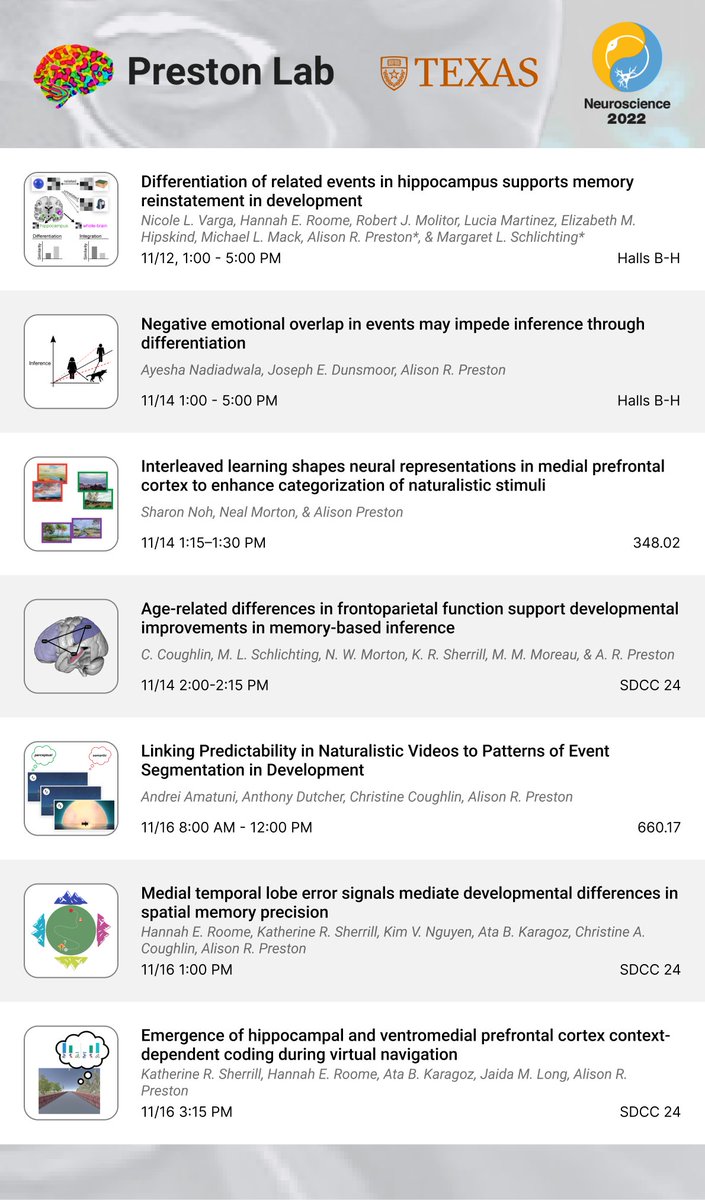
At #SfN2022 today at 1:15 in SDCC 24 I’ll talk about how an optimal interleaved learning schedule may help shape neural representations in medial prefrontal cortex to support efficient generalization of category knowledge. @sharon_noh @preston_lab
The Mack Lab is at #SfN22!
Saturday PM poster: @PerovicMateja & @em_heffernan UU2
Sunday AM poster: @yongzhen_xie WW37
Monday PM talk: Melisa Gumus, room SDCC 24
Titles below, visit https://t.co/884idvg1gN for PDF downloads!
The analyses in Psifr are based on measures developed by @PolynSean, @KahanaMichael, myself, and many others. See the user guide for references.
https://t.co/H5xQNnRKSD
Free recall experiments provide rich information about memory function, but analyzing free recall data can be complex and difficult. My Python package, Psifr, makes it easy to perform sophisticated analysis of free recall performance and organization. https://t.co/O3nPeUZ3tz 🧵
Psifr is written in Python, but the in-development {psifrr} R package makes it possible to call Psifr functions directly from R. Feedback on both Psifr and {psifrr} is welcome!
https://t.co/GXjhj1rRKn