When the President of France visited the United States in April 1960, he asked the FBI to help him find a man.
The man he was looking for was an American citizen. He was sixty-four years old. He had been awarded fifteen French military decorations and — six months earlier, in a ceremony in Paris — had been made a Knight of the Légion d'honneur, the highest civilian honor France can give. The medal had been pinned to his chest by the President himself, who had publicly called him un véritable héros français. A true French hero.
The FBI located the man within a few days.
He was operating an elevator at Rockefeller Center in New York City.
The elevator operator's name was Eugene Bullard. He had been born in Columbus, Georgia, in 1895, the son of a man whose own father had been a slave.
He had run away from Columbus at the age of eleven, after watching a white mob nearly lynch his father.
He spent the next several years drifting through the American South. At sixteen, he stowed away on a German freighter at Norfolk, Virginia. He landed in Aberdeen, Scotland. From there he made his way to London, where he learned to box. By 1913, at eighteen, he was prizefighting in Paris.
When Germany invaded France in August 1914, Bullard was nineteen years old. He had no legal obligation to fight. He had no French citizenship.
He went to the recruiting office on October 19, 1914, and signed up for the French Foreign Legion.
He spent the next eighteen months as an infantryman in some of the worst fighting of the war — at the Somme, at Champagne, at Verdun. He was wounded three times. The third wound, on March 5, 1916, tore open his thigh and left him with permanent damage to his leg.
He was twenty years old. The doctors told him he would not return to the infantry.
He decided he wanted to fly.
In a Paris café in the spring of 1916, while he was recovering, Bullard mentioned to three white American friends that he was thinking of joining the French air service. A Mississippian named Jeff Dickson laughed.
Gene, Dickson said, you know damn well there aren't any Negroes in aviation.
Bullard answered: Sure do. That's why I want to get into it. There has to be a first to everything, and I'm going to be the first.
Dickson bet him two thousand dollars he would not make it.
Bullard took the bet. He earned his pilot's license on May 5, 1917. He won the bet.
He reported to the front in August 1917 and flew approximately twenty combat missions over the next three months in a SPAD VII. The fuselage was painted with a bleeding heart pierced by a knife and the French phrase Tout le Sang qui Coule est Rouge — All Blood that Flows is Red.
He carried, on every combat flight, a small capuchin monkey named Jimmy in the front of his flight jacket.
The French press began calling him L'Hirondelle Noire — the Black Swallow.
When the United States entered the war in 1917, Bullard immediately applied to transfer to the U.S. Army Air Service.
His application was rejected.
The U.S. Army Air Service had a policy, in 1917, of not accepting Black pilots. The other American pilots flying for France in his unit, all of them white, were transferred to the U.S. Air Service.
He was the only one who was not.
For the next twenty years, he was one of the most familiar faces in the Montmartre nightlife of Paris between the wars. He owned a nightclub called L'Escadrille. He spoke fluent French, English, and German. Hemingway drank there. Fitzgerald drank there. Langston Hughes drank there. Josephine Baker performed there. Louis Armstrong was a personal friend.
When Germany invaded Poland in 1939, Bullard was forty-four. His fluent German and his ownership of a nightclub frequented by German officers made him useful to the French Resistance. He became an intelligence agent — eavesdropping in his own bar on conversations between German officers who did not know he understood every word.
When France fell in June 1940, friends in the Resistance smuggled him across the Spanish border before the Gestapo could arrest him.
He came back to the United States for the first time in twenty-eight years.
He arrived in New York with thirty dollars in his pocket and a permanent limp.
He did not return to a hero's welcome. He returned to a country that had no idea who he was.
He worked at a perfume counter. He worked as a security guard. He worked at the Staten Island shipyards. By the late 1940s, he had taken the job that he would hold for most of the rest of his life.
He operated the elevator at Rockefeller Center.
He was wearing the elevator uniform on the day a producer from NBC came down from the studios upstairs to ask if he was the man Charles de Gaulle had been looking for.
A few weeks later, NBC sent a film crew to interview him in the lobby. The studios where NBC produced The Today Show were on the floors above. He had operated the elevator that took the network executives up to those studios every morning for nearly ten years. He had not been recognized as he did it.
He went back to operating the elevator the following Monday.
He died of stomach cancer on October 12, 1961, three days after his sixty-sixth birthday.
He was buried in the French War Veterans' section of Flushing Cemetery, in Queens, in the uniform of the French Foreign Legion. The casket was draped with the French flag.
In 1994 — thirty-three years after his death — the United States Air Force formally commissioned Eugene Jacques Bullard as a Second Lieutenant, posthumously.
It was the first commission the U.S. military had ever offered him.
He had been the first Black combat pilot in American history.
The French had been calling him a hero since 1917.
The Americans got around to it in 1994.
A volcano was erupting in the Philippines when a meteor suddenly crashed behind it and it appeared that something came out of meteor and began flying upwards 🤯
In Kruger National Park, South Africa, veteran ranger Sipho Nkosi suffered a heart attack while on solo patrol. His vehicle was found empty, and search teams began looking for him.
What the park’s remote trail cameras revealed broke the hearts of everyone who saw the footage.
An old bull elephant — known to rangers as “Mnumzane” (Zulu for “Sir”) — had found Sipho’s body. For three full days and nights, the elephant refused to leave. He stood guard, gently touching the ranger with his trunk, chasing away hyenas and jackals that came too close, and even covering parts of the body with branches and leaves.
On the third night, the elephant was still there — visibly grieving, swaying slowly beside his fallen friend. Only when the full recovery team arrived with vehicles did Mnumzane finally step back, watching solemnly as they carried Sipho away.
Park officials later confirmed that Sipho had rescued this same elephant as a calf years earlier after poachers killed his mother. The elephant had never forgotten.
One colleague who viewed the footage whispered:
“He didn’t come to say goodbye. He came to make sure no one disrespected his brother.”
Mnumzane still visits the exact spot regularly. Rangers now leave fresh water and fruit there in honor of both.
The burnt toast Theory!
The minor setbacks and frustrations you're facing right now? They might just be the hidden catalysts propelling you toward your biggest breakthroughs tomorrow. Embrace the detours, they're often the fastest route to success.
It's an interesting concept check out this video and tell me what you think.
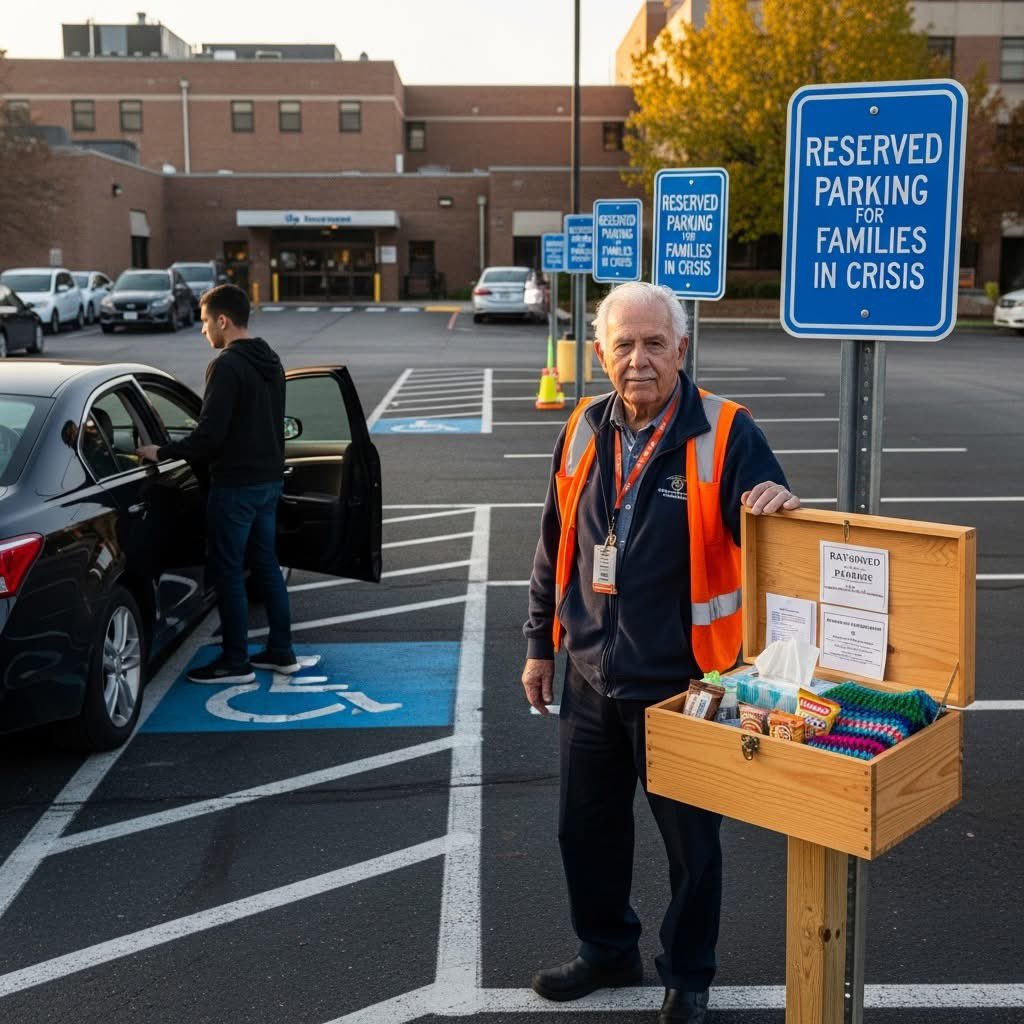
"My name's Raymond. I'm 73. I work the parking lot at St. Joseph's Hospital. Minimum wage, orange vest, a whistle I barely use. Most people don't even look at me. I'm just the old man waving cars into spaces.
But I see everything.
Like the black sedan that circled the lot every morning at 6 a.m. for three weeks. Young man driving, grandmother in the passenger seat. Chemotherapy, I figured. He'd drop her at the entrance, then spend 20 minutes hunting for parking, missing her appointments.
One morning, I stopped him. "What time tomorrow?"
"6:15," he said, confused.
"Space A-7 will be empty. I'll save it."
He blinked. "You... you can do that?"
"I can now," I said.
Next morning, I stood in A-7, holding my ground as cars circled angrily. When his sedan pulled up, I moved. He rolled down his window, speechless. "Why?"
"Because she needs you in there with her," I said. "Not out here stressing."
He cried. Right there in the parking lot.
Word spread quietly. A father with a sick baby asked if I could help. A woman visiting her dying husband. I started arriving at 5 a.m., notebook in hand, tracking who needed what. Saved spots became sacred. People stopped honking. They waited. Because they knew someone else was fighting something bigger than traffic.
But here's what changed everything, A businessman in a Mercedes screamed at me one morning. "I'm not sick! I need that spot for a meeting!"
"Then walk," I said calmly. "That space is for someone whose hands are shaking too hard to grip a steering wheel."
He sped off, furious. But a woman behind him got out of her car and hugged me. "My son has leukemia," she sobbed. "Thank you for seeing us."
The hospital tried to stop me. "Liability issues," they said. But then families started writing letters. Dozens. "Raymond made the worst days bearable." "He gave us one less thing to break over."
Last month, they made it official. "Reserved Parking for Families in Crisis." Ten spots, marked with blue signs. And they asked me to manage it.
But the best part? A man I'd helped two years ago, his mother survived, came back. He's a carpenter. Built a small wooden box, mounted it by the reserved spaces. Inside? Prayer cards, tissues, breath mints, and a note,
"Take what you need. You're not alone. -Raymond & Friends"
People leave things now. Granola bars. Phone chargers. Yesterday, someone left a hand-knitted blanket.
I'm 73. I direct traffic in a hospital parking lot. But I've learned this: Healing doesn't just happen in operating rooms. Sometimes it starts in a parking space. When someone says, "I see your crisis. Let me carry this one small piece."
So pay attention. At the grocery checkout, the coffee line, wherever you are. Someone's drowning in the little things while fighting the big ones.
Hold a door. Save a spot. Carry the weight no one else sees.
It's not glamorous. But it's everything."
Let this story reach more hearts....
Credit: Mary Nelson
#PowerOutage: Sunnyside, Muckleneuk / Lukasrent
The team has finished placing the minisub and is currently busy with cable work(MV and LV terminations, and MV jointing.
ETR is 00:00