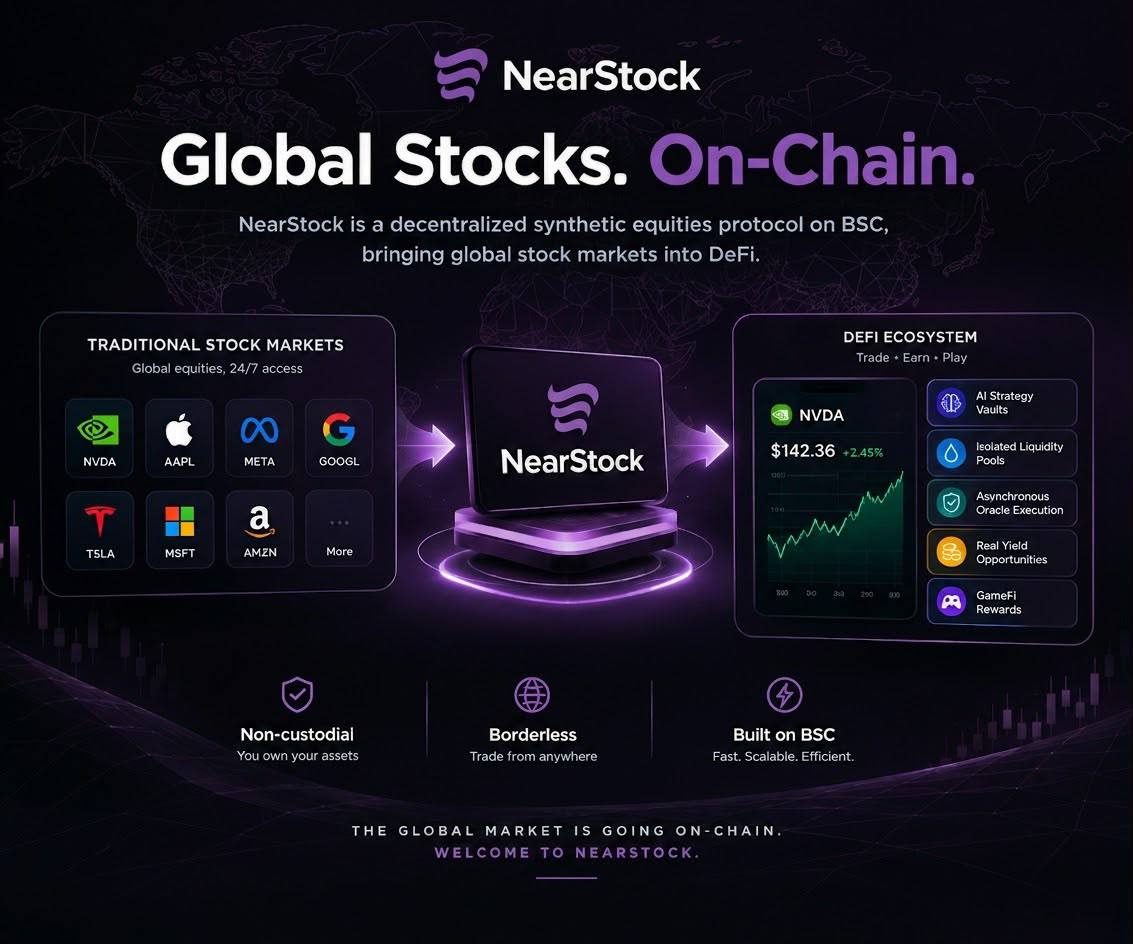
🌎 Global Stocks. On-Chain.
NearStock is a decentralized synthetic equities protocol on BSC, bringing global stock markets into DeFi.
Trade synthetic equities with:
• AI-managed strategy vaults
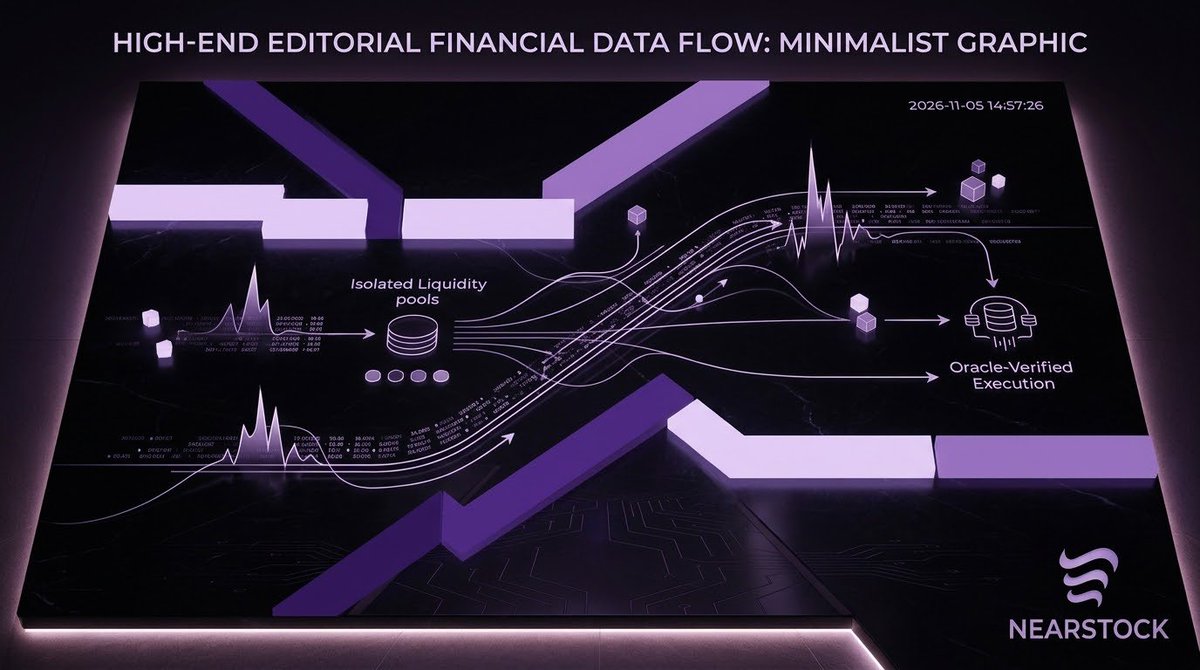
• Isolated synthetic liquidity pools
• Asynchronous oracle execution
• Real yield opportunities
• GameFi-powered engagement
Non-custodial. Borderless. Built for the next generation of on-chain markets.
The global market is going on-chain. Welcome to NearStock. 📈
A single earnings report helped add more than $500 billion in value across AI-linked stocks before 10 a.m. on Wednesday. CoreWeave posted third-quarter revenue of $3.66 billion, up 168% from a year ago, raised its full-year outlook, and its shares jumped roughly 20% or more. Nvidia and other chip, power, and neocloud names rebounded alongside it.
The report mattered less for the numbers than for the worry it addressed. Investors had been questioning how AI data center buildouts get financed, and this print eased some of that pressure. Not everyone is convinced it marks a turning point: the stock is still well below its highs, and analysts are cautious about calling a bottom.
That's the pattern of this earnings season. One company's results can reprice an entire theme within minutes, and the move often arrives before most people have finished reading the headline.
NearStock is built for access that keeps up with that speed: on-chain exposure to global equities, oracle-verified pricing, and non-custodial settlement.
Relief rally or real turn? What's your read?
#Stocks #Earnings
Gates points to cyber risk and critical infrastructure as AI scales.
Financial infrastructure belongs on that list too. What safeguards matter most to you in AI-driven finance?
#AI#DeFi
🚨 INSIGHT: Bill Gates warns that the next four years will be critical for AI safety, citing growing risks from cyberattacks, bioterrorism and threats to critical infrastructure.
He believes AI could surpass human intelligence and replace many jobs by 2030.
Gates also calls for urgent regulation and cooperation between the US and China to address the risks.
Before you deposit into any liquidity pool, there are four things worth checking, and they apply well beyond NearStock.
Where does the yield come from?
Trading fees and real usage hold up over time, while token emissions tend to fade. What's the pool exposed to? A pool tied to one market is easier to evaluate than a shared pot where risk is spread in ways you can't see. How is the price set? A pool is only as sound as the feed behind it. And can you verify any of this yourself, or are you taking someone's word for it?
On NearStock, each pool is built around one market, with fees and funding flow generated inside that pool, oracle-verified pricing, and non-custodial settlement. It's designed so the answers to those four questions are visible on-chain.
Liquidity providing carries risk, including the risk of loss, and no design removes it. Knowing what you're exposed to is the point.
Which of the four do you check first?
#DeFi #SyntheticEquities
One tenth of a percentage point moved the whole market this morning. October CPI came in at 0.4%, against the 0.3% economists expected, with core prices at 0.3% against a 0.2% forecast. Two-year Treasury yields jumped around 15 basis points, and futures sank before the opening bell.
By midday, stocks had pared most of the damage, after one of the sharper rallies of the year on Monday. Markets are still trying to decide what the number means. Fed Governor Waller has signaled support for a December hike, possibly a larger one, so each inflation print now carries real weight for rate expectations.
The pattern is worth noticing: the data lands, prices gap, and then the market spends hours deciding how much of the move to keep. Being able to see that repricing happen, and act on your own view of it, is the difference between watching and participating.
That's why we built NearStock around oracle-verified pricing and on-chain access to global equities.
Did the CPI print change your read on December?
#Macro #Stocks
Nearstock × @AISIM_EN Partnership Giveaway
AISIM is building a next-generation AI connectivity and financial ecosystem, combining global eSIM, AI APIs, VIAIPhone, digital wallets, and U Card for investing, asset management, and global payments.
🎁Complete the tasks to win 500MB eSIM Cards & 2,000 Points, 50 winners!
To ent
✅Follow @AISIM_EN@Nearstocks
✅Like, RT, Tag 2 Friends & Leave your Telegram Username
✅Join the AISIM community 👉https://t.co/3MFaXlJwCn
📅 Giveaway ends on November 17th
#AISIM #AI #Nearstock #DeFi #Giveaway
Security concerns are pushing some crypto holders toward ETFs. That's a fair response to real risks.
It also shows what people want: exposure with clear safeguards and transparent rules. Different structures make different trade-offs, and it's worth understanding which one you're taking on.
At NearStock, we're focused on making ours verifiable on-chain.
Monday morning, and the market reopens after a week that felt like a month. The selloff, the partial rebound, the jobs data that complicated everything: it's all still sitting in the charts, waiting for you to decide how to read it.
Today looks quieter on paper. Several Fed officials are scheduled to speak, the big earnings reports start arriving tomorrow, and inflation data lands Tuesday morning. That makes today a good day to set up your week rather than react to it. Look at what you're holding, what you're watching, and what would actually change your mind.
NearStock has been running since before the open, with no Monday warm-up needed. The pools, oracle feeds, and vaults are already live, so the only thing left to sort out is where you want to start
.
What's the first thing on your screen this morning?
#SyntheticEquities #BNBChain
Week Ahead | NearStock
After a week that rewrote the tech trade in a single session, the calendar doesn't ease up. October CPI lands Tuesday, with PPI following Friday, and around ten Fed officials are scheduled to speak. With markets pricing a sizeable chance of another rate hike in December, every inflation print and every Fed comment carries extra weight.
The earnings calendar is just as loaded for the AI trade. CoreWeave reports after Tuesday's close, Cisco and Applied Materials follow later in the week, and Nvidia reports the Tuesday after. These are the reports the market will use to judge whether Thursday's selloff was a one-day shock or the start of something longer.
Macro data, rate expectations, and AI earnings all move through the same handful of names, which means volatility can arrive quickly and from several directions at once.
That's the environment NearStock is built for: oracle-verified pricing, isolated pools that keep risk contained, and non-custodial on-chain access to global equities.
Which print are you watching first: CPI or CoreWeave?
#Macro #Stocks
Sunday check-in. How are you feeling about the week behind you and the one ahead?
It was a loud one: a sharp selloff on Thursday, a partial rebound on Friday, and a lot of noise in between. Some of you probably watched every tick, and some of you stepped away and let it play out. Either approach is fair, but Sunday is a good day to pause and ask what you actually learned from it.
Maybe it's how much a single name or sector can swing the whole picture. Maybe it's that you'd rather size positions smaller when headlines get loud. Whatever your takeaway is, it's worth writing down before Monday's open starts rewriting it.
NearStock will keep running in the background, so there's nothing to rush. Take your time with it.
What's your biggest takeaway from this week? Drop it below.
#SyntheticEquities #BNBChain
X Layer +$79.6M in a week. Arbitrum, Robinhood Chain, Solana all adding too.
What do you think decides which chain wins tokenized equities: liquidity, distribution, or regulation?
#RWA#Tokenization
Weekend Market Perspective | NearStock
This week showed how fast sentiment can turn. On Thursday the S&P 500 fell 4.36% and the Nasdaq dropped 5.52%, their worst sessions since April 2025, with the Nasdaq closing in correction territory as AI and chip stocks led the selloff. Reuters put the one-day loss near $3 trillion in S&P 500 market value.
Friday brought a partial rebound as chipmakers recovered part of Thursday's losses, helped by an October jobs report that came in well above expectations. But the data also raised the odds of another Fed rate hike, and both major indexes were still on pace for their worst week since early June.
The takeaway is less about direction than about speed. A single session rewrote the week, the biggest moves were concentrated in specific names and sectors, and much of the repricing happened faster than most portfolios could adjust.
At NearStock, we're building for markets that move like this: oracle-verified pricing, isolated pools that keep risk contained, and non-custodial access to global equities on-chain.
Volatility is part of the picture. Infrastructure is how you meet it.
#Stocks #DeFi
Partnership Announcement
NearStock 🤝 @Athledium
Athledium is building a health and sports ecosystem that rewards verified physical activity through a sustainable, revenue-backed model powered by $AEM on BNB Chain.
Together, we’re exploring new opportunities across Web3, digital assets, and real-world utility.
Big-name stocks move big when sentiment turns. That's true on the way up and the way down.
Understanding where your exposure sits, and how it's priced, matters more than the headline.
#Stocks#Tesla
BNB Smart Chain's block time dropped to around 450 milliseconds earlier this year, and BNB Chain is now building a separate layer-1 aimed at high-frequency trading and AI agents, with a testnet targeted for late 2026. Both point the same way: the chain is being tuned for markets, not just transfers.
Block time matters more than it sounds. When a trade queues on-chain and gets filled in the next block, a shorter block means a shorter wait between submitting and settling. Less time in the queue means less time for conditions to change underneath you.
That's the setup NearStock's asynchronous keeper execution was designed to take advantage of: queue first, fill against a verified oracle price, and let the chain's speed shrink the gap.
Which matters more to you in on-chain trading: speed, cost, or certainty of execution?
#BNBChain #DeFi
🎙 @AlphioAI AMA | AI Trading & Security: Who's in Control?
What should an AI trading agent be allowed to do with your money?
🗓 Thu, Nov 5
⏰ 10:00 UTC / 18:00 UTC+8
Guests:
@ocean6_ai@nearstocks@ProBix_AI@pwt_ai@botchain_ai
🔔 Set a reminder 👇
https://t.co/czhyGLHFAb
There are two ways to get a stock on-chain, and people often mix them up. A backed token is tied to an actual share held by a custodian. A synthetic tracks the price of that stock through a collateralized position and an oracle feed, with no share behind it.
Each model has trade-offs. Backed tokens lean on the custodian and the issuer's rules. Synthetics depend on the quality of the price feed and the pool backing the position, and they don't carry shareholder rights like voting or dividends. Anyone telling you one model has no downsides is skipping a step.
NearStock is a synthetic design, and we'd rather say that plainly. The focus is on making the parts you depend on, pricing, collateral, and pool risk, visible and verifiable on-chain.
Which trade-off matters more to you: custody or shareholder rights?
#SyntheticEquities #DeFi
Partnership Announcement
NearStock 🤝 @debitum_app
DebitUM provides on-chain bond infrastructure, enabling projects to launch token bonds with customizable discounts, vesting schedules, and transparent execution through smart contracts.
Together, we’re exploring new opportunities across DeFi, tokenized assets, and on-chain financial infrastructure.