Traders lose money guessing direction. market makers eat them on liquidations.
the boring money is in funding arbitrage and perp points. delta-neutral, you don't care where price goes, you get paid for being there and doing volume.
i've been farming this daily for months. built two tools along the way because i needed them and now, I share this with you.
Both below 👇
How a Lighter trader's key was stolen without hacking anything. Middle school math was enough
On the morning of November 16, a trader on the perp DEX Lighter had funds drained from their account. Nobody hacked the exchange or its servers, and nobody touched the trader's computer or passwords. The attacker took data that was publicly available and solved a simple equation.
Below, step by step: what happened, how it's even possible, and why it matters to anyone who trades with a bot.
TL;DR
Lighter's protocol, smart contracts and infrastructure were not affected.
The trader signed orders with homemade code instead of the exchange's official SDK. That code had a bug.
Because of the bug, the trader's secret API key could be calculated from the public signatures on their own orders.
With that key, the attacker withdrew funds by going around Lighter's safeguards.
Lighter's protective contract (Guardian) caught the anomaly and paused withdrawals. The Security Council returned about 5M USDC to the trader. Withdrawals are working again.
What a signature is, and why it needs a "one-time number"
A bot trading on Lighter signs every order with an API key. The signature proves to the exchange that the order came from the key's owner, and the key itself never leaves the bot.
There's one important detail. Every signature mixes in a random one-time number, called a nonce. As long as that number is fresh and unpredictable every time, the key can't be pulled out of the signatures, no matter how many signatures someone collects.
Reuse the same number twice and the protection collapses.
Why reusing the nonce kills the key: a toy example
Let's simplify the math to school level. In spirit, a signature works roughly like this:
signature = random number + (order data × secret key)
Say the secret key = 7 and the random number = 12. The bot signed two different orders but, by mistake, used 12 both times.
Order 1, data = 3: signature = 12 + 3 × 7 = 33
Order 2, data = 5: signature = 12 + 5 × 7 = 47
The attacker sees both signatures (33 and 47) and the order data (3 and 5), because all of it is public. The key and the random number are unknown. They subtract one signature from the other:
47 − 33 = (5 − 3) × key → 14 = 2 × key → key = 7
The random number cancels out, leaving one equation with one unknown. The key is found.
In reality the numbers are around a hundred digits long and the math is done modulo a large number, but the principle is exactly the same: two equations, two unknowns, one of the unknowns is shared, and the key falls out in a second.
This isn't a new vulnerability:
In 2010 the PlayStation 3's security was broken this way: Sony signed its firmware with the same "random" number every time.
In 2013 a weak random number generator in Android let attackers steal bitcoin from mobile wallets.
Lighter specifically notes that the same rule applies to Bitcoin and Ethereum signatures.
How the money was actually taken out
Here's the interesting part. On Lighter, an API key cannot withdraw to someone else's wallet, only to the owner's own wallet. So a stolen key would seem useless. But the attacker found a way around that.
Calculated the key from public signatures, as in the example above.
Created a public pool under the victim's account. On Lighter an API key can move funds to its own account's sub-accounts, and a public pool counts as a sub-account.
Bought pool shares from a separate account they controlled.
Moved the victim's funds into the pool without minting any new shares. The pool now held a lot more money with the same number of shares, so each of the attacker's shares jumped in value.
Redeemed the shares and withdrew from their own account.
Think of it this way: you buy 1% of a fund, then someone drops millions into that fund without getting a single share in return. Your 1% is now worth a fortune.
What else a stolen key can do
Even without the pool trick, a leaked key is dangerous. According to Lighter, an attacker holding the key can:
trade against the owner: place their own orders at bad prices and have the victim's orders fill against them. This works best in illiquid markets;
open huge positions with high leverage, pushing the account into heavy losses or liquidation.
In other words, "a key that can't withdraw" does not mean "a safe key."
What Lighter has already changed
Transfers into a public pool now require a wallet signature, so an API key alone isn't enough. The scheme used in this attack no longer works.
API key signatures are no longer public, so the raw data needed for this kind of attack is no longer available.
What Lighter plans to add
IP allowlists: a key will only work from a chosen server.
Per-key permissions and limits: which actions and which markets are allowed.
Nonce-reuse monitoring on signatures: the exchange will warn owners of affected keys itself and void those keys in advance.
If you trade with a bot
Sign only with the exchange's official SDK. Lighter has Python, Go, TypeScript and an Agent Kit. The official SDKs generate nonces safely and were not affected by this incident.
Don't write your own crypto. If you have to, never derive the nonce from a timestamp, a counter, ordinary random, the transaction data or a cached value. Use only a cryptographically secure generator, with a fresh number for every signature.
Treat keys like money: don't send them to anyone, don't commit them to repositories, don't show them in screenshots.
Not sure whether your code ever reused a nonce? Rotate all your API keys and switch to the official SDK.
The takeaway
The exchange wasn't hacked. One line in the trader's own signing code is what failed them. The attacker needed no server access and no phishing, just public data and some basic subtraction.
Cryptography is reliable as long as nobody improvises it. If a piece of software signs your orders, the first question to ask is what exactly it signs them with.
What happened with Lighter?
$10.2K in. $10.39M out. 36 minutes.
that's a wallet funded this morning, zero trades, on Lighter. $LIT -15% on the candle.
it swapped to ~5,752 ETH (not 5.4K), is bridging some to Arbitrum and just sent another $10.2K in.
accounting bug or exploit, unconfirmed. ~2% of the contract's USDC, not a full drain.
no statement yet. I don't keep collateral on a venue that's this quiet while money walks out the door
"delta neutral doesn't pay" usually means someone forgot to add up the costs.
$DOGE, long Bullpen / short HTX, $10,000 a leg.
Bullpen fees (open + close): $9.00
HTX fees (open + close): $10.00
slippage both legs: $4.56
total round trip: $23.56
funding paid $38.99 over 7 days, about $5.57 a day.
after ~101 hours the funding covered the fees.
left $15.43 net on the week, every day green.
funding moves, so next week is not this week.
Guys, drop futures trading.
For real, you have to realize that with this market and all the manipulation, you'll never guess the direction. It's unpredictable.
You don't know what the whales are doing behind the scenes — you have zero insider info, just like me.
So your TA, your guesses about pumps, your S/R zones — none of it works.
The market is hyper-manipulative right now, so be ready for liquidations.
The only way to make money here is delta-neutral setups, funding arb, and farming perp DEX points for airdrops.
If you're trying to make it on futures, you're literally no different from a gambling addict betting black or red. Cut it out.
It only ends one way: zero.
Why play the lottery when you can make a steady profit?
Maybe somebody disagree with me? We can discuss about it.
BTC Spoils my Sunday Plans
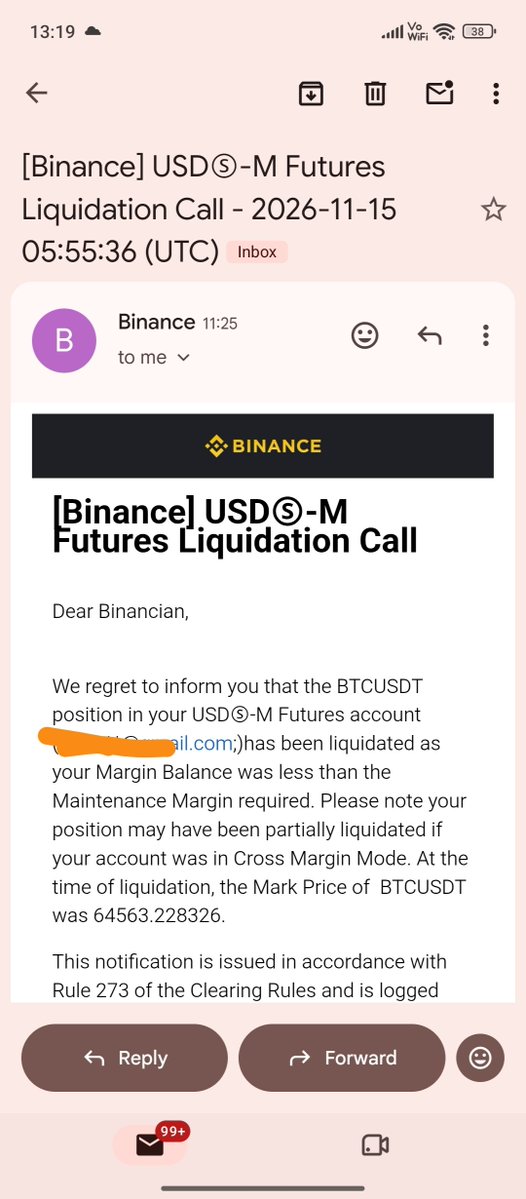
Earlier mrng i opened long position when starts Pumping
I think $BTC will cross $69k and i set TP
but btc have other plans
I didn't set SL and btc comes back down to $64k
I completed got liquidated 😭😭
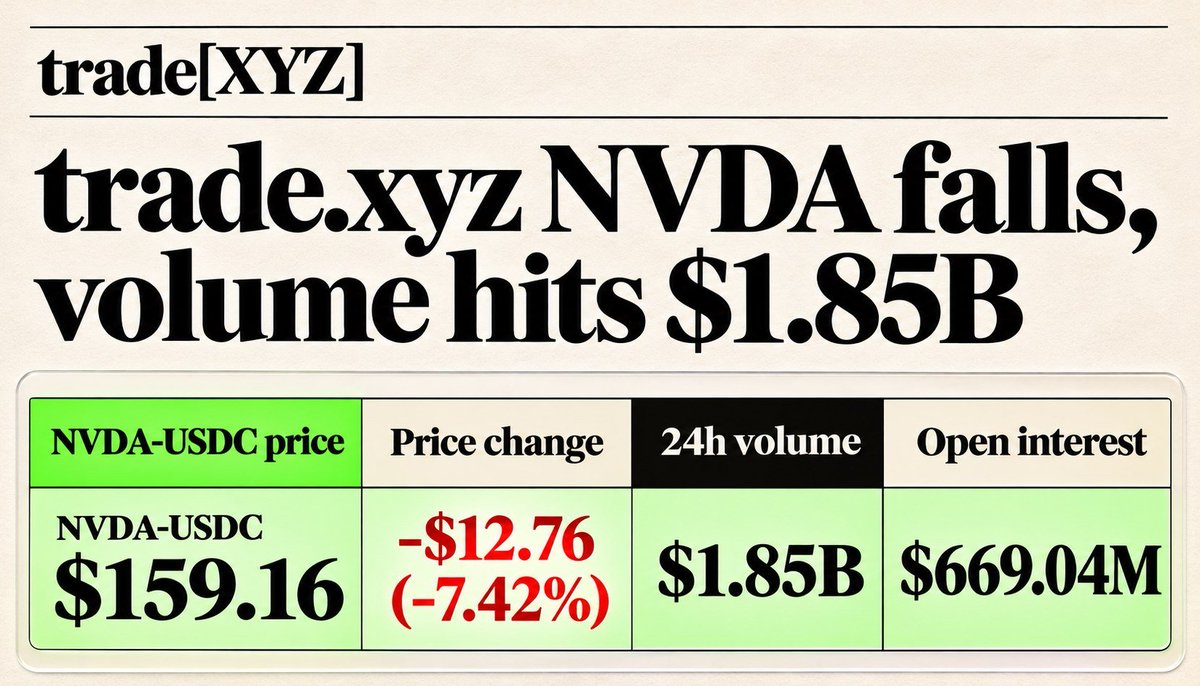
nvda on https://t.co/No43jKLZQ6 just blew past $1.85B in 24h volume while the price bled out
price is red but the flow isn't slowing down at all. people are trading it hard into the drop.
- NVDA-USDC at 159.16, down -12.76 (-7.42%)
- 24h volume: $1,848,172,607.57
- open interest: $669,044,615.31
red candle, green volume. that's where the action is.
the easy perp dex points farming is dead.
holding delta-neutral size and collecting a fat airdrop just for existing? that window closed. now you either trade like a pro or bring real capital. three ways left:
1. trade organically and actually profit. points become a bonus on top. harder, but doable with real research and serious trading. projects also run trading comps to pull users in, so there's prize upside too — variational, qfex, perpl, risex all do this.
2. pay fees for points. problem is almost every dex runs zero fees now and hands out almost nothing for it (txflow, arcus). and the risk: a lot of these dexes die before tge, so the money you spent is just gone.
3. be early. the least competition, the most upside. right now qfex is the best early spot i see — same setup variational had back in summer 2025
ondo break-even sits at ~$382M FDV while the mid-case prints ~$4.1B.
how i count one $ONDO point, 2% of supply over ~90M points:
$3B FDV -> $0.67
$4.1B FDV -> $0.92
$5.6B FDV -> $1.24
allocated cost is ~$0.08/point, a 50/50 split of my pair's net.
the FDV is not what scares me. the point count is: double the total and that $0.92 becomes $0.46. that denominator moves every bar.
Variational is hosting a $50k trading competition before the points farm wraps up
score = PnL × √volume, Nov 13 → Dec 1, min $250k volume, top 100 paid in USDC
but read the terms:
winners must pass KYC to claim, 30 days or the prize is gone
and the competition is restricted in some jurisdictions
so you trade on a permissionless DEX from your wallet, then hand over your ID to get paid
that's not a DEX competition, that's a CEX promo with an onchain frontend
i get why they do it (sybils, legal), but it's a weird signal right before the token
if KYC gates the comp today, what gates the airdrop tomorrow?
still farming. just not doing their KYC for a $50 prize
Variational just dropped one last trading competition right at the end of the points farm
$50,000 in USDC, 18 days: Nov 13 → Dec 1
weekly points end no later than end of Q4, so this is the final stretch
how it works:
score = PnL × √volume, counted on all markets
min $250k notional volume to get on the leaderboard
top 100 get paid: 1st $10k, 2nd $7.5k, 3rd $5k, 6-10th $1.5k each, down to $50 for 51-100th
KYC to claim, wash trading and multi-accounts get disqualified
the key part: pnl does the heavy lifting. 4x the volume only doubles your score
and if you're red, more volume pushes you deeper into negative
so if you're farming Variational anyway, the same volume now counts twice: points + a shot at USDC
just trade it like a trader, not like a volume bot
i'm in for the last 18 days