Getting Into a Token Is Easy to Celebrate. Being Able to Sell It Is What Actually Matters.
One of the biggest silent killers in newly launched token markets is the habit of celebrating the entry while completely ignoring the exit. Traders rush in because the chart looks clean, the narrative is hot, liquidity appears thick, and the buy transaction goes through without issues. The dopamine hits, the screenshot gets posted, and everyone moves on.
Then the moment comes when they actually want to leave.
That is usually when the real problems surface. Thin liquidity that looked fine on the buy side suddenly disappears. Tax that was “low” on entry becomes punishing on exit. A contract that simulated fine on the way in reverts or behaves differently on the way out. Price impact that felt acceptable when you were buying becomes brutal when you are trying to sell. In many cases, traders only discover these issues after their capital is already locked in.
This is one of the reasons the simulation and protection layer on @Hypesium stands out to me.
Instead of only checking whether a buy can execute, the system simulates the exact buy transaction against the current state of the chain and then immediately runs a sell test. The idea is simple but practical: it tries to surface whether the position can actually be exited before you commit funds. If the sell simulation fails under your chosen settings, the trade is treated as higher risk and can be skipped entirely.
On top of that, the protection profiles give traders a way to define how aggressive or conservative they want to be:
Safe**: tighter limits on tax, stronger liquidity floor, stricter sell test, and lower allowed price impact. Built for people who want more caution.
Risky**: looser thresholds that still keep the sell test active. Useful for faster, thinner launches where some risk is accepted.
Moon**: the most aggressive profile. Higher tax tolerance, no hard liquidity floor, but still requires the sell simulation to pass.
Off**: removes the protective checks while still simulating the buy so a reverting transaction is never sent.
The core point is that entry and exit are two different problems. A tool that only helps you get in faster is incomplete if it does nothing to help you understand whether you can get out.
Of course, simulation is not magic. It cannot predict that liquidity will still be there ten minutes later, that the deployer will not change something, or that the market will stay orderly. Conditions can shift after the transaction is confirmed. That is why this kind of feature works best as decision support rather than a substitute for actually reading the contract, checking the team, and understanding the liquidity situation yourself.
For a Telegram trading and sniper bot specifically built around fast launches on Elysium, pairing speed with these pre-trade checks is an interesting approach. The environment is designed for quick entries, but speed without any verification just means you lose money faster.
The best preparation is not just knowing when to click buy. It is understanding the real risks of the position before your money is already in it.
I will be watching how Hypesium’s protection system holds up once more people start using it in live conditions.
@Hypesium
Not every Web3 game needs to follow the same formula.
What caught my attention about @HyperHaulio is the idea of building a world that feels alive rather than simply creating another game where players complete tasks and move on.
HyperHaul introduces a pirate world where exploration, fishing, ship progression, and different environments are connected to changing market conditions.
The interesting part is how the seas are designed around different markets. Instead of having one static environment, the world changes with the conditions influencing it, giving exploration a different dimension.
There are four seas to discover, different fish to catch, and a progression system that takes players from a simple raft toward bigger ships.
But what makes a game worth returning to isn't just how much content it has. It's whether the experience gives players something new to discover, challenges them to improve, and makes their progress feel meaningful.
That's the direction I'm interested in seeing HyperHaul develop.
A pirate world, evolving ships, exploration, and a community of captains all sharing the same sea.
The game is live, and the journey from raft to flagship has officially begun.
Let's see how far this world can go.
@HyperHaulio on Robinhood Chain
@HyperHaulio Is Building a Pirate World. The Next Move Is Yours.
What if Web3 gaming could become more than just earning tokens and chasing the next airdrop?
What if you could enter a world where exploration, competition, strategy, and community participation all come together?
That is the kind of experience HyperHaul is working toward on Robinhood Chain.
HyperHaul is building a living pirate sea where every captain has a reason to explore, fish, sail, fight, and build their fleet.
And I think this is an interesting direction for Web3 gaming.
The industry has spent years attracting users with incentives, but attracting attention and keeping people engaged are two different challenges.
A project can get thousands of people to join its community, but what happens when the campaign ends?
What happens when the rewards are distributed?
The strongest gaming ecosystems need more than temporary excitement. They need an experience that gives people a reason to return, interact, compete, and become part of the journey.
This is the opportunity HyperHaul is exploring.
Imagine a pirate-themed ecosystem where building your fleet becomes part of your identity, exploration keeps the experience interesting, and interaction gives the community something to participate in beyond simply watching announcements.
The vision is straightforward, but the opportunity could be much bigger.
HyperHaul also has its Captains NFT initiative, featuring 3,333 free mints, while its $HH token is already live on Robinhood Chain.
For anyone interested in the project, this is a good time to start understanding what is being built rather than waiting until everyone is talking about it.
Follow the official account. Explore the project. Read the announcements. Understand the ecosystem and keep an eye on how the team turns its vision into a working experience.
Do not participate simply because a project is trending. Participate because you understand what it is building and believe its direction is worth following.
I want to see HyperHaul develop into an ecosystem where the community is not just there to watch the journey but has a meaningful role in it.
The pirate sea is opening, and the journey is only beginning.
Are you going to watch other captains build their fleets, or are you ready to explore what HyperHaul has to offer?
Let's give this project the attention it deserves while holding it accountable to its vision.
@HyperHaulio Robinhood Chain. A new world to explore, a fleet to build, and a community with a journey ahead.
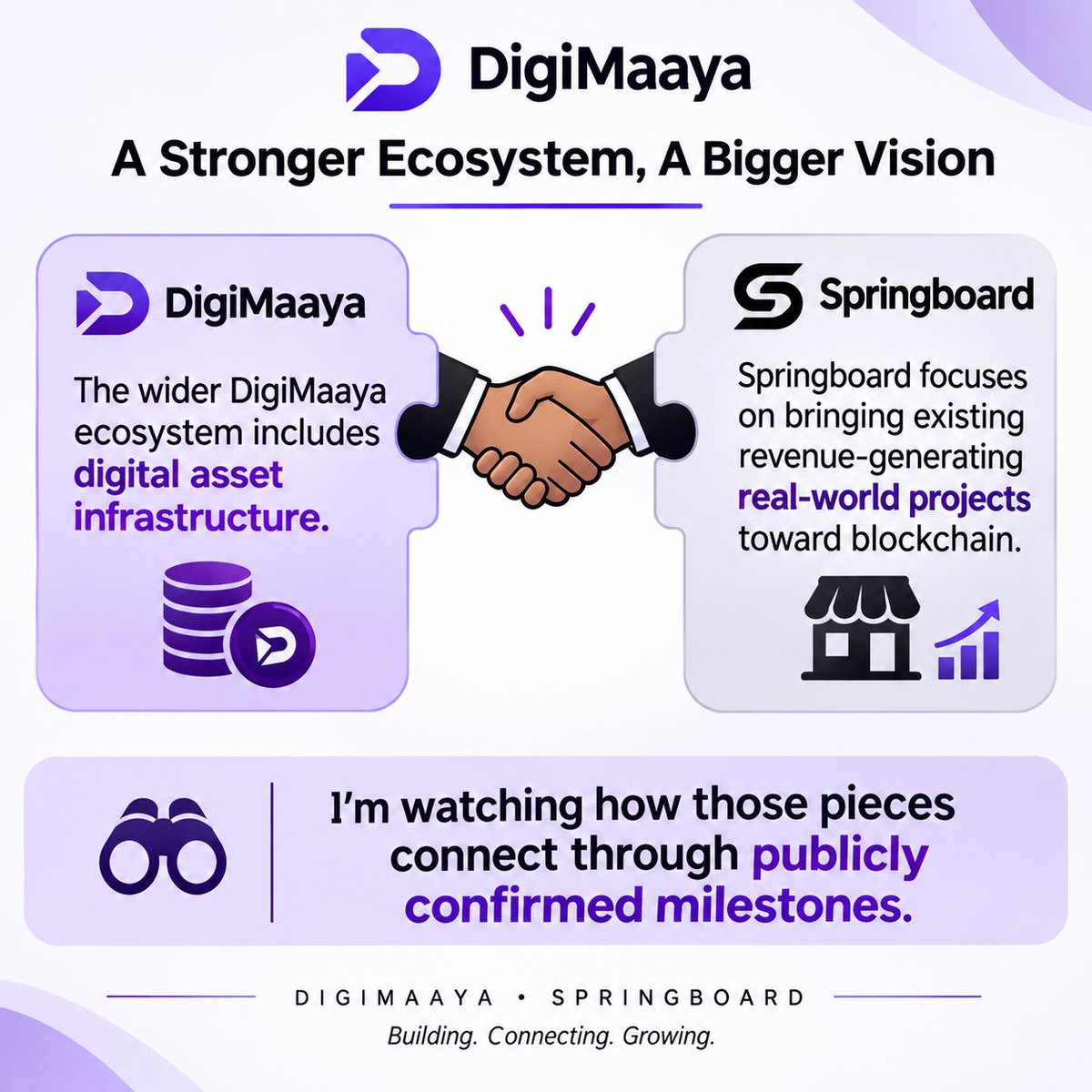
"The wider @DigiMaaya ecosystem includes digital asset infrastructure, while Springboard focuses on bringing existing revenue-generating real-world projects toward blockchain.
I'm watching how those pieces connect through publicly confirmed milestones."
@Cryptosulli01 My pick is $CHOO
Not just another meme chasing attention, but a community pushing a mission that matters: dog rescue and giving helpless pups a second chance. That's a story worth supporting.
CA: EJAxERvKU4kEVXn3NarjvRtgaMaJyP9ZuMeKA7JJpump
"What if blockchain adoption started with existing revenue-generating companies? That's the direction @DigiMaaya is pursuing through Springboard.
Learn about @DigiMaaya: https://t.co/gQLhtSfLMy
Official X update: https://t.co/5VEq6TXwLr
Speed is one of the most discussed topics in automated trading, but I think people sometimes focus on the wrong part of the equation.
A trading bot can detect a new opportunity quickly, but detection alone doesn't complete a transaction.
There is still the preparation, signing, submission, and execution process to consider.
And depending on the blockchain environment, every stage can introduce its own challenges.
This is particularly relevant when discussing @Hypesium and its approach to trading on Elysium.
Elysium has approximately 100ms blocks, HYPE gas, tip-based transaction ordering, and no public mempool.
These characteristics make it important for developers to understand how transactions are prepared and submitted within the ecosystem.
This is where Hypesium's multi-lane execution approach becomes interesting.
Rather than looking at transaction execution as a simple one-dimensional process, Hypesium is designed around multiple execution lanes.
Combined with its pre-signed sniping approach, the goal is to reduce unnecessary delays and make transaction execution more responsive to relevant market events.
Let's consider a practical example.
A new liquidity pool appears.
Several traders are interested in entering.
Some trading systems may still need to prepare their routes and transaction data after detecting the opportunity.
Hypesium's approach is to have important transaction components prepared ahead of time.
When the relevant event occurs, the system can move toward execution using that preparation.
The multi-lane component adds another dimension to how the system handles execution.
Why does this matter?
Because infrastructure should reflect the environment it operates in.
A system designed around one blockchain's transaction mechanics may not automatically be suitable for another network.
This is why I find Hypesium's focus on Elysium interesting.
It's not simply about claiming to be fast.
It's about building a system with the network's characteristics in mind.
There are still factors traders must consider, including liquidity, slippage, transaction ordering, fees, and execution reliability.
No architecture can guarantee that every transaction will succeed or that every trader will secure the desired entry.
But improving the underlying execution process is an important engineering challenge.
And that's exactly the kind of challenge I want to see more trading infrastructure projects take seriously.
@Hypesium is working in that direction.
When people talk about token sniping, the first thing that usually comes to mind is speed.
How quickly can a bot detect a new liquidity pool?
How quickly can it submit a transaction?
And how early can a trader potentially enter before the market becomes crowded?
These are important questions, but there's another part of the process that deserves just as much attention.
Transaction preparation.
Imagine a new token pool appearing on Elysium.
A traditional approach might involve detecting the pool first, identifying the trading route, preparing the transaction, calculating the required parameters, signing it, and then submitting it.
That's several operations happening around the moment an opportunity appears.
In a fast-moving market, unnecessary preparation can become a disadvantage.
This is the problem @Hypesium is approaching differently.
Its pre-signed sniping design focuses on preparing important transaction components before the relevant pool creation event occurs.
The concept involves three important stages:
1. Route preparation
The system prepares the transaction route ahead of time so that it doesn't need to begin the entire process after detecting a new opportunity.
2. Calldata preparation
The required transaction data is prepared in advance, reducing the amount of work needed at the detection stage.
3. Pre-signing
The transaction is signed before the relevant event, allowing the system to move toward execution without starting the signing process from zero.
Then comes the important moment.
When the relevant pool creation event appears, the prepared transaction can be used as part of the execution process.
@Hypesium also incorporates multi-lane execution into its approach.
Why is this particularly interesting for Elysium?
Because the network operates with approximately 100ms blocks, tip-based transaction ordering, HYPE gas, and no public mempool.
Building around these mechanics requires a different mindset from simply copying a trading bot's infrastructure from another blockchain.
However, pre-signing doesn't mean every transaction will succeed or guarantee that a trader gets the first position.
Network conditions, liquidity, transaction validity, ordering, and market competition still matter.
The important point is the engineering approach.
Instead of waiting until an opportunity appears before preparing everything, Hypesium is designed to move much of that preparation earlier.
That's a meaningful technical direction for a trading tool built specifically around a fast-moving ecosystem.
And this is one of the reasons I'm paying attention to @Hypesium .
Not every trading bot needs to support every blockchain.
Sometimes, focusing on one ecosystem and understanding how it actually works can be more valuable than trying to be everywhere.
That's an interesting approach behind @Hypesium.
Hypesium is building its trading infrastructure specifically around the Elysium ecosystem.
And there's a reason this matters.
Elysium has its own transaction environment, including approximately 100ms blocks, HYPE gas, tip-based transaction ordering, and no public mempool.
These characteristics create a different environment for traders, especially those participating in new token launches.
A traditional trading bot may detect a new liquidity pool and only then begin preparing the transaction.
But when every moment matters, that preparation time can become a disadvantage.
@Hypesium approaches this differently with pre-signed sniping and multi-lane execution.
The idea is to prepare important transaction details ahead of time rather than waiting until a new pool appears before starting the entire process.
This is more than simply creating another Telegram trading bot.
It's about understanding the infrastructure of an ecosystem and building tools around its actual characteristics.
I find this approach interesting because specialization can create advantages that general-purpose tools may struggle to provide.
Elysium is developing its own trading environment, and Hypesium is building tools designed around it.
The question is no longer just about having a trading bot.
It's about having infrastructure that understands the chain you're trading on.
The future of automated trading shouldn't be measured only by how many features a bot can display.
What matters more is whether those features solve real problems for the people using the product.
In Web3, especially within emerging ecosystems, traders need tools that can help them navigate fast-moving markets.
They need ways to identify new opportunities, understand token activity, prepare transactions, and manage positions.
But building those tools requires more than creating an attractive interface.
It requires understanding the blockchain infrastructure underneath.
That's what makes @Hypesium an interesting project to follow.
Hypesium is developing a trading platform specifically around the Elysium ecosystem.
Its approach is based on the idea that trading infrastructure should be designed for the actual environment in which it operates.
Consider what this means.
Elysium has approximately 100ms blocks, uses HYPE gas, supports tip-based transaction ordering, and has no public mempool.
These are important characteristics that influence how a trading system needs to approach transaction preparation and execution.
Hypesium is responding to this environment with several features.
Pre-signed sniping
Instead of waiting for a new pool to appear before beginning all transaction preparation, the system is designed to prepare important components in advance.
Multi-lane execution
An execution approach intended to support transaction handling within the Elysium environment.
Deployer tracking
An additional way for traders to monitor token deployment activity and gather information when researching new launches.
Automated exits
Tools designed to help traders establish conditions for managing their positions.
Trading-focused infrastructure
Rather than simply adding generic features, Hypesium is concentrating on the requirements of the Elysium ecosystem.
I think this specialization is worth paying attention to.
As more projects develop within an ecosystem, the need for dedicated infrastructure becomes increasingly important.
Traders need tools that understand the network.
Developers need infrastructure that supports their applications.
And ecosystems need products that make participation more practical.
@Hypesium is positioning itself around one important part of that picture: automated trading.
There are still questions that any serious user should investigate, including security, fees, transaction reliability, liquidity, and how the platform performs under real market conditions.
Technology should always be evaluated through actual performance, not just promises.
But the direction itself is interesting.
I want to see how far Hypesium can take this ecosystem-specific approach and what it can contribute to the growing Elysium trading environment.
Because building a product for a blockchain is one thing.
Building a product that understands how that blockchain actually works is another.