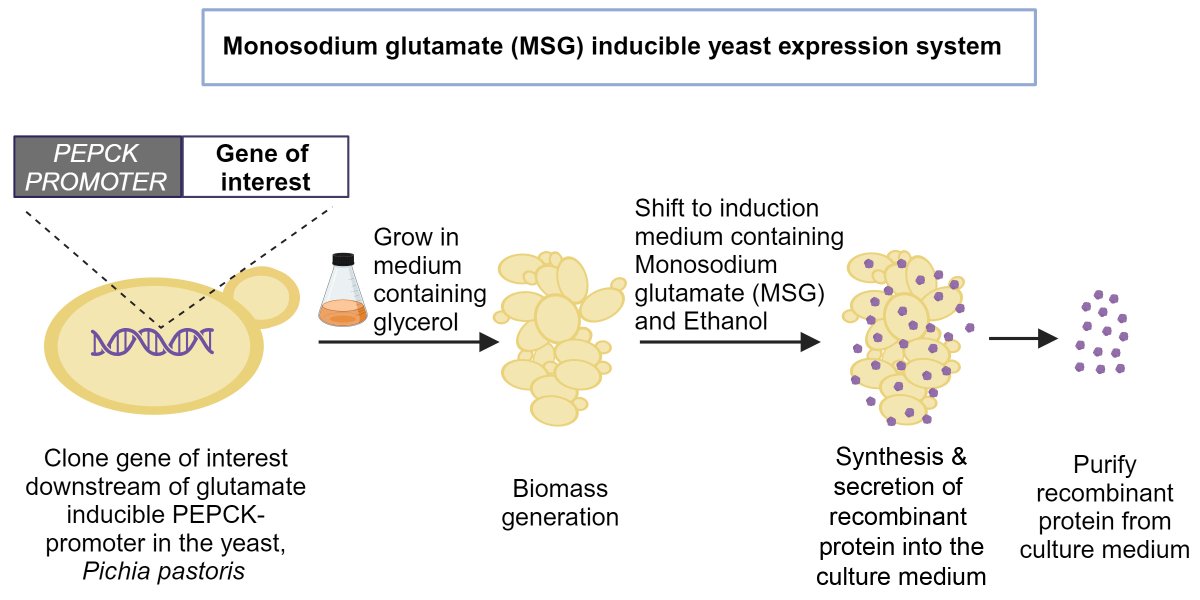
Excited to share that the second part of my PhD is now published in Nucleic Acids Research 🧬🎉
Huge thanks to Richa, Yash, and my supervisor Prof. P. N. Rangarajan 🙏
Now looking for postdoc & research opportunities 🚀
https://t.co/NAHoCPZJro
@BICS_IISc@iiscbangalore
WORST EXPERIENCE ! Wasted my 90 mins starving. My order was cancelled automatically after 90 precious minutes. No assistance from Zomato. What about Consumer's precious time and rights?
@zomato@zomatocare@Deepin@jagograhakjago
Researchers @BICS_IISc have developed a novel, safe method for mass producing recombinant proteins that relies on a common food additive called mono-sodium glutamate (MSG).
🔗 https://t.co/QDMEfOMYJw
#IIScresearch
Glad to share our recent article appearing in MICROBIAL CELL FACTORIES on the development of a glutamate inducible Pichia pastoris yeast expression system for production of recombinant proteins
https://t.co/LyXtvBENhD
Worst experience @hyattatlanta@Hyatt My friend stayed here who was looted by Hyatt Atlanta manager Mr Carlos. She gave her card to write down the details for a refund of security deposit from hotel but instead he swiped the card to make a payment of 800 $. Where cn we complain?
This is how I advise my #PhD students to write research manuscripts (in case someone finds it helpful).
General points:
1. Research questions addressed by your manuscript are key and should guide you.
2. Don’t view your manuscript as an article. See it as a STORY.
3. Pick the writing style that is easily understood by a broader community. Make reading easy.
4. Most of data should get into the paper. If some doesn’t support the hypothesis, it still must be in the Suppl. Information. It must show the reproducibility limits.
5. Make the paper shorter, not longer. Cut out things that may sound like ‘bluff’ or ‘decoration’ of the story. Use well-defined terminology, don’t invent it unless clearly necessary.
6. Focus on reporting & explaining the numbers. Minimize discussions of qualitative outcomes and your imagination.
▫️
Specific steps:
1️⃣ First, formulate and polish the key questions that your study addresses. It may take hours or even days (even though you've been doing research in this area for years). A single study should address no more than 1-3 key questions. It’s your perfect start for writing.
2️⃣ Write down the structure of your STORY first: Sections and Subsections that will answer those questions. Into each subsection, put 1-2 sentences that formulate the message(s) from this subsection. It will hugely help you navigate the manuscript later and save a lot of time.
3️⃣ Write approximate messages in the conclusion section. Usually, no more than 1-4 sentences.
▫️
At this point, SHARE your [structure+questions+messages] document with your advisor for feedback. Toss it back and forth until you both converge. You can also include major collaborators if needed.
▫️
4️⃣ Write the introduction part. Put down the paragraphs that introduce a reader into the key question(s) of the manuscript and the background of your story.
5️⃣ Write the main text for each section, smoothly and firmly. Each paragraph should add a separate value and end with a message-like sentence. Follow the “First… Second… Third…” structure for paragraphs when possible, it gives rigor and readability to your story.
6️⃣ Write the conclusions. Add a broader perspective that is justified and not generic.
7️⃣ Write the abstract. It must have simple terminology and clearly explain what readers can find inside the paper. It also should contain the key conclusions.
8️⃣ Write up 4-5 different titles and spend >30 mins with your team discussing which title sounds best.
Finally, iterate on the resulting draft within your team.
The number of drafts can easily exceed 20.
▫️
❗In addition, I always emphasize that a high quality of your research paper:
- sharpen your writing and analytical skills.
- shapes your reputation.
- shows who you are as a researcher and communicator.
▫️
p.s. Everyone has a different style of advising and writing. You can adopt only some specific steps if you find them helpful.
p.p.s. Another way that we sometimes use is by starting with figures ('story in figures' style).
#AcademicTwitter #AcademicChatter