A new study in Annals of Neurology shows that plasma P-tau217 detects Alzheimer co-pathology in Lewy body disorders and predicts cognitive decline in Parkinson's disease. Using a University of Pennsylvania longitudinal cohort — 46 PD and 10 DLB autopsy cases plus 173 clinical PD and 64 controls — investigators found P-tau217 higher in cases with AD co-pathology (median 0.3 vs 0.1, p<0.01) and discriminated co-pathology with an AUC of 0.84. Higher baseline P-tau217 was associated with faster dementia-rating decline and a 1.6-fold risk of cognitive progression (HR 1.597, p=0.003). The findings position plasma P-tau217 as a candidate stratifier for Lewy body disorder trials. https://t.co/CetfYttViU
New work in Alzheimer's & Dementia analyzes the Lifestyle for Brain Health (LIBRA) index across 149,948 adults aged 20–75 in the population-based German National Cohort (NAKO). Behavioral and psychosocial risks — smoking, physical inactivity, depression — clustered in younger adults, while cardiovascular risks (hypertension, coronary heart disease, hypercholesterolemia) dominated later life. Men carried higher LIBRA scores, and higher scores tracked with lower cognitive functioning and lower socioeconomic status across all age groups. The data extend modifiable dementia risk well before midlife and argue for earlier, equity-oriented prevention strategies rather than late-life-only frameworks. https://t.co/4rIZyynmXN
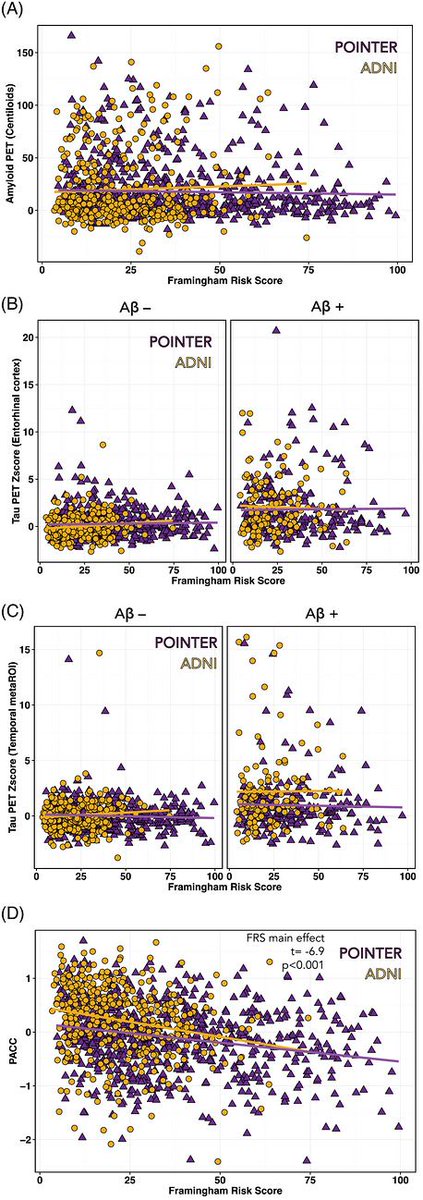
A new study in Alzheimer's & Dementia raises a generalizability flag for Alzheimer's disease biomarker models. Researchers harmonized health data, AD and cerebrovascular biomarkers, and cognitive performance between the community-recruited U.S. POINTER Imaging substudy and a matched sample from ADNI, which recruits primarily through academic specialty clinics. Elevated β-amyloid and tau tracked with cognition in ADNI but not in U.S. POINTER; the gap persisted across matching schemes and was not explained by vascular risk. The findings suggest Aβ–tau effects on cognition may be attenuated outside clinic-enriched samples — an important calibration point for biomarker-guided research. https://t.co/G7rCEP0HGj
New work in Alzheimer's & Dementia (SPRINT Pulse Wave Velocity substudy) tracks how blood pressure control reshapes the link between arterial stiffness and later cognitive impairment. Across 614 participants with 90 cognitive impairment events over 10 years, reductions in load-dependent pulse wave velocity under intensive BP control mapped to a 21% lower risk of cognitive impairment, while each 1 m/s rise in total or structural stiffness was associated with an 11–12% higher risk. The findings position vascular stiffness as a modifiable substrate for dementia prevention rather than a passive marker, and add precision to where antihypertensive benefit accrues. https://t.co/aLzUvT0rYZ
A new JAMA Neurology study develops and validates a plasma-based biological staging model for Alzheimer disease, designed to mirror the amyloid+tau PET-based staging from the revised Alzheimer's Association criteria. Using two longitudinal cohorts — BioFINDER-2 as the main cohort and the Knight ADRC for independent validation, spanning cognitively unimpaired, MCI, and dementia participants — the authors combine plasma endogenously cleaved MTBR-tau243 with %p-tau217 to estimate disease stage non-invasively. A Knight ADRC subsample carried neuropathological data, enabling biomarker-stage agreement to be benchmarked against autopsy findings. The approach offers a path to scalable, lower-burden AD staging beyond specialized PET infrastructure.
https://t.co/57WPirsFtw
A new Neurology population-wide cohort study used Swedish national registers (5,764 individuals starting their first antiseizure medication after dementia and epilepsy diagnoses, 2006–2023) to compare survival across the four most common ASMs. After adjusting for age, sex, year of start, and comorbidities, valproate (n = 746) was linked to higher all-cause mortality (aHR 1.34; 95% CI 1.20–1.48), while lamotrigine (n = 922; aHR 0.84; 0.75–0.93) and levetiracetam (n = 2,098; aHR 0.93; 0.85–1.03) showed lower or similar risk. Valproate also carried elevated cardiovascular mortality. The findings reinforce caution with valproate and support newer ASMs in dementia.
https://t.co/qBEEesnkpI
A new Neurology study from the Vanderbilt Memory and Aging Project followed 750 stroke- and dementia-free older adults (mean age 68, 52% female) over an average of 4.9 years to test MRI-visible perivascular spaces (PVS) as a marker of cognitive decline. Higher baseline basal ganglia PVS burden was associated with worse longitudinal performance across naming, processing speed, executive function (β = −9.51; 95% CI −14.33 to −4.68), visuospatial skills, and episodic memory. In head-to-head comparisons against white matter hyperintensities, lacunes, and microbleeds, basal ganglia PVS remained independently linked to executive and visuospatial decline, supporting PVS as a domain-specific small vessel disease marker.
https://t.co/U3AYyMXW3c
A new JAMA Neurology cohort study examines how age at Parkinson’s disease onset relates to the yield of genetic testing and the likelihood of a positive family history in carriers of pathogenic variants. The authors stratify carriers by age at onset and quantify how often a relevant family history is identifiable, helping to clarify which PD subgroups are most likely to benefit from a targeted genetic workup. The work informs clinical genetics referral patterns and supports a more age-aware approach to identifying monogenic and high-risk forms of PD, with implications for emerging genotype-stratified disease-modifying trials.
https://t.co/Tfd0zjEZvQ
New work in Acta Neuropathologica profiles alpha-synuclein biochemistry and seeding activity across clinically defined Parkinson’s disease subgroups. Using autopsy-confirmed PD cases versus matched controls, and stratifying into early-onset (<60 years), late-onset fast-progressing (<5 years duration), and late-onset slow-progressing (>10 years duration), the team found pSer129-aSyn elevated in PD detergent-insoluble fractions, with total aSyn highest in late-onset disease. FRET-based biosensor cells and seed amplification assays revealed the strongest seeding activity in late-onset and slow-progressing PD, and seeding activity correlated with pSer129-aSyn levels. The findings link aSyn molecular heterogeneity to clinical disease diversity.
https://t.co/OHtWvbLRTD
A new JAMA Neurology methodology paper evaluates the quantile-aggregation approach for Alzheimer disease randomized trials, an approach that pools treatment effects across cognitive, functional, and biomarker endpoints. Using both simulated datasets and publicly available AD trial data, the authors characterize when the method increases statistical power for detecting cross-domain effects and when its assumptions can mislead interpretation. The work clarifies practical conditions for its appropriate use in dementia trial design and informs statistical strategy for trials seeking composite endpoints. The analysis helps trialists choose more defensible aggregation schemes for upcoming AD studies.
https://t.co/Y2MjsneQfh
A new Acta Neuropathologica study asks why people with advanced Alzheimer pathology (Braak stage V) show such different cognitive trajectories. Quantitative imaging of frontal and temporal cortex in 61 autopsy cases showed neocortical p-tau burden ranging from 0.2% to 53.7%. In multivariable analysis only p-tau burden and microinfarcts independently predicted cognitive decline; amyloid, LATE-NC, and Lewy body pathology did not. Individuals with low burden (≤13%) maintained markedly better cognitive trajectories over the final 15 years of life than those with high burden (≥23.5%). The work supports neocortical tau quantification as a closer correlate of dementia severity than staging alone.
https://t.co/UJKeXS4dn8
A Neurology study from the International Collaborative Gaucher Group Registry estimates age-specific Parkinson disease risk in 1,618 patients with Gaucher disease type 1 (median age at last follow-up 47.8 years; 53% female). Fifty-one patients received a clinical PD diagnosis and 86 met a liberal possible-parkinsonian-syndrome (pPS) definition that combined motor and nonmotor signs with PD/DLB diagnoses. Kaplan-Meier age-specific prevalence (95% CI) reached 4.0% (2.7–5.7) for PD and 6.0% (4.5–7.9) for pPS by age 60, rising to 12.2% (8.6–17.0) and 22.9% (17.1–30.1) by age 80. The authors report that most patients remained PD-free despite very low residual β-glucosidase activity, informing genotype–phenotype models. https://t.co/RqjpIAtjto
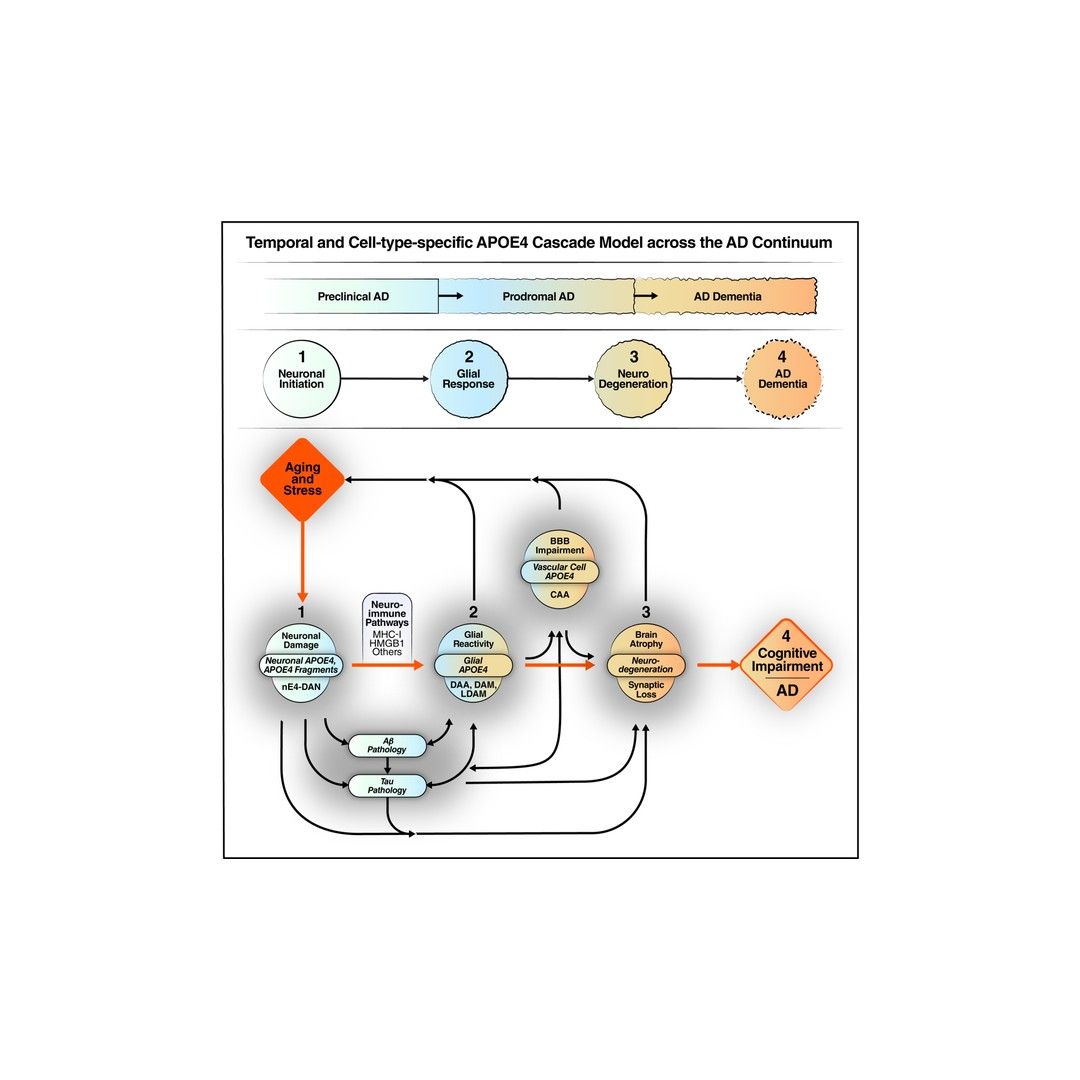
A new Neuron review proposes a temporal, cell-type-specific model of how APOE4 contributes to Alzheimer-disease progression. The authors synthesize current findings to argue that age-associated stress first upregulates neuronal APOE4 expression, producing early neuronal deficits characteristic of preclinical AD; APOE4-induced neuronal damage then triggers a harmful glial response that, together with glial APOE4 expression, amplifies neurodegeneration and accelerates onset of prodromal and dementia stages. The framework links cell-type expression patterns to disease timing across preclinical, prodromal, and dementia stages and motivates stage- and cell-type-specific therapeutic strategies targeting APOE4-driven mechanisms. https://t.co/ddYMSOaMgI
A new Acta Neuropathologica autopsy study characterizes co-pathologies in 63 adults with Down syndrome over age 40 (55 with dementia, 8 without), using NACC standardized neuropathology forms. Pure Alzheimer-disease neuropathological change was present in only 29% of individuals. Cerebral amyloid angiopathy was the most common co-pathology at 84%, followed by Lewy pathology 21%, hippocampal sclerosis 19%, and LATE-NC 17%. Brain weight was lower in individuals with dementia than without (900 ± 116 vs 1060 ± 108 g, P = .0006). LATE-NC and hippocampal sclerosis occurred exclusively in the dementia group. The data document the co-pathology profile of Down-syndrome–associated AD and suggest some individuals show resilience despite ADNC. https://t.co/UIUteduiz1
A JAMA Neurology study tested whether accelerometer-derived sleep-wake cycle metrics improve dementia risk prediction in adults aged 60+. Derivation in UK Biobank (n=53,448, mean age 67.5, 54.2% female, mean follow-up 7.8 years) and validation in Whitehall II (n=3,965, mean age 69.4, 25.9% female, 10.6-year follow-up) combined nine metrics into two components. Component 1 (less moderate-to-vigorous activity, more low-intensity time) and component 2 (more extreme sleep durations, longer nocturnal wake bouts) were each associated with incident dementia: HR 1.43 (95% CI 1.33–1.54) and HR 1.10 (95% CI 1.04–1.17). Adding the components improved C-index by 0.018 (95% CI 0.011–0.025), a contribution the authors describe as equivalent to APOE genotype. https://t.co/MhJYbezxJq
A new Acta Neuropathologica study tests a plasma protein signature for cerebral amyloid angiopathy (CAA), a condition reported in more than 90% of Alzheimer-disease brains and a major risk factor for amyloid-related imaging abnormalities on anti-amyloid therapy. Using the NULISA CNS panel on antemortem plasma from the Banner Sun Health Brain and Body Donation Program (N=251, discovery) and UC Irvine ADRC (N=110, validation), a five-protein model (CRP, IL4, CCL11, NPY, PDLIM5) plus demographics achieved AUC 0.90 (95% CI 0.86–0.94) for neuropathologically confirmed CAA. The signature outperformed a demographics-only model in independent replication and points toward a blood-based path to antemortem CAA detection. https://t.co/1J89kqcHnR
A new Acta Neuropathologica study tests whether APOE ε4, long implicated in pathological protein spread across neurodegenerative disease, also modifies TDP-43 distribution in sporadic ALS. Across 145 autopsy-confirmed sporadic ALS cases, researchers classified TDP-43 pathology into type 1 (motor-restricted) and type 2 (widespread cortical) subtypes, paired with APOE genotyping, exome sequencing of ALS genes, and amyloid-β/tau staging. APOE ε4 carriers showed a higher proportion of the widespread type-2 subtype; Bayesian structural equation modeling identified a direct APOE-ε4 → type-2 link independent of amyloid-β and tau pathways. The data position APOE genotype as a candidate stratifier in ALS subtype research. https://t.co/unz2sPflSN
An Alzheimer's & Dementia review synthesizes evidence on bidirectional NAD+-circadian-rhythm coupling in dementia pathogenesis. Postmortem brain tissue from 18 AD and 15 controls showed blunted circadian oscillations of NAD+, NADH, and sirtuins in the suprachiasmatic nucleus. AD brains exhibited reduced NAMPT (rate-limiting NAD+ synthetic enzyme) and impaired NAD+ biosynthesis. NAD+ depletion sensitized neurons to amyloid-beta toxicity; NAD+ supplementation restored sirtuin activity and autophagy. Circadian-NAD+-rhythm coupling offers a mechanistic framework linking sleep disruption, metabolic dysfunction, and neurodegeneration in AD.
https://t.co/vK6sUdBgEk
#Alzheimers #Neurodegeneration
An Alzheimer's & Dementia study integrates in-vehicle GPS trajectories with points-of-interest data to quantify daily environmental engagement and predict cognitive decline in older drivers. In 438 cognitively normal DRIVES Project participants, latent-class analysis identified three mobility phenotypes (home-centered, community-engaged, transitional). Cognitive decline over 3 years was steepest in home-centered group (MMSE −1.8 points/year vs. −0.7 in community-engaged, p=0.03). Reduced mobility preceded cognitive downturn by 6−12 months. These digital-phenotype biomarkers offer real-world proxies for neurodegeneration and intervention targets.
https://t.co/5i4lhFQbuG
#Dementia #Neurodegeneration