Someone sneezed so I said bless you & then I sneezed literally a minute later & she didn’t say it back. Be careful out there guys there’s a lot of evil spirited people walking among us in society
i love that our generation managed to kill the stereotype that if you have tattoos, you won’t be able to find a job.
now nobody can find a job, whether you have tattoos or not.
Not many white people rocked The Apollo but Lisa Stansfield was one of them. The energy in the building was crazy. The “I didn’t know she was white” hall of fame!
…flirted with a man @ 15 and he was 24, he stopped me and explained that no healthy adult is interested in a child. I’m older now ,Hope your pillow is always cool King
A glimpse at Jamaica’s beautiful folk culture, an Augus MAWNIN celebrations.
Happy Emancipation Day from Seville, St Ann, a place of significant Taino and Spanish heritage in 🇯🇲
The baby is only part of the birth. There's another birth that almost nobody talks about. The PLACENTA. For 9 months, your body grows an entirely new organ, an organ with one job keeping your baby alive. It delivers oxygen, nutrients, hormones, filters waste and connects two completely different circulatory systems without ever mixing your blood. Then, minutes after your baby is born that organ detaches from the wall of your uterus, and when it does, it leaves behind a wound roughly the size of a dinner plate. About 10 cm across, that is why you bleed after birth, because your body is healing a wound. At the same time, your uterus, which stretched enough to hold an entire baby, is working around the clock to shrink back down to its pre pregnancy size. Those after pains you're feeling those contractions, they are your uterus, squeezing itself smaller while compressing hundreds of open blood vessels to stop the bleeding. Now imagine this. If you had a wound that size anywhere else, on your body, on your arm, on your leg, your back, would anyone expect you to be back at work in a week? Would anyone expect you you to entertain visitors? Cook meals, carry a baby day and night smile for photos and get your body back, of course not. You'd probably be in the hospital on a drip. People would tell you to rest up. They'd expect weeks of recovery, yet when that exact wound is hidden inside your body, the world acts as though you should be back to normal almost immediately. 6 weeks later, you go for your postpartum, check up. Many women think it's a milestone that says, wow, you've recovered. It isn't. It's simply checking whether the bleeding has stopped, whether the placental wound has healed and whether your uterus is recovering as expected. It is not a certificate that says your body, brain, hormones, identity or even nervous system have all returned to normal. So if you've ever been wondering, why haven't I bounced back yet? Here's the better question why were you ever expected to bounce back from something this enormous in the first place? Your body is recovering from one of the most extraordinary healing processes a human being can experience. Give yourself some time and space to recover.
I know, with increasing precision, what I want my life to contain. Meaningful work. Financial ease. A home that feels expansive and alive. Books everywhere. A table with people around it. Work that travels further than I do. Time to think. Time to write.
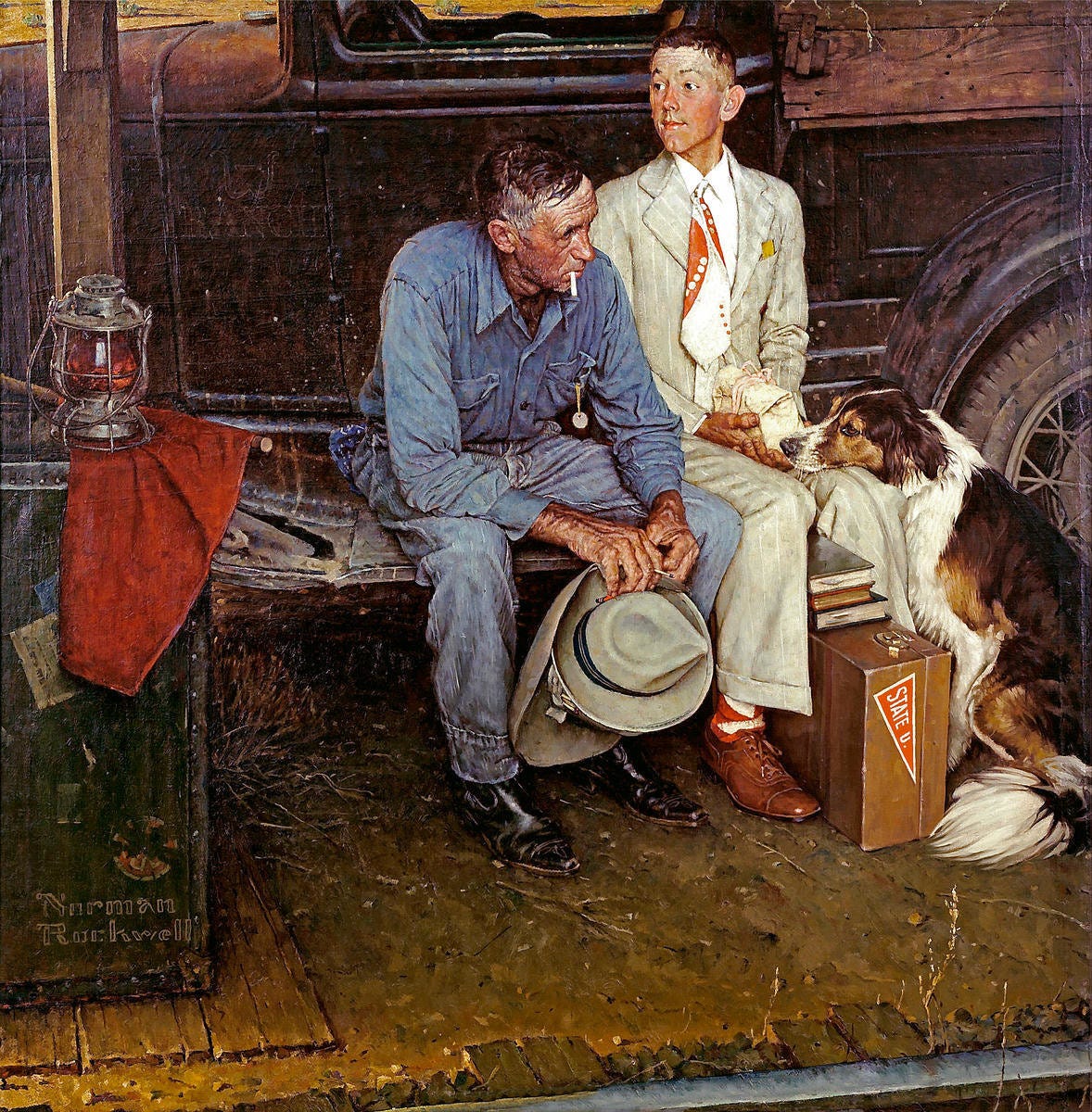
This is one of the most beloved paintings in America, and it puts its finger on something we all pass through, first as the child, and one day as the parent left behind...
The painting is Breaking Home Ties, by Norman Rockwell, on the cover of the Saturday Evening Post in 1954. A father and his teenage son sit side by side on the running board of a battered farm truck, waiting at a railway stop. A single track runs along the bottom of the picture. A ticket pokes from the boy's pocket. His suitcase is stacked with schoolbooks and wears a "State U" pennant. The train is coming to carry him off to college, away from home, for the first time in his life.
Everything is in the way they sit.
The son sits upright, scrubbed and dressed in his best, eyes fixed on the horizon, on the track, on the future rushing toward him. He is already half gone. For him that train is the beginning of everything.
His father sits beside him in worn work clothes and scuffed boots, looking the other way, down the line, as if he cannot bear to watch it arrive. The same train means the opposite thing to him. For the son it is the start of a life. For the father it is the day the house grows quieter, the chair at the table sits empty, and the person he built his world around walks out into a life that no longer has him at its centre.
Look at his hands. He is holding two hats. His own battered one, and resting on top of it, his son's crisp new one, held carefully together, because it is the last small thing he can still do for the boy...
And then the dog, its head laid in the son's lap, gazing up, refusing to look away. Rockwell knew exactly what that was for: "The father couldn't show how he felt about the boy's leaving," he said. "The dog did."
It has moved people for 70 years because every leaving is a beginning for one person and an ending for another. The child steps out into the world, as they should. And someone stays behind, watching them go, and loving them enough to let them go anyway...
Today i told my little sister that the complex she was looking at wasnt any dibbi dibbi complex and she asked me what's dibbi dibbi and I had to hang up.
Maturing is realizing they never burned witches. They burned midwives, healers, herbalists, and knowledgeable women.
Women who understood medicine, nature, and their own autonomy. Women whose knowledge threatened patriarchal control. The "witch hunts" were never about magic, they were about silencing women who couldn't be controlled.
I saw a post on Reddit that said that “The underlying purpose of AI is to allow wealth to access skill while removing from the skilled the ability to access wealth.” And I don’t think I’ve ever seen AI described so incisively.
I think if authors are too poor to survive piracy and readers are too poor not to pirate then we need to have a really serious conversation about where all that money is and why it isn't circulating properly.