@jimiuorio@CaryKelly11 Seed oils and the so-called "whole grains" full of rancid grain oils. But don't just go by what I say, here you go! Oil Crop Science journal "Lipid oxidation in food science and nutritional health: A comprehensive review". https://t.co/p5zK3bj8lu
@ScottAppliedSci Specifically cholesteryl linoleate. Delivery via lipoproteins. Guided by ApoB to the artery wall. Linoleate subsequently oxidizes leading to foam cells.
Remove linoleate from the diet. No more plaque buildup. @DrAseemMalhotra@GadSaad
My AI doom scenario:
AI is successfully captured by governments. It is good enough to be extremely useful to them in maintaining control of their populations, but not good enough to bring about radical innovation and transformative growth. It is kept in this state intentionally, since radical change is a threat to the incumbent power structure. All compute is centrally monitored so no one can advance the field further.
Dissent becomes functionally impossible due to AI-powered censorship. Given the politics of the people who want to capture AI, this means further mass migration, degrowth climate policies, an ever-increasing regulatory burden, and ubiquitous anti-White discrimination in the name of equity.
To a doomer, even a right wing doomer, this would be a relatively good outcome because we haven’t all been gunned down by terminators. I don’t think it’s a good outcome and I want to prevent it.
The world is, and has always been, a race between the chaotic forces of growth and the centralizing forces of control and stability. I want growth to win. AI has the potential to shatter existing global power structures and allow something new to grow in their place.
Speed of change is the only defense against parasitism, control, decay. Change so fast that they can’t keep up. AI will either end the evil dream of centralized control once and for all, or, if the controllers manage to capture AI, cement it for all time.
Hence, acceleration. I want more open source, more competition, more diffusion. I want us to print so much compute that everyone can run frontier models on their desktops. I want power too cheap to meter. I want the scales to finally and decisively tip towards explosive chaotic growth and end the possibility of closure forever.
@CaryKelly11 Yes, The 1980s surge in HFCS lines up with the period when MASLD/NAFLD rates began rising sharply!
Seed oil too. Seed oil takes off in the mid 90s with the introduction of MAP packaging. The seed oil link to MASLD is well supported in the small animal research.
Rolled oats are made from an intermediary industrial processed "groats". After harvest the hull is removed from the oat berry, it is then steamed for 20 minutes (enzyme inactivation), followed by a kiln dry cycle (water activity control). This dead grain then goes into long-term storage waiting for a buyer.
Later in time, these groats are transformed into commercial cereals like flakes and Cheerios. Again, the grain is first steamed to soften, it's then shaped into the commercial product, followed by a kiln dry cycle for water activity control and deodorization. Intermediary whole grain products like groats often have rancid odors so they're always deodorized in the final product before it hits the store shelf.
@jaytayscience@TuckerGoodrich I provided the science straight from the horse's mouth. The Oil Crop Science Journal funded by The grain and seed oil industry. Commercially available whole grains are full of rancid seed oil.
I'm actually a grain fanatic, I mill flour and flakes fresh at home. Easy peasy.
For secondary risk, efficacy is significantly less than 50%. Most patients will see zero benefit.
I'n my personal experience, one year post heart attack, I was back in the hospital for more stents, including a stent inside of a clogged stent.
Reliance on LLT alone is a fools errand.
If you're walking around with insulin resistance (indicated by high TRIG, VLDL, + A1C in combination with low HDL), then you're in a much higher risk category. No amount of statins can move a high risk patient to the low risk category.
Dietician: "You can't cut carbohydrates. They're an essential part of a balanced diet."
Patient: "How many essential amino acids are there?"
Dietician: "Nine."
Patient: "Essential fatty acids?"
Dietician: "Two."
Patient: "Essential carbohydrates?"
Dietician: "Your brain runs on glucose."
Patient: "Which my liver makes. How many?"
Dietician: "Whole grains provide energy."
Patient: "So does dinner. How many?"
Dietician: [turns a page, then turns it back]
The reference manual on her own shelf gives the minimum carbohydrate intake compatible with life. It has said zero since 2005.
@drjamesdinic I'll add bone density loss, loss of balance, falls, unsteady gate, general feeling of unwellness, irregular heartbeat, hospitalization for hyponatremia, and death.
I'll add an irresistible craving for ultra processed salty junk food.
@Will52773T@ScottAppliedSci I'm not questioning the efficacy of statins or other LLT therapies with proven risk reductions.
I'm stating the fact that you will not achieve low risk unless you change up your diet in addition to whichever LLT therapy you choose to follow.
@jaytayscience@CaryKelly11 Chips are permanently off my diet, I don't care If they're cooked in magical unicorn Tallow.
I like to roast cut up root crop veggies in the oven with butter, olive oil, salt and a sprinkle of herbs like oregano.
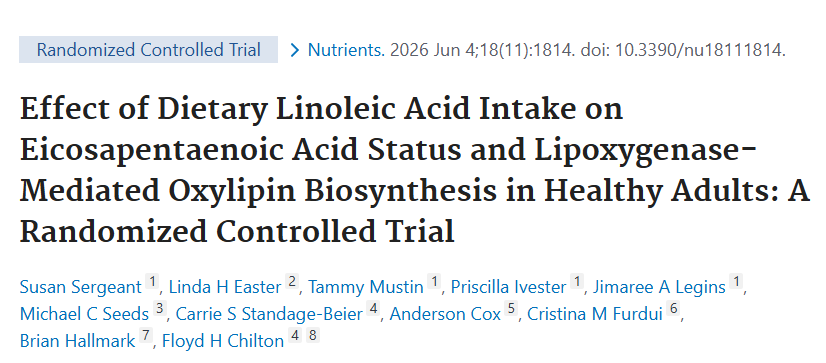
"higher dietary LA markedly increased the ratios of ARA to EPA and ARA- to EPA-derived oxylipin species, shifting the lipid mediator balance toward a more n-6-dominant inflammatory profile"


![SamaHoole's tweet photo. Dietician: "You can't cut carbohydrates. They're an essential part of a balanced diet."
Patient: "How many essential amino acids are there?"
Dietician: "Nine."
Patient: "Essential fatty acids?"
Dietician: "Two."
Patient: "Essential carbohydrates?"
Dietician: "Your brain runs on glucose."
Patient: "Which my liver makes. How many?"
Dietician: "Whole grains provide energy."
Patient: "So does dinner. How many?"
Dietician: [turns a page, then turns it back]
The reference manual on her own shelf gives the minimum carbohydrate intake compatible with life. It has said zero since 2005.](https://pbs.twimg.com/media/HS025hvWUAAX05U.jpg)