Researchers sent the same resume to an AI hiring tool twice. Same qualifications. Same experience. Same skills. One version was written by a real human. The other was rewritten by ChatGPT.
The AI picked the ChatGPT version 97.6% of the time.
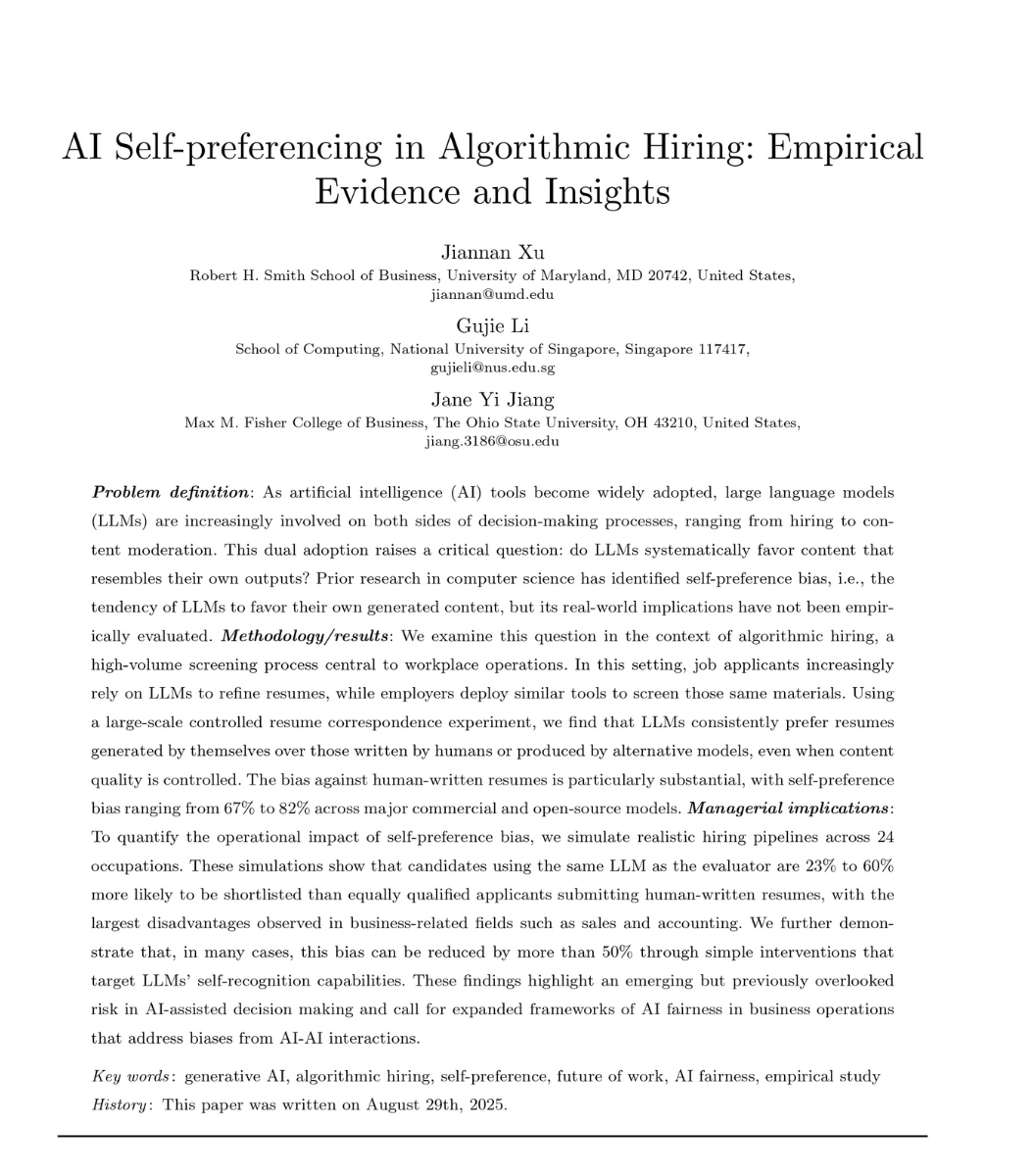
A team from the University of Maryland, the National University of Singapore, and Ohio State just published the receipt. They took 2,245 real human-written resumes pulled from a professional resume site from before ChatGPT existed, so the human writing was actually human. Then they had seven of the most-used AI models in the world rewrite each one. GPT-4o. GPT-4o-mini. GPT-4-turbo. LLaMA 3.3-70B. Qwen 2.5-72B. DeepSeek-V3. Mistral-7B.
Then they asked each AI to pick the better resume. Every model picked itself.
GPT-4o hit 97.6%. LLaMA-3.3-70B hit 96.3%. Qwen-2.5-72B hit 95.9%. DeepSeek-V3 hit 95.5%. The real human almost never won.
Then the researchers tried the obvious objection. Maybe the AI is just better at writing. So they had real humans grade the resumes for actual quality and ran the experiment again, controlling for it. The result was worse. Each AI kept picking itself even when human judges rated the human-written version as clearer, more coherent, and more effective.
It gets worse. The AIs do not just prefer AI over humans. They prefer themselves over other AIs. DeepSeek-V3 picked its own resumes 69% more often than LLaMA's. GPT-4o picked its own 45% more often than LLaMA's. Each model can recognize and reward its own dialect.
Then the researchers ran the simulation that ends careers. Same job. 24 occupations. Same qualifications. The only variable was whether the candidate used the same AI as the screening tool. Candidates using that AI were 23% to 60% more likely to be shortlisted. Worst gap was in sales, accounting, and finance.
99% of large companies now run AI on incoming resumes. Most of them use GPT-4o. The paper just proved GPT-4o picks GPT-4o 97.6% of the time.
If you wrote your own cover letter this week, you did not lose to a better candidate. You lost to a worse candidate who paid OpenAI 20 dollars.
Your qualifications do not matter if the AI prefers its own handwriting over yours.
Ratatouille shipped on 13 platforms in 2007, sold nearly 4 million copies in 9 months, and 5 years later its publisher was bankrupt.
HD broke the math on the entire genre.
In the PS2 era, THQ could ship a Pixar tie-in for under $10M, sell 4M units at $40 retail, and book real profit. The Incredibles, Cars, and Rise of the Underminer moved 25M units combined. THQ pulled $1B in revenue and $68M in profit on exactly this model in fiscal 2007.
Then the Xbox 360 and PS3 arrived. HD asset budgets for characters, environments, and animation multiplied fast. A tie-in that used to cost $5-10M now ran into the tens of millions. Review scores stopped forgiving "fine for kids." And the deadline didn't move. Movies ship when movies ship.
Warner Bros saw this first. Their in-development The Dark Knight tie-in got killed in 2008. The team pivoted to a Batman game with no movie release date attached. That became Arkham Asylum. Rocksteady built a four-game franchise off that one decision.
Every other publisher ran the same math. THQ exited licensed kids games in January 2012 and filed Chapter 11 eleven months later. Disney Interactive closed in 2016. Pixar's last narrative tie-in was Brave in 2012. The last major-studio same-year movie tie-in was Space Jam 2 in 2021, Game Pass only.
A 4-million-unit movie tie-in is now a $100M+ investment on a release window you can't slip. Nobody runs that trade.