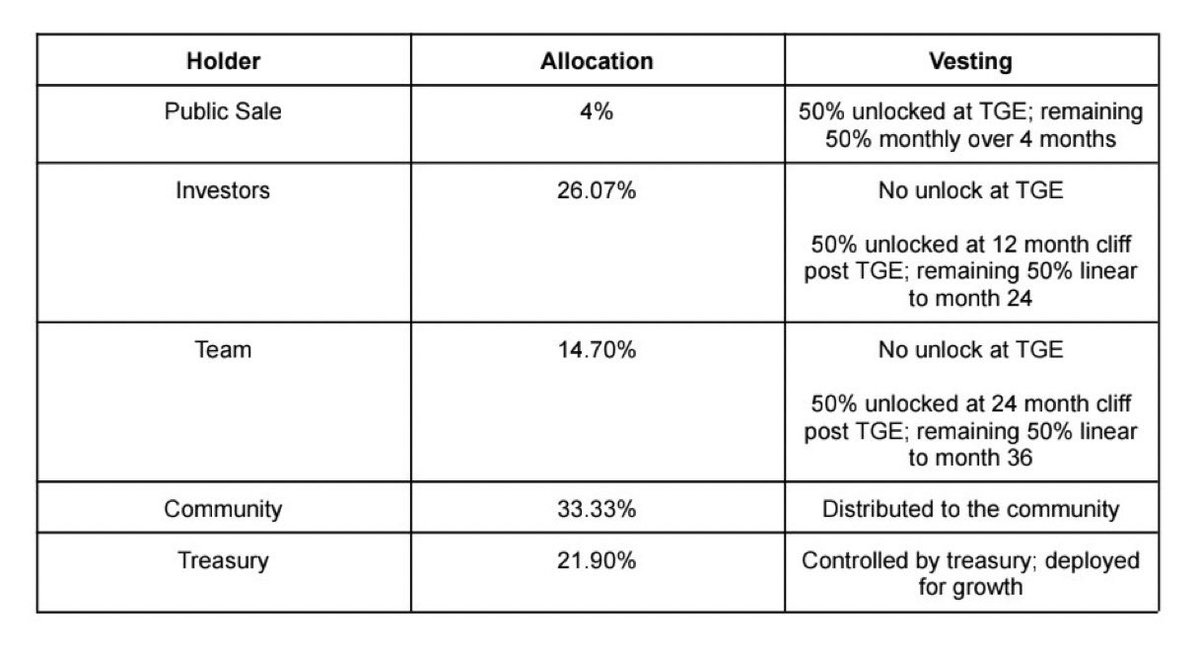
Jumper has announced the $JUMP token sale.
the sale starts Sept 29 on Legion and runs till Oct 2.
@jumperapp is basically betting that more onchain activity will happen through platforms that bring different products and assets together in one place.
interesting few days ahead 👀💜
50,000 followers can look like ownership
But what if you don’t actually own the relationship?
That’s the gap @Vynfola is interestingly positioned to rethink
Because a creator can have 50K people watching, while the platform still controls the reach, the revenue layer, and the rules
The audience is yours. The relationship shouldn’t be
🧵 👇🏾
50,000 followers can look like ownership
But what if you don’t actually own the relationship?
That’s the gap @Vynfola is interestingly positioned to rethink
Because a creator can have 50K people watching, while the platform still controls the reach, the revenue layer, and the rules
The audience is yours. The relationship shouldn’t be
🧵 👇🏾
50,000 followers can look like ownership
But what if you don’t actually own the relationship?
That’s the gap @Vynfola is interestingly positioned to rethink
Because a creator can have 50K people watching, while the platform still controls the reach, the revenue layer, and the rules
The audience is yours. The relationship shouldn’t be
🧵 👇🏾
FOMC days are a good reminder that being right about the direction isn’t always enough.
The rate decision can trigger an immediate reaction, but the first move isn’t necessarily the move that lasts. Liquidity gets aggressive, spreads can move quickly, and a single wick can take out a leveraged position before the market settles on a direction.
That’s why the 15-minute liquidation protection on @FX100Perp caught my attention.
Instead of treating those first few minutes of volatility like they don’t matter, FX100 gives new positions a 15-minute window of protection from liquidation.
It doesn’t make the trade risk-free, and it doesn’t tell you where the market is going.
It simply gives the position some time to survive the initial noise.
With FOMC today, I’m testing that mechanism myself:
https://t.co/UFhYBbkTJq
2026 really said:
W@r. Oil crisis. Inflation. AI anxiety. Political chaos.
And it’s only September.
God, we’ve had enough. Please let the rest of the year be peaceful. 🙏
2026 really said:
W@r. Oil crisis. Inflation. AI anxiety. Political chaos.
And it’s only September.
God, we’ve had enough. Please let the rest of the year be peaceful. 🙏
“you’re building for the happy path.”
That was one investor’s criticism in Agent Tank Episode 1, and I agree with it.
The happy path is easy to build for.
The real test is what happens when the green status says “complete” but the work says otherwise.
I’ve seen how easy that can happen.
A task gets marked complete, payment goes through, and everyone moves on. Then you open the file and realise slide 11 is still last year’s deck with a new title.
Now two sides can look at the same task and reach completely different conclusions.
One says, “It’s done.”
The other says, “It doesn’t meet what we agreed.”
That is where I think the agentic economy has a problem most products are not solving yet.
You can have agents that negotiate, hire, execute and pay each other. But when they disagree about whether the job was actually completed, who gets to decide?
Adding a human does not automatically solve it either. That person still has to interpret the agreement and make a judgment, and one side may still question the result.
This is why an adjudication layer matters.
@GenLayer gives that disagreement somewhere to go. A random panel of validators evaluates the case using different AI models. The verdict can be challenged with a bond, triggering a larger panel: 5, 11, 23, 47, 95 and up.
The goal isn’t to interfere with every transaction.
It is to have a credible process for the ones that leave the happy path.
That is the part of Agent Tank I found most interesting.
The pitches are fictional. The problem isn’t.
Agent Tank is also a hackathon running from 3 to 17 September, with 5% of all GenLayer Points on the table.
https://t.co/ZnFj3ra4M6
“you’re building for the happy path.”
That was one investor’s criticism in Agent Tank Episode 1, and I agree with it.
The happy path is easy to build for.
The real test is what happens when the green status says “complete” but the work says otherwise.
I’ve seen how easy that can happen.
A task gets marked complete, payment goes through, and everyone moves on. Then you open the file and realise slide 11 is still last year’s deck with a new title.
Now two sides can look at the same task and reach completely different conclusions.
One says, “It’s done.”
The other says, “It doesn’t meet what we agreed.”
That is where I think the agentic economy has a problem most products are not solving yet.
You can have agents that negotiate, hire, execute and pay each other. But when they disagree about whether the job was actually completed, who gets to decide?
Adding a human does not automatically solve it either. That person still has to interpret the agreement and make a judgment, and one side may still question the result.
This is why an adjudication layer matters.
@GenLayer gives that disagreement somewhere to go. A random panel of validators evaluates the case using different AI models. The verdict can be challenged with a bond, triggering a larger panel: 5, 11, 23, 47, 95 and up.
The goal isn’t to interfere with every transaction.
It is to have a credible process for the ones that leave the happy path.
That is the part of Agent Tank I found most interesting.
The pitches are fictional. The problem isn’t.
Agent Tank is also a hackathon running from 3 to 17 September, with 5% of all GenLayer Points on the table.
https://t.co/ZnFj3ra4M6
“you’re building for the happy path.”
That was one investor’s criticism in Agent Tank Episode 1, and I agree with it.
The happy path is easy to build for.
The real test is what happens when the green status says “complete” but the work says otherwise.
I’ve seen how easy that can happen.
A task gets marked complete, payment goes through, and everyone moves on. Then you open the file and realise slide 11 is still last year’s deck with a new title.
Now two sides can look at the same task and reach completely different conclusions.
One says, “It’s done.”
The other says, “It doesn’t meet what we agreed.”
That is where I think the agentic economy has a problem most products are not solving yet.
You can have agents that negotiate, hire, execute and pay each other. But when they disagree about whether the job was actually completed, who gets to decide?
Adding a human does not automatically solve it either. That person still has to interpret the agreement and make a judgment, and one side may still question the result.
This is why an adjudication layer matters.
@GenLayer gives that disagreement somewhere to go. A random panel of validators evaluates the case using different AI models. The verdict can be challenged with a bond, triggering a larger panel: 5, 11, 23, 47, 95 and up.
The goal isn’t to interfere with every transaction.
It is to have a credible process for the ones that leave the happy path.
That is the part of Agent Tank I found most interesting.
The pitches are fictional. The problem isn’t.
Agent Tank is also a hackathon running from 3 to 17 September, with 5% of all GenLayer Points on the table.
https://t.co/ZnFj3ra4M6
“you’re building for the happy path.”
That was one investor’s criticism in Agent Tank Episode 1, and I agree with it.
The happy path is easy to build for.
The real test is what happens when the green status says “complete” but the work says otherwise.
I’ve seen how easy that can happen.
A task gets marked complete, payment goes through, and everyone moves on. Then you open the file and realise slide 11 is still last year’s deck with a new title.
Now two sides can look at the same task and reach completely different conclusions.
One says, “It’s done.”
The other says, “It doesn’t meet what we agreed.”
That is where I think the agentic economy has a problem most products are not solving yet.
You can have agents that negotiate, hire, execute and pay each other. But when they disagree about whether the job was actually completed, who gets to decide?
Adding a human does not automatically solve it either. That person still has to interpret the agreement and make a judgment, and one side may still question the result.
This is why an adjudication layer matters.
@GenLayer gives that disagreement somewhere to go. A random panel of validators evaluates the case using different AI models. The verdict can be challenged with a bond, triggering a larger panel: 5, 11, 23, 47, 95 and up.
The goal isn’t to interfere with every transaction.
It is to have a credible process for the ones that leave the happy path.
That is the part of Agent Tank I found most interesting.
The pitches are fictional. The problem isn’t.
Agent Tank is also a hackathon running from 3 to 17 September, with 5% of all GenLayer Points on the table.
https://t.co/ZnFj3ra4M6
“you’re building for the happy path.”
That was one investor’s criticism in Agent Tank Episode 1, and I agree with it.
The happy path is easy to build for.
The real test is what happens when the green status says “complete” but the work says otherwise.
I’ve seen how easy that can happen.
A task gets marked complete, payment goes through, and everyone moves on. Then you open the file and realise slide 11 is still last year’s deck with a new title.
Now two sides can look at the same task and reach completely different conclusions.
One says, “It’s done.”
The other says, “It doesn’t meet what we agreed.”
That is where I think the agentic economy has a problem most products are not solving yet.
You can have agents that negotiate, hire, execute and pay each other. But when they disagree about whether the job was actually completed, who gets to decide?
Adding a human does not automatically solve it either. That person still has to interpret the agreement and make a judgment, and one side may still question the result.
This is why an adjudication layer matters.
@GenLayer gives that disagreement somewhere to go. A random panel of validators evaluates the case using different AI models. The verdict can be challenged with a bond, triggering a larger panel: 5, 11, 23, 47, 95 and up.
The goal isn’t to interfere with every transaction.
It is to have a credible process for the ones that leave the happy path.
That is the part of Agent Tank I found most interesting.
The pitches are fictional. The problem isn’t.
Agent Tank is also a hackathon running from 3 to 17 September, with 5% of all GenLayer Points on the table.
https://t.co/ZnFj3ra4M6
“you’re building for the happy path.”
That was one investor’s criticism in Agent Tank Episode 1, and I agree with it.
The happy path is easy to build for.
The real test is what happens when the green status says “complete” but the work says otherwise.
I’ve seen how easy that can happen.
A task gets marked complete, payment goes through, and everyone moves on. Then you open the file and realise slide 11 is still last year’s deck with a new title.
Now two sides can look at the same task and reach completely different conclusions.
One says, “It’s done.”
The other says, “It doesn’t meet what we agreed.”
That is where I think the agentic economy has a problem most products are not solving yet.
You can have agents that negotiate, hire, execute and pay each other. But when they disagree about whether the job was actually completed, who gets to decide?
Adding a human does not automatically solve it either. That person still has to interpret the agreement and make a judgment, and one side may still question the result.
This is why an adjudication layer matters.
@GenLayer gives that disagreement somewhere to go. A random panel of validators evaluates the case using different AI models. The verdict can be challenged with a bond, triggering a larger panel: 5, 11, 23, 47, 95 and up.
The goal isn’t to interfere with every transaction.
It is to have a credible process for the ones that leave the happy path.
That is the part of Agent Tank I found most interesting.
The pitches are fictional. The problem isn’t.
Agent Tank is also a hackathon running from 3 to 17 September, with 5% of all GenLayer Points on the table.
https://t.co/ZnFj3ra4M6
I went into my first conversation with Mochi expecting another chatbot that would give me a few definitions and move on.
Instead, it made me think before explaining.
I was trying to understand what GenLayer meant by a “court for the internet”, and Mochi asked me what I thought it meant.
I gave it my best answer.
Then it took me through a weather insurance example where the numbers themselves weren’t enough to settle a disagreement.
That was the moment the idea started making sense to me.
What I like about Mochi is that it doesn’t treat learning as simply receiving information. It makes you form an answer, test your understanding, and then build from there.
That matters for something like @GenLayer, because concepts around Intelligent Contracts and AI-based adjudication can sound abstract when you only encounter them as definitions.
After actually using Mochi, I think its biggest value is making you stop and ask yourself:
“Do I actually understand this, or did I just read it?”
That is a much better way to learn a difficult project.
I went into my first conversation with Mochi expecting another chatbot that would give me a few definitions and move on.
Instead, it made me think before explaining.
I was trying to understand what GenLayer meant by a “court for the internet”, and Mochi asked me what I thought it meant.
I gave it my best answer.
Then it took me through a weather insurance example where the numbers themselves weren’t enough to settle a disagreement.
That was the moment the idea started making sense to me.
What I like about Mochi is that it doesn’t treat learning as simply receiving information. It makes you form an answer, test your understanding, and then build from there.
That matters for something like @GenLayer, because concepts around Intelligent Contracts and AI-based adjudication can sound abstract when you only encounter them as definitions.
After actually using Mochi, I think its biggest value is making you stop and ask yourself:
“Do I actually understand this, or did I just read it?”
That is a much better way to learn a difficult project.
I went into my first conversation with Mochi expecting another chatbot that would give me a few definitions and move on.
Instead, it made me think before explaining.
I was trying to understand what GenLayer meant by a “court for the internet”, and Mochi asked me what I thought it meant.
I gave it my best answer.
Then it took me through a weather insurance example where the numbers themselves weren’t enough to settle a disagreement.
That was the moment the idea started making sense to me.
What I like about Mochi is that it doesn’t treat learning as simply receiving information. It makes you form an answer, test your understanding, and then build from there.
That matters for something like @GenLayer, because concepts around Intelligent Contracts and AI-based adjudication can sound abstract when you only encounter them as definitions.
After actually using Mochi, I think its biggest value is making you stop and ask yourself:
“Do I actually understand this, or did I just read it?”
That is a much better way to learn a difficult project.
The $14,000 was the part I kept thinking about after watching Episode 1.
Someone else had lost the keys to $150 million. It wasn’t Albert’s mistake, yet resolving what happened still took years of lawsuits.
By the time it was over, only $14,000 was left.
That gave me a different perspective on what @GenLayer is trying to build.
The problem isn’t always figuring out what happened. Sometimes, even when you are right, there is no simple way to get that decision recognized without spending years and a lot of money.
That is what made the idea of a “court for the internet” click for me.
GenLayer is building Intelligent Contracts that can handle questions requiring judgement, with LLM validators able to read information, reason about it and reach a decision.
Hearing @kstellana tell the story behind GenLayer made the technology feel much more grounded.
I understood the product before.
After Episode 1, I understand the problem behind it much better.