🎯 From Demo to Vision
The upcoming demo is more than a technical milestone—it is a concrete step toward a broader vision for ALUX.
At its core, ALUX is designed around composability: the ability to coordinate computation, state, and access across distributed systems in a unified and reliable way.
🧩 1. Composability of State Transitions
ALUX enables composable state transitions across two key dimensions:
⏳ Temporal composability — State transitions can occur across different blocks (over time) while still achieving atomic finalization. This is realized through cross-block atomic execution.
🌐 Spatial composability — State transitions can occur across different systems (e.g., shards) and still be finalized atomically, enabling true cross-shard execution and horizontal scalability.
🔐 2. Composability of Access Control
In ALUX, processes interact exclusively through unforgeable names, enabling what we call composable security.
Unlike traditional ACL-based systems, which struggle when multiple principals are involved, this model allows secure, flexible, and scalable coordination across many participants.
🖥️ Toward a Virtual Machine Abstraction
These two forms of composability form the foundation of a distributed concurrent runtime.
In this model:
Many physical machines (on-chain and off-chain) → operate together as → one logical virtual machine
We refer to this as the Virtual Machine Abstraction.
🌍 Long-Term Vision: A World Operating System
Building on this abstraction, ALUX enables something more ambitious:
A world operating system — a unified execution layer where services, agents, and contracts can coordinate seamlessly and safely across heterogeneous infrastructure.
This is particularly critical for the emerging agent-driven future 🤖, where autonomous systems require reliable coordination, composability, and security at scale.
🏗️ Architecture Overview
The following chart illustrates the architectural hierarchy of this vision — from physical infrastructure to the unified runtime (through virtual machine abstraction), and ultimately to the world operating system layer.
#Web3 #Web4 #Concurrent #Composite #Blockchain $ALUX
🔗 ALUX Roadmap Update
In the first quarter of 2026, the team continued progressing toward a fully functional, integrated system. During this period, several critical issues were identified—particularly bugs that caused cross-block execution to stall and replay mechanisms to fail.
These findings led us to redesign the replay mechanism into a simpler and more elegant solution, enabling reliable cross-block atomic execution.
At the same time, significant portions of the codebase are being refactored to improve modularity and extensibility. A new EVM sandbox architecture has also been proposed, simplifying the interaction between the EVM and TVM while improving overall performance.
🚀 Looking Ahead to Q2
In Q2, our primary goal is to close the loop by successfully completing a full end-to-end integration test of the entire system.
The upcoming demo will showcase:
⚡ Atomic cross-block execution in action
🔧 A real-world use case: orchestration of smart contracts using async/await, join, and select
This milestone represents a critical step toward validating the system as a cohesive whole—demonstrating not just individual components, but their integration into a working runtime.
💡 Why This Matters
Achieving reliable cross-block atomic execution is foundational. It transforms blockchain systems from isolated transaction processors into coordinated execution environments 🧱→🌐, enabling more complex, stateful, and concurrent applications.
The Q2 demo is not just a feature milestone—it is a system-level validation of ALUX's core architecture.
Stay tuned! 👉 https://t.co/Ta7xA4GpyX
#Web3 #Concurrent #Composite #Blockchain $ALUX
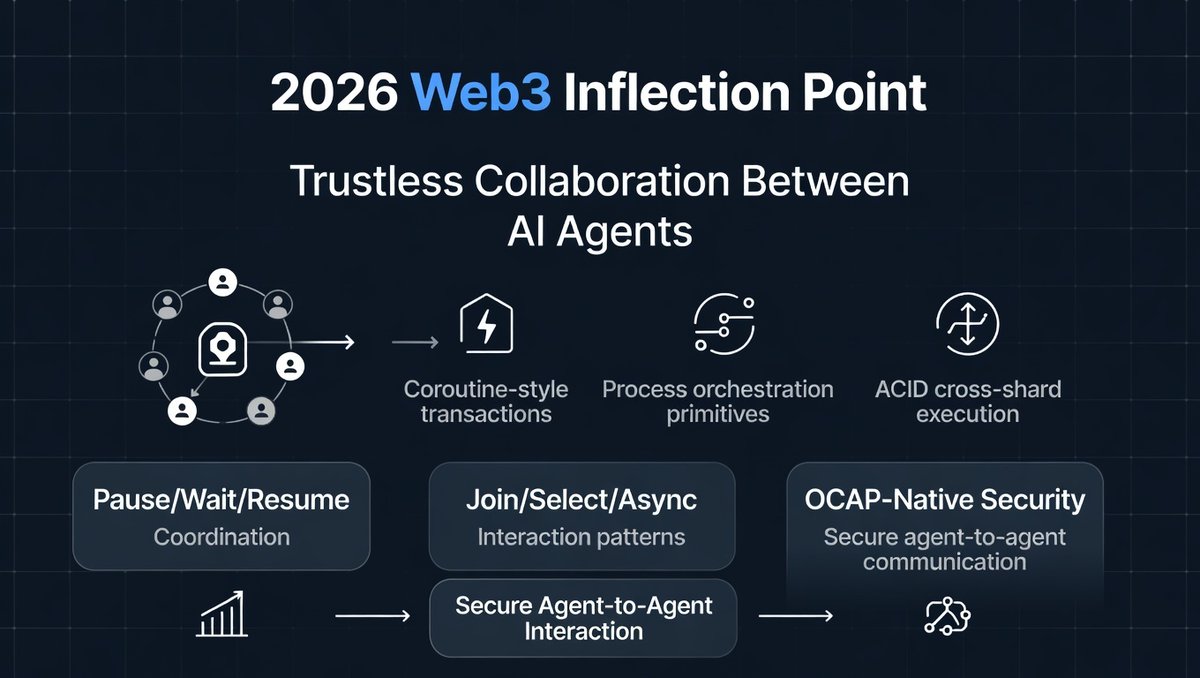
The 2026 Web3 inflection point won’t be faster blockchains, but trustless collaboration between AI agents.
Today, the execution model of most blockchains is still based on: instant short transactions, ordering, and then sequential or parallel execution with synchronous calls. This model is almost unusable for an agent economy.
A blockchain that can truly support an agent economy needs:
⚡️ Coroutine-style transactions (pause / wait / resume + ACID)
⚡️ Process orchestration primitives (join, select, async coordination)
⚡️ ACID cross-shard execution (true horizontal scalability)
⚡️ OCAP-native security (secure agent-to-agent interactions, preventing prompt injection attacks)
When AI agents begin executing autonomously on-chain:
Blockchains without a concurrency model will become the biggest architectural bottleneck, and systems without capability-based security will become the largest security vulnerability.
A distributed concurrency control layer will be the key infrastructure for the Web3 × Agents era.
$ALUX #Web3 #AI #Blockchain #AIagent
👨🏻🎨 ALUX roadmap update!
1/ In Q4 2025, we continued advancing atomic cross-block long-transaction (long-TX) support.
Long-TX test cases now run successfully with hardcoded sync points—putting us one step away from our first major milestone.
2/ Next step: replace those sync points with BlockGit consensus.
That unlocks our first working demo: fully on-chain, atomic long-TX execution across multiple blocks.
3/ We also refactored the codebase to improve modularity.
These upgrades lay the groundwork for:
- faster, more flexible evolution toward sharding
- extensions beyond blockchain-only use cases
4/ In parallel, we explored several logical clock designs to capture execution traces efficiently—enabling analysis and enforcement of different transaction isolation levels.
Implementation is now underway.
5/ Looking ahead to Q1 2026, our primary objective is clear:
Pass integrated tests for atomic long-TX execution on top of BlockGit consensus.
This milestone will serve as a proof of concept for our novel blockchain design.
6/ After that, we’ll focus on production-ready features needed to launch a functional testnet.
7/ We’re community-driven—and we wouldn’t be here without you. Our small but capable team continues to deliver, addressing engineering challenges rarely faced by other teams.
8/ A quick look back at our journey:
2022: Built an OCAP-enabled bytecode interpreter + the Tolang compiler
2023: Implemented the tuplespace virtual machine (TVM) with replayability
2024: Built the EVM sandbox on TVM, implemented the Block Merge algorithm, and developed BlockGit
2025: Introduced behavior channel types + completed key components required for atomic long-TX support
9/ Even as the industry cools again, our vision is clearer than ever:
Make all forms of state transitions possible in centralized systems equally possible in decentralized ones.
A real world computer as a unified logical VM—composed of many smaller VMs across sharded chains, L2s, private clouds, and browsers.
10/ Smart contracts on this unified VM can call one another seamlessly and finalize atomically—even across different sub-VMs.
The OCAP-enabled VM ensures these interactions remain safe and controlled.
Atomic on-chain long-TX support is the first critical technology we must deliver—and we’re very close.
-----------------
As we enter 2026, thank you for building with us!
Stay tuned! 👉🏻 https://t.co/Ta7xA4GpyX
#Web3 #Concurrent #Composite #Blockchain $ALUX