This one didn't receive enough attention so let me TL;DR it for you.
Basically, @pendle_fi 's TVL has grown by 43% while emissions went down by 58%.
In other words, you don't need to pay for TVL with your own tokens. ethereum:0x808507121b80c02388fad14726482e061b8da827 buybacks turned out to be a smart move. As for buybacks, these oftentimes (not always tho) outperform emissions, meaning, more tokens have been bought back (and distributed to stakers) than were emitted during one epoch.
If I were to create lists of tokens I'd be scooping, Pendle's would definitely be on one such list. NFA, obviously.
Btw, I suggest/recommend you check out @Shaurya477 's Penconomics site for more info. Find the link to that one in the image description below.
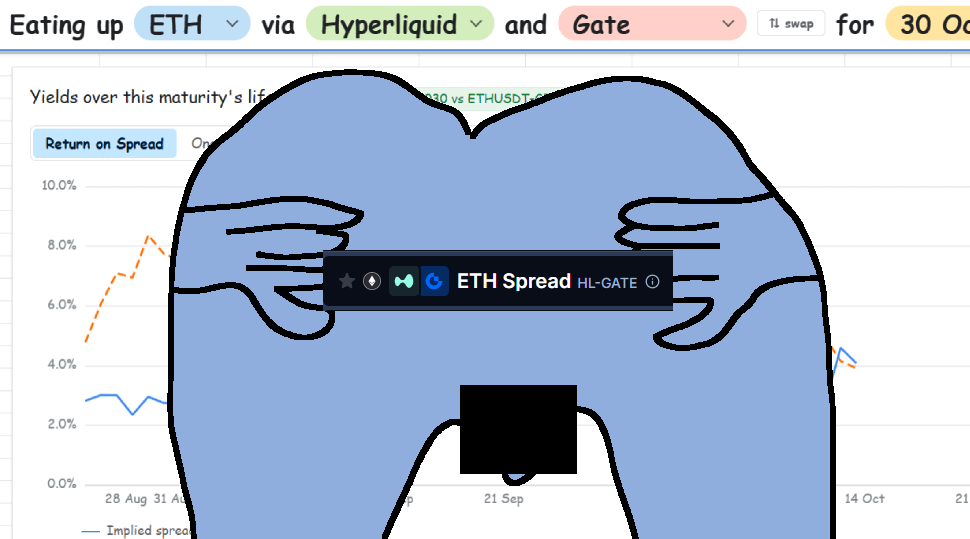
Some traders have been earning 20%+ fixed APR by running arbitrage strategies on Boros.
But what if you could earn that amount in one 𝑚𝑜𝑛𝑡ℎ?
This is what some nefarious actors have already been doing - let me walk you through EXACTLY how.
👇
Why ya'll cringing about token posts
It's literally a once a year event where the highlight is everyone coming to Asia to shill our bags
I'm pretty proud of it
Sounds bullshit, but this was real:
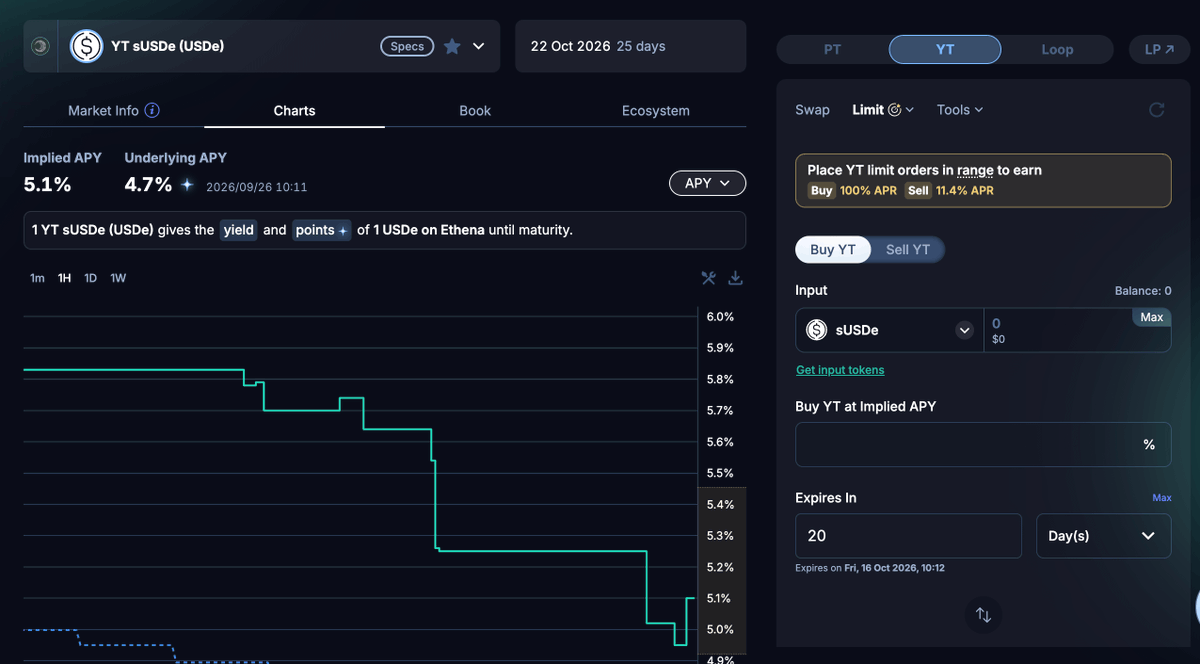
I was earning ~50%+ APR on sUSDe using @pendle_fi.
Basically getting paid to leave a limit order to buy YT at a yield I was already happy with.
Here’s how it worked:
- Get USDe from @ethena and stake into sUSDe
- Go to @pendle_fi and place a YT limit order inside the incentivized range
- Keep the order resting and earn $PENDLE maker incentives
This stuff is probably too much effort for 99% of us lol, which is exactly why opportunities like this can exist.
At the time, the maker incentives pushed the APR above 50%.
And the interesting part was the payoff structure:
If nobody filled my order:
I kept earning $PENDLE incentives while the order sat on the book + 5% sUSDe native yield.
If someone filled it:
I bought YT at roughly the ~5% implied yield I was already happy owning.
So the way I looked at it wasn’t really: “Farm 50%+ APR on sUSDe.”
It was more like getting paid to leave a bid on yield.
Obviously this wasn’t literally risk-free.
But from the trade-structure perspective, I liked both outcomes.
And this is also why I’m watching sUSDe yield closely right now.
My read is that Ethena has a pretty strong incentive to keep sUSDe attractive.
Higher yield makes holding and staking USDe more compelling, which can help support USDe supply growth and, indirectly, the broader ENA ecosystem.
I think ~5% is already a strong zone in the current environment.
There are always weird opportunities onchain if you’re willing to actually dig.
Some highlights of @arc's onchain activity over the past 24 hours.
- $15M in trading volume
- $85k in trading fees have been earned by the top pools
- Top pools mosty from @Arguspad, solana:F9gvdBs5kmTuPAw8oyPkohRBvXLbtfGwUiFvgsjhpump, @BeanCatArc_.
Data powered by Chord.
Partners Group is one of the world's largest private markets firms, managing around $185B in AUM with more than 20 years of experience investing in infrastructure.
Its Next Generation Infrastructure strategy focuses on assets across energy, transport, digital infrastructure, and other long-duration projects that generate real cash flow over time.
The strategy targets around 10-12% net returns from infrastructure cash flow and asset appreciation.
BUT, this type of exposure has traditionally been hard to access.
Private infrastructure usually comes with:
🔹High minimum investment
🔹Long lockup periods
🔹Limited liquidity
🔹Distribution mainly built for institutional investors
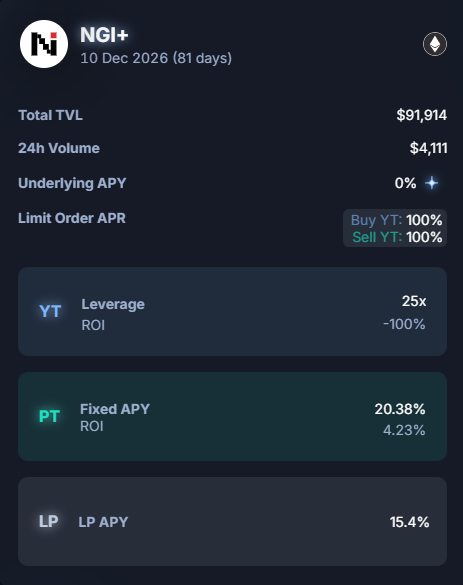
However, by being issued by @AssetoFinance, NGI+ brings exposure to Partners Groups Next Generation Infrastructure strategy onchain, making a traditionally illiquid private-market asset easier to access and integrate into DeFi.
And with the listing on @pendle_fi, users do not have to simply hold the underlying asset.
They can choose different ways to get exposure:
1⃣PT: lock in for 20% fixed APY
2⃣YT: gain more 24x exposure from NGI+ NAV growth
3⃣LP: earn swap fees + $PENDLE incentives
⚠️Note: NGI+ does not distribute yield continuously.
So for LP and YT positions, holding through the distribution period may help the strategy better capture the underlying returns.
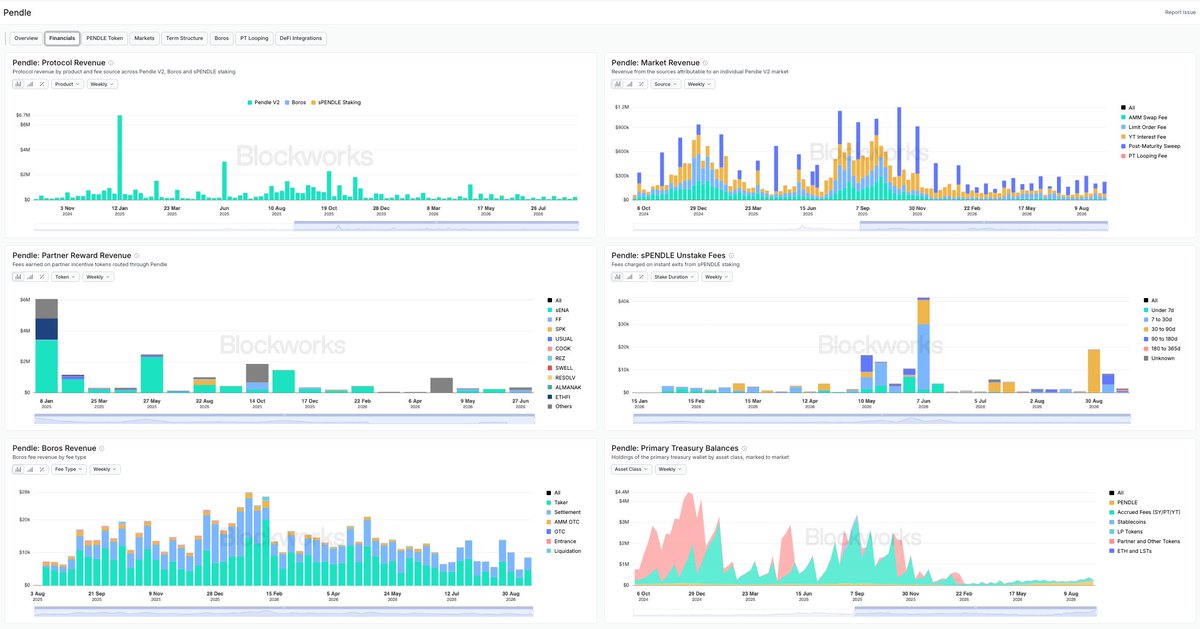
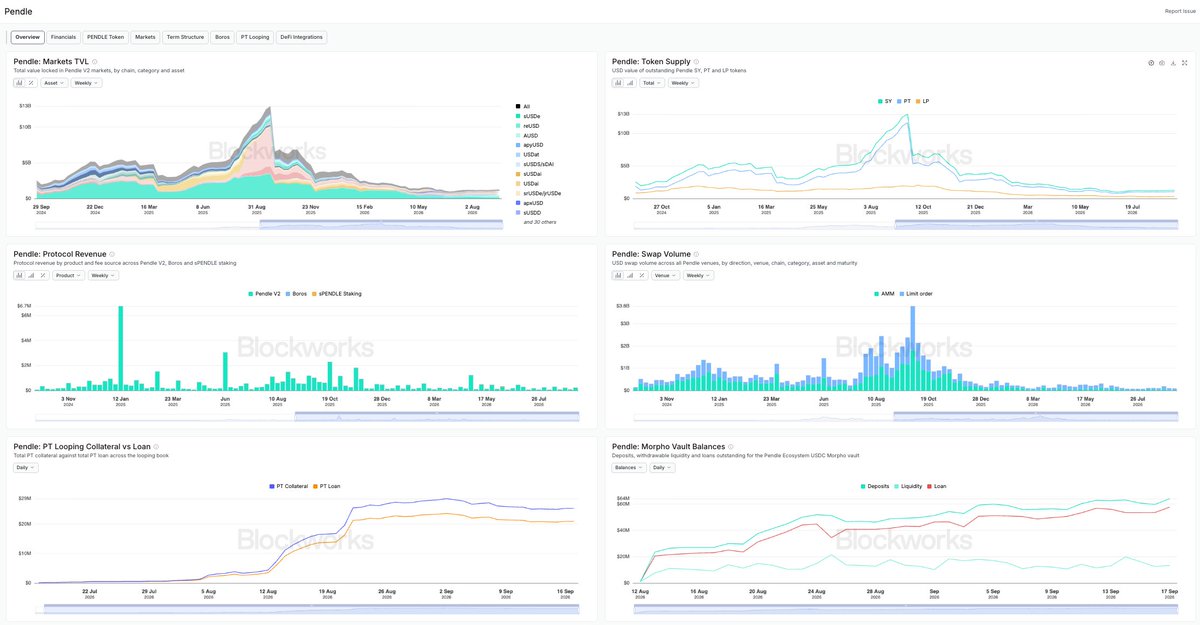
NEW: Now tracking @pendle_fi data in our comprehensive new dashboard.
Pendle's Financials, PENDLE Token, Markets, Term Structure, Boros, PT Looping, and DeFi integrations, all in one place.
Pendle support just got a little more alive :)
Professor Peepo is now animated, and if AI can’t solve your problem, you can create a ticket and chat directly with our support team inside the dApp.
No need to go to Discord to chat with our support!
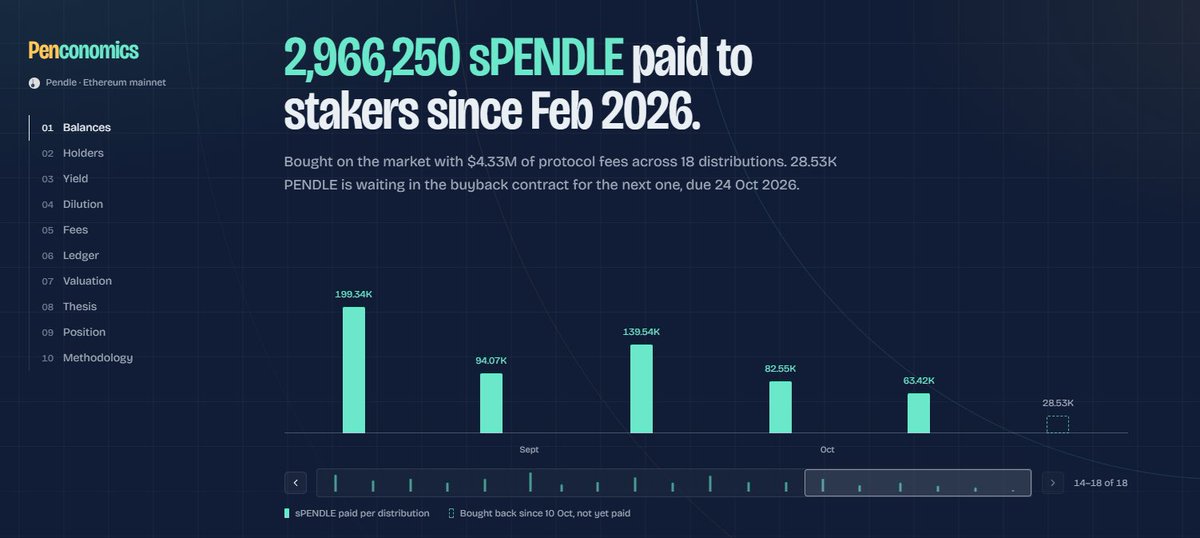
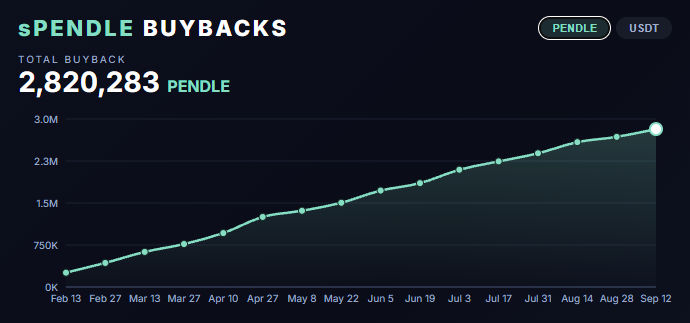
In just ~7 months, $PENDLE buyback has already passed 2.8M ($4M) 🔥
Every $PENDLE is acquired from the open market, then distributed fully back to sPENDLE stakers.
Emission is also down 78% since the start of the year, translating to ~0.5% annual inflation vs. >1.5% buyback YTD
Pendle's product velocity might be one of the fastest in DeFi right now.
The team keeps shipping and improving UI/UX at a pace that few DeFi protocols can match.
But the interesting part isn’t just how fast they ship.
It’s what they keep doing with that speed: compressing complex DeFi workflows into simpler, end-to-end products.
🧵👇
So from a DeFi user perspective, the simpler the better.
Pendle is getting closer to the "I don't need to think" product.
Take all the complex stuff happening underneath, package it into an end-to-end product, and just let me use it.
That’s the kind of DeFi UX of all DeFi users want.
Pendle's product velocity might be one of the fastest in DeFi right now.
The team keeps shipping and improving UI/UX at a pace that few DeFi protocols can match.
But the interesting part isn’t just how fast they ship.
It’s what they keep doing with that speed: compressing complex DeFi workflows into simpler, end-to-end products.
🧵👇
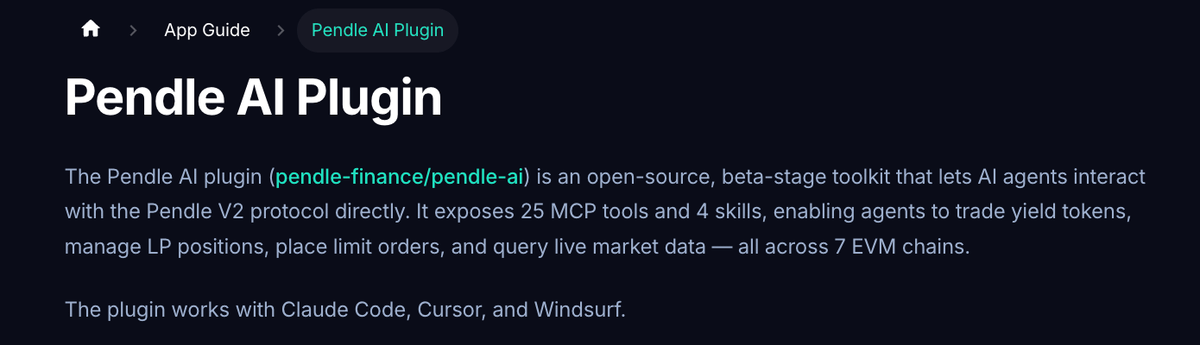
5⃣Opening Pendle to AI agents
Pendle + Boros AI Suite introduced an open-source AI plugin and MCP with 25 tools.
Market data and Pendle workflows can now be queried and interacted with directly by AI agents.
Pendle is not only simplifying UX for users, but also opening the same infrastructure to agents.