Don’t forget Syphilis as a cause of Membranous Nephropathy (MN).
Kidney biopsy showed a MN, with full house Ig, suggesting lupus MN.
Later, revealed that patient had history of syphilis.
Mass spectrometry showed NDNF, confirming MN associated with syphilis.
https://t.co/EiiuPJmgSo
This was a difficult but good teaching case.
Easy to call idiopathic MPGN but…
LM: Membranoproliferative Glomerulonephritis (MPGN) pattern
IF- dull minimal IgG IgM C3 kappa lambda
EM- massive deposits.
Pronase IF/IgG subclass all negative. At this point I had an idea-
FIBRONECTIN GLOMERULOPATHY
Did mass spectrometry. Confirmed the diagnosis=Large amounts of fibronectin.
55 yr old with proteinuria and declining renal function.
Kidney biopsy: Great teaching case
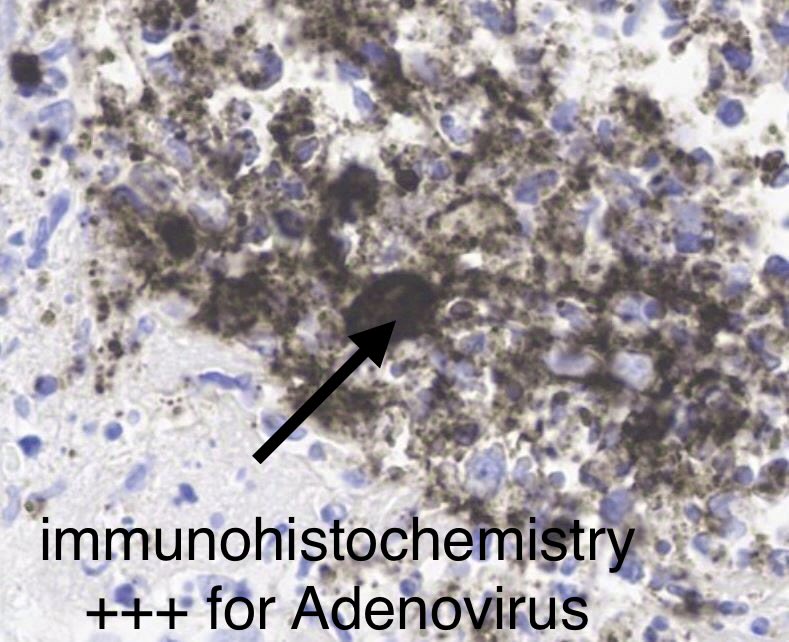
Severe inflammation and necrosis with abscess formation.
Look carefully=you see cells with large nuclei in the mix of inflammatory cells.
IHC= Positive staining for ADENOVIRUS.
DX: Adenovirus-associated interstitial nephritis.
55-yr old with kidney &
heart transplant, fevers, rise in serum creatinine.
Finding the etiology of membranoproliferative glomerulonephritis https://t.co/OHHlnZPmGT
My review of evaluation of MPGN on kidney biopsy is out.
Take home messages:
1. Idiopathic/primary immune complex (IC)-MPGN is very rare.
2. Careful evaluation of IC-MPGN will invariably reveal the etiology. Always rule out monoclonal Ig.
3. Beware of entrapment of Ig in cases of C3GN, as you might label these as IC-MPGN.
4. Consider infection related GN in cases of C3GN, even if IC is sparse/absent, in the right clinical scenario.
IgA nephropathy progresses to kidney failure in up to 50% of patients within 10–20 years.
On March 29th, the NEJM published the final 24-month data from APPLAUSE-IgAN and the results change the treatment landscape.
Here’s what every nephrologist needs to know 🧵
Barratt J et al. NEJM 2026. DOI: 10.1056/NEJMoa2600743
In occasione della Giornata Mondiale del Rene, oggi a Roma si è svolta la conferenza stampa degli "Stati Generali della Dialisi Peritoneale ", con presentazione dell'analisi HTA che ha dimostrato i vantaggi clinici ed economici di questa modalità di trattamento domiciliare
This NEJM Stats, STAT! animated video explores the minimal clinically important difference — the smallest change in a score, scale, or outcome that has been established as clinically meaningful.
https://t.co/s0RkouiUFA
In March, Regulus shared early results from its Phase 1b clinical trial of their lead compound, farabursen. This drug works by targeting the microRNA miR-17, increasing the amount of a protein called polycystin, which is important for healthy kidneys.
Farabursen, a novel oligonucleotide targeting miR-17 therapy is very promising for people affected by adult dominant polycystic disease. We look forward to the results of pivotal clinical studies and to its future availability in clinical practice.
In people who received the highest dose of farabusen in the Phase 1b trial, it stopped their kidneys from getting larger. Phase 3 clinical trials are expected to start later this year.
In people who received the highest dose of farabusen in the Phase 1b trial, it stopped their kidneys from getting larger. Phase 3 clinical trials are expected to start later this year.
@PKDFoundation Farabursen, a novel oligonucleotide targeting miR-17 therapy is very promising for people affected by adult dominant polycystic disease. We look forward to the results of pivotal clinical studies and to its future availability in clinical practice.
The image shows a glomerulus on PAS stain with global endocapillary hypercellularity and numerous intracapillary hyaline pseudothrombi. This pattern of injury is most commonly seen in the setting of cryoglobulinemic glomerulonephritis or in lupus nephritis when subendothelial deposits become large enough to protrude into the intracapillary space. In this case the patient had underlying cryoglobulinemia and the immunofluorescence panel showed IgG, IgM, C3, kappa and lambda which are compatible with a mixed (type II) cryoglobulinemia. While the patient did not have lupus or hepatitis C (a common etiology of mixed cryoglobulinemia), they are being worked up for Sjögren syndrome, which is also known to be an etiology of cryoglobulinemia.
Pubmed is down. NCBI is down. I do not know what this is but is horrible, what happens is unforgivable. Europe and Asia have to do more to be independent.
This is difficult & rare.
Suspicion is key.
LM-large glomeruli, appear hypercellular, but a closer look & you see foam cells.
Stain for CD68 & glomerular capillaries light up & are filled with CD68+ macrophages.
IF/EM essentially negative.
Dx: Histiocytic glomerulopathy
1/3