أصدرت جمعية القلب الأمريكية والكلية الأمريكية لأمراض القلب أمس أول دليل إرشادي على الإطلاق يهدف إلى الوقاية من متلازمة القلب والكلى والتمثيل الغذائي (CKM) وإدارتها.
1️⃣المرحلة 0: صحة مثالية لا توجد عوامل خطر رئيسيةNo CMR.
2️⃣ المرحلة 1: زيادة أو خلل في وظيفة الأنسجة الدهنيةdysfunctional adiposity: زيادة الوزن/السمنة أو مقدمات السكري لا توجد عوامل خطر أيضية أخرى مرض الكلى المزمن أو أمراض القلب والأوعية الدموية.
3️⃣ المرحلة 2: عوامل خطر أيضية Metabolic risk factors(ارتفاع ضغط الدم اضطراب شحوم الدم داء السكري من النوع الثاني أو متلازمة التمثيل الغذائي) و/أو مرض الكلى المزمن ولكن بدون أمراض القلب والأوعية الدموية.
4️⃣ المرحلة 3: أمراض القلب والأوعية الدموية تحت السريرية subclinical CVD (بدون أعراض).
5️⃣ المرحلة 4: أمراض القلب والأوعية الدموية الظاهرة Clinical CVD.
٩ يونيو ٢٠٢٦
https://t.co/NaRIJI2hme
Guías americanas ACC 2026
de Sd. Cardiorrenometabólico.
Unos meses antes de que se publiquen las europeas.
Hay que leerlas despacio pero ninguna sorpresa:
FOCO en:
- Prevención 🔦
- Adiposidad disfuncional 🔦
- Inflamación🔦
MISMA enfermedad vista desde órganos diferentes:
- ICFEp 🫀
- Aterosclerosis 🧈
- ER 💦
- MASLD 🦆
- DM2 🍬
Por tanto MISMO tratamiento independientemente del órgano desde de que la mires.🪞🔭
Costes asumibles cuando haces el análisis coste efectividad /QALYs
Chirría un poco los “y/o” de los grupos farmacológicos en los tiempos en los que estamos.
Los tratamientos deben ser “y” porque actúan por vías diferentes por tanto suman impacto en el beneficio.
https://t.co/e7ANNs1Lbo
#ERA26 live from the Matters of the heart session
Predictive Value of Urine Tubular Biomarkers on Kidney Outcomes: Observations from EMPA-KIDNEY ✨
Speaker 🗣️: Greco Malijan @grecombm
#ERA26
Matters of the ❤️
Going on with: Identifying non-responders to SGLT2 inhibitors in the CREDENCE Trial: a biomarker-guided approach for targeting alternative therapies
Speaker 🗣️: Sok Cin Tye
GLP-1 receptor agonists are not just weight-loss drugs.
They sit at the intersection of metabolism, inflammation, neuroplasticity, and cognition.
That is why their relevance to metabolic psychiatry is becoming harder to ignore. 🧵👇
Prediabetes affects 1 in 3 adults, yet many don’t know they have it. It’s not just about blood sugar, it’s a cardiometabolic risk factor. Thanks to @endocrinenetwrk for the interview about my session at #AACE2026.
https://t.co/Ya7Ct0ThrV
Primary care is key to detecting kidney disease early.
Explore our new cheat sheets:
🔹 Early Identification
🔹 Cardio–Kidney–Metabolic Health
🔹 KRT & Conservative Care
🔗 https://t.co/mdLsFJeZwZ
Resources developed with support from the ISN Strategic Partner Program.
#KidneyHealth #PrimaryCare #CKD
Nuevas recomendaciones de manejo de Diabetes tipo 2 de la American Association of Clinical Endocrinology (2026). Muy prácticas. Puntos importantes:
🔵No asumas siempre tipo 2: Si hay falla terapéutica anormalmente rápida o cetosis atípica, usa péptido C o autoanticuerpos (GAD-65) para descartar tipo 1, LADA, MODY.
🔵Abordaje centrado en complicaciones, no en metas glucémicas: Bajar la HbA1c ya no es lo único. El estándar es iniciar iSGLT2 (falla cardíaca/ERC) o arGLP-1 (riesgo cardiovascular/MASLD) como primera línea, independientemente de la HbA1c basal o el uso previo de metformina
🔵 La esteatosis hepática metabólica (MASLD) ahora es una indicación directa y formal para iniciar arGLP-1 (como semaglutida) o pioglitazona (aunque… piensa bien si vale la pena la ganancia de peso, edema, fracturas óseas / NO usar en falla cardíaca)
🔵 Si la HbA1c de presentación es >7.5% o está >1.5% por encima de la meta: inicia con dos fármacos desde el día uno (en general).
🔵 La reducción de peso es importante, así que apunta a una pérdida de peso >7-10%. Considera uso de tirzepatida o Semaglutide, y aunque son muy útiles, considera la accesibilidad a largo plazo y recordando siempre que la intervención nutricional y el cambio de hábitos siguen siendo la única base inquebrantable.
Completo en el canal (https://t.co/3O93s10Td0).
KDIGO has initiated a focused update to the 2024 CKD Guideline. The update will focus on Chapter 3, "Delaying CKD Progression and Managing Its Complications," with attention to newer therapies that may help delay CKD progression and manage complications.
Read the news release: https://t.co/L1KKYe3bgw
The Work Group will review emerging data on SGLT2 inhibitors, GLP-1-based therapies, and nonsteroidal mineralocorticoid receptor antagonists in people living with CKD without diabetes. The update will be co-chaired by Adeera Levin (CA) and Paul Stevens (UK), co-chairs of the 2024 CKD Guideline.
You can review the Scope of Work and share any comments via the feedback form on the guideline website through Tuesday, March 24: https://t.co/WXDohGFrW8
#CKD
Clinical practice guidelines shape cardiovascular care worldwide. This report outlines the principles and development process used by the ACC and AHA Joint Committee to produce evidence-based recommendations. 📚🫀 https://t.co/Dek2yXgQfc #JACC
Today is World Sleep Day.
Read our latest Editorial:
Sleep your way to better metabolic health https://t.co/0TpAaRWrxo
#sleep#MetabolicHealth#WorldSleepDay#FREE to read
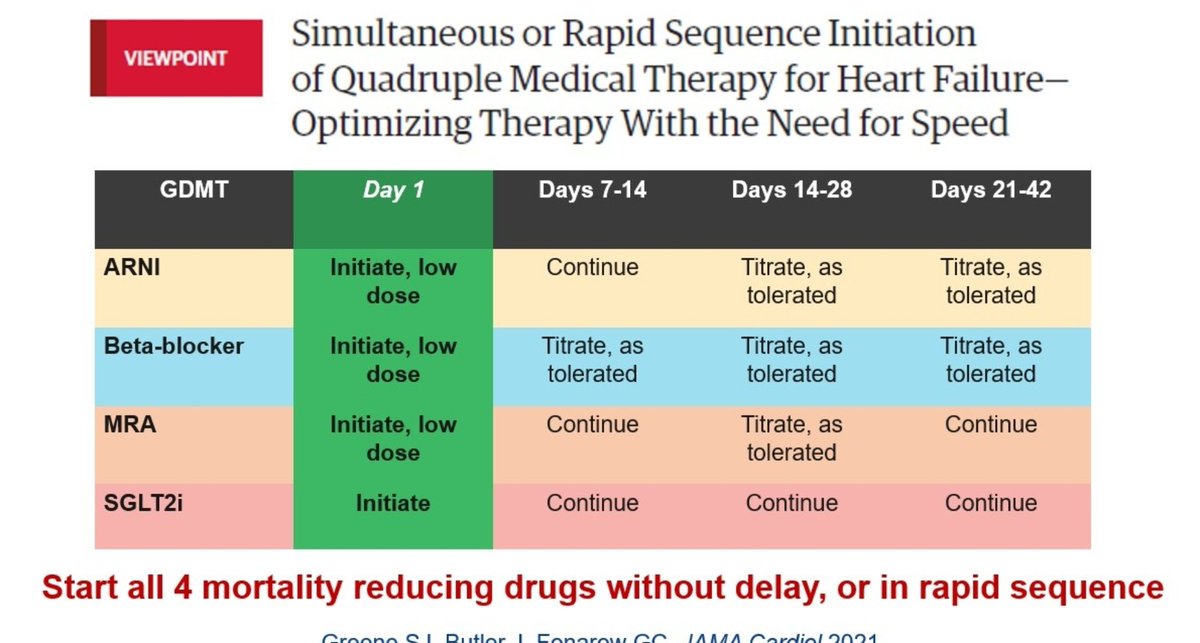
Rapid Initiation of Quadruple Guideline-Directed Medical Therapy (GDMT) in HFrEF: “Treat Early, Treat Together”
The contemporary heart-failure paradigm has shifted from slow, sequential drug introduction to early, near-simultaneous initiation of all four mortality-reducing pillars. The rationale is straightforward: most survival benefit occurs within weeks, not months, and delay exposes patients to avoidable risk.
Core therapeutic pillars (HFrEF)
ARNI (or ACEi/ARB if ARNI not feasible) — neurohormonal blockade with reverse remodeling
Evidence-based β-blocker — sympathetic modulation, arrhythmic protection
Mineralocorticoid receptor antagonist (MRA) — antifibrotic, potassium-sparing neurohormonal control
SGLT2 inhibitor — rapid hemodynamic and metabolic benefit independent of glycemia
Practical rapid-sequence strategy
Day 1 (index visit / stabilization phase)
Initiate ARNI + β-blocker + MRA at low dose, plus SGLT2 inhibitor (standard dose). The emphasis is breadth before depth: establish all four classes early rather than maximizing one agent in isolation.
Weeks 1–2
Clinical reassessment: blood pressure, renal function, potassium, congestion status, and symptoms. Begin gentle titration where tolerated.
Weeks 2–6
Progressive up-titration of ARNI and β-blocker toward target doses; maintain MRA and SGLT2 inhibitor unless contraindications emerge. Monitoring cadence should be tight during this window.
Why speed matters
Event curves in major trials separate within 2–4 weeks
Early multi-pathway blockade reduces hospitalization risk rapidly
SGLT2 inhibitors confer immediate hemodynamic stabilization
Combined therapy is synergistic rather than additive
Clinical safeguards
Avoid initiation during hemodynamic instability or severe volume depletion
Monitor creatinine and potassium within 1–2 weeks of MRA/ARNI start
Expect modest BP reduction — prioritize continuation over aggressive discontinuation
Reassess diuretic needs as GDMT improves congestion
Implementation pearl
Think in terms of “therapeutic stacking”: introduce all four survival therapies early, titrate pragmatically, and individualize pace — but do not defer class initiation without a clear clinical reason.
Bottom line — CME INDIA 2026 message:
In HFrEF, the safest delay is no delay. Early quadruple GDMT initiation maximizes survival benefit while patients are still stable enough to receive it.
https://t.co/oEe82Z9Zql
#CKD care is not one-size-fits-all 🧩🩺
From prevention ➝ end-of-life, goals shift:
🟢 guideline-driven therapy
🟡 individualized treatment
🔴 symptom-focused care
Key principle: align #GDMT with life expectancy, function & patient priorities 🤝❤️
https://t.co/jEAWS6ukkV
A recent meta-analysis shows that the urinary albumin-creatinine ratio (UACR) is more strongly associated with kidney failure than the urinary protein-creatinine ratio (UPCR). Read more in #ASNKidneyNews: https://t.co/5TsMgcqZHt