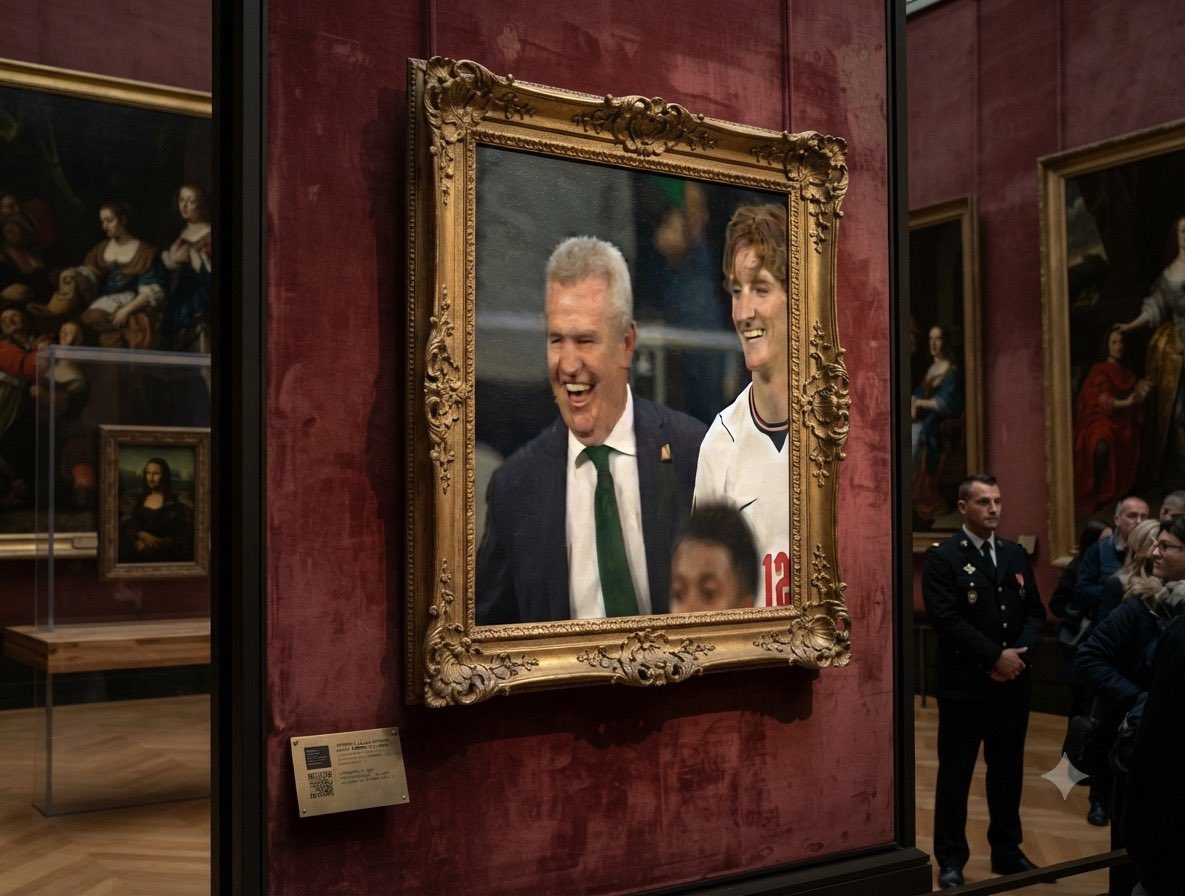
@tdgator9 That comment perfectly illustrates your misunderstanding of the sport. The fact that 17- and 18-year-olds can outplay established professionals is proof that football is unique. It demands a distinct set of skills that athleticism alone cannot replace
Dos jugadas de este Mundial me dejaron pensando en algo que trasciende el resultado: cuánto tensiona el reglamento del fútbol principios que, fuera de la cancha, damos por intocables.
La primera fue la anulación de un gol de Egipto ante Argentina. El VAR se retrotrajo a una falta cometida en el origen de la jugada, varios segundos y muchos metros antes de la definición, para borrar el tanto. En este caso la decisión pudo ser correcta: el contacto existió. Pero el principio que la habilita inquieta. Si un gol, el hecho más definitivo del juego, el que hace estallar un estadio y un país, puede deshacerse retrocediendo a una fase previa cuya frontera es interpretativa, entonces ningún gol es del todo firme hasta que alguien, desde una cabina, decide hasta dónde mirar hacia atrás. La certeza, ese bien que en el derecho protegemos como sagrado, queda supeditada a una apreciación elástica sobre dónde empieza una jugada.
Hay un viejo aforismo jurídico que parece darle la razón al videoarbitraje: causa causae est causa causati, la causa de la causa es causa de lo causado. Si la falta originó la jugada, y la jugada terminó en gol, ¿no es la falta, al final, causa del gol? Suena impecable, pero tiene trampa. El propio derecho que acuñó la máxima aprendió pronto a ponerle freno: sin límites, todo termina siendo causa de todo, y habría que sentar en el banquillo también a quien fabricó el arma, y al que le vendió el acero. Por eso la doctrina se queda en la causa próxima y no persigue la cadena hacia atrás hasta el infinito; el aforismo se agota en una o dos iteraciones, no en varias jugadas y muchos metros de distancia. El VAR, en este caso, sí la persiguió. Retrocedió pases y metros como si el hilo causal no tuviera que cortarse nunca. Toma el aforismo, pero se olvida de su límite.
La segunda es más antigua, pero igual de incómoda: la sanción que trasciende al infractor. Una expulsión que no solo se paga en el partido donde se comete la falta, sino en el siguiente. Y como el fútbol es una empresa colectiva, el castigo, formalmente individual, lo termina cumpliendo todo un equipo, una afición, casi un país. En 1998, Zidane fue expulsado en la fase de grupos y su ausencia dejó a Francia al borde de la eliminación ante Paraguay, salvada apenas por un gol de oro. La falta fue de uno; el precio estuvo a punto de pagarlo una nación entera.
Conviene recordar que esta norma no es de derecho divino. Las tarjetas nacieron apenas en 1970, y la propia FIFA acaba de reformar en 2026 el castigo por acumulación, precisamente para que los seleccionados no se pierdan partidos decisivos. Es decir: la institución ya admitió que el diseño podía ser injusto. Solo que la reforma se quedó a medias, porque atacó la acumulación de amarillas pero dejó intacta la raíz: que una pena recaiga sobre quienes no cometieron la falta.
Naturalmente no pido un fútbol sin reglas ni sin tecnología. Pido, apenas, que reparemos en la paradoja. En el torneo que más se acerca a lo que Shankly llamaba, con ironía, algo más importante que la vida y la muerte, dos de sus normas: la falta de certeza del gol por actos futbolísticamente lejanos y la pena que trasciende al infractor, chocan de frente con nociones de justicia que en cualquier otro ámbito nos parecerían inaceptables.
El fútbol se toma licencias que el derecho no se tomaría. Vale la pena, al menos, pensarlas.
O Japonês Kubo é o primeiro jogador com nome de uma forma geométrica a disputar 3 mundiais.
Superou Redondo e Cuadrado, ambos apenas com duas participações.
I know you guys just adore the lush and exotic bougainvillea, so I went on a hunt to find the biggest.
This is what I came up so far , somewhere in a small village in Mexico , this giant resides .
I spoke with @LaulPatricia about Marxism:
One is: What’s remarkable is that Marxism has been tried. Now, of course, defenders of Marxism say it hasn’t really been tried anywhere, but certainly the people who implemented it claimed they were implementing Marxism.
And this is a massive experiment—a global experiment—with a very clear outcome. Namely, the Soviet Union was a disaster. The imposition of communism on Eastern Europe was a disaster. The imposition of communism in Venezuela was a disaster. The imposition of communism in Maoist China was a disaster. Disaster in terms of both poverty and oppression and genocide and stupid wars. So the world has told us what happens under communism, and it’s a sign of how out of touch intellectuals can be that there are still people who defend it despite the entire world giving a very clear-cut answer.
One more is: would you rather live in North Korea or South Korea? Would you rather live in the old East Germany or West Germany? We have an experimental group and a matched control group in terms of culture, language, and geography, and the answer is crystal clear. So this is a sign of, I think, the pathology of intellectual life—that Marxism can persist.
The other is, you did call attention to one of the appeals of Marxism, though, and more generally of heavy, strong influence of government guided by intellectuals, which is that there are certain kinds of reforms that you can state as principles. You can articulate them verbally as propositions—like equality, human rights, democracy—but there’s other kinds of progress that take place in massive distributed networks of millions of people, none of whom implements some policy. But collectively, there is an order, an organization that’s beneficial.
So that can happen organically through, for example, the development of a language. No one designed the English language. It’s just hundreds of millions of English speakers. They coin new words. They forget old words. They try to make themselves clear. And we get the English language and the other 5,000 languages spoken on earth.
Likewise, a market economy is something where knowledge is distributed. You don’t have a central planner deciding how many shoes of size 8 will be needed in a particular city, but rather information is conveyed by prices, which are adjusted according to supply and demand. And you’ve got a distributed network of exchange of information that can result in an emergent benefit.
Now, intellectuals tend to hate that. They like rules of language—of correct grammar. They like top-down economic planning. They like cultural change that satisfies particular ideals described by intellectuals. And so rival sources of organization, like commerce, like culture—traditional culture—tend to be downplayed by intellectuals.
And this can be magnified by the fact that many dictatorships give a privileged role to intellectuals, which may be why, over the course of the 20th century, and probably continuing to the present, there has not been a dictator that has not had fans among intellectuals—including the mullahs and ayatollahs of Iran, but also the communist dictators: Mao and Castro, even Stalin in his day. And every other dictator has had, actually, often fawning praise from Western intellectuals.
Thomas Sowell le da una clase magistral de economía y conocimiento a la ignorante de Alejandra Ocasio-Cortez, que se dedica a criticar al capitalismo viviendo y disfrutando de él, y lo hace con una mezcla de palabras para parecer intelectual.
Después de la respuesta, yo ella me iría definitivamente a Cuba. Hipócrita de mierda.