ROBOPET® mint is now live on Netrun.
ROBOPET® are digital creatures living inside the @web_punk universe, forming one of the largest collections on @solana.
Mint: https://t.co/0NZkk6Hx7A
500,000+ imprints created on Netrun in less than 5 days.
The testnet phase has now officially ended, and Netrun mainnet is scheduled to go live next week.
Selected testnet participants and future mainnet users will receive ecosystem rewards and airdrops starting next week.
Netrun testnet is now live.
Open to developers and creators globally, Netrun is a metaprotocol for programmable non-fungible systems and evolving digital objects on @solana.
https://t.co/72Kr3nXgku
We’re delaying the Netrun Testnet launch while we wait for @phantom to review and approve our domain and app.
Even though we’re launching on @solana devnet, we want to make sure everything meets the highest standards of security and trust for our users before going live.
Preview of the upcoming Netrun metaprotocol on @solana@jadoncarter walks through creating state tokens, minting assets and domains, and exploring the marketplace experience inside Netrun.
Programmable systems are coming on-chain.
Runners were never meant to stand still.
Netrun moves like a horse across endless terrain, carrying memory, identity, and motion between systems.
Built on the @solana rails.
Netrun is pioneering a new chapter in the @AEL ecosystem.
We are proud to introduce the first-ever @solana faucet.
Joinlist is now open. Apply below.
https://t.co/yjwSIsBytc
Hear from @kuzey, director of @AEL in simple terms:
“Netrun turns on-chain assets into programmable objects, able to hold state, evolve over time, and interact across apps. It doesn’t introduce a new Layer 1.”
Inspired by inscription models like BRC-20, but designed for @Solana’s speed, scalability, and richer data structures.
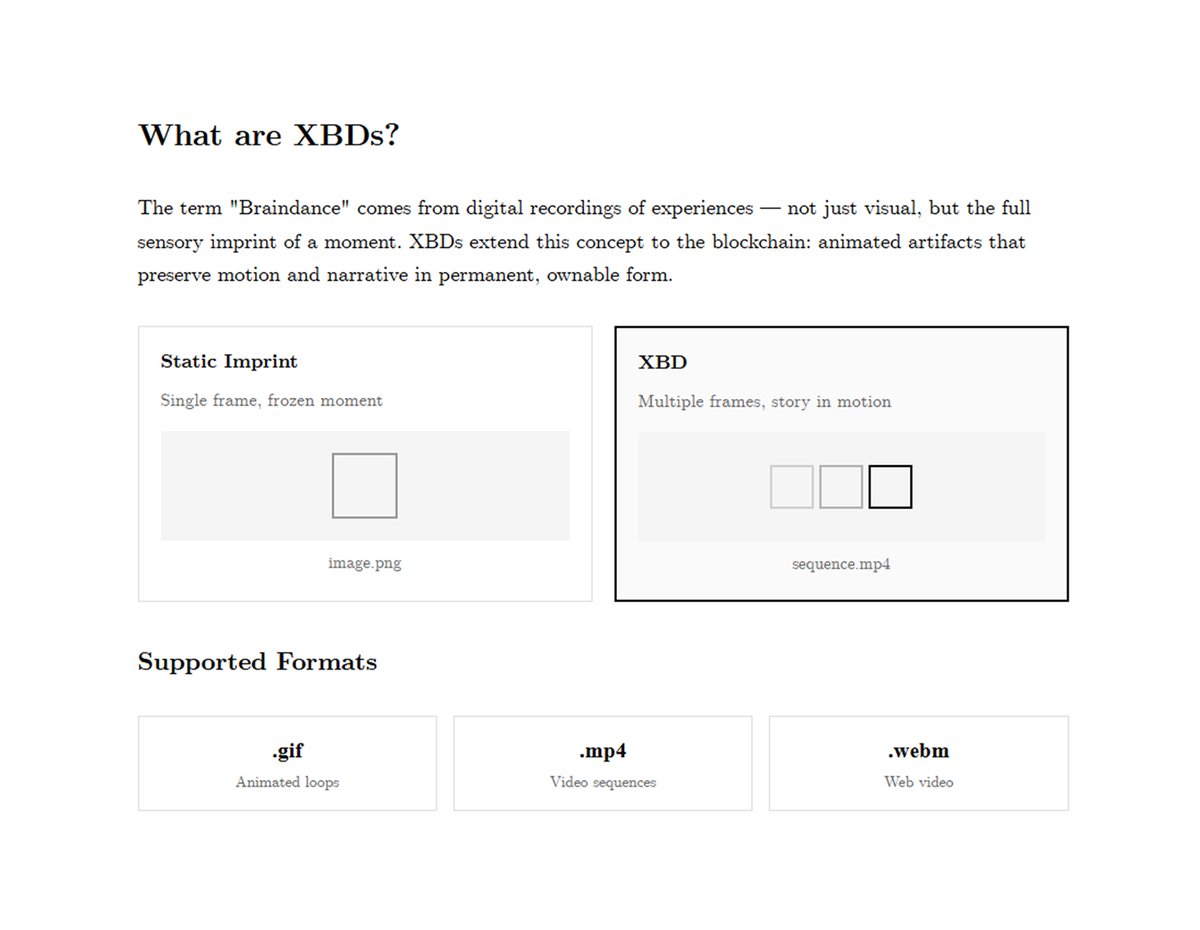
Dropped an article about XBDs (𝒳)
Introducing Extreme Braindances — dynamic imprints that bring time, motion, and narrative on-chain. While traditional NFTs capture what something looks like, XBDs capture what happened: events, sequences, and memories unfolding frame by frame.
From seamless loops and short clips to multi-frame sequences and raw recordings, XBDs turn moments into structured, ownable artifacts. Each imprint carries temporal metadata like duration, frame count, and content integrity, making them verifiable and composable within programmable systems.
This is a shift from static media to living records of action and experience.
XBDs extend the Imprints standard into the temporal dimension. They transform NFTs from static certificates of ownership into living records of motion, narrative, and experience — memories preserved in permanent, tradeable form.
Give it a read ~ https://t.co/ggjksTjDrT
Introducing Subdomains (λ)
Subdomains on Netrun follow the same idea as domains. They are purely collectible and have no functionality. They don’t resolve anywhere, don’t link to wallets, and don’t represent identity. Instead, they are structured name variations that expand how a name exists across different collectible series.
For example, a name like "jadon" can appear as "jadon[.]net", "jadon[.]run", or "jadon[.]ae". These are not technically connected. Each one is a separate collectible in its own series, and the value comes from how the name is structured.
Key characteristics:
• Purely collectible, no resolution or identity (yet)
• Extension-based, each suffix is its own series
• Scarcity-driven, short and clean names are more valuable
• Culturally influenced, memes, numbers, and trends matter
Subdomains expand this concept by increasing the number of possible variations around a name. They don’t add utility, they add depth, making names more expressive as digital collectibles.
Introducing State Tokens (π)
State Tokens transform assets from static ownership records into programmable objects with memory, behavior, and evolving state. Instead of tokens that simply exist, they can update over time, react to interactions, and carry logic across applications.
Built for programmable non-fungible systems, State Tokens enable assets to function more like living systems than files — powering dynamic game items, evolving identities, adaptive financial positions, and shared objects that persist across ecosystems.
https://t.co/s5j1ONpNu6
Introducing Netrun: a metaprotocol for programmable non-fungible systems on Solana.
Digital assets are moving beyond simple ownership. As applications become more dynamic, there is a growing need for infrastructure that allows assets to evolve, interact, and carry real logic. Today’s NFTs are mostly static — they represent ownership, but they do not do anything.
Netrun changes that.
Netrun turns non-fungible assets into programmable objects — assets that can hold state, update over time, and interact across different applications. Instead of isolated collectibles, they become dynamic building blocks developers can use to create entirely new systems.
Netrun is built around a new set of primitives:
• Assets with embedded logic and evolving state
• Composable objects that can be shared across apps
• Native interaction between assets and systems
• Compatibility with existing standards and tooling
• High-performance execution powered by Solana
This unlocks a new class of applications not possible with traditional NFT infrastructure, including:
• Dynamic on-chain games where assets evolve through usage
• Cross-application identity and reputation systems
• Programmable financial positions and strategies
• Shared digital objects that persist across ecosystems
• Data-driven assets that respond to real-world or on-chain inputs
Netrun shifts the paradigm from owning objects to running objects.
Netrun is designed to work with existing infrastructure, not replace it — extending what assets can do without fragmenting the ecosystem.
If you are building applications that require dynamic assets, shared state, or cross-app composability, Netrun is the foundation.
We are working with builders across gaming, identity, finance, and beyond — if you want to build with us, get in touch at [email protected]




![netrun_xyz's tweet photo. Introducing Subdomains (λ)
Subdomains on Netrun follow the same idea as domains. They are purely collectible and have no functionality. They don’t resolve anywhere, don’t link to wallets, and don’t represent identity. Instead, they are structured name variations that expand how a name exists across different collectible series.
For example, a name like "jadon" can appear as "jadon[.]net", "jadon[.]run", or "jadon[.]ae". These are not technically connected. Each one is a separate collectible in its own series, and the value comes from how the name is structured.
Key characteristics:
• Purely collectible, no resolution or identity (yet)
• Extension-based, each suffix is its own series
• Scarcity-driven, short and clean names are more valuable
• Culturally influenced, memes, numbers, and trends matter
Subdomains expand this concept by increasing the number of possible variations around a name. They don’t add utility, they add depth, making names more expressive as digital collectibles.](https://pbs.twimg.com/media/HHabQwWWYAA89tp.jpg)





