Research doesn’t always want to stay in papers. @netscisociety
I’m a co-founder of SparseMind AI, a startup born directly from my research @Tsinghua_Uni
Accumulating theoretical evidence and practical validations, our work is ready to move from research to real-world impact.
“AI's future is not bigger, but smarter,” says Prof. Carlo Cannistraci. His project, SparseMind AI, won third at the HICOOL Global Entrepreneur Competition, algorithmically removing up to 99% of model bulk. This “sparse revolution” makes AI more accessible & sustainable for all.
Last week in Boston for the @netscisociety#netsci2026 I had the honour to offer a talk on my theory for link prediction and its application to neural networks. Thanks to @HirokiSayama to feature the work.
#NSIA@NSIAsatellite Natasa Przulj,Professor of Computational Biology, MBZUAI; Professor, Computer Science UCL, Inventor of graphlets kick-starts the inaugural edition of the Network Science Informs AI satellite @netscisociety#netsci26
@elonmusk@NVIDIAAI visit us @Tsinghua_Uni for breakthrough in efficient AI. Today released the first algorithm performing better than dense networks at 2:4 50% semistructured sparsity and approaching dense at 1:4 (75%) in LLMs. https://t.co/BeCxxZ3yjF
📢 ABSTRACTS OPEN!
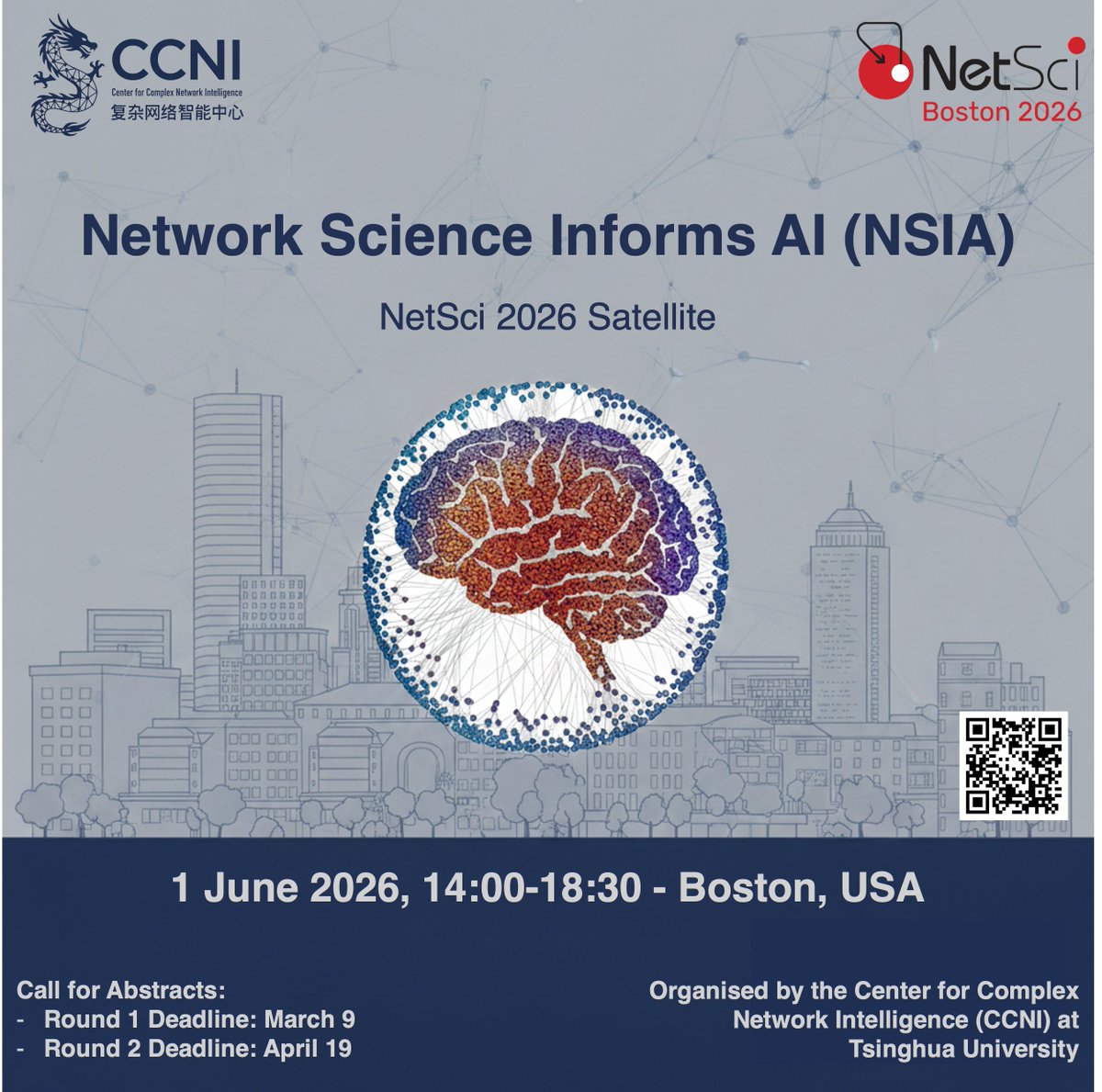
Round 1 submissions are now open for the inaugural Network Science Informs AI (NSIA) satellite at @NetSciConf ! 🧠🕸️
We explore network topology, sparsity & dynamics as drivers for next-gen AI.
🗓️ Deadline (Round 1): March 9 (AoE)
📍 Organized by: @CCNI_lab
🔗 Submit here: https://t.co/lIBDp3nbLu
For more info: https://t.co/f2kjPwRygy
Follow us on LinkedIn: https://t.co/Y61ppr8uWx
#NetworkScience #AI #DeepLearning #ComplexSystems #NSIA2026 #NetSci2026
🚀 Announcing the inaugural NSIA Satellite at #NetSci2026!
We’re bridging the gap between Network Science and AI to build the next generation of intelligent systems. Join us in Boston for a deep dive into topology, brain-inspired connectivity, and emergent learning.
📅 June 1, 2026
📍 Boston, USA
📝 Call for Abstracts: Feb 12 – March 9 (Round 1)
Ready to redefine AI? Submit your work and join the dialogue.
🔗https://t.co/QFwEO03vv5
#NSIA2026 #NetworkScience #AI #MachineLearning #ComplexSystems
Brain network science modelling of sparse neural networks enables Transformers and LLMs to perform as fully connected
Y Zhang, D Cerretti, J Zhao, W Wu, Z Liao, U Michieli, CV Cannistraci
Thirty-Ninth Conference on Neural Information Processing Systems (NeurIPS 2025), 2025
Research doesn’t always want to stay in papers. @netscisociety
I’m a co-founder of SparseMind AI, a startup born directly from my research @Tsinghua_Uni
Accumulating theoretical evidence and practical validations, our work is ready to move from research to real-world impact.
“AI's future is not bigger, but smarter,” says Prof. Carlo Cannistraci. His project, SparseMind AI, won third at the HICOOL Global Entrepreneur Competition, algorithmically removing up to 99% of model bulk. This “sparse revolution” makes AI more accessible & sustainable for all.
Epitopological Learning and Cannistraci-Hebb Network Shape Intelligence Brain-Inspired Theory for Ultra-Sparse Advantage in Deep Learning
Y Zhang, J Zhao, W Wu, A Muscoloni, CV Cannistraci
The Twelfth International Conference on Learning Representations (ICLR) 2024, 2024
@nabla_theta + @OpenAI. Impressed by your “circuit sparsity” paper. It resonates with our @Tsinghua_Uni work soon @NeurIPSConf 2025 “Brain network science modelling of sparse neural networks enables Transformers and LLMs to perform as fully connected”
https://t.co/AMefIMZx7V
Long time I am not on X. I thank the organisers of the @ICCVConference "Beyond Euclidean: Hyperbolic and Hyperspherical Learning for Computer Vision" for inviting me as Keynote speaker in their inspiring workshop. @adn_twitts@geleonti@IndroSpinelli@GalassoFab10 et al.
📢 Call for Papers: NeurReps 2025 ‼️‼️‼️
🧠 Submit your research on symmetry, geometry, and topology in artificial and biological neural networks.
Two tracks: Proceedings (9 pages) and Extended Abstract (4 pages).
Deadline: Aug 22, 2025.
https://t.co/A3jYmIlTVH
It is fascinating to study complex systems such as the brain and to inspire new manners to train neural networks. We do this with a group of students @Tsinghua_Uni https://t.co/Qtdl4oNa8C
“#AI learns from the brain, and the #brain is revealed through AI,” says #TsinghuaRen Prof. Carlo Vittorio Cannistraci @NetworkAutomata (Italy), Chief Scientist at THU Laboratory of Brain and Intelligence, who envisions a new generation of AI that is energy-efficient & effective.
Interestingly, this shift has been linked to environmental factors like solar irradiance and even vitamin D levels, which are regulated by sunlight exposure. However, the exact mechanisms behind this phenomenon remain an area of active investigation
The "summer shift" refers to a phenomenon observed in the timing of STEMIs, a severe type of heart attack. During the summer months, there is a noticeable shift in the occurrence of STEMIs from daytime hours to nighttime hours. https://t.co/44ZHSADL5c
This seasonal variation appears to be influenced by factors such as sunlight intensity and circadian rhythms, which may alter the timing of heart attack onset.