No ticket to Cisco Live this year? 🎫 No problem.
You can still attend "Summer Camp for Networking Nerds" completely remote—and totally FREE.
If you're studying for your #CCNA, next week is a massive opportunity to level up. My new video breaks down how to hack the show from home:
👉 Free Cisco U Walk-in Labs (L2/L3)
👉 Live broadcast sessions that matter for the exam
👉 My personal curated schedule (including using AI to study!)
Don't miss out on the biggest networking week of the year just because you aren't there in person.
📺 Get your remote game plan here: https://t.co/JkcxcrgQUK
#CiscoLive #CLUS #CCNA #CiscoU #NetworkUpskill #CiscoChampion
@Wendellodom 📘 The Complete CCNA v2.0 Archive: If you want a static, scannable reference page containing our publishing schedule, the technical text breakdown, and the high-level timelines, I’ve archived everything on the blog: https://t.co/1nwf8ffZeO
📘 The Complete CCNA v2.0 Archive: If you want a static, scannable reference page containing our publishing schedule, the technical text breakdown, and the high-level timelines, I’ve archived everything on the blog: https://t.co/1nwf8ffZeO
We've covered the official timeline, and we've dissected the technical blueprint line by line. Now, let’s answer the question on every CCNA candidate's mind: "Where are the books, and when can I get them?" 📚
As co-author of the CCNA Official Cert Guides, I’m excited to pull back the curtain on our upcoming publishing roadmap at Cisco Press for the new CCNA 200-301 Version 2.0 curriculum. Our development teams are already hard at work mapping the new blueprint demands—from deeper troubleshooting to foundational AI skills—into our updated study materials.
In this final video of today's launch series, I lay out exactly what you can expect:
🔹Print Editions: Projected release calendars, new edition volumes, and package details for the unified Library Edition.
🔹 Premium Edition eBooks: A look at the digital features, interactive PDFs, bonus practice question banks, and integrated review tools built to maximize your study efficiency.
Whether you prefer the weight of a physical book on your desk or the dynamic portability of an interactive digital suite, this video will help you align your resource strategy with your targeted exam date.
📺 Watch Part 3: The CCNA v2.0 Cisco Press Publishing Roadmap: https://t.co/T7CVBTJS9h
Missed the earlier breakdowns? Catch up on the full launch series here:
🎬 Part 1 (Overview & Exam Strategy): https://t.co/5wt2xxMw42
🎬 Part 2 (Line-by-Line Blueprint Deep Dive): https://t.co/jUUmVg9wsm
#CCNA #CCNAv2 #CiscoPress #OfficialCertGuide #WendellOdom #CiscoChampion
Now it's time to dig into the actual technical changes inside Cisco's new CCNA 200-301 Version 2.0 blueprint. 🛠️ Dissecting a new exam curriculum means looking past the headlines and analyzing the shifting verbs.
Two massive takeaways stand out immediately:
1️⃣ Troubleshooting is back in a big way. Cisco has shifted key blueprint items from passive explanation to active resolution. They want to make sure you can find and fix problems, not just describe how they work.
2️⃣ Emerging tech is maturing. Yes, artificial intelligence (AI) has officially entered the chat. Understanding how AI impacts infrastructure operations is now an explicit baseline requirement for a modern network associate.
In Part 2 of my CCNA v2.0 breakdown series, I am taking you line-by-line through the new blueprint. We examine exactly what technologies have been completely retired, what brand-new topics have been introduced, and my custom "Top 5" list of critical shifts you need to conquer.
Next up, I will drop the final video of the day outlining our official Cisco Press publication roadmap for the upcoming print and digital study guides. But first, let's look at the engineering reality of the new exam.
📺 Watch Part 2: The CCNA v2.0 Blueprint Deep Dive: https://t.co/jUUmVg8YCO
#CCNA #CCNAv2 #CiscoCert #Troubleshooting #CiscoChampion #WendellOdom #CiscoPress
🚨 BREAKING NEWS: Cisco just announced a major update to the CCNA 200-301 exam blueprint—Version 2.0 is officially on the way! 🚨
Whenever a foundational certification gets an overhaul, it triggers immediate anxiety for candidates in the trenches. "Do I need to stop studying?" "Are my current books obsolete?" "Should I hurry up and take the exam before it changes?"
My best advice: Take a deep breath.
The strategy hasn't changed—only the roadmap. To help you navigate this transition, I am releasing a three-part video series today. Part 1 is officially live, and it breaks down the high-level announcement, the official transition timeline, and exactly how you should structure your study game plan between now and the end of the year.
Later today, I'll be dropping two companion videos: a line-by-line technical deep dive into the blueprint changes (including the return of troubleshooting and the entry of AI), followed by a full look at my upcoming publishing roadmap for the new Cisco Press Official Cert Guides.
Don't let the rumors catch you off guard. Get the facts, build your timeline, and keep moving forward.
📺 Watch Part 1: The CCNA v2.0 Overview & Strategy Game Plan: https://t.co/5wt2xxLYeu
#CCNA #CCNAv2 #CiscoChampion #CiscoCert #Networking #WendellOdom #CiscoPress
Address? Check. ✅ DNS? ...Still waiting. ⏳
If your SLAAC hosts aren't finding the DHCPv6 server, you probably forgot the O-bit. My new Config Lab for the CCNA shows you how to fix it in CML-Free.
Instructions and topology are live: 📺 https://t.co/BK2ETBf1oq
#CCNA#IPv6 #Networking #CiscoCert #NetworkUpskill
The DHCP lease is no longer the only way to get a dynamic address. 🌐
Meet the SLAAC + Stateless DHCPv6 combo. It’s the hybrid approach that gives hosts an address via SLAAC and "other" settings via DHCP. Master the A-bit, the O-bit, and the Relay Agent in my latest video:
📺 https://t.co/kWllo5gWXj
#CCNA #IPv6 #Networking #CiscoCert #NetworkUpskill
New Config Lab: Stateful DHCPv6. Can you configure the Relay Agent and set the M-bit correctly to get your hosts online?
Download the lab files and start the challenge:
📺 https://t.co/y1HyhX62GP
#CCNA#Cisco#IPv6#PacketTracer#NetworkUpskill
Host not getting an IPv6 address? Check your M-bit! 🚩
Stateful DHCPv6 requires more than just a server—it requires the router to signal the client and relay the request. My new video covers:
✅ DHCPv6 Relay Agent Config
✅ The M-bit (Managed-Config-Flag)
✅ Stateful logic vs. IPv4
📺 https://t.co/W6wZwAspQo
#CCNA #IPv6 #CiscoCert #Networking #NetworkUpskill
Check out the first comment for links to the related Config Lab!
IPv6 is more "polite" than IPv4. Why? Because it stopped shouting. 🤫
The broadcast is gone, replaced by a specialized toolkit of Multicast addresses. My new lesson dives into the specialized addresses that make IPv6 work (and show up on the #CCNA exam):
📺 https://t.co/zhiEP0kerS
Master the well-known and Solicited-Node Multicast addresses today. 🛠️
#IPv6 #Cisco #Networking #NetworkUpskill
If you know IPv4 but not IPv6, Link-Local Addresses (LLAs) can be one of the strangest IPv6 concepts to try and grasp.
Unlike IPv4, where an interface usually has one address, IPv6 interfaces require an LLA to function. These addresses are the engine behind IPv6 efficiency, allowing protocols like DHCPv6 to work without the "noise" of broadcasts.
In my latest video, I break down the "FE80" prefix, link-local scope, and the Modified EUI-64 process routers use to generate their own addresses.
📺 Watch the full lesson here: https://t.co/fuTbDlylp7
#CCNA #IPv6 #Networking #Cisco #ITTraining #NetworkUpskill #Learning
Also, practice the modified EUI-64 calculations to find a router’s LLA. Look for the video exercise in the first comment!
Continuing through the CCNA IPv6 topics... this week and next, wrapping up the addressing topics. Here's the lineup!
✅ Ready Now: Configuring GUAs on Routers
📅 Wednesday (April 15): Understanding Link-Local Addresses
📅 Wednesday (April 22): Understanding IPv6 Multicast Addresses
More IPv6 each week until it’s done, probably by Mid-May! Find everything in the CCNA Course Playlist: https://t.co/rywvqMKPV3
#CCNA #CiscoCert #IPv6 #Networking #StudyPlan
Time for a CCNA brain dump! 🧠💥
Don't just watch another video—do the work. My new Chapter 26 Mind Map exercise challenges you to organize everything you know about GUA and ULA terminology.
1️⃣ Recall the terms.
2️⃣ Map the connections.
3️⃣ Compare with my walkthrough.
Master the IPv6 vocabulary here:
📺 https://t.co/WzTxu8ILCy
#CCNA #IPv6 #Networking #StudyHacks #Cisco
Think you don't need Private Addresses in IPv6? Think again! 🌐
Meet the ULA (Unique Local Address)—the "neglected cousin" of the IPv6 world. It mimics IPv4 private addressing but with a much cleaner structure.
Learn the concepts, the prefixes, and the subnetting rules in my latest video:
📺 https://t.co/VAOqOx7mTZ
#CCNA #IPv6 #Networking #CiscoCert
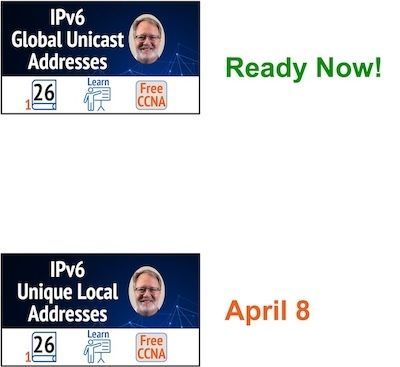
Time for some more #IPv6 fundamentals for CCNA! For the next month, I'm filling in my CCNA IPv6 lineup. This week, Global Unicast Addresses (GUAs) and Unique Local Addresses (ULAs). The GUA video is out now, and the ULA video will be released this week.
✅ Ready Now: IPv6 Global Unicast Addresses
📅 Wednesday (April 8): IPv6 Unique Local Addresses (ULAs)
More IPv6 each week until it’s done, probably by Mid-May! Find everything in the CCNA Course Playlist: https://t.co/dFJk4RgDTn
#CCNA #CiscoCert #IPv6 #Networking #StudyPlan
You have a project to convert a layer 2 switch to a layer 3 switch. The plan uses two SVIs and one routed port. Your planned config is shown below. On review, a co-worker tells you that you need additional commands to complete your configuration. Which answer shows one such command with the correct config mode?
interface vlan 1
ip address 10.1.3.1 255.255.255.0
!
interface vlan 200
ip address 10.1.1.1 255.255.255.0
!
interface gigabitethernet1/1/1
ip address 10.1.2.1 255.255.255.0
A) *no switchport* in Gig1/1/1 config mode
B) *no switchport* in interface config mode for both VLAN interfaces
C) *ip routing* in G1/1/1 config mode
D) *ip routing* in interface config mode for both VLAN interfaces
Find the explanation and answer on the NetworkUpskill Community page at: https://t.co/4dJFFSu85a
32 hexadecimal digits. 128 bits. 8 quartets.
IPv6 addresses are intimidating until you master the "shorthand." My latest CCNA lesson breaks down the two essential rules for abbreviating and expanding IPv6 addresses with 100% accuracy.
Stop fearing the hex. Watch the lesson here:
📺 https://t.co/VtgrV8jJbv
(1/2) #CCNA #IPv6 #Networking #Cisco
It's time for some #IPv6! I made a partial set of IPv6 videos a while back, so over the next several weeks, I’ll fill in the lineup. At that point, yes, finally, I’ll have a complete CCNA course set matching my Volume 1 CCNA OCG book! Woohoo!
First up, content related to the first of five IPv6 chapters. Two instructional videos are already posted – go ahead and watch those now if interested. On April 1st, no foolin’, I’ll post the last instructional video to round out the chapter. The new video discusses address abbreviation and expansion, along with how to find IPv6 prefix (subnet) IDs.
✅ Ready Now: IPv6 Address Space Vs. IPv4
✅ Ready Now: IPv6 Addressing and Routing
📅 Wednesday (April 1): IPv6 Address Abbreviation, Expansion, and Prefix IDs
More IPv6 each week until it’s done, probably by Mid-May! Find everything in the CCNA Course Playlist: https://t.co/dFJk4RgDTn
#CCNA #CiscoCert #IPv6 #Networking #StudyPlan