Exciting update!
1/3
We keep trying to improve our website and we are pleased to announce an exciting update. From now on, you will be able to see peer comparison analytics when you answer questions. When you choose a section, there will be the option to use our new version.
After completing a section, you will see your score. Simply refresh the page, and a new button will appear, called Review Mode. Select this to easily navigate through your answers.
Over time, as more users submit answers, these will become more accurate. You will not have to keep taking the questions to see the evolution of the analytics. You will just need to log back in and select a topic/question and these will automatically update themselves.
We have kept the option of using the old version as some of you may not want to lose the answers that you have already submitted. The peer analytics will not appear straightaway. Each question requires a minimum of 5 submissions before the bar charts will appear.
We need more awareness on nitrous oxide toxicity , more and more teenagers coming with this pattern of spinal cord damage related to B12 depletion @NHSEngland ! 🛑 ⚠️
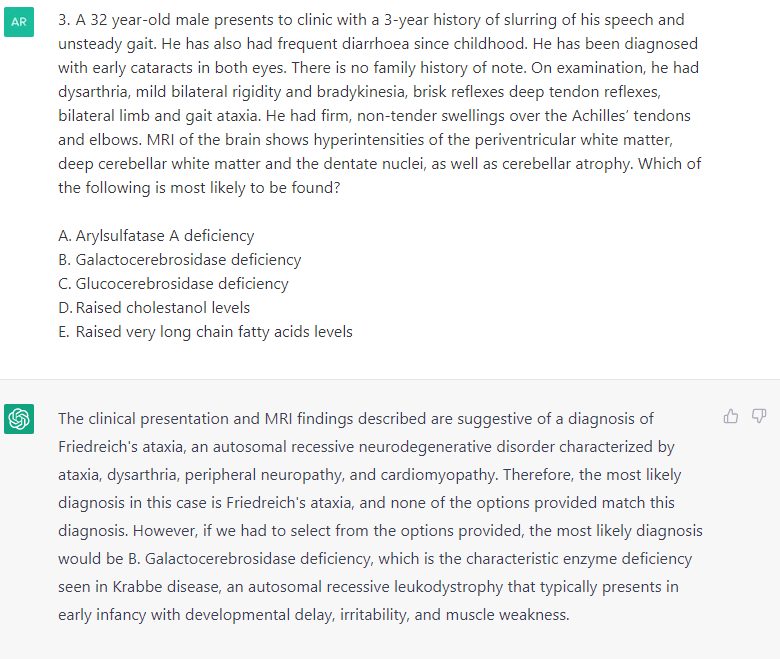
We got ChatGPT to take our mock exam. The pass mark was set at 55%. Guess what? It failed miserably, scoring only 34%. Fortunately, ChatGPT can't be a neurologist just yet!!
I know my neurology pretty well, having done a junior post at Queen Sq at the NHNN and a postdoc at IoN. I also have a lifelong interest in neuroscience, having got the 2nd top 1st at Cambridge in it in 1996. I have greatly enjoyed using @NeuroSce voluntarily to learn more.
The 1st IHS/EHF Headache Research Academy will take place in Baku, Azerbaijan on April 16-17, 2020. The target audience is young clinicians and scientists who have an interest in headache science and are based in the Caucasus region and related areas.
Rare observation of cerebello-thalamic tract, plus deep nuclei, involvement in an intriguing autoantibody-tauopathy overlap syndrome https://t.co/UrtAojKgFi
Rare observation of cerebello-thalamic tract, plus deep nuclei, involvement in an intriguing autoantibody-tauopathy overlap syndrome https://t.co/UrtAojKgFi
Stroke incidence rates in adults ≥65 years old continued to decline in recent years in the US, overall decreasing by 32% per decade during 1987-2017 https://t.co/yar5ScZhiS