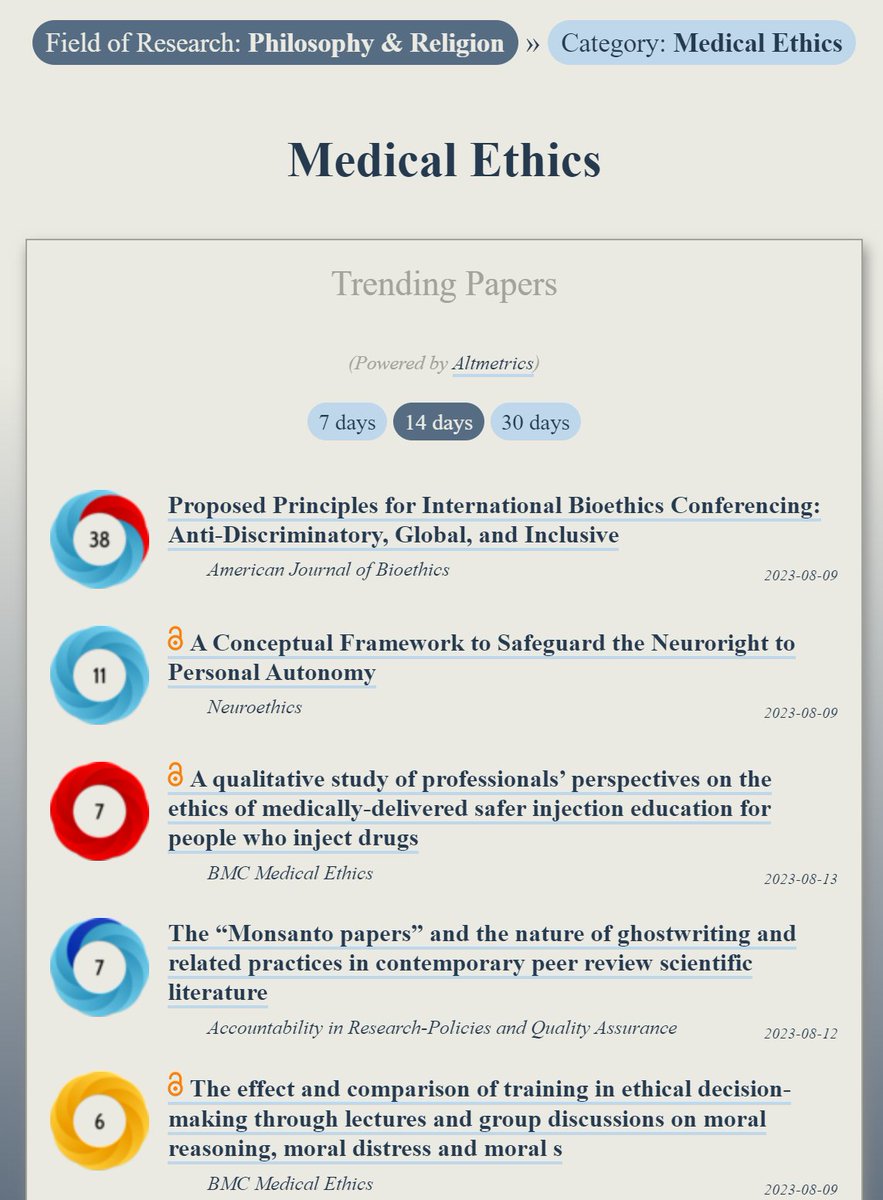
Trending in #MedicalEthics:
https://t.co/dyrNaQTGjw
1) Principles for Bioethics Conferencing (@bioethics_net)
2) The Neuroright to Personal Autonomy (@NeuroethicsJ)
3) Ghostwriting in scientific literature: The “Monsanto papers”
4) Safer injection education for people who inject drugs
In @NeuroethicsJ, #FSP Alum @BlumenthalBarby and colleagues interviewed clinicians & caregivers of pediatric refractory dystonia patients about deep brain stimulation treatment, seeking to understand how hope & unrealistic optimism impact decision-making. https://t.co/66PZt7VLdH
🔵New article published in @NeuroethicsJ "Revisiting Maher’s One-Factor Theory of Delusion" by Chenwei Nie, a POLONEZ BIS postdoctoral fellow at INCET @NCN_PL @MSCActions
This newly published paper by Chenwei Nie asks how many factors, i.e. departures from normality, are necessary to explain a delusion? https://t.co/NVmxJB4m51
Newly published, by J. Lee!
This paper analyzes the definition and diagnosis of Mild Cognitive Impairment, and explores MCI in relation to Alzheimer’s disease. https://t.co/PNvoMg2hJi
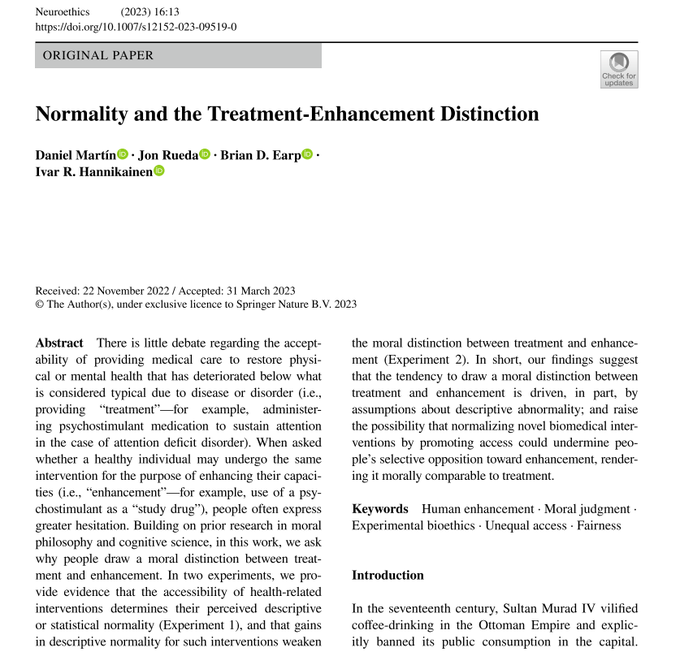
Junto con Daniel Martín y
@briandavidearp, nuestros compañeros @ruetxe e Ivar Hannikainen, han publicado el artículo "Normality and the Treatment-Enhancement Distinction" en la revista @NeuroethicsJ
No os lo perdáis 👇🏽
https://t.co/0KvDZ9xGOc
Daniel Martín @briandavidearp@ruetxe and Ivar Hannikainen have published the scientific article "Normality and the Treatment-Enhancement Distinction" in Neuroethics
@NeuroethicsJ
Read it here 👇🏽
https://t.co/0KvDZ9xGOc
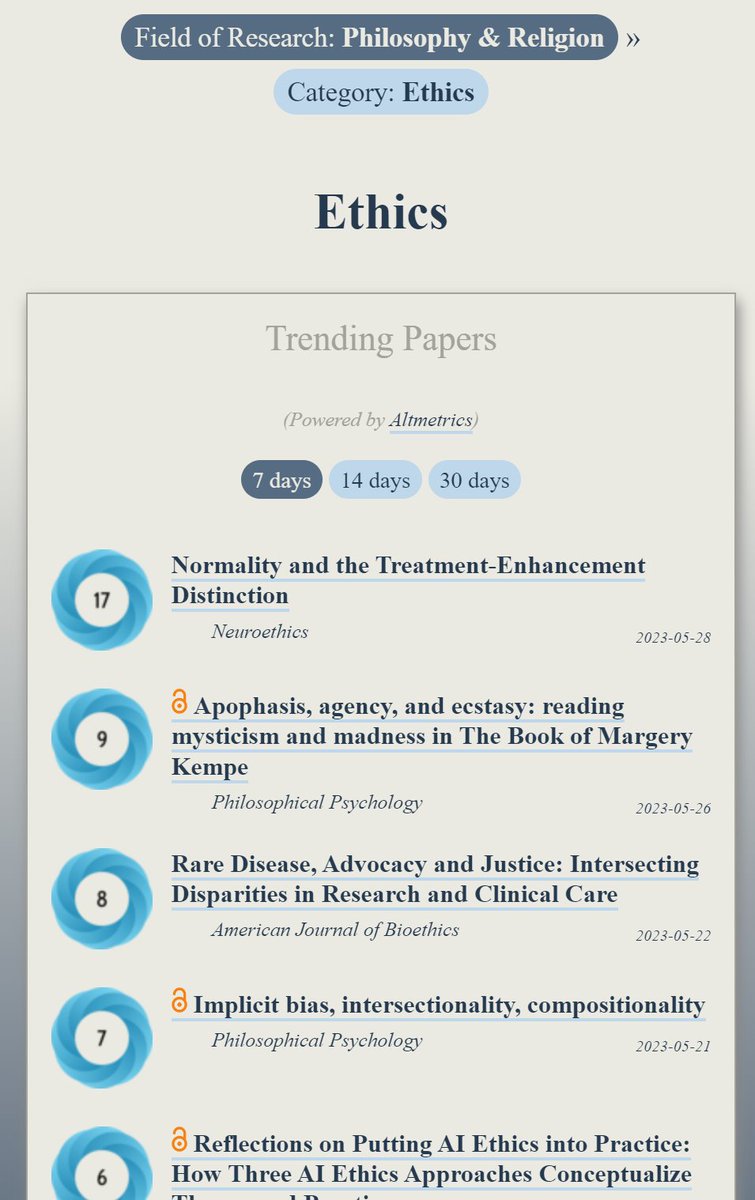
Trending in #Ethics:
https://t.co/10axjVlz8E
1) Normality & the Treatment-Enhancement Distinction (@NeuroethicsJ)
2) Mysticism & madness in The Book of Margery Kempe (@JournalPHP)
3) Rare Disease, Advocacy & Justice (@bioethics_net)
4) Implicit bias & intersectionality
In this paper, Lyreskog, Zohny, Saveulescu, & Singh argue that frameworks for understanding collective agency and responsibility are insufficient and may obstruct ethical analysis of the implementation of technologies related to collective minds. https://t.co/UmgPjVGYp8
This study by Collins and Klein found that neuroethicists almost always use ‘invasiveness’ to refer to the physical features of interventions, and that invasiveness does not determine which ethical issues are prioritized for a given type of neurotechnology.https://t.co/APdcyxn3mz
Newly published (open access): Rainey (@krummemholze) argues against the idea of neurorights as ‘novel human rights.’ Instead, we ought to think of them as Hohfeldian privileges, applying familiar and established rational and discursive norms. https://t.co/SNlJVp3fN8
New Monday, New Episode!
Check out the latest episode on “#Disability, Neurotechnology, & #Justice” featuring @r_chavarriaga Jasmin Harris, and Gregor @Wolbring , with guest host Sara Goering.
This is part of a special season with @neuroethicsinfo
https://t.co/KcMStiAyUh
Thank you again to all of our authors for making 2022 such a successful year for our journal! We look forward to reading your new contributions in 2023.
The most downloaded paper in @NeuroethicsJ in 2022 was "Human Brain Organoids and Consciousness" by Niikawa, Hayashi, @PhilosophyShep, and Sawai. https://t.co/MIiBTMR9N1
Our third most downloaded paper in 2022 was "Preserving Narrative Identity for Dementia Patients: Embodiment, Active Environments, and Distributed Memory" by @RHeersmink. https://t.co/X7KqzHfhtR
Our fourth most downloaded paper in 2022 was "On the Contribution of Neuroethics to the Ethics and Regulation of Artificial Intelligence" by @MicheleFarisco, Kathinka Evers, and @arleensalles. https://t.co/SXnu62tQ76
Our fifth most downloaded paper in 2022 was "Memory Modification and Authenticity: A Narrative Approach" by @Muriel_L_ . Congratulations Dr. Leuenberger! https://t.co/McajfAqSGA