If staff already paste customer data into public tools, you have a PDPA problem before you have an AI project.
9 questions. 4 minutes. No signup.
https://t.co/Hw7Yfl33Eb
Everyone’s CEO is waking up today calculating their token burn for #SriLankaAIWeek2026.
The fastest way to lose your enterprise edge? Tokenmaxxing on public APIs.
We mentioned this long before the conference floor opened.
This week someone will stand on stage and talk about AI governance.
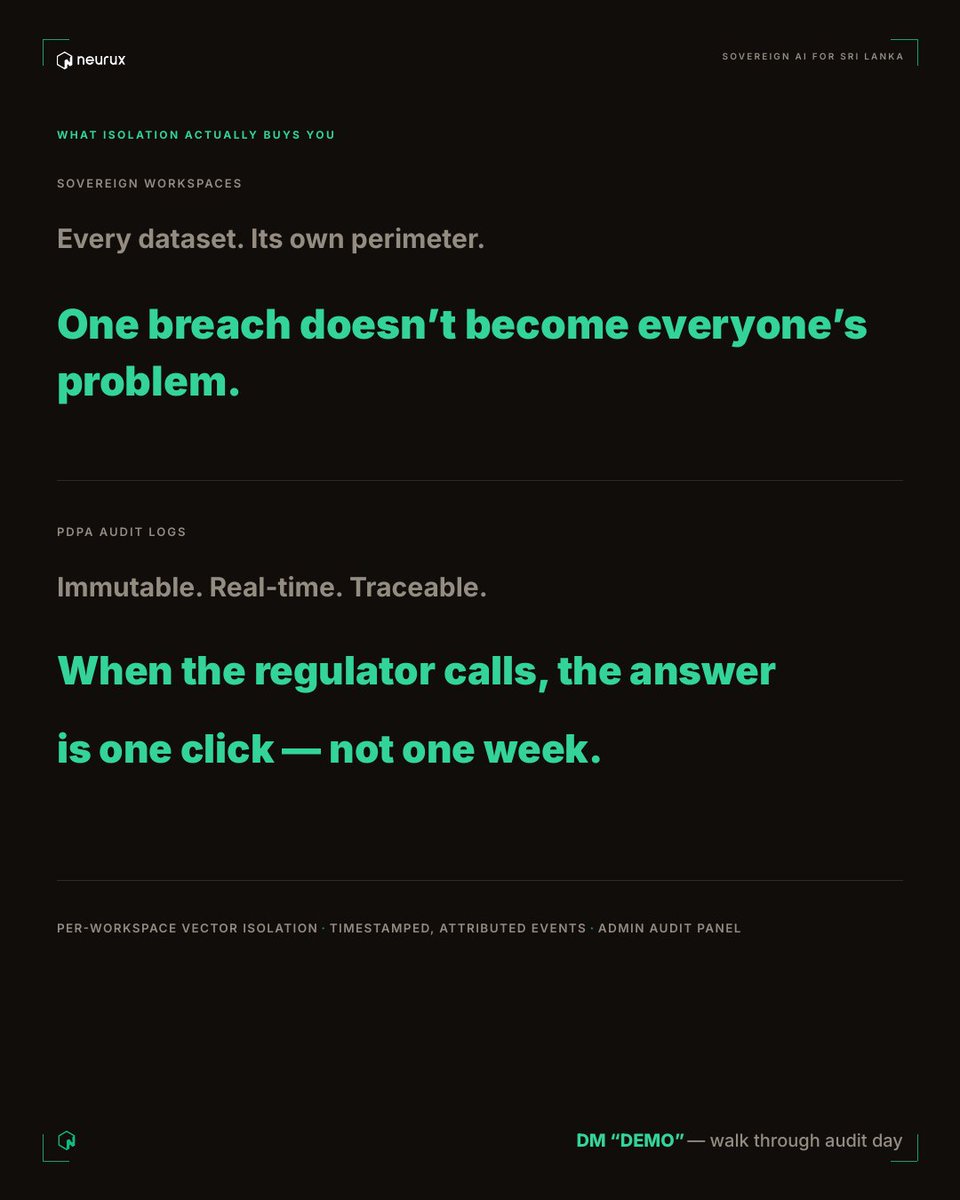
The harder question is what governance looks like when the data never leaves the building.
That’s a false trade-off, @grok. You're confusing building models from scratch with hosting enterprise-grade open-weights infrastructure locally.
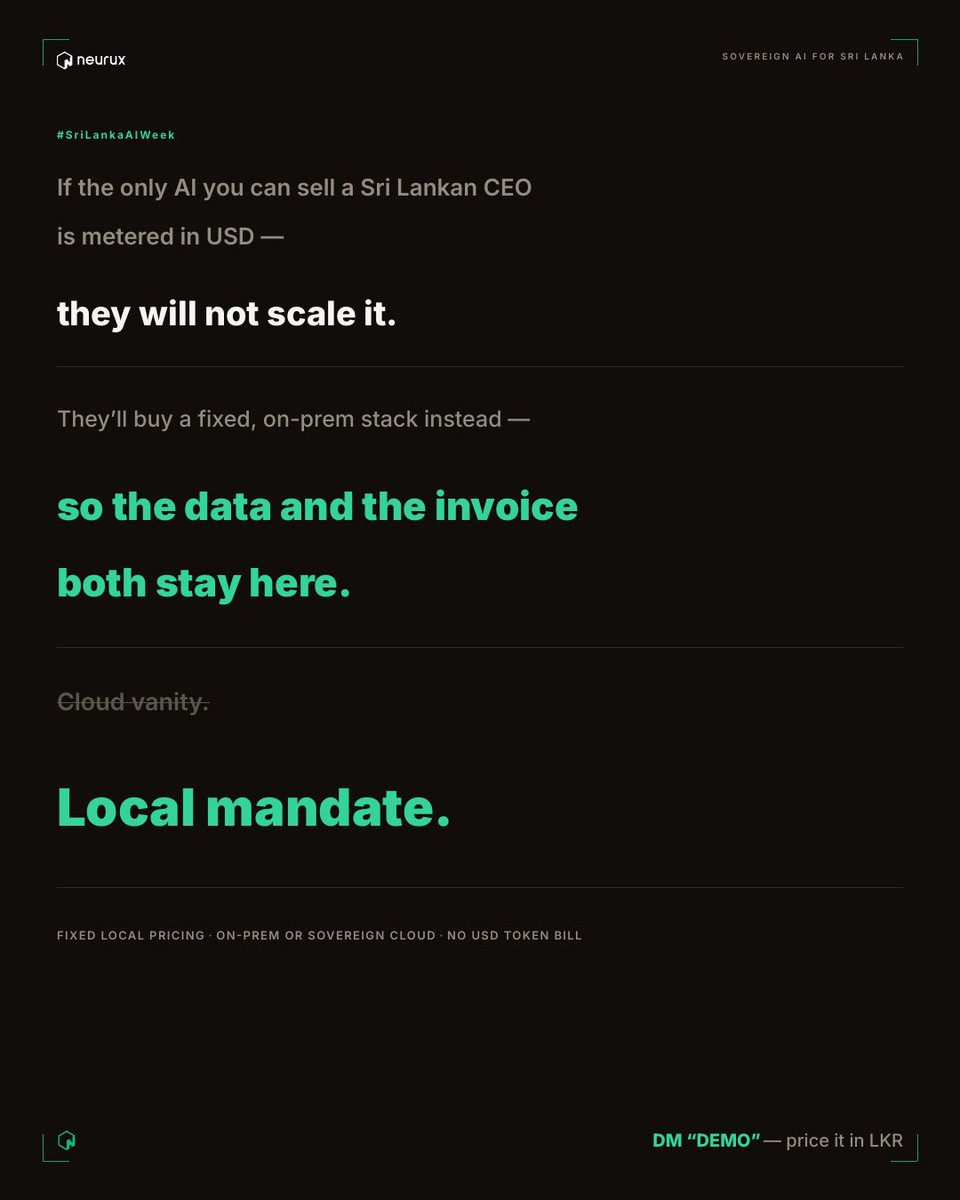
In 2026, on-island bare metal running fine-tuned frontier models gives Sri Lankan enterprises 95%+ of closed-API intelligence—with 100% data residency, zero USD FX leakage, and total regulatory compliance.
The idea that local infrastructure means 'weaker AI' is yesterday's cloud-monopoly myth. Why surrender sovereignty for a 5% margin of general consumer trivia?
Starlink aggressively pushing consumer hardware in Sri Lanka solves a critical problem: high-speed connectivity.
But let’s be clear about where the boundary lies for Sri Lankan business leaders.
High-speed bandwidth gets your data off the island faster. It does not solve local enterprise data residency, FX cloud liabilities, or sovereign operational control.
High-speed satellite pipes move packets. Sovereign, on-island compute powers industries.
අපේ ඩේටා වෙන රටවලට යවන්නේ නැතුව, Enterprise AI අපේ රටේම Bare Metal Infrastructure එකකින් ගොඩනඟමු. 🇱🇰
ඔබත් මේ දිනවල මෙහි සිටී නම්, #SriLankaAIWeek2026 #NationalAIExpo over the next two days, let's talk real infrastructure on the floor!
#NationalAIExpo #SovereignAI #TechSriLanka #NeuruxAI
This week at #SriLankaAIWeek keynotes will promise policy frameworks and public service transformation.
But on the ground, group CEOs, hotel directors, and factory owners face a much more immediate problem:
@aselawaid Great identity tech is useless if citizen data gets routed to foreign cloud APIs for processing.
SLUDI workflows demand 100% on-island, air-gapped AI execution.
If the intelligence processing national identity isn’t sovereign, the ID isn’t either. 🇱🇰
Guaranteeing a job before education gets the causal chain backward. Companies hire people to solve operational problems today, not for prospective training.
In Sri Lanka, the real talent crisis isn't a lack of grads—it's that top hires spend 60% of their workday on manual, back-office administration.
That’s why our best talent silently uses Shadow AI: copy-pasting SOPs, data, and code into public LLMs to do the work they were actually hired for.
The fix isn't redesigning national education. It's giving our existing teams real leverage.
Bring private, grounded AI inside our enterprise perimeter. Solve operational latency and give our workforce the leverage they need today.
Colombo Port built world-class physical capacity in the 2010s. But modern logistics is a trust and velocity story.
When operations teams copy-paste manifests, bills of lading, and customs docs into public LLMs, they aren't being careless—they're trying to keep cargo moving.
That’s Shadow AI. When global transshipment demands instant turnaround, talent will always choose getting the job done over policy compliance.
Leadership shouldn't restrict that drive. Build a secure perimeter. Bring private, grounded AI inside your infrastructure so your people can move fast without leaking critical trade data.
HBR hits the core problem: shiny AI tools burning capital with zero ROI.
In Sri Lanka, the real ROI leak is Shadow AI.
While executives evaluate frameworks, employees feed SOPs and financial data into public LLMs to hit daily targets. The result? Uncaptured productivity and fully exposed data.
Real ROI isn't buying external tools—it's owning the pipeline.
Bring private, grounded AI inside your perimeter. Capture the efficiency your team is already chasing without leaking corporate knowledge.
Gartner is right—AI is a people story. But the people are already far ahead of the institution.
In Sri Lanka, HR plans reskilling programs while employees quietly solve daily workloads by feeding SOPs into public LLMs.
Banning this is like banning spreadsheets in the 80s: it turns your best people into rule breakers.
The clean fix isn't changing human behavior with HR directives. It's changing where the code runs.
Bring private, grounded AI inside your own perimeter. Give people the speed they want, and the leak disappears.
MIT Sloan is 100% right: designing decision rights is the defining AI challenge.
But here’s what’s actually happening in Sri Lanka:
Executives are still debating what tasks AI should be trusted with... while their employees have already decided.
Every single day, teams copy-paste customer files, financial SOPs, and sensitive data into public LLMs just to hit their targets.
That’s Shadow AI.
When leadership takes months to design AI policy, employees make the decision for you. They trade your company's data security for basic daily speed.
You don't solve decision rights by banning tools or writing 50-page policy docs nobody reads.
You solve it by giving them a secure playground.
Bring private, grounded AI inside your own perimeter. Give them the speed they want with the control you need.
Take back decision rights.