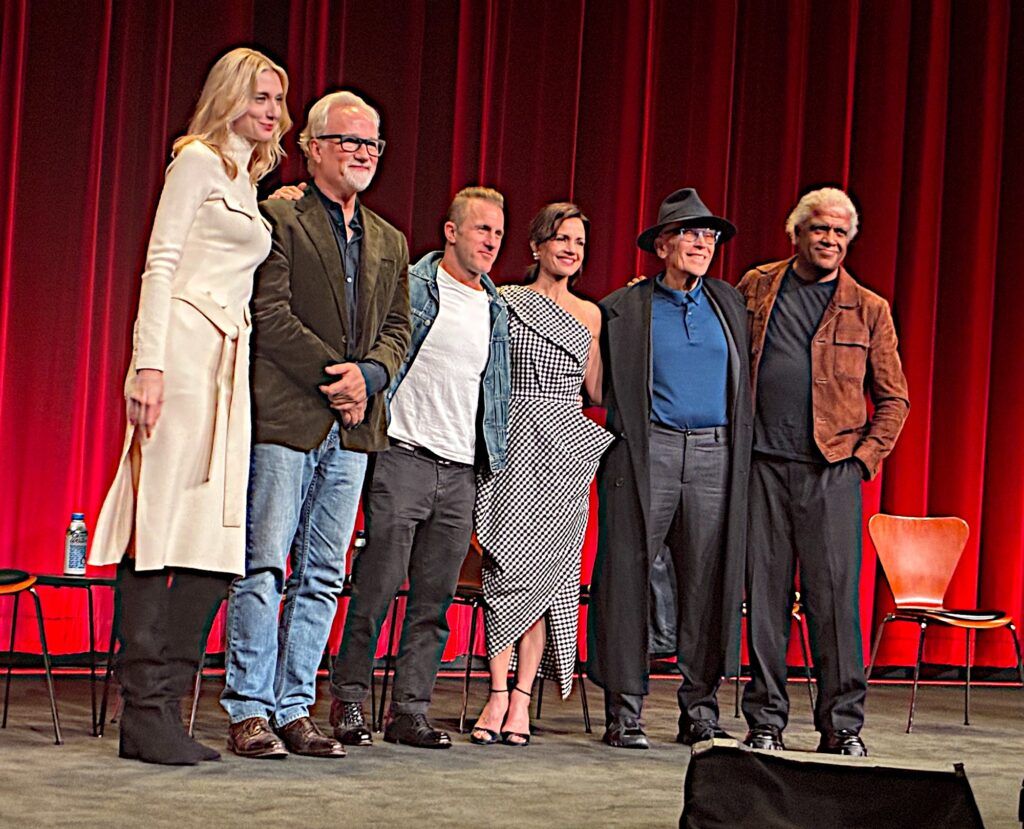
Ayer soñé con los hambrientos, los locos
Los que se fueron, los que están en prisión
Hoy desperte cantando esta canción
Que ya fue escrita hace un tiempo atrás
Es necesario cantarla de nuevo una vez más..🎶
(Charly Garcia.)
#libertad#ResistirDefender@Fed300spartan@SerenaRich
Steven Soderbergh will be missed. He directed all three films in the original trilogy and gave the franchise its unmistakable style.
Soderbergh previously explained why he wouldn’t return:
“After we made the third movie, I felt like the series was very much concluded for me. When the studio approached me to see if I’d be involved in continuing the franchise, I told them no, because it just doesn’t feel like a move forward for me. I’m chasing something else.”
It’s hard to imagine the original trilogy without his direction. His visual style, editing and sense of rhythm were a huge part of what made those films special.
Los Blaquier acuerdan compensar a los herederos de una familia judía cuando vendan un cuadro de Van Gogh valuado en US$180 millones
https://t.co/Q2ouASbjnl
Many people still confuse medieval Rus’ (Ruthenia) with modern Russia, but they are not the same — not historically, politically, or culturally.
Rus’ (also known as Kyivan Rus’ or Ruthenia) was the name of the ancient state founded in Kyiv in the 9th century by the Scandinavian Rurikid dynasty (Igor and Olga — Ingvarr and Helga in Old Norse — were the founding couple). It was one of the most developed European powers of its time: a Christianized, literate, and trade-rich civilization that connected Byzantium with Northern Europe.
By the year 1100, Kyiv was the fourth-largest city in Europe, several times bigger than Paris or London.
Moscow, on the other hand, didn’t even exist until 1147, more than two centuries after Kyiv was already a flourishing capital. Its founder, Yuri Dolgorukiy, was a descendant of Kyivan rulers — and his grave is in Kyiv, not Moscow. You can literally visit it today. Moscow began as a remote colony of Rus’, a place where Kyiv’s royalty sent their least important members to govern what was then considered a wild frontier.
For hundreds of years, the territory around Moscow was known as Moskovia (Muscovy). It had a very different history and political trajectory. After being conquered by the Mongols in 1237, Muscovy remained a vassal of the Golden Horde and later of the Crimean Khanate for over 450 years, paying tribute and adopting much of the political culture, administrative structure, and even vocabulary of its steppe overlords.
Only in the early 1700s, under Peter I, did Muscovy rename itself the “Russian Empire,” deliberately appropriating the name Rus’ and its history to create the illusion of continuity. This was political rebranding — not a historical fact.
There is no direct political ancestry between modern Russia and Kyivan Rus’. Moscow was a Rus’ colony for less than a century and then lived under foreign domination for over four centuries. If anything, its autocracy, militarism, and imperial expansion reflect the legacy of the Golden Horde far more than the democratic traditions and European orientation of ancient Rus’.
The truth is simple but important: Kyiv, not Moscow, is the cradle of Eastern Slavic civilization. Ukraine, not Russia, is the rightful heir of Rus’.
And stealing that heritage is one of the reasons for this war. That’s why Putin obsesses over his version of history — because our very existence exposes his lies.
Author: Volodymyr Kukharenko
Con un mínimo de solidaridad en el gremio y respeto por el trabajo propio, lo primero que deberían hacer los periodistas que cubren a la Selección es negarse a participar de conferencias de prensa en las que se excluya a TN y La Nación. O hacer preguntas sólo sobre esa censura.
The star and crescent has pre-Islamic Mesopotamian roots (crescent for Sin, star for Ishtar); later used in Byzantium, it was adopted by the Ottomans.
Which is your favorite flag?
@gabyspepe Al Papa lo paga el estado. Están todos como que vino de regalo. Que bendición. No van a ningún lado gratis!
Vergüenza ajena los gobernantes y el Papa también