NewGen L1 is the canonical blockchain layer of NewGenEngine.
In simple terms: it defines what becomes canonical inside the ecosystem.
A blockchain should not only produce blocks or move transactions.
It should manage state, finality, settlement, governance, economic rules, validator behavior, reputation, recovery, verification, and the boundary between on-chain authority and off-chain execution.
That is why NewGen L1 was built as a custom Rust runtime, not as a generic chain template.
The goal is to create a canonical foundation for:
• verifiable chain state
• finality and settlement
• adaptive fees and economic behavior
• mempool and anti-spam rules
• governance and emergency controls
• validator logic
• reputation and penalties
• node recovery
• snapshot bootstrap
• checkpoints and trust boundaries
• storage safety and pruning
• light verification paths
• native asset primitives
• compute worker eligibility
• AI reconciliation boundaries
• public evidence
One important part is the economic layer.
Fees should not be static numbers disconnected from network conditions. They should help protect the network from spam, react to pressure, and keep the chain usable as activity changes.
Fees are not only a cost. They are part of network protection, load control, and long-term sustainability.
Governance matters for the same reason.
Governance should not only exist on paper. It should control critical protocol behavior: economic policy, security policy, validator operations, emergency mode, reputation rules, and elevated permissions for compute-related roles.
Reliability matters just as much.
A serious chain should not only work when everything is perfect. It should recover nodes, restore state, verify alignment, use checkpoints and snapshots, and keep consensus moving when conditions change.
That is why recovery behavior, storage safety, light verification, and public evidence matter.
The same logic applies to validators.
A validator should not be limited to signing blocks forever.
Reliable nodes can become more useful over time.
The long-term direction of NewGenEngine is to let qualified nodes move beyond validation and participate in useful work: job execution, compute workloads, Cloud Unit capacity, and decentralized infrastructure.
But this must happen without weakening the chain.
If a validator evolves toward compute, the protocol still needs quorum protection, finality checks, quality rules, reputation, and controlled permissions.
The chain must remain the source of truth.
Compute can execute useful work.
AI can assist, reason, and interact with tools.
But neither compute nor AI should become canonical authority by themselves.
That is the core architecture:
NewGen L1 defines what is canonical.
E2 Compute Hub performs verifiable work.
NewGen AI operates within verified boundaries.
Native asset primitives can also support ecosystem objects such as tokens, badges, certificates, receipts, access passes, and other verifiable records.
NewGen L1 is not only a blockchain runtime.
It is the canonical base for a broader infrastructure stack: chain, compute, and AI — connected by explicit authority boundaries.
Public evidence and technical notes will continue to be published step by step.
#BlockchainInfrastructure #DePIN
Exactly.
AI compute demand is exploding, but the infrastructure model is still centralized, expensive, and opaque.
With NewGenEngine, I am working on a different path: distributed compute operators, execution evidence, and verifiable cloud infrastructure through E2 Compute Hub.
The next cloud should not be another black box.
@nosana_ai@elizaOS The biggest problem with decentralized compute is not supply.
It is trust.
If a workload runs on a node but the result cannot be verified, decentralization does not remove the black box.
It only distributes it.
The next cloud needs verifiable execution.
Shared security can improve scalability and reduce operational overhead.
But for decentralized compute, the harder problem is not only where consensus settles.
It is what the execution boundary can prove.
Fast state transitions do not matter much if the workload state itself remains unverifiable.
Cold truth: many AI startups are raising capital just to hand 80% of their runway back to Amazon and Microsoft cloud bills before the product even scales.
We are renting black-box servers at a massive markup, praying they don’t silently fail, throttle, or lock us in.
Centralized cloud was built for the last software era, not for the AI era.
If you are still relying on a single provider for your critical compute in 2026, you don't own your infrastructure.
You are just renting your survival.
E2 Compute Hub is now in final validation. The transition to verifiable, distributed cloud capacity isn't a trend—it's a necessity.
Disagree? Tell me why renting black boxes is still sustainable.
NewGenEngine is in final technical validation.
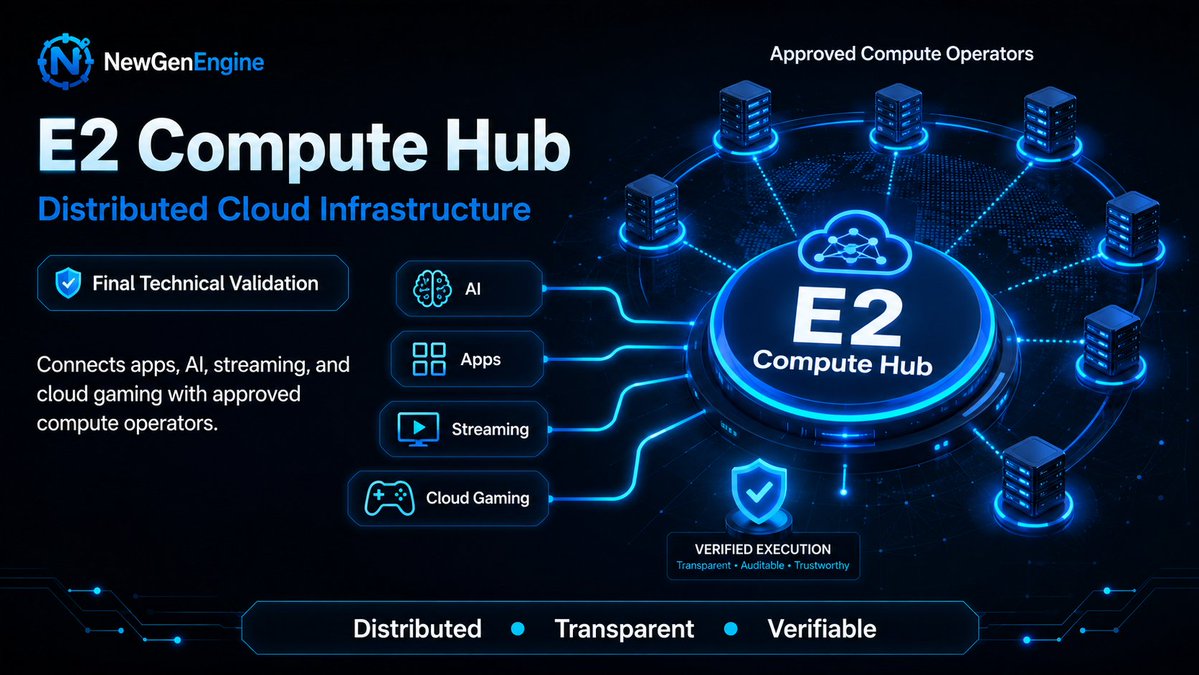
E2 Compute Hub is a distributed cloud infrastructure layer.
It is designed to connect apps, AI systems, streaming sessions, and cloud gaming workloads with approved compute operators.
The goal is simple: make cloud computing more distributed, transparent, and verifiable — with evidence that the work was executed correctly.
Built for AI, applications, streaming, gaming, and infrastructure that need trust.
More context is available on the profile.
NewGenEngine is structured around three connected layers:
• E2 Compute Hub for distributed cloud capacity
• a coordination layer for verification and system reliability
• AI systems with explicit trust boundaries
The current focus is final technical validation and public evidence.
#DePIN #CloudComputing
Validators are already powerful machines connected to a network.
Stopping at block validation is a waste.
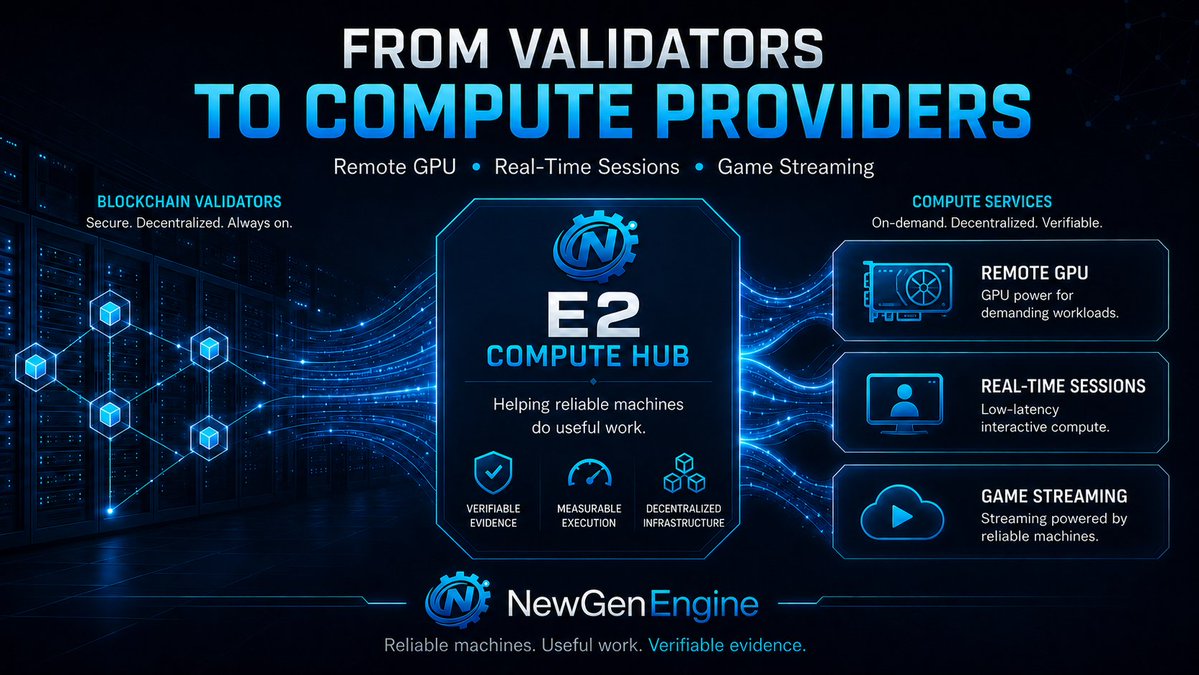
E2 Compute Hub is built to turn reliable machines into compute providers: machines that run useful workloads, build reputation, and earn more by doing real work.
And one of the most interesting use cases is interactive compute:
remote GPU access,
real-time sessions,
game streaming.
Not just blockchain nodes.
Useful machines.
#DePIN #CloudGaming
Most blockchains use nodes to validate blocks.
NewGenEngine is being built around a bigger idea: reliable nodes should become useful infrastructure.
They should secure the chain, provide compute, execute real work, build reputation, and earn rewards for measurable work, not only inside the ecosystem but also for external workloads that need verifiable evidence.
That is the direction behind NewGen L1 and E2 Compute Hub:
from validators to decentralized compute infrastructure.
Step by step.
#DePIN #BlockchainInfrastructure
NewGen L1 is not being built as a blockchain that lives alone.
The idea is bigger than validators only producing blocks.
If a node is reliable, it should be able to become useful infrastructure.
Not just validating blocks, but also providing compute, executing work, and adding real power to the network.
That is the direction behind E2 Compute Hub.
A validator or node should be able to grow into something closer to a decentralized data center: a machine that can help secure the chain, provide compute, and earn more by performing useful work.
The chain remains the source of truth.
The compute layer connects to it.
And the work should be visible, measurable, and linked back to the system.
This is the direction NewGenEngine is building toward:
not only block validation,
but useful infrastructure.
#DePIN #BlockchainInfrastructure
This is the type of infrastructure behavior that matters.
NewGen L1 node D was started locally from a clean recovery state, restored via snapshot, completed recovery, aligned with the running server nodes, and rejoined the validator network without disrupting quorum.
A/B/C remained aligned.
Node D reset and recovered.
readyCount = 4
quorum = true
aligned state hash.
After resetting, node D simply remained out of sync.
Being part of the validator set/council, once fully aligned with the blockchain's canonical state, it was able to rejoin operational validation and resume mining.
This distinction is important.
A non-validator node can synchronize with the blockchain and follow the canonical state, but it cannot mine new blocks.
A validator node should mine only after restoring the blockchain's canonical state, aligning with the network, and being readmitted to operational validation.
Snapshot recovery isn't just a technical detail.
It's what allows a blockchain to recover from reboots, allow new or removed nodes to restart from a verified state, avoid rebuilding everything block by block, and preserve a canonical and reliable source of truth as the network grows.
A blockchain shouldn't only work when everything is perfect.
It should be able to recover.
Step by step.
#BuildInPublic #BlockchainInfrastructure
Not every day of development brings a new announcement.
Some days are dedicated to hardening what already exists.
Today, I am focused on NewGen L1 snapshot and recovery logic:
regression testing,
state consistency,
node restart behavior,
safe network rejoin,
and making sure recovery logic remains reliable across edge cases.
This matters because recovery is not a marketing feature.
It is infrastructure.
A blockchain should not function only when everything is perfect.
It must be able to recover, rejoin, synchronize, and maintain a clear canonical source of truth when nodes restart or recover.
NewGenEngine has already published public evidence in this area.
The next step is cleaner validation, stronger hardening, and clearer public evidence.
#BuildInPublic #BlockchainInfrastructure
Good question.
In NewGenEngine, compute roles do not become chain authority.
Compute reputation is not consensus power.
Reputation increases eligibility for useful work, not the power to define truth.
A node can execute workloads, submit evidence, build reputation, and become more useful infrastructure — but canonical state remains on NewGen L1.
The rules are built around separation:
quorum protection,
eligibility checks,
capability verification,
governance-bounded permissions,
penalties for bad behavior,
and a clear boundary between off-chain execution and canonical chain state.
That is the important distinction:
compute can earn work.
evidence can support verification.
reputation can affect eligibility.
but NewGen L1 remains the source of truth.
Most blockchains stop at validation.
NewGenEngine is not being built to stop there.
A reliable node should not only sign blocks forever.
If a node can prove reliability, build reputation, and stay aligned with the chain, it should be able to become something more useful:
an infrastructure node.
That is the direction behind E2 Compute Hub.
The future of decentralized infrastructure is not only about block production.
It is execution.
It is compute.
It is evidence.
It is reputation.
It is settlement.
It is useful work connected back to canonical state.
Because compute without verification is just a claim.
If someone says they executed a workload, the system should not simply trust them.
It should ask:
was the worker eligible?
was the capability real?
was the workload executed?
was evidence produced?
does reputation support it?
can the result connect back to the canonical layer?
That is where NewGen L1 and E2 connect.
The chain defines what becomes canonical.
E2 performs useful work.
Evidence connects execution back to the system.
This is the bigger idea:
not just validators,
but infrastructure nodes.
not just compute marketplaces,
but accountable compute.
not just AI output,
but AI operating inside clear authority boundaries.
Most crypto infrastructure talks about decentralization.
But decentralization becomes much more powerful when machines can do useful work, prove it, and build reputation over time.
Compute should not be invisible.
Execution should not be trusted blindly.
Reputation should matter.
Evidence should matter.
NewGenEngine is being built around that stack:
Canonical blockchain.
Verifiable compute.
AI with clear boundaries.
Step by step.
#DePIN #VerifiableCompute
The uncomfortable truth:
AI compute is becoming critical infrastructure before society has a clear way to verify it.
Everyone talks about GPUs, power, cooling, and water.
Almost nobody talks about proof of execution, failure recovery, accountability, and who controls the compute layer.
That may become the bigger risk.
AI infrastructure is not just a GPU race.
The harder question is who can coordinate the full stack: power, cooling, networking, scheduling, utilization, reliability, and proof of execution.
Raw compute gets the headlines.
Accountable compute will decide who can actually build durable infrastructure.
The “show me” era should be brutal for weak crypto projects.
Narratives are easy.
Working infrastructure is harder.
Public evidence is harder.
Recovery paths, execution, verification, and real boundaries are harder.
The next serious projects should not win by sounding bigger.
They should win by proving more.
A simple question behind E2 Compute Hub:
If a machine claims it executed useful work, should the system just trust it?
Or should execution, evidence, reputation, and canonical state be connected?
That difference is where compute starts becoming accountable infrastructure.
Too much technology asks people to trust what they cannot see.
I don’t think that is good enough.
AI should not be a black box.
Compute should not be a black box.
Blockchain infrastructure should not be only marketing.
NewGenEngine is being built around a simple idea:
make progress visible,
make systems understandable,
and let people judge the work over time.
#BuildInPublic