While Lauren St. Cyr, the spoiled child of oligarch Edouard Baussan, calls for a “robust” international mission in Haiti, it is well understood within the U.S. diplomatic circles that Baussan himself controls six of the seven voting members of the Presidential Transitional Council (CPT). Through this influence, Baussan has secured carte blanche authority over the CPS and consolidated total control of Haiti’s ports and customs, ensuring his family's unchallenged dominance in the region. #Haiti
The U.S. is intensifying its focus on Haiti’s economic elites, with key figures such as Coles, Baussan, and Handal already under scrutiny, and more potentially facing similar attention. As these power structures begin to unravel, it may be time for both the Haitian diaspora and those within Haiti to reflect on the future of the country’s leadership. The current elite is being destabilized, and those who have contributed to the ongoing turmoil must recognize that change is imminent. This is an evolving process, one that could reshape Haiti’s future. #Haiti
It’s both alarming and telling that not a single major Haitian journalist network has dared to cover the public statement issued by CPT member Fritz A. Jean, who highlighted the deeply troubling publication and quiet acceptance of a 27-year contract awarded to CPS. This isn’t just an administrative irregularity; it's an outright abuse of power. Typically, such contracts are bound by a 9-year limit, and stretching it to nearly three decades reeks of corruption, backroom deals, and deliberate manipulation of the system.
What makes this even more outrageous is the deafening silence surrounding it. Why is no one investigating? Why has no major outlet pursued this story, especially when it was condemned by a figure sitting at the highest level of the transitional executive power?
In light of this, it’s worth recalling a key passage from The Zombie Files by Max Kail, which highlighted how the international community once pressured former President Jovenel Moïse to reform or cancel overpriced contracts, particularly those involving customs at the Dominican border, Haitian ports and private electricity suppliers. The CPS deal seems to be a continuation of the very practices the international community previously condemned. #Calan
CARICOM has just been informed of the arrest of former Haitian senator Nenel Cassy, a known close associate of powerful gang networks and a key figure within the inner circle of Didier Fils-Aimé.
Sources familiar with the case say the arrest comes as no surprise, given the mounting evidence linking Cassy to notorious gang leaders and his suspected involvement in orchestrating political violence across Haiti. Incriminating documents and communications reportedly uncover a deep entanglement between Cassy and the criminal underworld, further highlighting the extent of corruption and destabilization facing the nation. #Calan
What in the hell are we witnessing right now? For the first time in modern history, a U.S. administration is bending over backwards to prop up a Haitian leader surrounded by suspicious surrounded by individuals widely rumored to be under imminent U.S. sanctions. The level of lobbying behind this must be monumental. And who’s footing the bill? Wouldn’t be surprising if it's coming right out of the pockets of the Haitian taxpayer, again. #Calan
The United States is aware of reported bribery attempts to undermine Haiti’s stability. We commend those TPC members for rejecting corruption and reaffirm our support for their collaborative work with the Prime Minister to work together to stabilize Haiti, in our shared national interests.
We will hold accountable anyone who seeks to disrupt this cooperation.
With the official arrest of Pierre Réginald Boulos by U.S. Immigration and Customs Enforcement’s Homeland Security Investigations for violations of the Immigration and Nationality Act tied directly to the destabilization of Haiti the international community, including CARICOM, can no longer ignore the blatant and ongoing collusion between the Haitian government and criminal enterprises.
Under the leadership of Alix Didier Fils-Aimé, the Haitian government has not only tolerated but actively facilitated the expansion of gang power as a means to maintain political control and suppress opposition. It is no coincidence that kamikaze drone operations—ostensibly aimed at dismantling gang strongholds—have yielded few results. Even more telling is the complete absence of operations targeting the notorious gang leader "Krisla" from Ti Bwa, despite his violent influence over the Carrefour region.
Krisla’s deep-rooted alliance with the Fils-Aimé administration has afforded him political protection and impunity. His influence is so entrenched that he has even attempted to install his own mayor in Carrefour, an audacious move backed by elements within the central government. Thankfully, this brazen attempt was stalled, as the administration failed to secure the necessary five votes from the CPT (Transitional Presidential Council) to legitimize his candidate, but the very attempt reflects the dangerous extent of gang penetration into state institutions.
This government-gang nexus has transformed Haiti into a hostage state, where political power is increasingly reliant on criminal allegiances rather than democratic legitimacy or public trust. The arrest of Boulos is only the beginning. Accountability must extend beyond individuals to the systemic corruption and collusion that continues to hold Haiti captive.
To the others who have built empires of luxury and power off the suffering and blood of Haiti’s most vulnerable: your time is running out. Upon his arrest, Boulos reportedly stated, “Do not house me with the general detainee population. I’ve provided a lot of information, and based on that, others will be joining me soon.”
Take note he has begun to speak, and the fallout is coming. The clock is ticking, and this time, it's not on your side. #Calan
As highlighted in our previous post, after years of unchecked impunity, accountability is finally catching up with key figures in Haiti’s ruling class.
Senator Marco Rubio announced today that the United States is taking action against individuals with legal status in the U.S. who have supported Viv Ansanm, a designated Haitian terrorist group responsible for driving much of the gang violence and instability across the country.
“The U.S. will not allow individuals to enjoy legal status here while backing violent or criminal organizations,” Rubio declared.
Among those now under scrutiny is Pierre Reginald Boulos, a powerful Haitian businessman and former presidential candidate, who was arrested by ICE in South Florida. While officials have not confirmed a direct link between Boulos’ arrest and Rubio’s statement, the timing speaks volumes. As The Miami Herald reported, “Rubio did not provide any names and the State Department did not respond to questions about whether he’s speaking about Boulos or others.”
Still, the arrest signals a shift in tone and in tactics. For years, Haiti’s political and economic elites have operated with impunity, profiting from instability while ordinary citizens bear the brunt of the crisis. But now, the fall of someone once seen as untouchable suggests a new chapter may be unfolding: from unchecked power to potential prosecution.
The message is clear. Wealth, status, and foreign ties no longer guarantee immunity. As international pressure builds and investigations widen, the era of foreign backed impunity may finally be giving way to long-awaited justice. #Calan
"Deputy Secretary Landau also affirmed the United States’ commitment to accountability for those who undermine Haiti’s stability. The United States will continue to leverage all tools, including sanctions, visa restrictions, and other measures against individuals who enable violence and instability.”
After months of relentless whistleblowing by numerous conscious Haitian civil society organizations, it is deeply unfortunate that the Prime Minister waited for directives from international actors his so-called headmasters before acknowledging the destructive and unsustainable path he and his inner circle have taken since assuming power.
Since his arrival, the Prime Minister and several close associates have been the subject of numerous allegations of corruption, embezzlement of public funds, and direct ties to criminal networks that have fueled gang violence and paralyzed the nation. Despite overwhelming evidence and calls for accountability from both domestic and international voices, the administration has operated with impunity, tightening its grip on power while the country plunges further into crisis.
The route chosen by these leaders has not only exacerbated Haiti's instability but has also enabled the empowerment of dark forces that continue to erode the nation’s institutions and social fabric. When will those responsible for this collapse recognize that their insatiable greed and thirst for control can never outshine the legacy of strength, resilience, and liberation that Haiti represents to Black nations across the globe?
We can only hope that Deputy Secretary Landau’s statement is more than diplomatic posture that it marks the beginning of genuine consequences for those undermining Haiti’s sovereignty and dignity. May it catalyze a new chapter driven by justice, transparency, and a truly Haitian-led restoration of democracy and peace. #Calan
Brazil’s leader is increasingly incoherent on the world stage. And at home, his popularity is slipping. What has Luiz Inácio Lula da Silva done wrong? https://t.co/CDzKIwR8WS
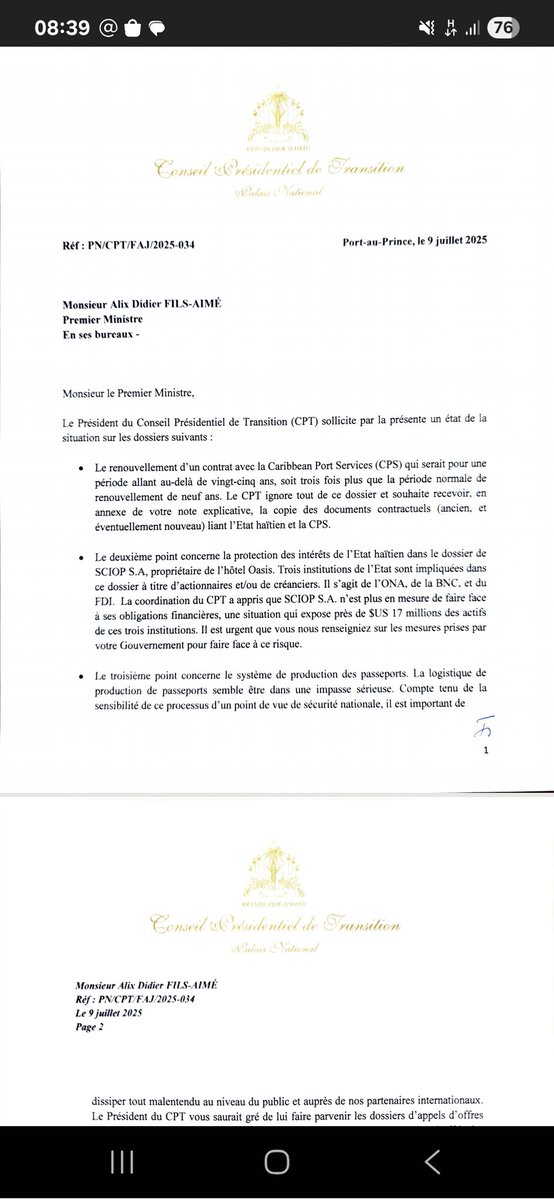
The inquiry letter from the president of the CPT clearly highlights the depth of corruption within the current prime minister's administration, carried out in collusion with specific groups in the private sector. It's no surprise, then, that the United States is working on new sanctions. #Calan
A government built to guide Haiti forward is now tangled in the very corruption it was meant to confront.
Three members of the Conseil Présidentiel de Transition (CPT) under active indictment for corruption remain in power without a shred of accountability. No resignations. No apologies. No shame.
The recent UN report couldn’t have been clearer: Haiti’s public administration has been infiltrated by private interests, and corruption is deeply entrenched. It directly connects government figures to illicit private sector dealings. The consequences? Already knocking at the door.
And yet, the CPT’s leadership stays quiet. The Prime Minister looks the other way. Those implicated act untouched, unmoved, and unbothered as if the suffering of the people is just background noise.
Let’s be clear: this is not a misunderstanding. It’s willful disregard of the truth. And the longer these individuals cling to power, the more faith is lost not just in them, but in the entire transition they promised to lead. #Calan
Colombia's ambassador to the US returned to Washington, appearing to take a conciliatory tone after a diplomatic tussle over allegations of Republican leaders' involvement in the Latin American nation's domestic affairs https://t.co/qLmpMJuyFK
Unchecked Corruption: How Haiti's Leaders Are Undermining the Nation
According to sources close to the U.S. Embassy, the Haitian Prime Minister has quietly orchestrated a controversial, long-term deal with Caribbean Port Services (CPS) Haitian stakeholders, extending a contract for more than 25 years. This backdoor agreement was carried out without the knowledge or approval of the Presidency, bypassing critical institutional safeguards and operating in complete secrecy. It’s a glaring violation of democratic norms and transparency, one that has not gone unnoticed by international financial observers.
What’s unfolding is more than political negligence, it’s a calculated effort to consolidate power and profit at the expense of the Haitian people. As noted in the latest UN experts report, International financial institutions are watching closely, alarmed by the reckless abuse of public office and growing concerns over the misuse of national assets.
Meanwhile, disturbing allegations point to Fils Aimé’s covert attempts to land a lucrative $43 million deal in the passport production sector. Industry insiders are sounding the alarm over what appears to be an aggressive campaign to privatize and profit from one of the country’s most vital public services. His actions signal a blatant intent to convert a national necessity into a personal cash machine, regardless of the consequences for Haitian citizens.
If these corrupt maneuvers are allowed to continue, the implications are grave. Haiti risks becoming further isolated, as citizens may soon find themselves unable to access travel documents, effectively cut off from the rest of the world. The government’s betrayal of the public trust is threatening not just institutional integrity, but the basic mobility and rights of its own people.
This is not mere incompetence, it’s exploitation by design. The Prime Minister and his allies are showing just how far they’re willing to go to stay in power and enrich themselves, even if it means selling off the country’s future piece by piece.
The international community is no longer fooled. More sanctions are not just likely, they are imminent. The Haitian people are bearing the brunt of this rampant corruption, and unless it is confronted head-on, the nation’s downward spiral will only accelerate. Haiti deserves better. #Calan
Even the most hopeful forecasts put Cuba’s budget deficit at around 10% of GDP this year, one of the highest rates in the world.
Discontent has fuelled another wave of emigration from the country. Anti-government protests may be on the way https://t.co/7tm5dlwR3C
Persona Non Grata: Venezuela Escalates Tensions with the UN
The world just witnessed another blow to international diplomacy. Venezuela, a country long criticized for silencing dissent, has now officially rejected oversight from the highest office in human rights at the United Nations.
On July 2, Venezuela’s National Assembly voted to declare Volker Türk, the UN High Commissioner for Human Rights, persona non grata, a move rarely taken against a figure of his stature. Though largely symbolic in nature, the declaration is a powerful and alarming signal: Venezuela no longer intends to cooperate with international human rights monitoring.
This decision comes after the UN released reports detailing arbitrary arrests, suppression of peaceful protests, the erosion of judicial independence, and attacks on journalists and civil society groups in Venezuela. Rather than address these concerns, President Nicolás Maduro’s government chose to discredit the messenger, accusing the UN of “serving imperial interests” and violating Venezuela’s sovereignty.
But let’s be clear, human rights are not optional, and oversight is not imperialism.
This is a test not only for the UN, but for the international community as a whole. Will other countries rally in defense of the principles the UN represents? Or will this moment pass quietly another crack in the foundation of international law?
Volker Türk, in his response, remained firm:
“Human rights are not negotiable. We will continue to stand with the people of Venezuela.”
But without access on the ground and support from the Venezuelan government, that promise becomes much harder to fulfill. #Calan
The Price of disengagement: What Trump's UN Cuts Mean For Haiti
As President Donald Trump renews his calls to cancel billions in U.S. spending for the United Nations, one nation stands to suffer gravely: Haiti. For a country already teetering on the edge of collapse, the withdrawal of international assistance could be devastating.
A Daily Struggle for Survival in Haiti
Haiti is in the grip of overlapping humanitarian, political, and economic crises. Every day, millions of Haitians face life without access to clean water, reliable healthcare, stable shelter, or personal safety. Gangs control large portions of the capital, Port-au-Prince, making movement within the city and distribution of aid perilous. Food insecurity affects over 40% of the population, with many surviving on a single meal a day, if that.
Basic services, including education and healthcare, are barely functional, if at all. Hospitals lack equipment and medication. Schools operate sporadically or not at all due to insecurity. Thousands of families have been displaced by violence, forced to live in makeshift camps without sanitation.
In this chaos, the United Nations and its network of humanitarian partners remain a vital lifeline.
The UN’s Critical Role in Haiti
The UN’s presence in Haiti includes agencies like UNICEF, the World Food Programme (WFP), and the UN Development Programme (UNDP), among others. These organizations run programs that feed children in schools, deliver vaccines and medical supplies, and provide emergency housing to families displaced by gang violence or natural disasters.
The UN also plays a stabilizing role through peacebuilding efforts and support for the Haitian National Police, including training and capacity building programs to help restore a semblance of law and order.
Without sustained funding, many of these initiatives would come to a halt. Food rations would stop. Medical clinics would close. Peace and security missions would be rolled back, potentially leaving a vacuum for gangs and criminal enterprises to further entrench themselves.
Why Trump Wants to Cut UN Spending
Donald Trump has long argued that the United States contributes too much to the United Nations compared to other countries, often pointing out that the U.S. covers roughly 22% of the UN’s regular budget and nearly 28% of peacekeeping costs.
From a political and economic standpoint, Trump frames the cuts as an "America First" fiscal policy. Reducing international aid, in his view, reallocates taxpayer money to domestic issues such as infrastructure, border security, and national defense. Supporters of the policy see it as a way to curb wasteful spending and push other nations to step up their financial responsibilities.
The Cost of Disengagement
While fiscal responsibility is a legitimate concern, the consequences of disengagement are global. Haiti is a textbook example. Pulling billions in UN funding might offer a short-term political win, but it risks creating long term chaos in fragile states like Haiti, chaos that often spills over into regional instability, migration crises, and international security threats.
For the Haitian people, it’s not just a policy debate. It’s the difference between eating and going hungry. Between getting medicine and dying from preventable disease. Between living under the rule of law and being ruled by fear.
If the U.S. wants to remain a global leader not just in rhetoric, but in values turning its back on Haiti now would be a profound moral failure. #Calan
Public Interest Hijacked: Why Haiti’s Private Elite Tried to Seize a National Bank
In a letter sent by SOGEBANK to the group representing the interests of Hotel Oasis, the bank formally stated its intent to take control of the entity due to a delinquent debt exceeding $7 millions. This revelation sheds light on the private sector's maneuvers last year through Laurent Saint-Cyr to seize control of the National Bank of Credit (BNC). The motive is now unmistakably clear: BNC holds over $8 million in loans and equity in the Hotel Oasis.
Moreover, FDI and ONA are also financially entangled in the Oasis project through debts and shareholdings. With Hotel Oasis unable to meet its obligations, the private sector attempted to exploit the BNC by manipulating its financial statements to retain control of the distressed assets. This was yet another instance of financial predation an all too familiar practice in Haiti's economic landscape.
To achieve this, the private sector, as always in Haitian economic history, had deployed its loyal proxies Vertilaire, Gilles, and Augustin with the backing of Leslie Voltaire, to install a puppet board at the BNC. Fortunately, the operation failed.
However, the damage to public trust is profound. This scandal exposes how systemic manipulation, greed, and corruption have deeply compromised key institutions. The role played by the three indicted CPT members in facilitating this scheme highlights a painful truth: the Haitian middle class has once again sacrificed its credibility for the interests of the private sector.
Given that state institutions hold greater leverage both in debt and equity within the financial structure of Hotel Oasis, international financial institutions are now quietly observing, awaiting the Haitian government's next move.
It is no surprise, then, that credible sources confirm the United States is preparing to impose a new round of sanctions on 11 Haitian nationals, most of them prominent figures in the private sector. These sanctions, which are expected to be announced before the end of July, will send a strong rhetorical and legal message: financial impunity and predatory behavior on state institutions will no longer go unchecked. #Calan