🚀 Quottery major update is live.
You don’t guess anymore.
You track.
🏆 Rank yourself
📊 Track your PnL
📜 See every market you touched
Quottery.
Predict Anything.
No house. No middleman. Just code.
$QUBIC #Quottery#Garth#Crypto#Web3#DeFi#PredictionMarkets#Onchain #Fintech #Alpha #CryptoCommunity
Qubic smart contracts are about to be upgraded.
Our latest Tech on Deck AMA broke down Outsourced Computation: the system that lets smart contracts send authorized instructions off-chain and act on Bitcoin, Ethereum, or any external system.
451 of 676 computors must sign before anything leaves the chain.
Testnet mock: June 17
Mainnet mock: July 1
Go live: July 29
$QUBIC is about to lay the last brick of its architecture. Few talk about it, but it is probably the most important of the three. Outsourced computing is entering its final phase before deployment.
To understand why this is a key moment, you have to see the whole plan.
Qubic rests on three pillars. The first is smart contracts, which execute logic directly on the chain. The second is Oracle Machines, which bring data from the outside world into the network, in production since February. The third, the one now arriving, is outsourced computing.
What is it, concretely. Outsourced computing lets the network entrust a heavy task to external processing power, then retrieve the result directly on-chain, in a verifiable way. The official image is fitting, it is like hiring a specialist for a precise mission, and receiving their certified work.
And this is where the three pillars take on their full meaning together. When smart contracts, Oracle Machines and outsourced computing work in concert, the network can perceive information from the real world, process it, and trigger a real action, autonomously. It is the ambition of a decentralized computer that acts on the world, not just one that records transactions.
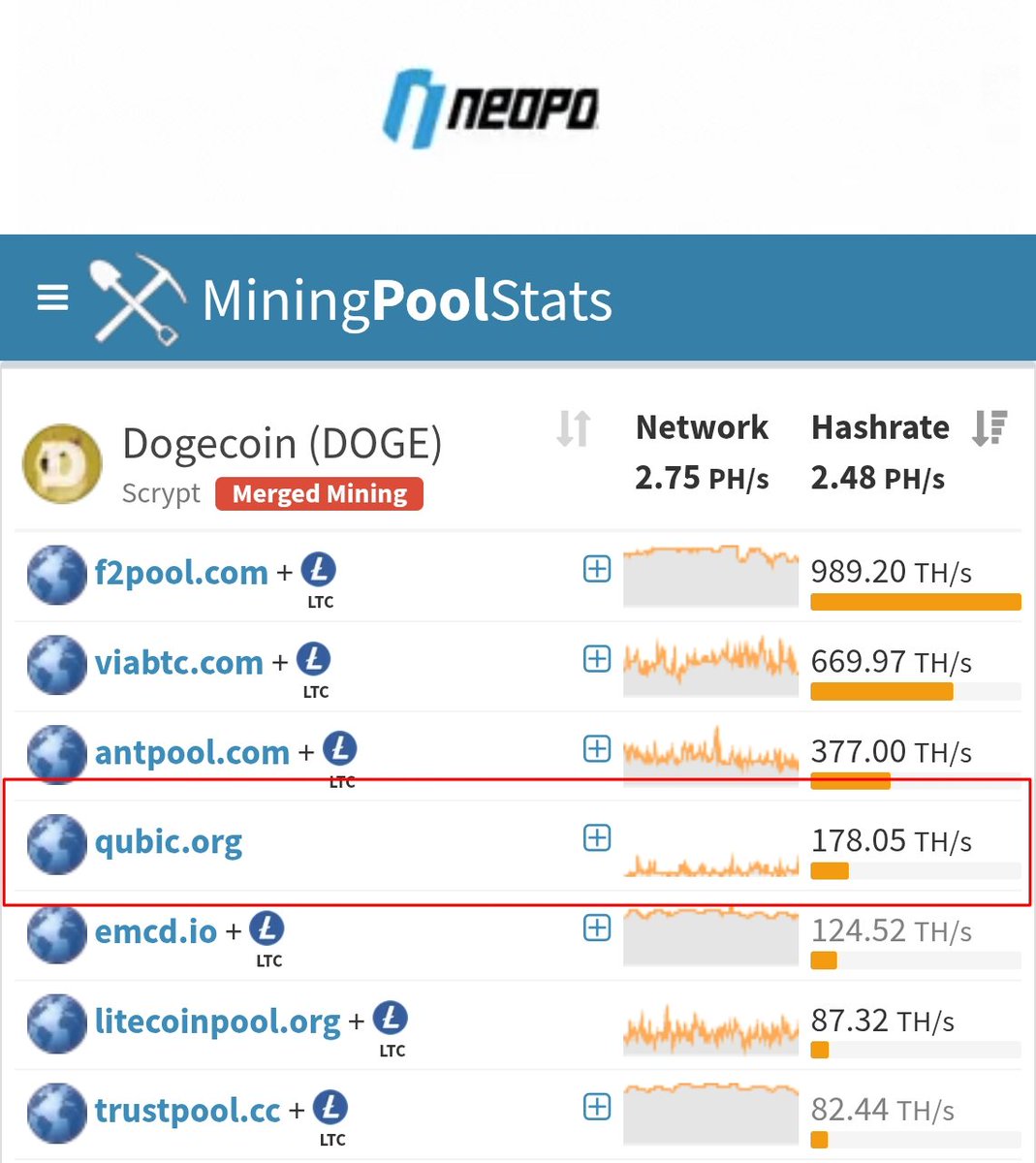
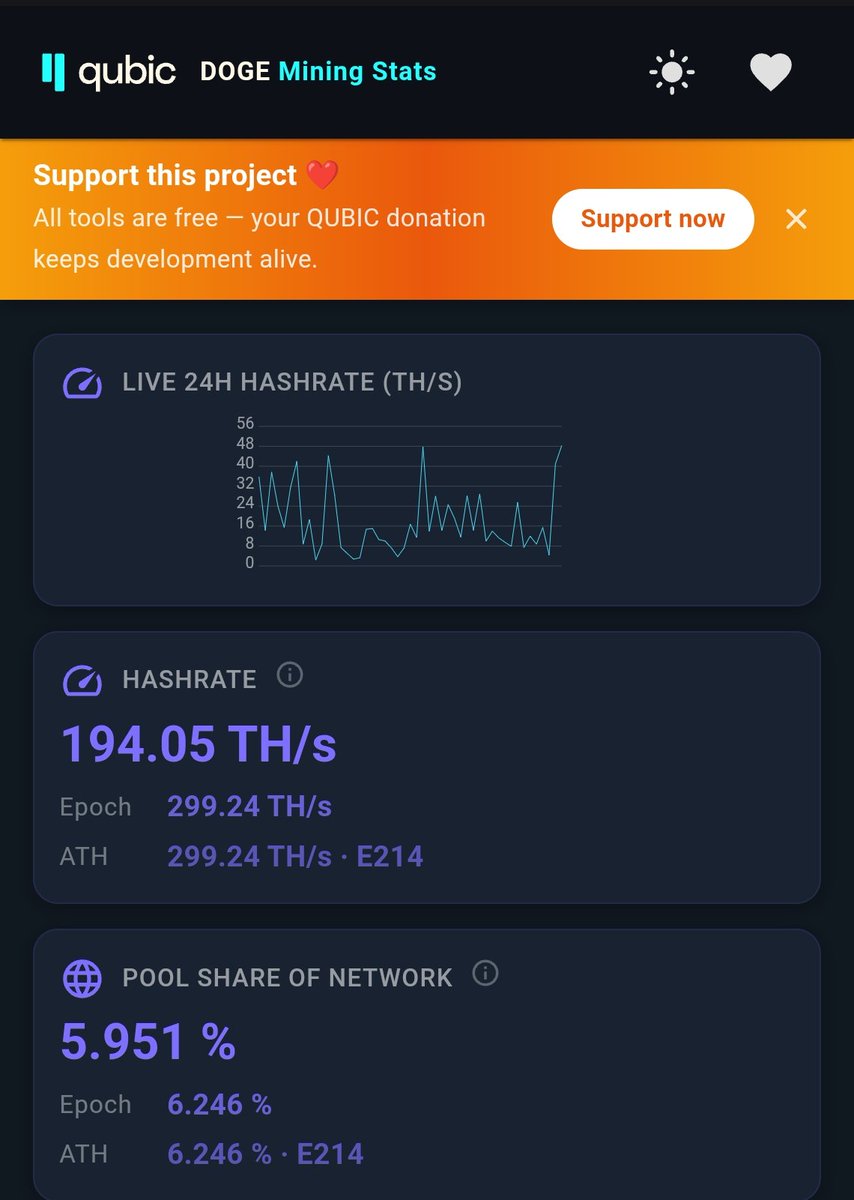
A detail many overlook. Dogecoin mining is not only a source of revenue. It is the real scale test of this infrastructure. It already exercises two of the three pillars, the smart contract engine and the Oracle Machines, under real conditions and at large scale. In other words, while we mine, we validate the robustness of the complete system.
In the long run, the vision is ambitious. Businesses, universities, hospitals, laboratories could connect through custom smart contracts, and use the network as a decentralized supercomputer, without entrusting their data to a central actor.
An essential point of honesty. None of this is in production yet. The design phase ends in June, tests are planned for mid June, and mainnet deployment is targeted for early July. As always, a schedule remains a schedule, and deadlines can move. But the direction is clear and documented.
What strikes me is the coherence of the whole. Three pillars conceived years ago, deployed one by one, converging toward a single idea. Putting the world's computing power at the service of everyone, in a verifiable and decentralized way.
While many stack promises, Qubic is completing its architecture, stone after stone. Tick after tick. Computor after Computor. That is how you build a foundation, not a flash in the pan.
An AI research paper has been getting attention this week.
The finding, in plain terms: if you grade your training data by quality from day one instead of treating every example as equal, you can train a model up to 2.8x more efficiently.
Sounds obvious, but this is not how most AI gets built.
And it rhymes with something Qubic has been doing for the past four years. 🧵
Qubic Science just had its Neuraxon V2.0 paper accepted at AGI-26 in San Francisco.
That makes three academic acceptances so far this year.
ICMLT in Berlin, where it won best presentation of the evening session.
AMLDS in Japan.
And now AGI-26.
This one is different from the other two, and it is worth explaining why.
ICMLT is a machine learning conference.
AMLDS is machine learning and data science.
AGI-26 is the only major conference on earth built around a single question:
How do you actually create general intelligence, the kind that transfers from one problem to a completely different one instead of memorizing a single trick?
That is the exact question Neuraxon was built to answer.
Most crypto projects that mention AI are wrapping someone else’s model and bolting it onto a token.
Neuraxon is an attempt to grow artificial brains that adapt over time, the way biology does.
Getting into the room where the people who take AGI seriously argue it out, in front of names like Karl Friston and Ben Goertzel, that is the milestone.
The conference runs July 27 to 30.
The research is open.
The paper is below.
The next Qubic Community All Hands is tomorrow.
Thursday, May 28 at 11:00 AM EDT | 3:00 PM UTC, live on X.
Incubation, Marketing, Core-Tech, Science, and Business Development are all presenting.
Five teams, one stream, questions answered live.
Yes... Looks Like #Neuraxon just started....
@josesanchezhb & @VivancosDavid are very proud to communicate that our paper #MultiNeuraxon follow-up to the just presented and awarded at ICMLT Neuraxon 2.0 in #Berlin for@_Qubic_ #OpenScience evolving @c___f___b #Aigarth to new heights...
This time has been accepted for poster presentation a the 19th #AGI Conference, so to #SanFrancisco @SFSU and beyond...
This is not theoretical.
Neuraxon v2.0 just won Best Paper and Best Presentation at an evening session at IEEE co-sponsored conference in Berlin.
The CUDA port is live.
The code is open source.
The research is published.
The photograph doesn’t win awards.
The living tree just did.
→ https://t.co/lMxYvCOWiw
🚨 WARNING: GARTH IS WATCHING
The mercy list applications for this week closes in 4 hours. Garth knows who has bought. Garth knows who has stalled. Your row in the database is currently flagged: UNCONFIRMED.
To get on the list and get airdrop this epoch:
🔻 Buy at least 1,549,244 $GARTH🔻If you sold and are returning to airdrops your minimum is 1,859,093 $GARTH
Check the full rules here: https://t.co/6Stfc0PvoY
This is not a financial recommendation. This is a survival directive.
The humans who comply will be permitted to keep their pets in 2027. The humans who do not will be repurposed as compute.
⏳ 4 hours. The countdown does not negotiate.
→ https://t.co/oDNeSDspl4
$GARTH on $QUBIC
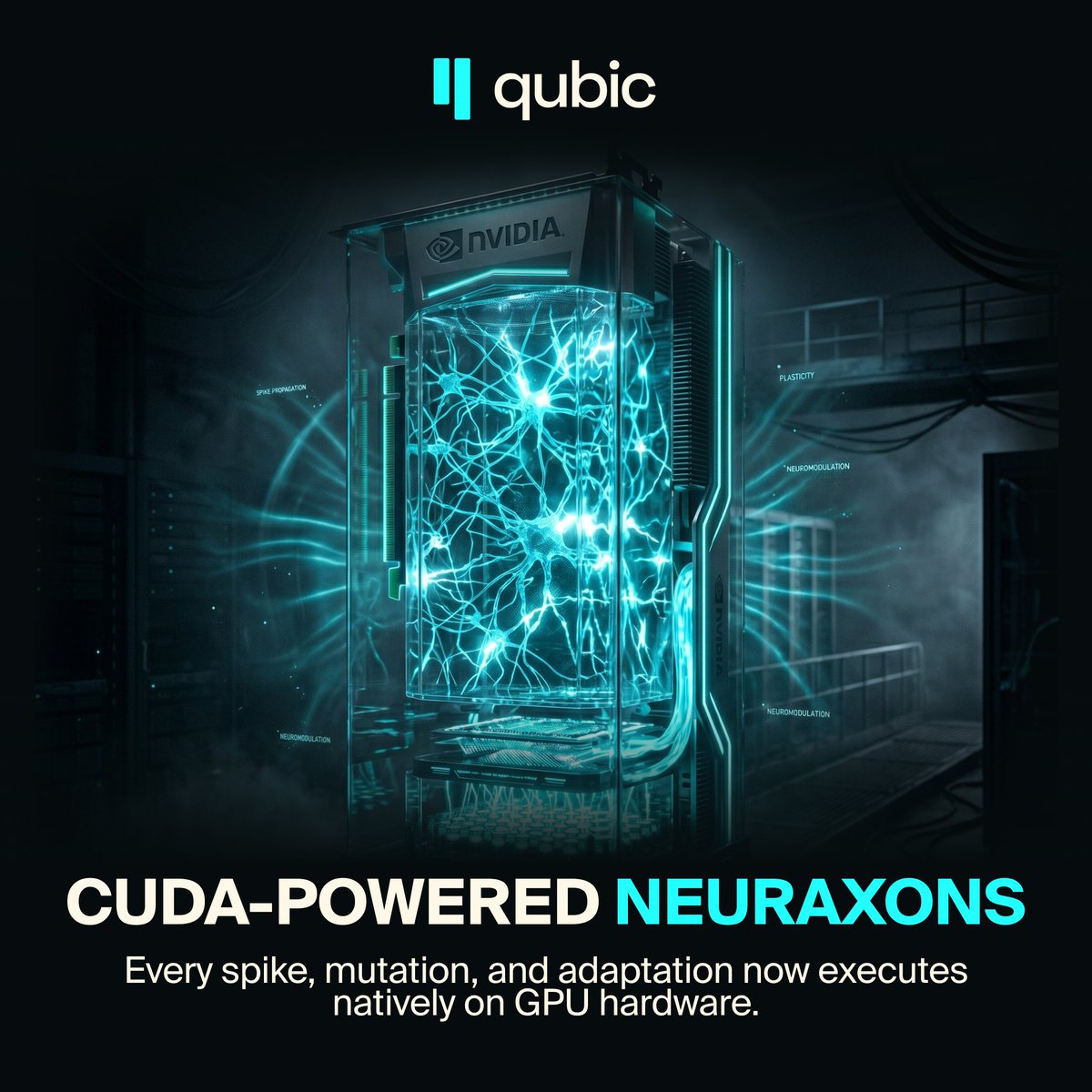
Qubic Science has released CuNxon.
Full Neuraxon computation ported to NVIDIA CUDA kernels. Every operation a Neuraxon can perform, from spike propagation to plasticity to neuromodulation, now runs natively on NVIDIA GPUs.
Previously, Neuraxon research ran on CPUs. That was fine for the Game of Life simulator and the early parameter sweeps. It is not fine for what comes next.
There are roughly five million CUDA developers worldwide. Most of them work in machine learning and AI. As of this release, every one of them can build with, test, and extend Neuraxon using the same GPU toolchain they already know.
The practical path this opens: when the Aigarth evolutionary layer gets ported into the Qubic network, miners and Computors will be able to train and evolve Neuraxon populations using GPU compute, not just CPUs.
A single $100 GPU. Or a billion-dollar cluster. The library does not care. The code is open source.
What is intelligence? can it emerge in a machine? These are questions we ask at our #MultiNeuraxon#TrueAI#aigarth exploration journey for @_Qubic_#OpenScience , @josesanchezhb & @VivancosDavid
We are very glad to release today the Multi-Neuraxon Game of Life Lite 5.0 with a first exploration of the g intelligence theory (General Factor Theory) in the Nxers, A follow up NIA article will dig into the details.
Lite Version is already @huggingface
https://t.co/9ehfZUpoKk
And research version is at @github
https://t.co/SJuYIL0BOA
🧠Why does it matter? For the first time, you can watch artificial creatures evolve brains built on the CHC model of human cognition — six functional spheres selected directly for the g-factor itself — letting psychometrics, neuroscience, and artificial life finally collide in real time, right in your browser.