@hemantmehta Also doesn’t know that the Spanish aren’t ancestral to Argentina and Paraguay . Or that the British aren’t ancestral to Australia and New Zealand . Or does this only apply when the players are black ? lol
Transnet Freight Rail railed 165 trains last week on the coal line to Richards Bay Coal Terminal.
3 weeks in a row now with this tempo at close to ~65 million ton per annum. Well done.🇿🇦
Transnet Freight Rail railed 165 trains last week on the coal line to Richards Bay Coal Terminal.
3 weeks in a row now with this tempo at close to ~65 million ton per annum. Well done.🇿🇦
@MudiTheInvestor@BabaOtter Mone of us are any better sha.
All we do is cherry pick.
Nigerians once sent Ghanians out, Ghana did same at some point.
Igbos known to be hostile towards non igbos, yoruba known to do same.
Northerners use violence sef.
It's a universal problem and picking on one is also bad
Even if the false "white genocide" narrative did not form part of the advisory brief, the fact remains that: IF Starlink was a client and the company's owner, of his own accord, amplified a harmful falsehood whose geopolitical consequences are still being felt, a communications consultancy could not simply look the other way. Communications professionals are not passive bystanders. They have ethical, political and moral responsibilities, and many firms routinely decline clients or withdraw services where those considerations are at stake. Silence, in such circumstances, is itself a choice.
@NgwenyaNhla He’s correct. South Africa has an estimated 70 billion tons of coal deposits valued at some US$20 trillion depending on the price of coal/ ton. About 80% of this strategic assets sits in Mpumalanga, ironically one of the poorest provinces of the Colony. We must protect it dearly.
Let me educate you not with anger, but with truth. You assume South Africans lack exposure. You assume we believe other African countries are poor and undeveloped. That is not the case. We know the reality. We know Nigeria has oil. We know Ghana has gold. We know Kenya has tech. We know Botswana has diamonds. We know Zambia has copper. We know Zimbabwe has platinum and lithium. We know the DRC sits on $24 trillion in minerals. We know Africa is rich.
But here is what you do not understand, wealth beneath the ground does not translate to prosperity above it. You can have all the minerals in the world but if your leaders steal, your constitutions hostile towards humans rights, if your institutions are corrupt, if your people are divided by tribe, if your healthcare collapses, if your schools crumble, if your youth flee then you are poor. Not in resources. In governance. In accountability. In dignity.
We do not look down on Africa. We look at the mirror Africa refuses to face. We see our own flaws corruption, unemployment, crime and we fight them. We protest. We vote. We demand better. That is what makes us different. We do not run. We stay. We build. We hold our leaders accountable, even when it hurts.
You say we lack exposure. But we see you. We see your leaders flying overseas to get treated, some in our country to get medical treatment, while your children starve. We see your ports exporting raw minerals while your people have no jobs. We are not blind. We are not ignorant. We are honest.
The difference between South Africa and many other African countries is not wealth. It is the willingness to confront failure. We own ours. You run from yours. That is not a lack of exposure. That is a lack of accountability. And until you fix that, no mineral, no resource, no tweet will save you. Go home. Fix your house. Then talk to us about exposure.
Kabelo won a R12.8m earthworks package on a R327m wastewater project in Ekurhuleni. 3 weeks later, men at the gate told him 40% belonged to them. He had the contract, machines and workers, but no longer controlled whether they could enter the construction site.
A Thread
Been enjoying this exchange . Whoever said South Africans needs to follow this debate - the analysis (either pro- or against ) is simply something to marvel 🇿🇦
Mbuyiseni, South Africans are deeply pro-education. Our parents sacrificed everything for us to learn.
What we reject is how credentials & elite jargon are weaponised to delegitimise our lived experiences. When we speak about illegal immigration, jobs, crime & failing services, we're told we're "not educated enough" & lectured with failed ideologies.
Weaponised PhDs dismissing the daily reality of ordinary citizens won't work anymore. Disagreeing with bad policies isn't anti-education, it's pro-reality.
We want good schools and a country that puts citizens first.
Yhoo. I am busy reading Ndlozi's PhD and I must admit I am struggling to understand how this opening chapter survived rigorous academic scrutiny. The chapter is structured almost entirely around Ndlozi's personal encounter with his estranged father. For lengthy stretches it reads less like a doctoral thesis and more like a memoir of childhood abandonment.
Yes, auto ethnography is a legitimate research methodology. The issue is not the use of personal experience. The issue is what is done with it. Personal narrative must illuminate the research problem not substitute for its analysis. A researcher cannot simply recount a deeply personal experience and then declare it theoretically significant. The analytical bridge must be built not assumed.
What I find troubling is that the connection between Ndlozi's one experience of father absence and the broader claim of colonial "permanent juniority" is repeatedly asserted but insufficiently demonstrated. The reader is expected to accept an enormous conceptual leap that should have been painstakingly justified through evidence, argumentation and engagement with competing explanations.
I am equally concerned about the methodology. Humanities scholars may disagree with me and I am open to correction but from the perspective of someone trained in scientific research, this approach would struggle to pass muster even in many undergraduate research projects. Reflexivity requires a researcher to acknowledge their positionality and potential biases. It does not require the researcher to become the dominant subject of the thesis itself.
A strict examiner might reasonably ask “Is this a PhD about black youth politics in the Vaal or is it a PhD about Mbuyiseni Ndlozi's relationship with his father?” When that question can be asked with a straight face after reading the opening chapter, there is a serious issue of focus.
What makes the situation even more disappointing is that Ndlozi appears not to have produced peer reviewed journal articles arising from this work. That matters. The value of a PhD is not merely that it is completed and archived. Its value lies in its contribution to the broader body of knowledge through scholarly circulation, criticism, replication, engagement and debate.
A thesis that remains largely confined to an institutional repository is a contribution that never fully enters the marketplace of ideas. Concepts remain underdeveloped, arguments remain insufficiently challenged and theoretical claims remain untested by the discipline of peer review. For a project making such ambitious claims, that is a significant missed opportunity.
The tragedy is not that the work exists. The tragedy is that it seems never to have been pushed through the crucible of open scholarly contestation where strong ideas are refined, weak ideas are exposed and genuine contributions are forged. If there was a significant theoretical contribution here, academia may never fully benefit from it. That is a loss not only for the field, but for Ndlozi's own scholarly legacy.
In many ways the thesis helps explain why Ndlozi often struggles to engage contemporary socioeconomic issues with analytical depth. The same tendency is visible throughout his PhD work. Personal narrative frequently displaces rigorous engagement with competing evidence, alternative explanations and material realities.
That is why we should be cautious about elevating academic credentials above scrutiny. A PhD is not proof of insight. It is not proof of wisdom. It is not proof that one's conclusions are correct. What matters is the quality of the analysis and the willingness to test ideas against evidence.
The danger arises when people mistake academic status for intellectual authority. Scholarship is a living process of challenge, debate and refinement. Once a scholar stops engaging criticism, stops publishing, stops testing ideas in the marketplace of peer review and public scrutiny, their contribution risks becoming academically inert.
Credentials may command attention, but only ideas can earn respect. And ideas that are insulated from challenge eventually become dogma rather than scholarship. The public should judge arguments on their merits, not on the titles that precede someone's name.
@Symply_rhoda1 A father’s job isn’t to make sure his kids love him when they become adults. A father’s job is to protect his kids as they grow up and give them skills they need to survive in adulthood. That’s our only job. If they love us, all the better. It’s just not our goal.
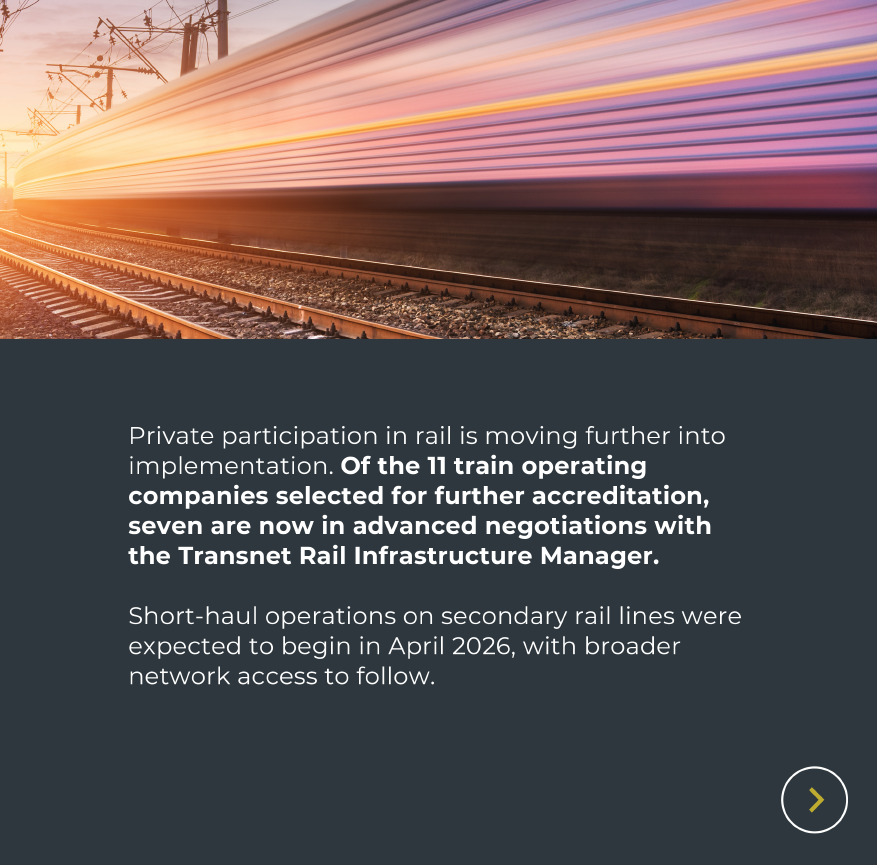
South Africa is taking a significant step toward advancing its rail sector, with private companies moving closer to participating in train operations.
For more about progress on reforms, read the BLSA Reform Tracker Quarterly Review https://t.co/iJhi2LqPfn
Professor @AntonEberhard's post is not a serious intervention in current energy policy. It is nostalgia — the comfortable, rearview-mirror exercise of a retired academic who feels increasingly irrelevant as South Africa’s electricity recovery outruns his preferred narratives.
Let me explain why.
1. Nostalgia fixates on past “mistakes” while ignoring present recovery
Eberhard lists Duvha, Majuba, Medupi, and Kusile. But his framing is stuck in 2019. The facts on the ground have moved on:
▪️Kusile is now fully operational (all six units, 4,800 MW), contributing to nearly a year without load-shedding (GCIS, May 2026).
▪️Eskom reported a R23.9 billion profit before tax in FY2025 — the first profit in eight years — and has invested that back into critical infrastructure (@Eskom_SA media statement, 2026).
▪️The Energy Availability Factor is recovering, and load-shedding hours fell from 6,367 in FY2024 to 175 in FY2025.
Eberhard’s post mentions none of this. Why? Because acknowledging recovery would undermine the permanent-crisis narrative on which his public relevance depends.
2. Nostalgia confuses correlation with causation
Eberhard implies that because problems occurred at these stations, they must all be symptoms of “State Capture” and “technical debt.” But as my doctoral thesis demonstrates this is empirically false:
▪️Planned maintenance (PCLF) was highest during the State Capture period — the opposite of “deferred maintenance.”
▪️ Eskom was an international outlier for over-maintaining its fleet, exceeding VGB best-quartile PCLF in 10 of 11 years.
▪️The sharpest EAF decline began in FY2019 — not during State Capture, but during and after the implementation of governance reform.
▪️My causal analysis (Callaway–Sant’Anna staggered DiD with Fisher randomisation inference, p = 0.0091) shows that the involuntary suspension of experienced station general managers in FY2019 caused a −14.04 percentage point reduction in EAF across treated stations — a loss of 2,000–3,000 MW directly attributable to reform-era disruption, not historical debt.
Eberhard is not engaging with this evidence. He is repeating a falsified hypothesis as if the past five years of data and peer-reviewed research did not exist. That is not scholarship. That is nostalgia.
3. Nostalgia avoids accountability for the present
The City of Cape Town’s approved 2019/2020 budget — R50.8 billion (R44 billion operating, R6.8 billion capital) — was a model of fiscal discipline and service delivery prioritisation. It focused on basic services, drought recovery, and economic growth.
What is Eberhard’s comparable contribution to solving today’s electricity constraints?
Where is his proposal for the 2030 capacity cliff — the 9.5 GW of committed baseload retirements within a 24-month window from April 2028 (NTCSA, 2026)? Where is his engagement with the Cliff Intensity Index that I operationalise to measure the velocity mismatch between coal retirement and renewable integration?
There is none. Because nostalgia does not solve structural problems. It only mourns them.
4. Nostalgia is a luxury of those who no longer have to fix things
Eberhard is Professor Emeritus. He has earned the right to reflect. But reflection is not the same as analysis, and posting four power station names on social media is not the same as offering a workable path forward.
The people who actually have to keep the lights on — Eskom’s current leadership, the National Transmission Company, the City of Cape Town, and the engineers who kept the fleet running during State Capture despite board-level dysfunction — do not have the luxury of nostalgia. They have to manage the 2030 cliff, the grid connection queue, and the institutional friction that my thesis quantifies.
Eberhard’s post contributes nothing to that effort. It is a fossil of a debate that has already been settled by data, by causal identification, and by operational reality.
Engineer Matshela Koko 26.05.2026
To label citizens who demand that their government fully enforce immigration laws without fear, favor, or prejudice as xenophobes, charlatans, extortionists, or lumpen elements is a misdiagnosis of the genuine safety, security, and sovereignty risks posed by porous borders. When government leadership fails to uphold its social contract with the people, it is inevitable that a leader will emerge from among the masses to champion their concerns.
The Thomas-Kilmann Conflict Model cautions against relying solely on avoidance or competition when managing conflicts. Applying this framework, protests against illegal immigration should be approached with careful diagnosis and constructive interventions. Dismissing or threatening protestors through labels and or unleashing the mighty hand of the law on them not only undermines legitimate grievances but also escalates tensions.
A balanced response by government and embassies requires acknowledging the citizens’ concerns, engaging in dialogue, and implementing fair solutions that strengthen both national security and social cohesion. Only then can conflict be transformed into an opportunity for trust-building and effective governance. Political rhetoric or sloganeering will not persuade the citizens to back down, because their demands are rooted in concrete lived realities rather than abstract words.
(Writing in personal capacity)
#ImmigrationPolicy #BorderSecurity #CitizenVoices #ConflictManagement
#conflicttransformation
#conflictresolution
#conflictmapping
#SocialContract #NationalSovereignty #DialogueNotLabels #Governance #ProtestRights
@MbuyiseniNdlozi@MmusiMaimane