Thread on one of the optional launch modes that we will use on @GIWA_by_Upbit, which you can currently test to launch coins both on Giwa test net and RHC:
https://t.co/vyfEO5bI35
Solving one of the biggest issues in crypto - fair launching mechanism.
1/零 ZERO is a fair launch with no bonding curve, no presale, no allocation.
Every block that has ticket buyers draws exactly ONE winner, picked by that block's own hash.
Same ticket price for everyone. Capital buys more entries. It never buys better odds.
2/How it works:
1B supply. 500M goes to winners, 500M goes to liquidity. Creator commits 0.01 ETH minimum. That commit goes straight into the LP pot.
The creator gets nothing for it and buys tickets at the same price as you.
3/You buy tickets at a fixed price. 5% is protocol fee, 95% goes into the LP pot.
Your tickets sit in a queue for the current block. Nothing is decided yet.
The draw for that block resolves on the NEXT transaction, using blockhash of the block you bought in.
4/That ordering is the whole point.
When you buy, the block hasn't been mined. The hash that picks the winner does not exist yet.
Nobody can see it. Not you, not the creator, not a bot reading the mempool.
winner = keccak256(blockhash(buyBlock), token) % ticketsInBlock
5/Each draw hands out 500M / winsTarget tokens.
Wins accumulate until either:
the win target is hit, or
the deadline passes
Whichever comes first ends the mint.
6/Here's the part almost nobody catches.
ONE winner per block. Not one per ticket. Not one per X of volume.
One. Per. Block.
So the odds you actually care about are not your tickets over total tickets. They're your tickets over the tickets in your block.
7/Which means the optimal play is not buying big.
It's buying alone.
500 tickets in a crowded block ≈ 500 tickets of dilution. 1 ticket in a block where nobody else bought = you win that draw outright.
Quiet blocks are free money. Everyone piling in at once is fighting each other.
8/Whales still have an edge inside a contested block, weighted by quantity. That's fair.
What they cannot do is buy a better rate. Ten thousand tickets across ten blocks gets ten shots, same as ten people with one ticket each in ten empty blocks.
9/When the mint ends, finalize() does three things:
→ unlocks the token for trading → burns every unwon token→ dumps the entire ETH pot into a real Uniswap v3 pool
10/That burn matters.
If the deadline hits before the win target, the undrawn supply is sent to dead. Permanently.
A launch that only sells half its wins ends up with half the supply and the same liquidity. Slower mint = harder float.
11/The liquidity is not "locked for 12 months."
The v3 position is minted to the pad contract, and the pad has no function that decreases liquidity. None. There is no withdraw path in the bytecode to call.
It is not a promise. It is an absence.
12/Trading fees on that position stay collectable, though.
collectFees() is public. Anyone can crank it. The ETH side goes to the furnace, the token side is burned.
So the pool keeps eating its own supply for as long as people trade it.
13/Summary:
fixed ticket price, no whale discount
one winner per block, hash you can't see when you buy
unwon supply burned
95% of every ticket becomes permanent liquidity
LP locked by construction, not by pinky swear
fees buy-and-burn forever
14/零 means zero.
Zero presale. Zero team allocation. Zero unlock schedule. Zero rug path.
Launch one on https://t.co/IEY0Ccl2S7
An experiment combining old-school coreVault locked-LP mechanics with OHM-style reserve design, but backed by real tokenized Micron stock ($MU).
Core idea:
The floor is tokenized Micron ($MU) sitting in a permanently locked Uniswap pool.
Nobody can withdraw the LP (including the deployer).
Every trade pays 5% tax → converted to more $MU and compounded into the locked floor.
The floor is designed to only go up.
Key mechanics:
1. Ratchet emissions
Stake $SEMI → new tokens are only minted when MU-backing-per-token hits a new high across a 6h epoch.
No classic rebase. Yield only comes if the floor actually grows.
2. Bonding
Bring $MU → get discounted $SEMI (24h vest).
All bonded $MU goes into the locked floor.
System is gated so bonding can never lower backing per token.
3. THE FAB (built on top, optional) (Wafer Wars)
Stake real tokenized chip stocks (NVDA, MU, AMD…).
Every epoch the worst performer “busts”.
20% of its value permanently goes to the $SEMI floor, 80% to survivors.
Last wafer standing takes the rest.
Current state: still under $60k market cap, ~$35k liquidity, very early.
They claim full immutability (no admin keys, 100% supply into the pool at launch, verified contracts). Always verify yourself.
A bit of speculation:
Bull case → If volume + bonding + Wafer Wars keep ratcheting the locked MU floor higher, the “real equity floor that only goes up” narrative could create a reflexive loop. Growth-only emissions try to fix one of OHM’s biggest historical problems. (+ new things being built on top)
Bear case → Floor is a single volatile stock. If activity dries up, the ratchet stops and premium compresses toward the floor.
Interesting design. Extremely early. Good tech.
Not financial advice. DYOR.
Gud ponzu
↑ BACKING IS ABOVE ITS HIGH — if it holds through the window, the next poke (in 2h 48m) mints up to ~284.8k $SEMI. It settles on the window LOW, not the last price.
The FAB: https://t.co/9tNpT59Ixq
10 wafers, each a real tokenized chip stock. Every epoch the worst performer busts and its pod is fed to the survivors. Last chip standing takes it all.
1 · Pick a wafer
Each wafer holds one stock: NVDA, MU, AMD, SKHY, INTC, TSLA, AAPL, META, MSFT, SNDK — real Robinhood-issued tokenized equities trading on-chain. You're betting your chip outperforms the others, epoch after epoch.
2 · Stake it
You stake the wafer's own stock token (grab it with ETH/USDG on https://t.co/yt3v5iJoSe). Click the wafer → enter amount → Stake. Two wallet prompts: Approve, then Stake.
⚠ Principal is locked for the whole season. No early exit — you ride until you win or your wafer blows. Staking also freezes briefly right before a bust is due (no last-second sniping).
3 · The bust
Every epoch, on-chain and permissionless: all living wafers' prices are read and the one with the worst return since the last tick dies. It's relative — if every chip pumps, the weakest pump still busts. Exactly one dies per epoch.
The dead pod is swapped to $MU: 20% → the locked SEMI floor (up only, forever), 80% → split equally across surviving wafers, then pro-rata inside each pod. A thin survivor pod pays its stakers the fattest share.
4 · Claim / Exit
Winnings accrue in $MU live — hit claim anytime, your stake stays in the fight.
exit settles you out: if your wafer busted, principal is gone but you sweep every $MU it earned before dying. If your wafer won the season, you exit with full principal + all winnings.
5 · Endgame
Season ends when one wafer remains. Its stakers ate a slice of every single bust. The final kill's proceeds go entirely to the $SEMI floor, so there's no free ride on the last tick. A new season opens automatically.
The FAB: https://t.co/9tNpT59Ixq
10 wafers, each a real tokenized chip stock. Every epoch the worst performer busts and its pod is fed to the survivors. Last chip standing takes it all.
1 · Pick a wafer
Each wafer holds one stock: NVDA, MU, AMD, SKHY, INTC, TSLA, AAPL, META, MSFT, SNDK — real Robinhood-issued tokenized equities trading on-chain. You're betting your chip outperforms the others, epoch after epoch.
2 · Stake it
You stake the wafer's own stock token (grab it with ETH/USDG on https://t.co/yt3v5iJoSe). Click the wafer → enter amount → Stake. Two wallet prompts: Approve, then Stake.
⚠ Principal is locked for the whole season. No early exit — you ride until you win or your wafer blows. Staking also freezes briefly right before a bust is due (no last-second sniping).
3 · The bust
Every epoch, on-chain and permissionless: all living wafers' prices are read and the one with the worst return since the last tick dies. It's relative — if every chip pumps, the weakest pump still busts. Exactly one dies per epoch.
The dead pod is swapped to $MU: 20% → the locked SEMI floor (up only, forever), 80% → split equally across surviving wafers, then pro-rata inside each pod. A thin survivor pod pays its stakers the fattest share.
4 · Claim / Exit
Winnings accrue in $MU live — hit claim anytime, your stake stays in the fight.
exit settles you out: if your wafer busted, principal is gone but you sweep every $MU it earned before dying. If your wafer won the season, you exit with full principal + all winnings.
5 · Endgame
Season ends when one wafer remains. Its stakers ate a slice of every single bust. The final kill's proceeds go entirely to the $SEMI floor, so there's no free ride on the last tick. A new season opens automatically.
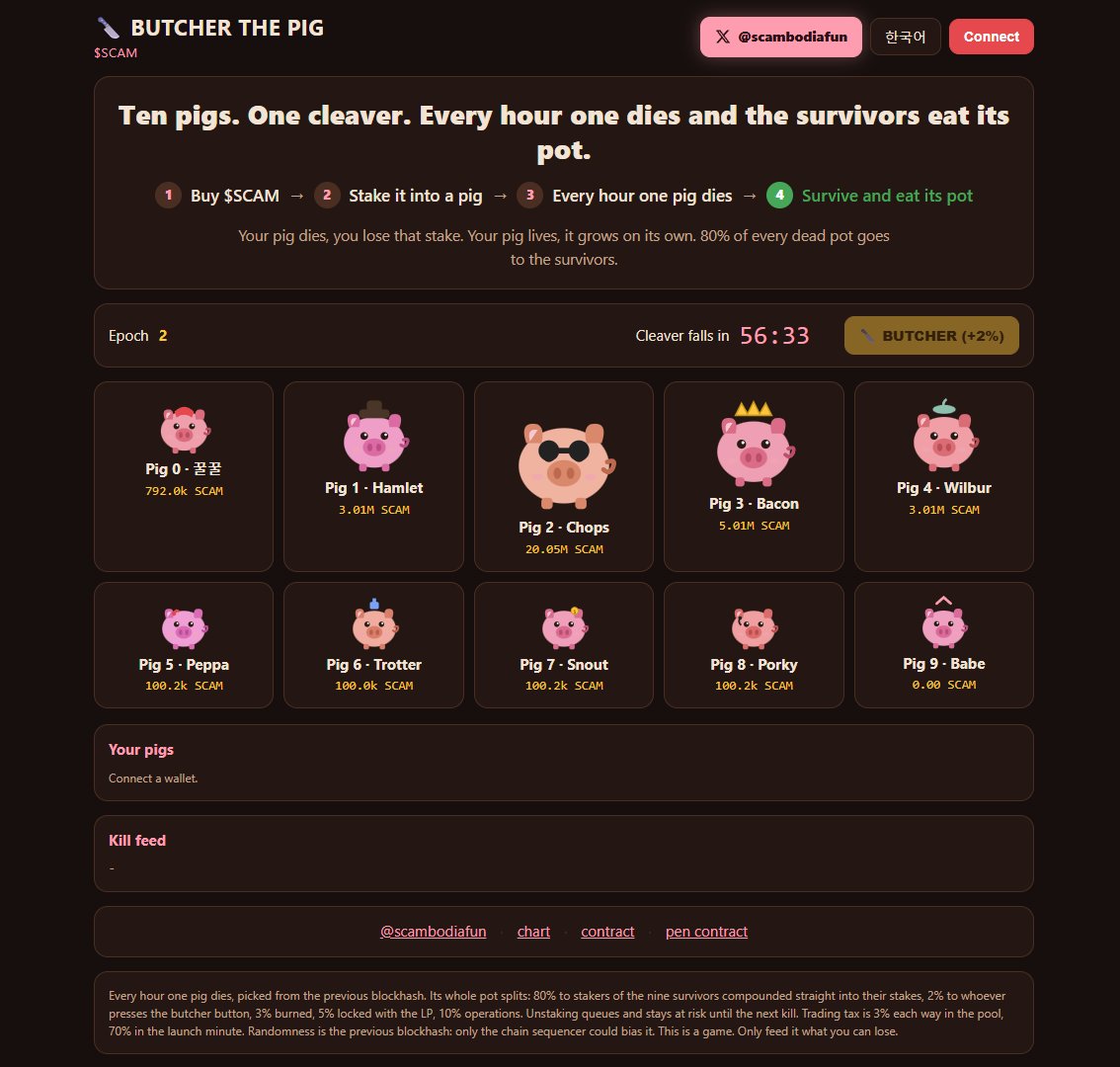
basically it's a gamified survival lottery on RHC called "Butcher the Pig" — every hour one random staked pig gets butchered via blockhash, and its pot gets split among the 9 survivors. 80% rewards go to stakers, taxes fund burns & ops, and the whole thing leans into the "pig butchering scam" meme ironically. the self-aware scam branding is the whole gimmick
윷 THE FOUR STICKS is live. - seeded with 2,000,000 $giwa
Korea's oldest game, onchain. Four sticks, five throws. Stake $GIWA on 도 개 걸 윷 모 and a block hash you can't see coming throws them.
Pig 3.13x. Horse 12.51x.
10% of every win burns GIWA.
Enter the casino:
https://t.co/g58GZ17kUh
$SCAM — robinhood early call.
2 elite + 3 proven-good tracked wallets currently hold this (validated on-chain). called at $15.9k · liquidity $6.0k.
observed on-chain activity, not a buy signal. thin memecoin liquidity cuts both ways. dyor, nfa.
trade on BasedBot :
https://t.co/MhcCT7UGq0
chart + trade :
https://t.co/ElNJnKsjbp
CA: 0x2f061b5284b4b75e66b88f1ebca500a0e7d0e543
There has been a little confusion related to the X account and the dev team.
I'm the main dev behind the project and manage this X. I'm currently in Poland which is shown on my X account details.
However I travel a lot and have real estate investments in various countries including Cambodia, and when I was setting up X app couple months ago I used local AppStore while I was travelling. That's why that part shows Cambodia.
To avoid any confusion scheduled a call for on monday with Apple Support to help me change my Apple Store location to where I live now.