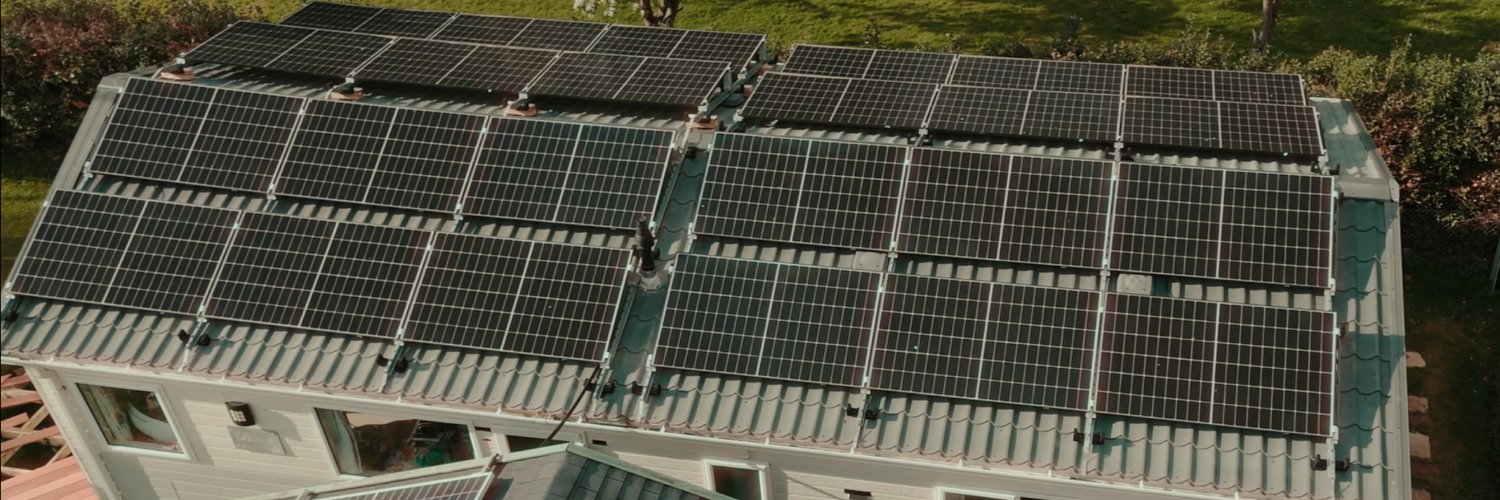
He sold EVERYTHING for a UK based #Bitcoin mining project🇬🇧
Solar panels, mining for heat, a Tesla, UK crypto regulations and how much money Steve makes FOR FREE, this is:
OFF GRID STEVE
Please watch, share and send to a mate 🧡
And follow Steve 👉 @NiceAction
🧵
If you start with price, you miss the point of Bitcoin.
Most people overcomplicate Bitcoin because they start in the wrong place.
A better question: Why does Bitcoin exist, and how could it improve our money?
6 minutes. Why Bitcoin matters👇
Take a look at these two insects.
Pretty similar right? Both flying insects, both yellow and black. Both have stingers. But to a gardener they could not be more different.
The image on the left is a honey-bee. They are critical to the pollination of many plants, especially those that produce nuts and fruits.
In a world without the honey-bee we'd still have food because grains and other plant-based food is often wind/self pollinated. But we'd have less variety, growing food would be harder, and prices would be a lot more.
The image on the right is a yellow-legged hornet. They stress your gardens: they chew bark, damage fruit and - most importantly - hunt other pollinators. A garden without them is a healthier garden.
But the point is, if you don't know your insects, haven't researched how each impact the garden and have a "no flying insects" policy for your garden, your garden will grow more slowly, and garden by garden - you create a world where food is more expensive, less resilient and less bountiful.
Lumping bees and hornets under "flying insects" is like lumping bitcoin mining operations and AI data centres under "data centres": technically accurate, useless for policy, and dangerous for the grid.
Yet that is exactly what happened in Cedar Falls in Black Hawk County, Iowa yesterday.
The city council voted unanimously to block a Bitcoin mining facility from its 60% wind-powered industrial park - an operation that would have monetised surplus energy, and balanced the intermittency of that wind energy, without competing with a single resident for electricity.
The concerns? Power usage, losing control of the city and fear that these operations would consume more electricity than the city itself.
Every single one of those concerns applies to AI data centres. None of them apply to Bitcoin mining.
🤦♂️
Source: https://t.co/xqxazChDTX
They sprayed the bee.
Here is the nuance most people miss: the gardener who sprays pesticide on all flying insects does not get a pest-free garden. They get an unpollinated one
The fruit costs more. The garden grows more slowly. The ecological balance is more fragile.
A grid with flexible load has a shock absorber. When demand spikes, the miner steps aside in less than a second, freeing capacity without anyone building a new power plant.
A grid without Bitcoin mining has no buffer, no surplus buyer and no way to balance supply and demand in real time without firing up gas-peaker plants that cost more and sit idle most of the year.
The gardener who knows the difference has a healthier garden. The grid operator who knows the difference has a healthier grid. The word "data centre" is doing the same work as "flying insect."
It collapses two fundamentally different things into one category so that people can avoid understanding the difference. The resilience of the grid suffers - and consumers get higher prices
And this is worth understanding: it is human nature to fear what we do not fully understand
If you cannot tell which insect pollinates and which one predates, the rational response is to keep both out. But rational is not the same as smart. Because playing it safe with a category you haven't bothered to research doesn't remove the risk.
It just makes sure the risk is invisible until the garden, and those who rely on it, suffer.
This $799 Bitcoin Solo Miner is .... Insane! ⛏️⚡️
There is now a bitcoin home miner for everyone, from $99 bitaxes to the beast NerdOctaxe.
Choose which Bitcoin miner YOU SHOULD BUY or build in this video
#FckMinerCentralisation#OpenSource
THE MAN THEY CALLED A NUTTER JUST GOT A KNIGHTHOOD
In 2003, the Post Office fired Alan Bates from his small branch in Llandudno, Wales. The reason? He refused to repay £1,200 that the Horizon computer system had invented out of thin air.
He invested £65,000 in that post office. He made 507 calls to the helpline. He kept meticulous records proving the software was broken. The Post Office's response was to terminate his contract and walk away.
Their own internal documents called him "unmanageable." People at industry conferences called him a nutter and a thief. He couldn't afford a hotel room at one protest event. He slept in a tent.
So naturally he spent the next 20 years building the Justice for Subpostmasters Alliance, dragging the Post Office into the High Court, winning a landmark judgment in 2019 that proved Horizon was riddled with bugs, errors and defects, and triggering the overturning of more than 900 wrongful convictions.
Over 900 people were prosecuted. Around 700 convicted. 236 went to prison. The scandal was linked to at least 13 suicides. The compensation bill has now passed £1.2 billion.
Fujitsu (@Fujitsu_Global) knew about the bugs from 1999. The Post Office (@PostOfficeNews) knew. They prosecuted people anyway. Then they destroyed the evidence, sacked the forensic accountants when they got too close to the truth, and deleted social media comments from victims.
Paula Vennells, the CEO who presided over much of it, collected a CBE. She kept it for years. Bates turned down an OBE in 2023 specifically because of that.
He finally accepted a knighthood in 2024. After the ITV drama. After the public inquiry. After the nation had caught up with what he'd been saying since 2003.
Twenty years. Sleeping in a tent. Called a thief by the people who were supposed to represent him.
Sir Alan Bates was right from the start. The institution was lying from the start. That is the whole story.
Sources: @ComputerWeekly | @BBCNews | @ITVNews | @guardian |
This is exactly the problem.
Data breaches aren’t rare anymore. They are expected.
Medical data. Passports. Financial data next.
And now we’re rolling out CARF to collect even more of it globally?
CARF (Crypto-Asset Reporting Framework) sounds like compliance.
In reality, it is mass financial surveillance.
It forces exchanges to collect, store and share huge amounts of user data across borders.
That data will leak. It’s not a question of if.
Every exchange, every platform becomes a honeypot.
Names
Addresses
Wallet activity
Transaction history
You’re not just securing funds anymore, you’re securing identities at scale.
When this fails, it fails globally.
Not 300,000 people. Potentially millions.
Because CARF links jurisdictions together, one weak link exposes everyone.
The argument will be “we need this for tax compliance”.
But good policy should balance enforcement with risk.
This doesn’t.
It massively increases the attack surface while assuming perfect security.
That’s not realistic.
We already know how this plays out.
Traditional finance has breaches constantly.
Now we’re applying the same model to a system originally designed to reduce trust requirements.
There are better approaches.
Targeted enforcement
On-demand reporting
Systems that don’t require bulk data storage
Collecting everything “just in case” is lazy policy and dangerous design.
If your system requires everyone’s sensitive financial data to be stored and shared globally to work…
It’s not robust. It’s fragile.
Privacy and compliance are not mutually exclusive.
But CARF, as it stands, heavily sacrifices one for the illusion of the other.
We should be building systems that minimise trust and data exposure.
Not recreating the same centralised risks that keep failing, just on a global scale.
@BitcoinArchive For context, 15-bit integers go from 0 to 32,767. At 1 check per second, you could manually break 15-bit in 9 hours
Bitcoin uses 256-bit ECC keys. That is 2^241 x larger. ie: a 3.53×10^72 (a number followed by 72 zeros) larger
That's ~the number of atoms in 10,000 galaxies
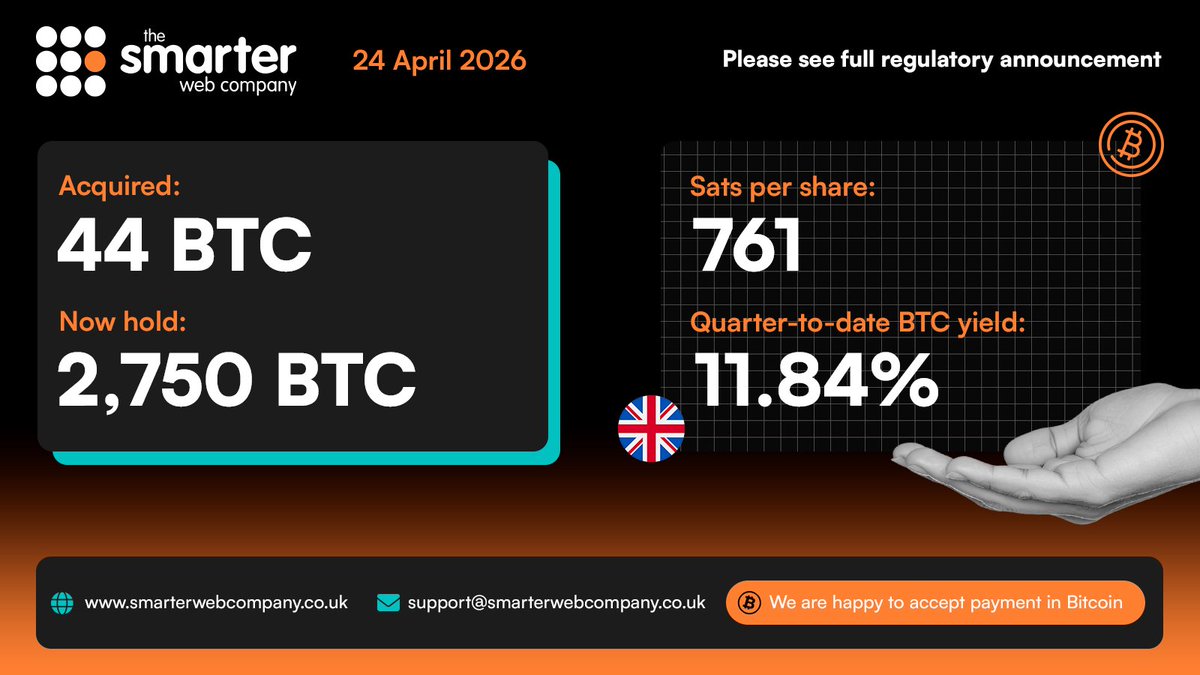
RNS Announcement: Bitcoin Purchase
The Smarter Web Company announces the purchase of additional Bitcoin as part of "The 10 Year Plan" which includes an ongoing treasury policy of acquiring Bitcoin.
Please read the RNS on our website (link in comments).
LSE: #SWC | OTCQB: $TSWCF | FRA: $3M8
A personal note. After years of public discussion/work: the podcast, social media, venture capital, everything — I'm stepping back to focus on my family.
My kids are growing fast. My wife deserves the best of me. To everyone who listened, read, grew, and built alongside me — thank you. What a blessing you all have been!
Why should government be small?
Why should politicians not be trusted?
Wise men know/knew that the role of government should be only to protect:
1. Your life
2. Your freedoms (liberty)
3. Your property
That you should be able to live freely without coercion or theft of your property. This is the moral line.
When Bastiat wrote The Law, he astutely identified that when the government gets into the business of redistribution, it inverses morality, because it can no longer protect your life, liberty and property.
It is a simple concept that many struggle with as they have been gaslighted into believing there are things which are necessary for the government to do.
Life, liberty and property are universal rights. When the government takes and redistributes it creates preferences for votes, therefore these universal rights fall away. In reverse:
3. They no longer protect your property as they confiscate it through taxation and threats of violence.
2. They no longer protect your liberty as they legislate preferences based on accumulating and retaining power. Hence the slow slide into authoritarianism.
1. They no longer protect your life, as they use violence to extract and redistribute.
The only way to end the failure of the state, politicians and politics is to return to freedom and return to government protecting only life, liberty and property.
These are universal, these are fair.
In 2025, Scottish wind farms were paid £350 million to turn off.
We paid for clean energy to NOT be generated.
Then paid again, over £1 billion, to fire up gas plants instead.
£1.35 billion. Added to your energy bill.