This is wild 🤯
Somebody finally realized AI coding agents spend half their time searching your codebase instead of actually understanding it.
So they built a local knowledge graph for Claude Code, Cursor, Codex CLI, OpenCode, and Hermes Agent.
Not another wrapper
Not another “AI devtool” landing page
An actual semantic layer that indexes your entire repo and lets agents query relationships, call graphs, routes, symbols, and dependencies instantly.
The wild part?
On real repos like VS Code, Django, Excalidraw, Tokio, and OkHttp, CodeGraph cut:
→ ~59% tokens
→ ~70% tool calls
→ ~49% execution time
→ ~35% cost
Instead of Claude Code or Codex endlessly grepping files and spawning exploration agents, they query a pre-built graph and move straight to the relevant context.
That changes the feel of AI coding completely.
Especially on larger codebases where Cursor, Claude Code, and Codex usually start drowning in file reads.
And the setup is absurdly simple:
npx @colbymchenry/codegraph
No external APIs
No cloud dependency
No weird config hell
Just local semantic intelligence for your codebase.
This is one of those repos where you instantly understand why it blew up to 14k+ stars so fast.
100% open source
Link in comments
Most AI tools make you choose: the smartest model, or keeping the work private. For privileged material that's no choice — it can't go to the cloud.
So I built AirGap Box: a Mac mini running a capable model with the network off. Hand it a document, review it offline, confirm with lsof that nothing left.
The next year of this is less about which model is smartest and more about where it runs.
the 32GB dual-GPU rigs everyone's flexing on this site?
my laptop holds 4× the memory at full precision, runs cooler than your radiator, and fits in a backpack.
unified memory ate local AI. everyone else is copying Apple's homework.
☁️ VPS equivalent: $5–10/mo anywhere. push.
PC equivalent stack total: $5,300–7,500 + your weekend configuring Linux, fighting NVIDIA drivers, and explaining the power bill to your wife.
Claude can now make your entire codebase self-explaining 🤯
It maps your app into:
→ an interactive HTML architecture view for humans
→ a structured JSON memory file for AI agents
The next coding agent instantly understands: APIs, components, dependencies, database flows, auth, background jobs — everything.
No more throwing AI into a random repo with zero context.
Your codebase literally explains itself now.
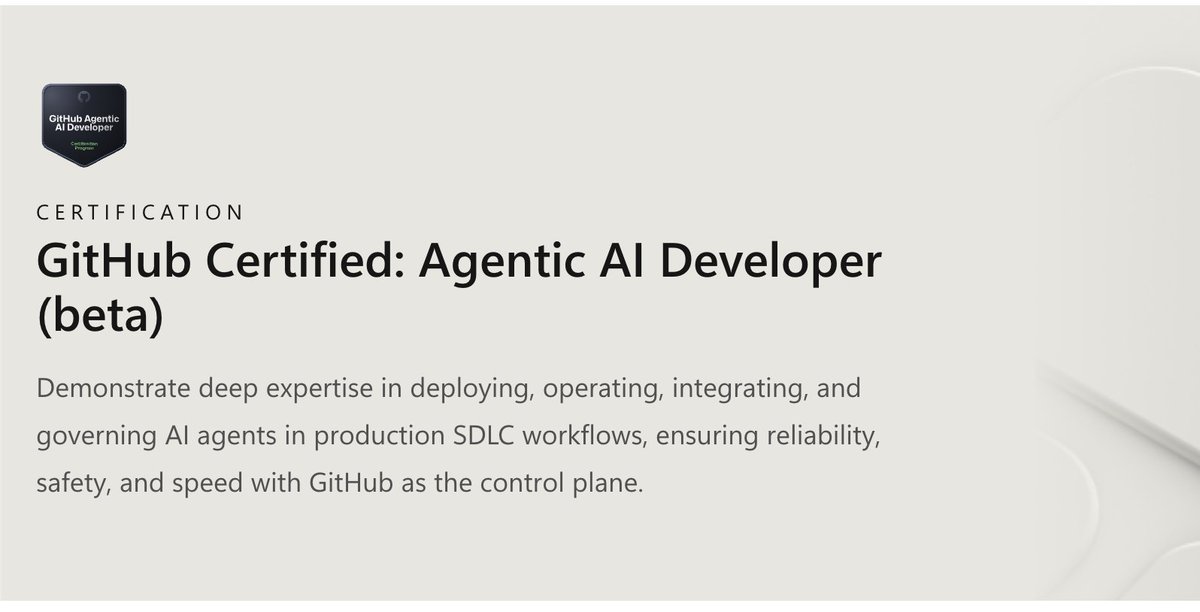
github just created an official certification for "agentic AI developer."
exam: GH-600.
skills tested: multi-agent orchestration, state management, system design.
GA: july 2026.
first 100 beta takers: 80% off. deadline may 31.
this is the first time "AI agent engineer" has a credential behind it.
not a linkedin skill tag.
not a course completion badge.
a formal certification. backed by github and microsoft.
the role is real. the credential is real.
the free roadmap to get there is 14 weeks and $0.
like + bookmark to save.
RAG might already be becoming obsolete.
A month ago, Andrej Karpathy dropped a simple GitHub gist called “LLM Wiki.”
Now the comments section looks like the birth of an entirely new AI category.
5000+ stars later, developers are rapidly building:
• persistent AI memory systems
• self-maintaining knowledge bases
• multi-agent research environments
• contradiction detection engines
• AI-native company operating systems
• local-first memory architectures
• graph-based reasoning layers
• evolving second brains
And the craziest part?
Most of them were built in DAYS.
Because the core idea is insanely powerful:
Instead of AI repeatedly retrieving raw chunks like traditional RAG…
…the model continuously maintains a living knowledge system.
Not temporary context.
Persistent synthesis.
The shift sounds subtle until you realize what it changes:
RAG:
retrieve → answer → forget
LLM Wiki:
ingest → synthesize → evolve
That one architectural difference is causing an explosion of experimentation right now.
People are already building:
• agent memory operating systems
• AI-maintained engineering documentation
• self-healing knowledge graphs
• persistent research environments
• conversational memory architectures
• contradiction-aware wikis
• context compression engines
• machine-readable company systems
The comments section alone feels like watching an ecosystem form in real time.
One developer built deterministic contradiction detection using sheaf cohomology
Another built “sleep consolidation” for AI memory systems inspired by human memory formation
Another created persistent multi-agent vault conversations
Another turned entire repositories into continuously maintained AI wikis
Another built local-first memory systems with audit trails, provenance, graph exports, and MCP integration
This is the important part:
Karpathy didn’t launch a product.
He introduced a pattern.
And patterns are what create ecosystems.
The same way:
• transformers created modern AI
• RAG created AI retrieval startups
• agents created orchestration frameworks
LLM Wikis may create persistent AI memory infrastructure.
That’s why this moment feels different.
For years, AI systems have been stateless.
Now developers are trying to build systems that actually accumulate understanding over time.
And once knowledge compounds instead of resetting…
…the entire interface layer of AI changes.
(Link in comments)
GITHUB JUST CREATED AN OFFICIAL CERTIFICATION FOR THE MOST IN-DEMAND DEVELOPER ROLE OF 2026.
It is called Agentic AI Developer.
GH-600.
And it is the first formal signal that running AI agent teams is now a recognized engineering discipline with a credential behind it.
Not a prompt engineer.
Not a vibe coder.
An Agentic AI Developer.
The person who operates, supervises, and integrates AI agents across the entire software development lifecycle.
The person who knows where agents fail in production.
The person who understands how to build autonomous workflows that do not introduce catastrophic failure modes into CI/CD pipelines.
The person every engineering team is going to need and almost none of them have right now.
GitHub certifying this role changes the hiring conversation permanently.
Before GH-600: "Do you work with AI agents?" is an interview question with no standard answer.
After GH-600: the credential tells the hiring manager exactly what you know and what you can do before the interview starts.
The engineers who get certified in the first wave of GH-600 will have a credential for a role that has more demand than supply for the next 3 to 5 years.
The engineers who wait until it is mainstream will be competing with everyone who moved first.
If you are already working with GitHub Copilot or building agent-driven workflows you are already doing this job.
GH-600 is how you prove it.
Bookmark this.
Follow @cyrilXBT for every AI certification worth your time the moment it drops.
OpenAI spent billions on training infrastructure.
Two Aussie brothers made AI training 30x faster ~ with $500K total. 🤯
Meet Daniel & Michael Han 🇦🇺
> Brothers from Sydney, Australia
> Daniel was an engineer at NVIDIA
> Sped up the t-SNE algorithm 2000x. Cut SVD memory in half.
> Found and fixed 20+ bugs in Meta’s Llama, Google’s Gemma, Mistral, and Phi
> Big AI labs missed bugs in their own models. He caught them.
> Started Unsloth in December 2023 with his brother Michael
> Built tools that make LLM fine-tuning 2-30x faster, with 70-90% less memory
Released it 100% open source. Free for everyone. 🚀
> 64,000+ GitHub stars
> 10 million model downloads every month
> NASA and Canva use their code
> Raised only $500K total in seed funding
> Got into Y Combinator S24
> Led by two brothers with a small team of 8 shipping code
While big labs burn billions, they made AI accessible to everyone.
Absolute Legends 🐐
shipped claude-failover.
claude max scripts dying when you hit your limit or anthropic has an outage? one command flips them to a local mlx model. claude stays default. lazy-loaded.
mit, apple silicon.
https://t.co/Nuv0xMtvcv
Still incredible that the DeepMind documentary has footage of exact moment Demis is told that AlphaFold can “easily” predict all known (1-2B) protein sequences “in a month” and he says to do it.
Then, it shows the moment AlphaFold is released to the world.
Consistency is the name of the game. 😤 Working through those pull-and-roll drills to sharpen the defense. Every rep counts when you’re chasing that world title. 🌎🏆
A kid just built a DIY digital camera using a dev board and an industrial camera module.
Not a toy. An actual working camera.
Some teenagers today can already build things that once required an entire engineering team.
The future is going to look very different.