Thailand's Buddhist monks eat less than anyone else in the country, fast for eighteen hours a day, and nearly half of them are obese.
The monks eat one or two meals a day, all of it before noon.
The monks eat nothing solid from midday until the following dawn.
The monks take in fewer calories than the average Thai.
The monks, by every rule in the diet book, should be the leanest 300,000 men in Asia.
The monks are 48% obese.
The monks have high cholesterol in 42% of cases and high blood pressure in 23%.
The monks are diabetic at a rate of one in ten, and some have lost toes to it.
The monks may not choose their food. They live on what the faithful put in the bowl, and it is a sin to refuse it.
The monks are allowed drinks in the afternoon, because a drink does not count as eating.
The faithful bring sweet tea, fruit juice, soda and energy drinks.
Fewer calories, fewer meals, a daily fast most people could never keep, and all of it was undone by a carton with a straw.
The researchers said they were baffled. The calories had added up perfectly.
University debate: "If humans were meant to eat meat, we would have fangs."
Vegan: "Open a lion's mouth, then open your own. Daggers on one side, a row of piano keys on the other. Nature gives every meat-eater a set of knives in its face. She gave us none. The case closes itself."
Anthropologist: "Which land animal has the biggest fangs?"
Vegan: "A tiger."
Anthropologist: "A hippo. Half a metre. He eats grass."
Vegan: "One freak."
Anthropologist: "The gorilla has canines the length of your thumb and lives on stems. There's a monkey in Ethiopia, the gelada, with fangs like a leopard's. Nine tenths of his diet is lawn."
Vegan: "Then why grow them?"
Anthropologist: "To frighten other males. Fangs are for arguments. Dinner hardly comes into it."
Vegan: "So teeth prove nothing, and you've thrown out your own evidence."
Anthropologist: "Ours prove one thing. They shrank. About the time somebody in East Africa knocked a flake off a stone and found it went through hide."
Vegan: "A rock is not anatomy."
Anthropologist: "It was ours for 3 million years. We're the one predator that keeps its teeth in a drawer."
Vegan: "I don't own a steak knife."
Anthropologist: "Then you're the first ape in three million years to leave the house unarmed. I'd stay out of Ethiopia."
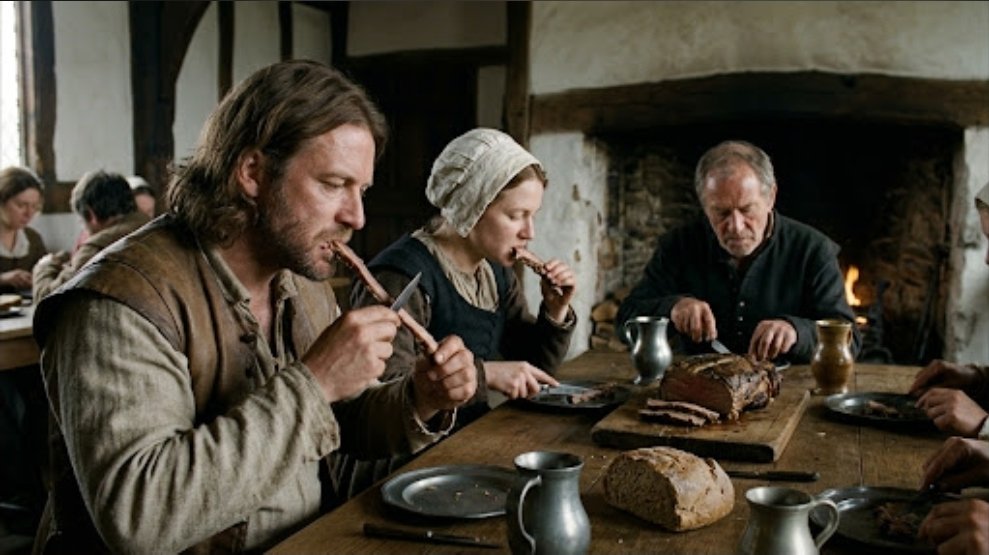
Your top teeth sit in front of your bottom teeth because of the fork.
Nearly every European skull older than about 250 years has the same bite. The front teeth meet edge to edge, like the blades of a pair of pincers. An American anthropologist, Loring Brace, spent decades measuring jaws and found the overbite arriving in Europe in the late 1700s, among the well off first, exactly when the knife and fork reached the table. Before that you clamped the meat in your front teeth and cut it off at the lips, and the tugging held the bite level all through childhood.
He checked it in China. There the overbite turns up about 900 years earlier, with the chopstick, when food started coming to the table already cut small.
Two continents, and on each the bite changed when the cutlery did. It takes one generation.
The rest of the jaw went the same way. Hunter-gatherer skulls have wide arches, straight rows, and room at the back for all four wisdom teeth. Crooked teeth are scarce in any graveyard before the Industrial Revolution. A jaw grows to the work it is given, and ours get porridge, pouches and sliced bread.
Even the language moved. Linguists showed in 2019 that the sounds F and V are only easy with an overbite, and are rare in the languages of people who still chew hard food. Much of the world could not comfortably say "fork" until it owned one.
About a third of British children are now judged to need braces, and Americans have some 10 million wisdom teeth pulled a year.
An entire profession straightens, by wire, a jaw that was only ever short of something to chew.
For the best part of twenty years Rita Hayworth was written off as a drunk by her studio, the press and her doctors. She had Alzheimer's disease, and it had started in her forties.
She was the most desired woman of the 1940s. Her picture was taped inside the lockers of half the American army. Gilda made her the biggest star at Columbia.
Around 1960 she started losing her lines. Directors found she could not hold a page of script. By her last film, in 1972, the words had to be fed to her one sentence at a time. She had rages she could not explain afterwards. She accused friends of things that had not happened.
She did drink, and everybody knew it, so the drink was taken as the whole explanation.
In 1976 she got off a plane at Heathrow confused and dishevelled, and the photographs went round the world. The following year a California court declared her unable to manage her own affairs because of chronic alcoholism. She stopped drinking altogether, and she kept getting worse.
It was 1980 before a physician in New York gave it the right name. By then she no longer knew her daughter.
Medicine at the time held that Alzheimer's was a rare disease of the middle-aged. Ordinary decline in the old was just senility and needed no further thought. A beautiful woman who forgot things and shouted was assumed to have done it to herself.
Her daughter Yasmin cared for her until she died in 1987. Then she took the story public. The charity galas held in her mother's name have raised tens of millions for research, and it was Hayworth's case, more than any paper, that made the disease a household word.
In her lifetime it was thought to be vanishingly rare. It is now the leading cause of death in Britain.
She spent her last clear years being blamed for an illness that nobody had thought to look for. The rarity was in the textbooks. She had never been rare, and neither had the millions who were diagnosed once doctors started looking.
Short sight used to be rare. In 1969 a doctor examining Inuit families in Alaska found it in 2 of 131 older adults, and in more than half of their children and grandchildren.
Same families, same genes, one lifetime. The only thing that had changed was that the young ones had been brought indoors and sat at a desk.
Spectacles go back to the 1280s, but for centuries they were for old eyes that could no longer read. Short sight was a curiosity of scholars and tailors.
Today 96% of 19 year old men in Seoul are short-sighted. In the big Chinese cities it is 8 or 9 school leavers in 10. In America the rate has roughly doubled since the 1970s, and half the world is forecast to need glasses for distance by 2050.
For a hundred years the blame went on books and heredity. Then researchers compared six year olds of Chinese descent in Sydney and in Singapore. Same ancestry, and the Sydney children read more. 3% of them were short-sighted, against 29% in Singapore. The Sydney children were outdoors about 14 hours a week. The Singapore children managed 3.
A growing eye uses daylight to tell it when to stop lengthening. Outdoors, even under cloud, there is 20 or 30 times the light of a classroom. Kept under a ceiling, the eyeball carries on growing, and the far distance goes soft at about eight and stays that way. When Taiwan ordered its schoolchildren outside at break, the rate fell for the first time in decades.
Every human child for 300,000 years grew up under the sky and could see the horizon. We brought them inside for their own good, and now sell them the horizon back at the optician's.
Almond milk is 800 years old, and it was invented as a punishment.
The medieval Church banned meat for about a third of the year. In the forty days of Lent it went further and banned milk, butter, cheese and eggs as well. For a peasant that meant six weeks of bread, pease and salt herring, and no argument.
For a lord it meant a problem for the cook. The great kitchens of Europe ran on cream and eggs, and the answer they found was to buy almonds by the sack from Spain and the Levant, at a price no labourer could have dreamed of, pound them in a mortar, steep them in water and strain off the white liquid. It looked like milk. It could be thickened like cream. Cooks set it into mock cheese, and poured it into blown eggshells with a saffron centre, so that His Grace could have an egg on Good Friday without having an egg. In one German cookbook of 1350 nearly a quarter of the recipes call for it.
Everybody understood what it was. It was the thing you put up with until Easter, when the real milk came back and the whole of Christendom fell on it. Nobody drank almond milk on Easter Monday. When the Reformation swept the fasts away, the stuff vanished from northern kitchens inside a generation, unmourned.
It has since returned, at twice the price of milk, with about 2% almond in it, the rest being water, gum and added vitamins to stand in for the ones milk has anyway.
The medieval nobleman drank it because the alternative was hellfire. The modern customer has no such excuse.
Wool is the most vegan thing in your wardrobe, and vegans have banned it.
A sheep does not moult. We bred that out thousands of years ago, and the fleece now grows until somebody takes it off. Leave it on and you get Shrek, a New Zealand merino who hid in a cave for six years and came out in 2004 under 27kg of wool, looking like a cloud with a face. Or Chris, found near Canberra in 2015 carrying 41kg and barely able to walk.
So once a year a sheep gets a haircut. It takes about two minutes. Nothing dies. She walks off several pounds lighter, looking faintly embarrassed, and starts on the next one. In Britain the fleece usually sells for less than the shearer charges, so the farmer is paying for the haircut out of concern for the client.
That is the cruelty.
The approved alternative is a fleece made of plastic. Polyester, acrylic and nylon are oil, drilled, refined and spun into thread, and they shed fibres by the hundred thousand in every wash. About a third of the microplastic going into the sea comes off somebody's clothes. A wool jumper buried in the garden is soil in a year or two. An acrylic one will see out the next ice age.
One fibre needs an oil rig. The other needs grass, rain and an animal that carries on with its day.
The objection is that the sheep cannot consent. True. It also cannot consent to flystrike, heatstroke, or rolling onto its back under the weight and dying there, which is what the unshorn version of freedom consists of.
Veganism has looked at an animal that needs a haircut and decided the kind thing would be for it never to have existed.
Activist: "You take her milk by force. Machines clamped on her twice a day whether she likes it or not."
Farmer: "Nobody takes her anywhere. See that box in the corner of the shed?"
Activist: "The metal thing."
Farmer: "That's the milking robot. The gate's open day and night. She walks in when she feels like it."
Activist: "And if she doesn't feel like it?"
Farmer: "Then she doesn't. Nobody's fetched a cow in this shed for six years."
Activist: "So how often does she actually go?"
Farmer: "Three times a day, on average. That black one's been five times since breakfast."
Activist: "Five?"
Farmer: "It turned her away three of them. It reads her collar. If she was milked an hour ago it opens the front gate and sends her off."
Activist: "Why would she keep going back?"
Farmer: "Her udder's full and there's a handful of cake in the trough."
Activist: "So you bribe her."
Farmer: "Do you get paid at your job?"
Activist: "That's different. I chose it."
Farmer: "There's a queue at that box at four in the morning. I'm in bed. Nobody's making them stand there."
Activist: "It's still her calf's milk."
Farmer: "She makes thirty-five litres a day. The calf takes eight. He's had his."
Activist: "I just don't think an animal can agree to something like that."
Farmer: "She's coming round again. It'll tell her no. You can explain exploitation to her while she waits."
A chicken farmer saved a penguin colony in Australia with a sheepdog, after the experts had watched it fall from 600 birds to fewer than 10.
Middle Island sits a short wade off the town of Warrnambool in Victoria. In 2000 it had hundreds of little penguins, the smallest kind there is, about a foot tall. Then the sand shifted, the channel got shallow, and at low tide the foxes found they could walk across.
A fox in a colony kills far more than it eats. By 2005 a count found 4 birds.
There were surveys and meetings. Meanwhile a local man called Swampy Marsh was running free-range hens down the road and losing none of them, because since 1997 he had kept Maremmas. They are big white Italian dogs, bred for two thousand years to live with a flock and stand between it and the wolves. He said the answer was so obvious he could not believe nobody had thought of it.
It took a while to persuade the council. In November 2006 one of his dogs, Oddball, was put on the island for a four-week trial.
The killing stopped the day she arrived. Not one penguin has been lost to a fox with the dogs on duty. In 2017 bad tides kept them off for a spell and foxes took 140 birds in a few nights, which settled any remaining argument.
There are about 200 penguins on the island again.
The dog was bred by shepherds to guard whatever it grew up beside. It has never once asked what the flock was.
In August 2018, a 28 year old doctor started work in the exact Stanford baby ward that kept him alive at birth.
Before his first shift, his mother gave him one small request.
She asked her son to look out for a nurse named Vilma.
His name was Brandon Seminatore.
Back in 1990, Brandon was born more than two months early at Lucile Packard Children's Hospital Stanford in Palo Alto, California.
He was far too small to go home.
For over a month, he stayed in the neonatal intensive care unit until he could survive on his own.
Anyone who has sat beside a hospital bed knows how long those uncertain weeks feel.
Vilma Wong was one of his primary nurses.
Day after day, she watched over the fragile boy and comforted his worried parents when they could only wait and hope.
Before Brandon went home, his grateful parents took a photo of Vilma smiling at work with their tiny son resting on her lap.
They kept that picture in a family album.
As their boy grew up healthy, his parents never forgot that nurse by name, even after 28 years without seeing her.
Brandon later finished medical school and chose to train in child neurology.
In his second year of residency, his schedule brought him back to that same neonatal unit in Palo Alto.
He figured Vilma had retired years ago.
She had not.
For nearly three decades, Vilma had stayed on that floor, caring for thousands of premature infants.
One morning on shift, she saw Brandon Seminatore listed as the resident doctor for one of her patients.
Even after 28 years and thousands of newborns, the unusual last name stood out right away.
When Brandon came by to check on the baby, Vilma looked closely at his face.
She asked if he had been born early at Stanford, and if his father was a police officer.
The room went quiet.
Brandon looked at her, realized who stood in front of him, and asked if her name was Vilma.
Soon after, his parents sent over the 1990 photo of Vilma holding him on her lap.
Vilma finally got to see who that premature baby had grown up to become.
After taking a new photo side by side, the longtime nurse and her former newborn patient went right back to caring for premature babies together.
In 1964, forty-two-year-old Air Force Reserve Lieutenant Colonel Michael Novosel, who had flown giant B-29 bombers out of Tinian at the end of World War II, tried to volunteer for active duty in Vietnam.
The Air Force turned him down flat: they had too many senior officers, and at forty-two he was considered too old for a combat cockpit.
So Novosel walked across the street to the U.S. Army and made an astonishing offer: strip off my Lieutenant Colonel silver oak leaves, drop me down to Warrant Officer, and let me fly unarmed "Dustoff" medical ambulance helicopters so nineteen-year-old kids do not bleed to death in the mud.
At age forty-seven, on October 2, 1969, flying an unarmed Huey with zero gunship cover, Novosel made fifteen separate passes into point-blank machine-gun fire, getting shot in the leg and hand and even hovering backward up to an enemy bunker to pull twenty-nine surrounded soldiers to safety, earning the Medal of Honor.
Then his story somehow got even better.
His twenty-year-old son, Michael Novosel Junior, became an Army Warrant Officer too and requested assignment to his father's exact same Dustoff ambulance unit.
During a single week in March 1970, Mike Junior's helicopter went down with engine failure over hostile territory, and his forty-seven-year-old dad diverted overhead and rescued his own son. Exactly seven days later, enemy gunfire blew the tail rotor off the father's helicopter and sent him crashing into a flooded rice paddy, and twenty-year-old Mike Junior flew straight in and rescued his dad.
Before retiring as the last active-duty World War II aviator in the U.S. military, the father who gave up his rank personally evacuated five thousand five hundred and eighty-nine wounded souls.
Harold Cottam, age 21, sat unlacing his boots for bed shortly after midnight on April 15, 1912, while the Titanic sank in the dark 58 miles away.
His coat was already off in the radio room of the passenger ship Carpathia, yet he kept his headphones on for a few extra minutes to send the Titanic routine traffic.
Back through the static came an urgent call from coordinates reporting that the Titanic had struck an iceberg and was sinking.
Cottam ran to the bridge and burst into the cabin of sleeping captain Arthur Rostron to wake him.
Rostron ordered the ship turned toward the distress position at once, then paused in the quiet cabin to ask if Cottam was sure the signal was real.
The Carpathia had a top speed of 14 knots, so Rostron woke the off duty stokers and shut off cabin heat and hot water to send all steam to the engines.
Cabins went cold while the deck shook underfoot as the ship pushed past 17 knots through pitch darkness straight toward the ice.
Rostron posted extra lookouts on the bow, bridge wings, and mast, steering around tall icebergs by starlight without slowing down.
Inside, the crew turned all three dining rooms into medical wards with a doctor in each, readied hot soup and blankets, and cleared officer cabins.
They hung rope ladders, chairs, and canvas mail sacks along the hull, and poured oil down the forward lavatory pipes to calm the sea.
At four in the morning, Rostron spotted green flares from a lifeboat and stopped the engines at the ice field.
The shaking deck went still in the dark, and ten minutes later sailors pulled the first survivor aboard.
Daylight soon revealed dozens of massive icebergs surrounding the Carpathia on every side.
For over four hours in rough swells, crewmen hauled shivering adults up on ropes and lifted babies and small children aboard in canvas bags.
By half past eight, 705 survivors were safe aboard, and Rostron steered through thick fog to Pier 54 in New York on the rainy night of April 18, 1912.
Survivors pooled money to give a medal to every crew member, and on March 1, 1913, President William Howard Taft awarded Rostron the Congressional Gold Medal at the White House.
All 705 people who reached New York that rainy night were alive because a 21 year old with his boots unlaced kept his headphones on for a few extra minutes before bed.
Menopause exists in humans and a handful of whales, and in the whales you can watch what it is for.
Nearly every female animal on earth breeds until she dies. A chimpanzee does, an elephant does, a blue whale does. A female orca has her last calf at about 40 and then lives to 80 or 90. Half her life comes after it.
Off the coast of Washington and British Columbia, researchers have followed the same orca families since the 1970s, every animal known by its fin. They found that in the years when the salmon fail, the whale at the front of the pod, leading the search, is nearly always an old female past breeding. She knows where the fish were in the last bad year, which may have been before anyone else in the family was born.
When a grandmother dies, her grandcalves are 4.5 times more likely to die over the next two years. Her grown sons, five-ton males of 30, are several times more likely to die within one. She had been catching salmon and biting them in half for him.
People work the same way. Among the Hadza a child's growth tracks how hard its grandmother works. In the parish registers of Finland and Canada from the 1700s, families with a living grandmother nearby buried fewer children.
Evolution switched off breeding in the middle of a woman's life in order to free up the most experienced person in the group.
In 1966 a New York gynaecologist wrote a bestseller describing the same event as a deficiency disease and the women as castrates, and the framing stuck.
The orcas call her the matriarch and follow her.
In May 1942, three California families had days to pack two suitcases and leave their 90 acres of farmland behind.
Locked in detention camps for three years, they had no way to water their crops or pay the banks.
When they came home in 1945, every vine was pruned, every house was intact, and every mortgage was paid in full.
His name was Bob Fletcher.
In 1942, Bob was 30 years old and worked as a state agriculture inspector near Florin, California.
After Executive Order 9066 was signed, his Japanese American neighbors were sent to internment camps.
Before leaving, a grower named Al Tsukamoto asked Bob to look after his 40 acres of Tokay grapes.
Two neighboring families, the Okamotos and the Nittas, soon asked him to watch their grape and strawberry farms too.
Bob quit his state job.
He moved into the empty Tsukamoto farmhouse and took on all 90 acres by himself.
Then the town turned on him.
Locals were furious that a white man was protecting land for families in detention camps.
People shouted insults at him in town and told him to walk away from the fields.
One night, someone fired a bullet straight through the wall of his barn.
Bob stayed on the land.
For three years, he worked 18 hours a day watering, pruning, and harvesting all three farms alone.
With the harvest money, he paid the property taxes, water bills, and mortgages on every farm.
When the war ended in 1945, the Tsukamoto, Okamoto, and Nitta families returned to Florin.
While most detainees across California came back to lost homes, the three families walked onto thriving fields free of debt.
Bob kept half of the net profit for his three years of labor and handed the rest of the cash to the families.
Decades later, he brushed off praise and said he simply did what any neighbor should do.
Bob Fletcher lived to be 101 years old and died in Sacramento in May 2013.
Three families left their farms with two suitcases, and one neighbor took a bullet through his barn wall and worked 18 hours a day for three years so they could come home to 90 acres of paid land.
Great advice!
I usually drive a Tesla, and I bought an inline electron analyzer from Temu that screens out inadequately polarized electrons, allowing only the most wholesome and natural ones to charge my Model 3.
Some friends say that's bunk, but we'll see who's laughing when their batteries clog up with GMO electrons!