What a way of ending the month!
I am happy to announce that I´ve just accepted an offer to join @TecdeMonterrey@CSocialesTec as an Assistant Professor of Economics! Happy about this outcome :)
Nosotros vamos en serio.
Porque estos 26 van con la misma hambre de 18 millones de ecuatorianos. Con el mismo sacrificio de los que salieron desde abajo y llegaron lejos.
Esta es nuestra lista, y vamos a demostrar al mundo que esto es Ecuador.
#UnSoloEcuador 🇪🇨
What explains cross-national variation in state capacity (and, therefore, development) in Latin America? #Colonialinstitutions (James Mahoney), #Trade (Sebastian Mazzuca) or #War (yours truly)? Tomorrow at 1:45 PM we debate each other at @lasaintcongress
I've written a @claudeai skill that is useful when you’re starting a new project and want to absorb fifty papers before writing a word yourself.
/tyler converts a folder of academic PDFs into a token-efficient markdown wiki for literature review. Point it at a directory of papers and it produces one lightweight .md file per paper, plus an index, so Claude Code can load an entire literature into context without burning tokens on raw PDF parsing.
Named in honour of @tylercowen, the economist behind @MargRev and a famously voracious reader.
Available from --> https://t.co/B6mVrbmB4U
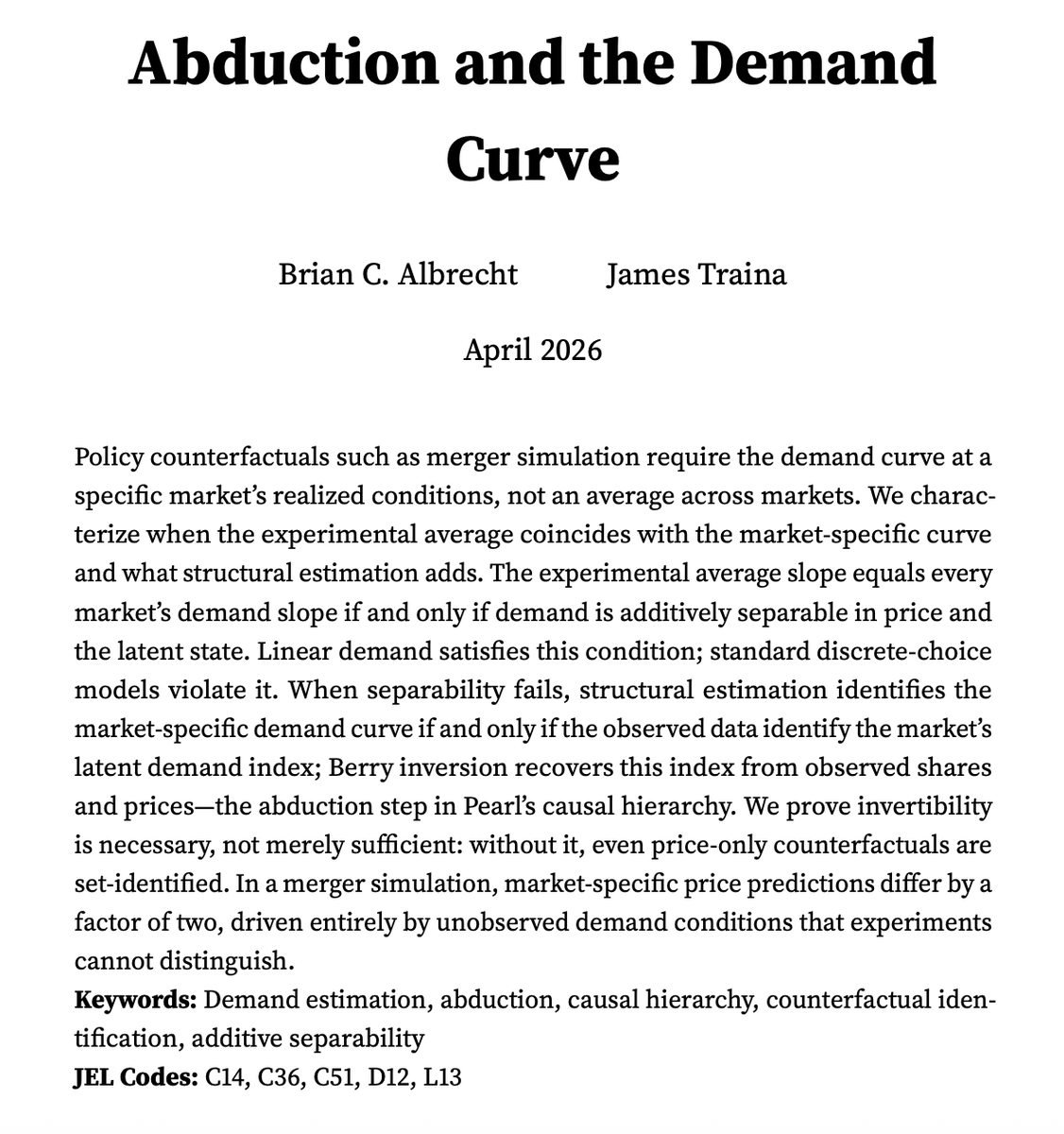
"Abduction and the Demand Curve"
A new paper with @EconTraina
The demand curve is the most basic object in economics. Hold everything else fixed, change the price, see what happens. Ceteris paribus. Day one stuff. Okay, maybe day 3.
But what does "everything else" include? Unobserved quality, local tastes, recent advertising. Things the econometrician doesn't see. A market's demand curve holds those fixed.
Now suppose you run a randomized experiment. Set a price, observe quantity, repeat. You've eliminated confounding. You have a causal effect. We love experiments. Perfect. Right? Right?
Are these the same things? This maybe isn't well-known outside of IO, but the answer is no.
When they aren't, what are you supposed to do? This paper connects the experimental literature with the structural IO demand estimation literature to make clear the interplay .
In the experiment, you've averaged over all those unobserved conditions. You know what happens on average across markets when you set a price.
You don't know what happens in THIS market, with THIS unobserved quality, at that price. The experiment gives the average demand response. Policy happens in a specific market.
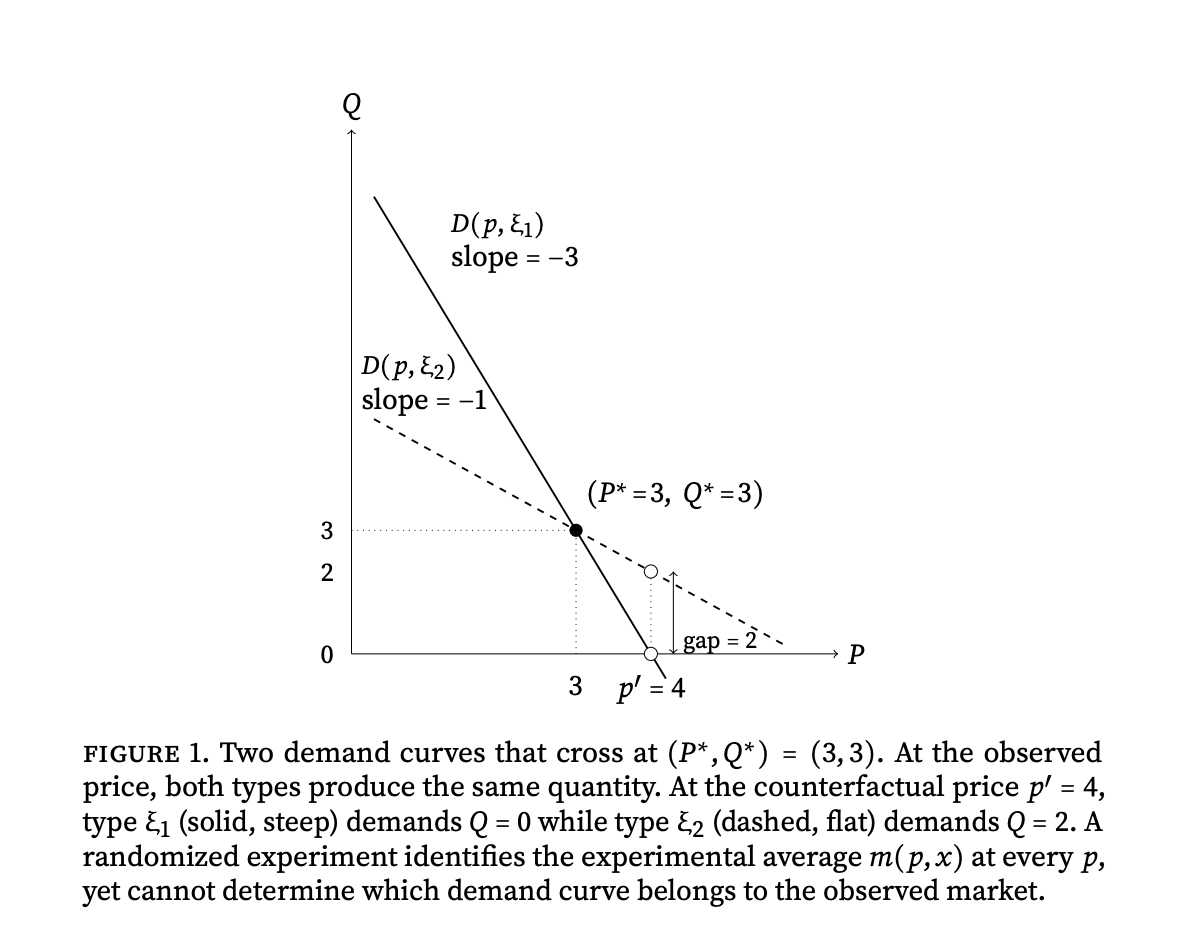
Two markets produce the same quantity at the same price. An experiment can't tell them apart. But at any other price, they diverge. The demand curve is a market-specific object. So what bridges the gap? Good ole' Berry (1994_ inversion.
You observe a market's shares, prices, and characteristics. Inversion recovers the unobserved demand index, the δ*, that rationalizes what you see. It pins down WHERE on the demand function this particular market sits.
Prior work treats this as a computational convenience. Berry (1994, p. 249) compares it to "taking logarithms of observed data." Berry and Haile (2021, p. 40) call it a "trick." They leave as an open question what happens when invertibility fails, "perhaps involving partial identification."
We answer. Without inversion, even price-only counterfactuals are set-identified. The trick is not optional. Inversion is not just sufficient but necessary for recovering market-specific counterfactuals.
But when exactly do you need it? Berry and Haile (2021) say experiments "generally" don't identify demand. Angrist, Graddy, and Imbens (2000) showed that when demand differs across markets beyond an additive shift, IVs identify a weighted average of derivatives, not any single market's response. Imbens even reiterates the point in his Nobel lecture.
We first make "generally" exact beyond the linear case of AGI (2000). We characterize precisely when the experimental average price response equals every market's demand slope (if and only if additive separability holds, a knife-edge that every standard discrete-choice model violates).
So outside of that case, what are we to do? That hasn't stopped IO economists. Are they just making stuff up? No! Berry inversion baby!
Along the way, we can make a few more connections. @yudapearl asked whether ceteris paribus demand can even be formally defined in counterfactual language. We do that.
The demand curve is the unit-level counterfactual Q_p(u) for a market with realized conditions held fixed.
We also show the connection to Pearl's causal hierarchy. Experiments give Rung 2 (causal). The demand curve is a Rung 3 object (counterfactual). There's generically a gap between them. Berry inversion is what is called abduction in SCM to move between those rungs.
The econometrics and CS frameworks are saying the same thing, and the demand curve is the natural, well-developed setting to see it.
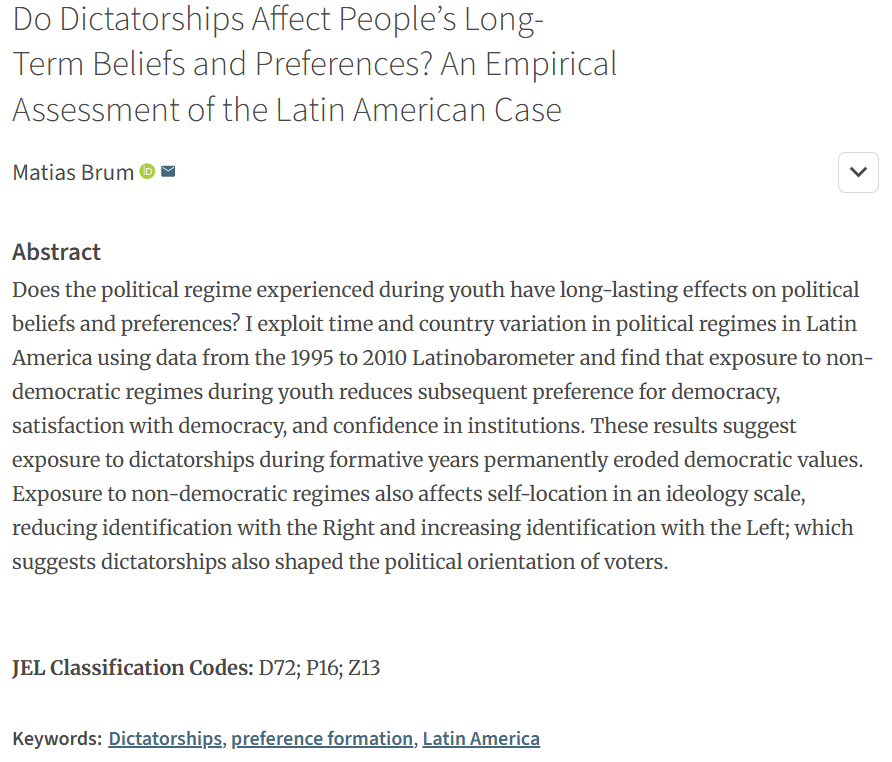
Do dictatorships leave a permanent mark on people's minds? New paper out in @EconomiaLACEA: growing up under authoritarian rule in Latin America durably erodes democratic values and shifts political orientation to the Left. https://t.co/TEoUvtJS2m
El FIFA Fan Festival™ Guadalajara llega a Plaza de la Liberación, donde viviremos la pasión del futbol con gastronomía, música y color con La Fiesta más Mexicana. 🤩🇲🇽
La entrada será libre y gratuita. No se requiere registro, sujeto a capacidad de aforo. 👀🎟️
#SomosGuadalajara #Somos26 #FIFAWorldCup
🆕 Understanding development in the long run: Cracks in the consensus on institutions?
Today on VoxDev, @jpfaguet (@LSE_ID) & @fabiosanchez_to (@EconomiaUAndes) challenge the consensus that extractive institutions always harm long-run development: https://t.co/sh4FWP3nqM
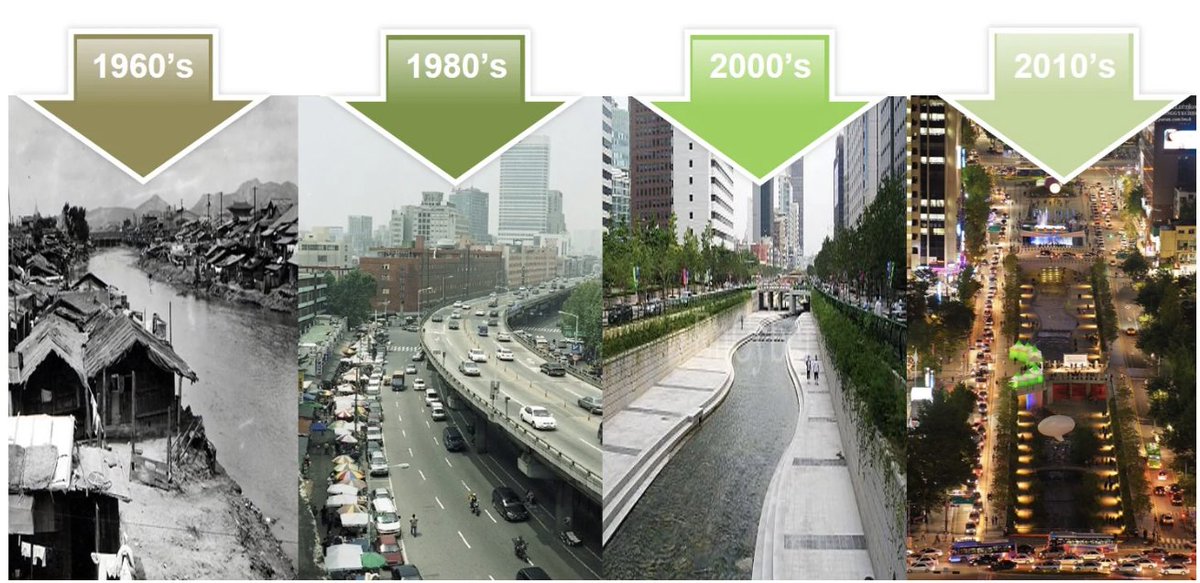
A fundamental lesson from my posts these last two weeks on modernization, industrial policy, and development is that development economics should be about understanding why South Korea got rich but Bolivia did not.
The current field has largely given up on that question. Sharply identified RCTs on small micro programs are a fine way to publish in the AER and get tenure at a fancy university, but a profession that knows everything about microfinance impact evaluations and almost nothing about industrialization has misallocated its own intellectual capital on a pretty heroic scale.
Four images of Seoul:
These students are exceptional. Rather than serving as RAs in predoc programs, they produce independent research in the second (and often third) year of their master’s. They also complete a demanding PhD-level core in micro, macro, and metrics. The best of these papers rival second-year PhD work and strongly signal their research potential. A 30 year track record confirms this.
𝐄𝐮𝐫𝐨𝐩𝐞'𝐬 𝐏𝐨𝐢𝐬𝐨𝐧 𝐏𝐢𝐥𝐥: 𝐓𝐡𝐞 𝐔𝐧𝐢𝐧𝐭𝐞𝐧𝐝𝐞𝐝 𝐂𝐨𝐧𝐬𝐞𝐪𝐮𝐞𝐧𝐜𝐞𝐬 𝐨𝐟 𝐂𝐨𝐡𝐞𝐬𝐢𝐨𝐧 𝐅𝐮𝐧𝐝𝐬 𝐚𝐧𝐝 𝐖𝐡𝐲 𝐓𝐡𝐞𝐲 𝐌𝐮𝐬𝐭 𝐄𝐧𝐝
Check out my new book with CUP, already available for preorder at Amazon, Barnes & Noble, or your favorite bookseller👇
Mexican management quality is both lower on average and less correlated with firm size than in the United States, a sign of misallocation in the economy, say researchers at @Stanford, @WorldBankGroup, and @LSEnews. #Chart https://t.co/9jAe5FbgKq
My travels have convinced me that we are now in the Age of Emboldenment.
How so? First, the good news. AI is having an effect that is often not discussed: it gives the underconfident a voice. People who once struggled to articulate what they knew deep in their minds but had a difficult time finding the words can now communicate with much more clarity and precision. Giving the once voiceless a voice is wonderful.
But there's a dark side to this emboldening. AI is also giving people an awkward and truly borrowed confidence. Some act as if consuming an idea is the same as understanding it. With every new prompt, the AI answers come fast and furious, and with such seductive fluency. The sand castle looks magnificent. Then the questioning starts, the tide comes in, and the sand castle disappears.
The differentiator here? Using AI as an assistant versus using AI as a steroid. Using AI to help hone your own ideas and write them more clearly, organize your thinking, or stress-test your argument? That strikes me as a force multiplier. It makes genuine expertise more powerful and more visible, and this helps us all learn more from others' ideas. AI as an assistant.
But, relying on AI to generate ideas that you do not actually understand yourself? That is the steroid at work. And, I am not saying this as an academic who romanticizes/rewards struggle for its own sake. I see the same within organizations, even where total output, not struggles, is crucial. The premise here is that the struggle and wrestling with an idea are creating the understanding. You cannot borrow it. You cannot shortcut it.
Making real change within organizations almost always requires some sort of verbal discussion and defense of a proposed action, policy, or idea. The person who has genuinely wrestled with a hard problem and the person who asked AI to wrestle for them are not the same. Just like steroids get detected, fake knowledge gets exposed. Always has. AI just accelerates both the inflation and the reckoning.
So, let me end with a prediction that complements what I wrote earlier: critical thinking and communication will soon become, by far, the most valued skills in the room (maybe they always have been in some rooms, but even more important now). Homogeneity is the reason why: everyone has access to the same AI. This means that the differentiator isn't who can generate the answer, it is who understands and can explain it.
The Age of Emboldenment is here. Make sure your confidence is built on bedrock, not sand.
This post is part of a broader project I’m developing in AI at Your Side: The Student’s Guide to Smarter Learning (with @raul_sosa2908, forthcoming at Oxford University Press), where the goal is not to replace thinking with AI, but to discipline it. Hayek is a perfect example: you can get a fluent summary in seconds, but that is precisely what prevents understanding. The book builds a framework for using AI as a sparring partner—something that helps you reconstruct arguments, test intuitions, and push your reasoning further, rather than short-circuit it. That is the spirit behind this series.https://t.co/K6U1A3gcQe
Two years after its launch, Mexico's $25 billion Mayan Train is struggling. Ticket sales are low, hotels along the route sit mostly empty and despite government promises, the local communities near the line say they have seen little benefit https://t.co/Ci0srlaBB4
In preindustrial Japan, the widespread distribution of land among peasants led to lower wages and GDP per capita than in England, says @YuzuruKumon of @OfficialUoM. #ResearchHighlight https://t.co/EoeAW4kJUr
Mmm, no se. Mas que en tecnicas, la "revolucion de credibilidad" puso a los economistas a pensar en contextos, instituciones, ¿teorias?, que implicasen una "identificacion limpia" y tecnicas para hacer inferencia valida. Es decir, los puso a pensar como economistas.