@TheStalwart@dioscuri Simulation hypothesis. If running high-fidelity simulated worlds (such that the inhabitants are sentient) becomes common post-singularity then even if only a fraction of those worlds are simulacra of the historical Earth they outnumber the real Earth and we're likely in one.
@KelseyTuoc One of these things is not like the others: administrators of food stamp and affirmative action programs may be indifferent to applicants lying, but owner occupancy fraud is a principle-agent problem and if lots of people are doing it then lots of people are in the wrong.
@KelseyTuoc RF engineering relies on being able to accurately predict how waves will behave. With five digits of pi, we wouldn't be able to reliably produce antennae, resonators, filters, and so on. Simulations would be catastrophically wrong; stuff would be within tolerance only by chance.
@ciphergoth Org members assigned specific permissions: admin, whitelist, blacklist, contextualize certain actions. The real solution is fixing the government's system; it should not be physically possible to add randos to the natsec group chat.
@AmandaAskell Artificial womb research faces catastrophic financial and regulatory barriers to reaching the prototype stage, we already have extended fertility spans via egg freezing, AI-assisted childcare sounds like marginal productivity gain for daycares, UBI is expensive, etc.
- brain desires new good
- ask brain if this is desire for positional good or functional good
- brain doesn't understand, pull out illustrated diagram explaining relative income effect & hedonic treadmills
- brain laughs "its a real desire ma'am"
- acquires good
- its positional
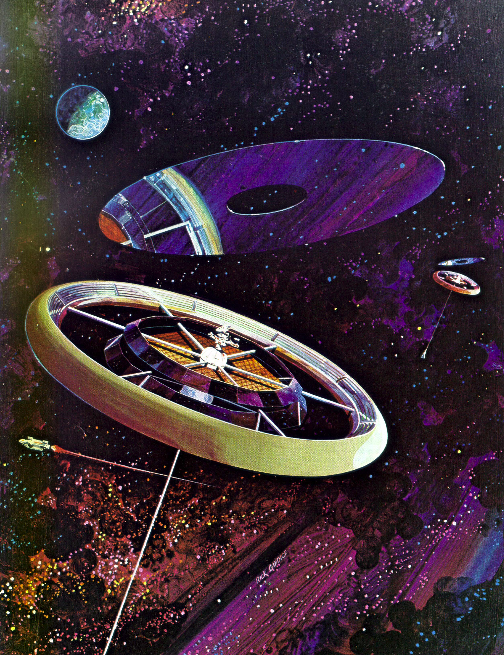
STANFORD TORUS MEGATHREAD
You’ve seen the pictures, but you probably don’t know the full story.
It's the result of a 10-week engineering study at Stanford University in 1975, funded by NASA and led by Girard O’Neill - the most thorough study on free-space settlement to date.
1/
@parafactual I am not positive that slow takeoff is likelier than fast, but I do think that any task which cannot be evaluated on the order of milliseconds is unlikely to be RL'd into superhuman territory.
@parafactual Current AIs that have achieved something like fast takeoff did so using reinforcement learning (e.g. AlphaZero became superhuman at chess in nine hours by playing 44 mm games). Doesn't seem to generalize well to tasks which are not purely informational, c.f. self-driving cars.
it's a little-known fact that god actually didn't die until the widespread use of pseudorandom number generators by modern computers, each use a small act of divination, exhausted god's ability to respond to all divination. god was killed mostly by microsoft in the 90s
Xenosemanticity has good mouthfeel but is sadly less applicable to us. Even if mind-readers were real you wouldn't be able to defeat them by kludging disparate concepts together to make verboten thoughts – when the rest of your thoughts are plaintext, cyphertext stands out.
Interesting term from LW post on interpretability. Autostigmergy: encoding information into the environment so it doesn't need to be in your own memory. Humans do that all the time, albeit to augment our memory and not defeat mind-readers.
https://t.co/4ArygVdsNS