In a defiant interview with the FT, Volodymyr Zelenskyy said Donald Trump had an instinctive affinity for autocrats and the super-wealthy. The Ukrainian president explained his views on the relationship between the US and Russian heads of state https://t.co/LydswPxdYG
An astrophysicist worked with Claude Science to create the first complete ultraviolet map of the sky. Astronomers have already created complete sky maps from radio to gamma rays. But large regions of the sky have never been observed in UV.
In today’s science blog, Brice Ménard explains how he guided Claude to find existing datasets, combine them, and fill in the gaps with statistical inference. The work would have taken humans weeks of work, but, with Claude, just took a few days while Ménard worked on other projects.
The resulting map is a useful teaching tool and an example of exactly the sort of slow, low-priority work which scientists never quite get around to, but which AI now makes feasible.
Read more: https://t.co/1B3NDPNa13
Today, NASA announced PRIMA, a new space telescope that will explore long-standing mysteries around the formation of planets, stars, black holes, and even how water on Earth came to be. https://t.co/am7EPkNYof
China has reportedly got its hands on the cockpit canopy and a weapons-bay door of an Australian F-35. A few considerations on what that does, and doesn't, mean.
An F-35's low observability rests on three pillars:
SCOOP: A shipment of F-35 parts, including a canopy, wound up in Hong Kong — sparking an investigation on Capitol Hill and raising the possibility that China could have access to key components of the highly-classified program.
with @marksatter
https://t.co/Y0ufsqEcY0
La compromissione dei dati di @Revolut sembra essere molto, ma MOLTO più grave di quanto raccontato.
Se le affermazoni dell'attaccante sono corrette, Revolut non è stata "bucata", ma ha risposto ad una PEC (compromessa dall'attaccante) direttamente delle Forze dell'Ordine, a una richiesta di informazioni.
Cosa che è TENUTA a fare.
Questo significa che ci aspettiamo dal @Viminale che confermi o smentisca, perché se la compromissione riguarda mail legittime (PEC), il problema NON È LIMITATO A REVOLUT ed è ORDINI DI MAGNITUDO più grande e pericoloso.
E può coinvolgere OGNI SERVIZIO e OGNI DATO.
La compromissione qui non è di @Revolut, è di una (o più) Forze dell'Ordine Italiane.
@Mauro_Gilli Also worth separating DUV from EUV here. Access to DUV projection optics, even genuine ZEISS modules, doesn’t translate into the EUV stack. With EUV you’re dealing with multilayer mirrors, vacuum/contain control, actuation and wavefront metrology… that’s a different beast.
We’re sharing a solution to the Navier-Stokes Millennium Prize Problem, one of the deepest problems at the frontier of mathematics.
The proof was produced by a group of agents, using an OpenAI next-generation model significantly more capable than GPT-6 Astra.
The problem concerns whether the description of smooth three-dimensional fluid motion modeled by the Navier-Stokes equations can break down. It has remained unresolved for roughly 90 years.
1/x Today I'm going to try and explain the stability aspects of heavy lift vessels. I'll try to keep it accessible for everyone, so bear with me (it's a bit nerdy, I admit)... a small🧵 (I did use AI to create the graphs based on my explanation)
SCOOP: The elimination of a futuristic drone battalion is part of a broader “back-to-basics” approach ordered up by Gen. Christopher LaNeve, the acting chief of staff of the Army who is closely aligned with Defense Secretary Pete Hegseth.
The battalion was a signature initiative of LaNeve’s predecessor, Gen. Randy George, whom Hegseth ousted in April. https://t.co/bwjP6L0MNa
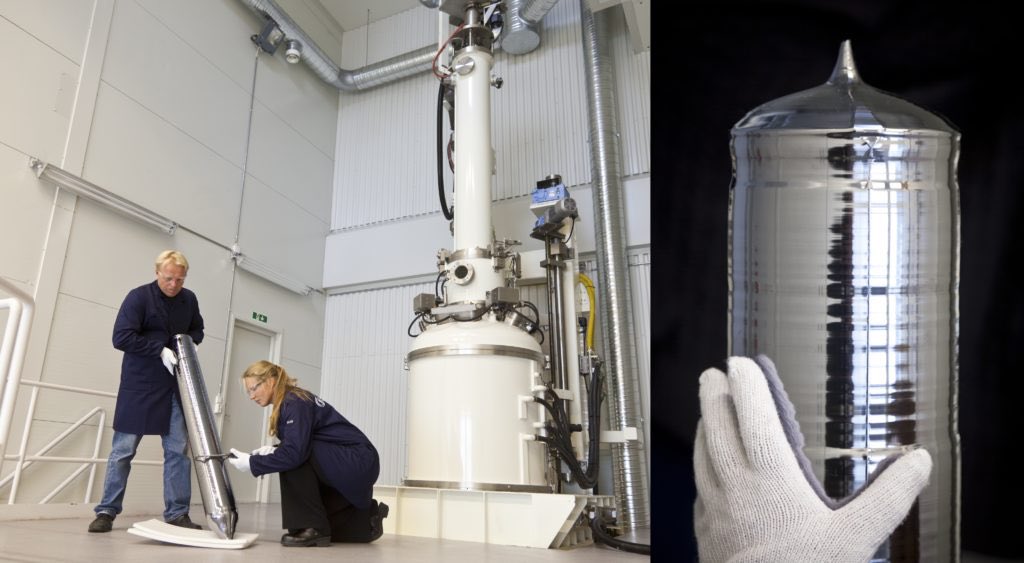
Making Silicon Crystals
Step 1. Melt a lot of silicon down into a hot pool of liquid silicon.
Step 2. Adjust the temperature until the pool is just above its melting point.
Step 3. Dip a cold thing into the pool (seed)and the silicon will start to freeze onto it.
Step 4. Slowly rotate the seed to keep everything round.
Step 5. Very slowly lift this thing out of the pool.
Step 6. Lift it out at juuuussssst the right speed so that the silicon keeps it wetted at the bottom and freezes to it as it is retracted. The pull speed controls how big the diameter is.
Step 7. When it start to get a bit long just lift it faster and it will taper off.
This is why silicon ingots have their distinctive shape. Once you know the process the shape is very intuitive.
These ingots are then salami sliced into wafers and those wafers then get etched into chips.
This is called the Czochralski (CZ) method, if you can create a hot pool of something you can generally produce giant single crystals of that material.
It works for semiconductors, optical crystals, metals, anything where you want a bulk crystal with controlled grain.
Turbine blades use a different method because they have to be made with cooling channels and other intricate features that cannot be produced with reductive machining.
Conquering the next battlefield: Space.
We bet our own money to rapidly design, build, test, and fly a fully integrated satellite. Last month, ANDURIL-216 reached orbit. Anduril, alongside a few core partners, went from clean sheet to on orbit in less than two years.
All systems are nominal. We've made first contact and fully commissioned the bus, power distribution devices, and edge compute payload. The first calibrated images are in from all three payloads onboard the spacecraft: one long-wave infrared, two electro-optical.
The firsts go beyond the vehicle. Our space team used Lattice to commission and task ANDURIL-216, the first time Lattice has commanded an on-orbit spacecraft.
More to come.
A giant leap to Mars! 🚀
NASA recently completed testing of a lithium-fed electromagnetic thruster, reaching 5x more power than today's electric propulsion systems. Paired with a nuclear power source, this tech could slash travel time to Mars!
MORE: https://t.co/1P7FnGfkf5…
Weapons of Mass Production
Today there are a handful of single assets that gate huge sectors of the economy. The criteria should be something like >50% of the global supply passes through this one cool thing.
• Falcon 9
Commercial access to space is 90% via the Falcon 9 launch system.
• Ulsan shipyard
Large high quality FPSOs and LNG tankers are almost exclusively manufactured here.
• Muroran forge press
Giant forged ingots >200 tons are mostly made in Japan and by this giant forge press.
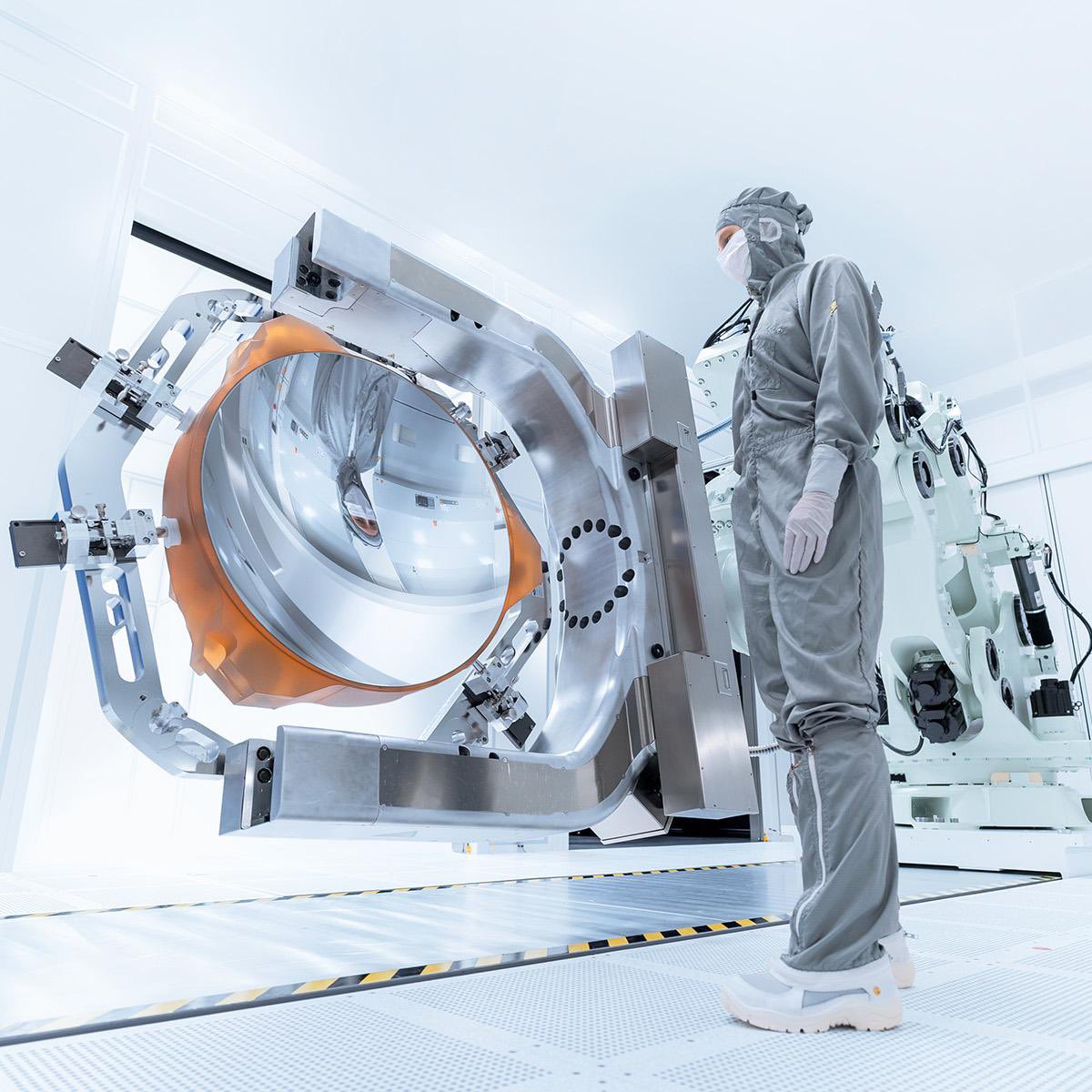
• Zeiss vacuum grinder
The mirrors that allow ASML to do frontier EUV lithography are made by 1 machine.
There are a few others but you get the idea, what else should be on the list?
High NA-EUV Lithography
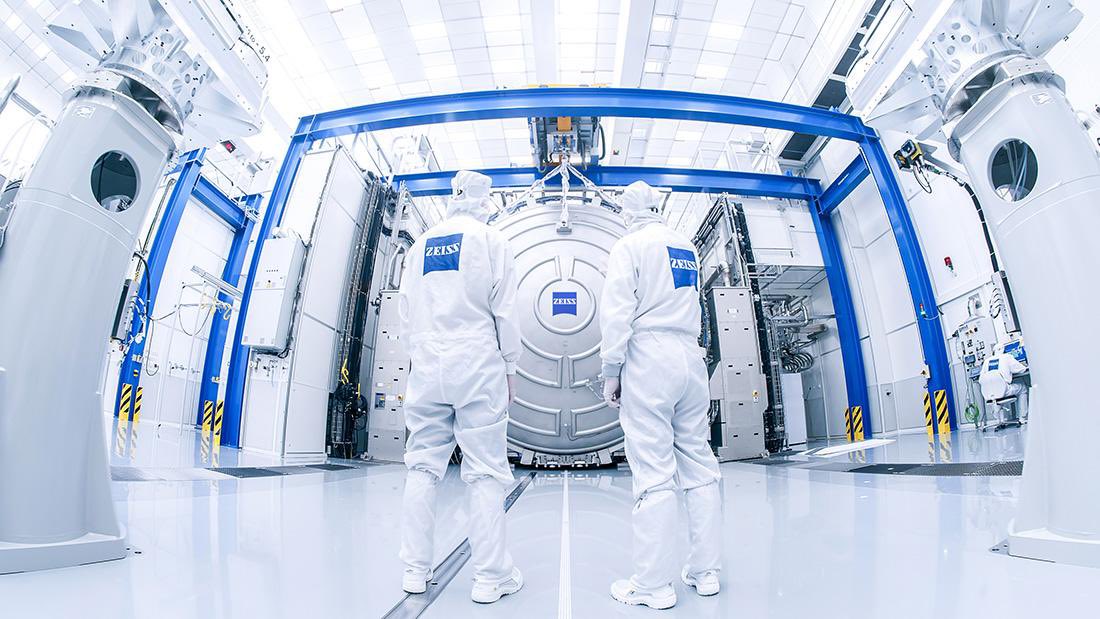
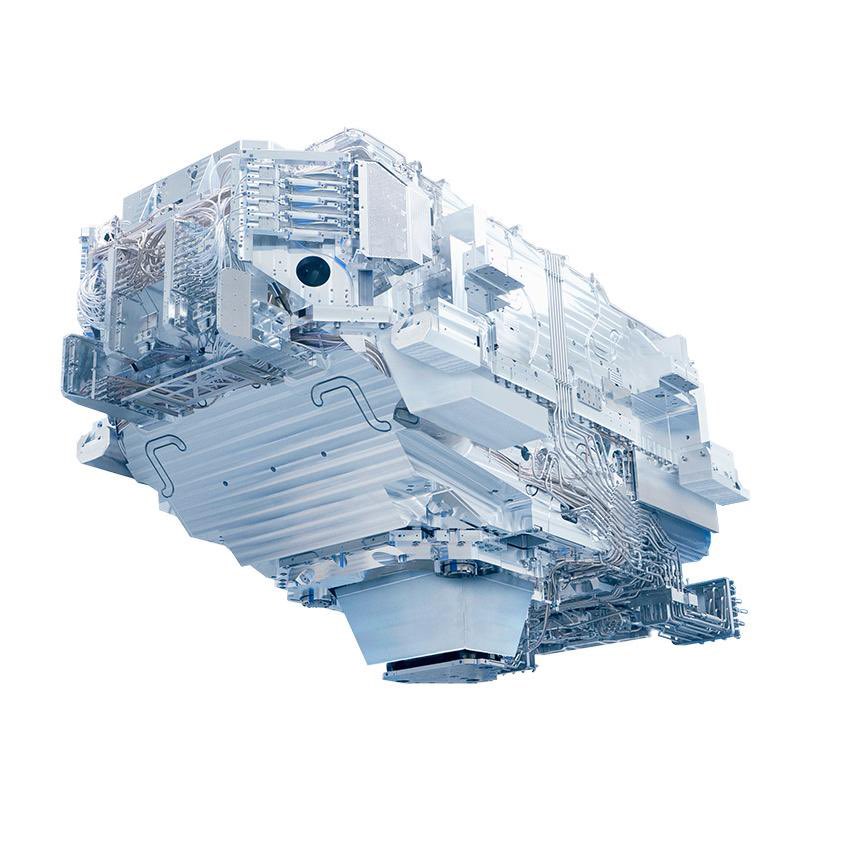
Zeiss is beginning production of their High NA-EUV systems for ASML.
“High NA” means high numerical aperture, which is a measure of the angular range from which an optical system can pick up light. For context High NA has numerical aperture of 0.55, whereas current EUV NA is 0.33
A 66% improvement.
That’s a feature density improvement of 1.67^2=2.789 so a near tripling of transistor density per unit area. It brings the critical dimension down to 8nm from 13nm.
Q: How did Zeiss achieve this?
A: With great difficulty.
• The projection optics system is 40,000 parts and around 12 tonnes.
• The illumination system is 25,000 parts and is 6 tonnes.
• The machine that manufacturers these mirrors is based in Germany, and consists of 100,000 parts and is 150 tonnes, the machining chamber itself is a 5m x 5m x 10m vacuum chamber.
The mirrors are machined for 3 months[!] to achieve a precision equivalent to 1mm deviation over an area the size of the Pacific Ocean.
It’s worth noting here that theoretical maximum NA = 1.0
Hyper NA (>0.7 and achieved using 8 mirrors) is expected the enter production 2032 - 2035.
That brings the critical dimension down to around 6nm and that might be the end, a single silicon atom is 0.23nm so the precision would be +/- 24 atoms.
Fun note… there is a category of lathes and machine tools called “ultra-precision” and these have axis resolutions of 1-2nm and can produce contoured shapes to 25nm accuracy.
You can buy “ultra-precision” machines, grinding machines for optical equipment have incredibly precise axis control because surface asperity on a mirror is visible to the eye.
B23B is the IPC/CPC class, and it teaches some interesting niche stuff (tells you where the future is going, even with trade secrets omitted).
The Trump administration is considering an executive order, and other means, to ban Chinese open-source models within in the United States. Kimi K3 has reignited this debate. Reporting this morning by Axios. Commerce is also considering adding Chinese AI labs to the Entity List.
Kimi K3 scores 57 on the Artificial Analysis Intelligence Index. Its intelligence is comparable to Opus 4.8 and GPT-5.5 but remains behind Fable 5 and GPT-5.6 Sol. Moonshot AI has expressed plans to release the 2.8T parameter model's weights, which would make it the leading open weights model
Key results:
➤ Strong agentic task performance: @Kimi_Moonshot's Kimi K3 reaches an Elo rating of 1668 on GDPval v2. This is a marked improvement over K2.6’s 1190, surpassing GLM-5.2 (1514), GPT-5.5 (1494), and Claude Opus 4.8 (1600). However, it still lags behind Claude Fable 5 (1760). Kimi K3 also scores an impressive 53% and takes the #1 position on AutomationBench-AA, our implementation of Zapier’s Agentic SaaS workflow evaluation.
➤ Second-highest performance on AA-Briefcase (agentic knowledge work): On our private long-horizon knowledge work evaluation, Kimi K3 reaches an overall Elo of 1547, +732 points from Kimi K2.6 and behind only Claude Fable 5. It is well-rounded: its rubric scoring and analytical quality almost reach Claude Fable 5’s scores, while GPT-5.6 Sol continues to outperform other leading models on presentation quality.
➤ Set to lead open weights models once weights are released: Moonshot AI has not yet released the weights but expressed plans to do so. Once available, Kimi K3 would clearly lead other open weights models including GLM-5.2 (51) and DeepSeek v4 Pro (44). However, at 2.8T parameters, it is significantly larger than its open weights peers (eg. GLM-5.2 at 753B params and DeepSeek V4 Pro at 1.6T), as well as the Kimi K2 to K2.6 models (1T params).
➤ Cost per task ($0.94) is similar to GPT-5.6 Sol ($1.04), ~1/2 the price of Opus 4.8 ($1.80) and higher than open weights peers: Moonshot AI’s pricing for K3 is significantly higher than their K2 pricing (K3’s output token price is $15/1M tokens while K2.6 was $4). This positions the model as cheaper on a cost per task basis than Opus 4.8, similar to GPT-5.6 Sol ($1.04) and more expensive than open weights peers, GLM-5.2 ($0.32) and DeepSeek V4 Pro ($0.04)
➤ Improved token efficiency alongside higher intelligence: Kimi K3’s token usage on the Artificial Analysis Intelligence Index decreased significantly, using 21% fewer output tokens than K2.6. The new model used approximately 132M output tokens to complete all nine evaluations, compared to approximately 166M for K2.6, while achieving higher scores.
➤ Native multimodal capabilities: Kimi K3, like K2.6, is released with native image and text multimodal input. If weights are released, this will position Kimi K3 as one of the leading open weights models with multimodal input capabilities
Other model details:
Context window: 1M
Size: 2.8T total parameters
Pricing: The first-party API is priced at $3.00/$15.00 per 1M input/output tokens, with cached input discounted 90% to $0.30 per 1M tokens.
Modality: Native multimodal input supports text and images, and the model remains text-only for output.
Accessibility: Accessible at launch through Moonshot’s first party API. Model weights are not yet released but Moonshot AI has expressed plans to do so.
New test footage: first missile shot from YFQ-44A.
YFQ-44A executed an end-to-end, beyond-line-of-sight strike against a simulated target.
The test, executed out of @EdwardsAFB, represents an important step in turning CCA into an operational capability.