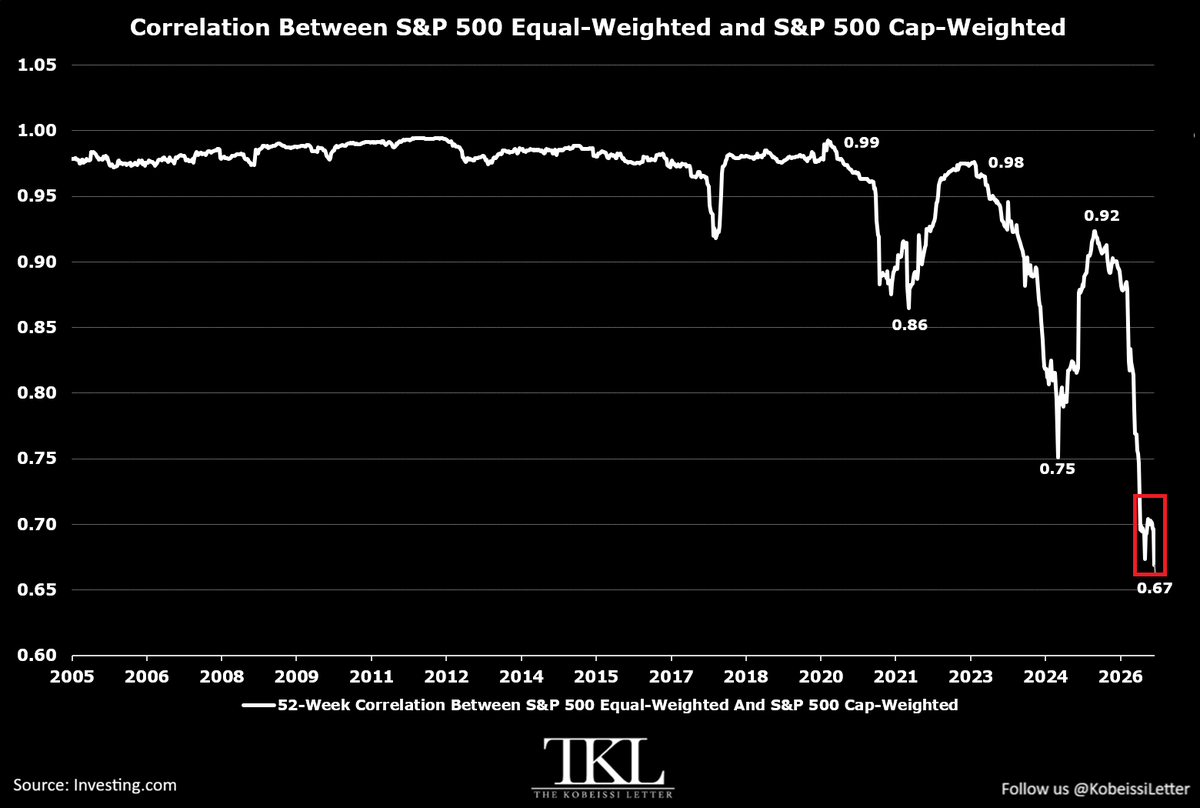
The US stock market has never been this fragmented:
The 52-week correlation between the equal-weighted S&P 500 and the S&P 500 index is down to 0.67, its lowest level on record.
This measures how closely the performance of the equal-weighted S&P 500 tracks the cap-weighted index, with a lower reading indicating a growing gap between the broader market and mega-cap stocks.
The correlation has declined -0.25 points since August 2025.
By comparison, before the 2020 pandemic, this figure remained between 0.95 and 0.99 for nearly 15 years.
To put this into perspective, during the 2000 Dot-Com Bubble, this metric never declined below 0.85.
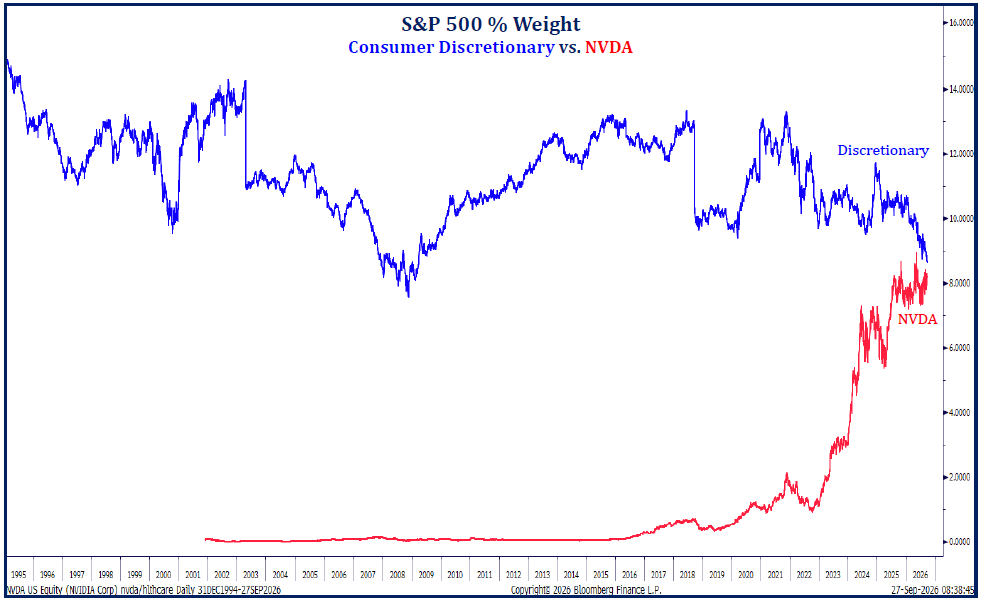
The S&P 500 is more concentrated than ever.
Iranian Boeing 737 seized at Istanbul Airport over a $3.4 million debt
The jet was preparing to fly to Iran when lawyers for a Turkish company and enforcement officers arrived after a court order.
The seizure is tied to secondary US sanctions on Iranian civil aviation.
Passengers and cabin crew were taken off the plane and sent back to the terminal.
Ackman raises a critical point — they’re not adjusting their models for the fundamental structural changes we’re experiencing.
Fed needs to modernize its thinking. ⬇️⬇️⬇️
Long-term oil futures prices remain completely oblivious to anything that’s happening in the Middle East. They continue to be almost perfectly correlated with breakeven costs in the shale patch.
Despite another day of lower international crude oil prices, refined product markets continue to move in the opposite direction.
According to AAA data (below), diesel has pushed above $6.50 a gallon, while regular gas is near $4.50.
Also and of note, refined products are increasingly featuring in diplomatic interactions, as this recent example (below) from the Financial Times illustrates -- this as pressure grows for export bans.
#economy #markets #energy #oil #diesel @FT
BREAKING: Iran has issued "Code 100," its highest alert level, for all armed forces in the past hour, covering the IRGC, the Army and security forces, per initial reports.
Trump cut short his weekend at Camp David to return to the White House tonight citing the potential for significant escalation, Netanyahu cut short his US trip to return to Israel the same day, and every US embassy in the Middle East has issued a security alert in the past hours.
The Greenland deal is Classic Trump 101: start with the wild ask — “we should own Greenland” — get everybody freaking out, and then negotiate toward what you really want.
And what did he want? A bigger, permanent U.S. security footprint in Greenland and a way to keep China and Russia out.
You can hate the style, but this is how he deals: start huge, create leverage, then land the part you actually came for. #Greenland @realDonaldTrump
SAUDI ARABIA DECLARED FORCE MAJEURE ON CRUDE TO EUROPE.
BLOOMBERG CONFIRMS EUROPEAN REFINERS WILL RECEIVE ZERO DELIVERIES IN OCTOBER.
Refiners lose their contracted supply with no immediate replacement, forcing higher spot purchases that feed directly into diesel and gasoline prices paid by European households and industry.
The easy way to fix inflation would be cutting federal spending.
Instead, the Fed's going to continue its 100-year tradition of crushing the real economy so Washington can keep spending like meth addicts with your credit card.
Warsh Fails the Oil-Shock Test
An oil shock is not a monetary-policy failure. It is a tax imposed by producers abroad, a supply disruption, or both. The Federal Reserve cannot drill another barrel, reopen a shipping lane, or make gasoline cheaper by raising the cost of a mortgage.
Yet Kevin Warsh’s response to the current energy-price surge suggests that he would do exactly what the Fed has too often done: hike into a supply shock, sacrifice the interest-rate-sensitive economy, and call the resulting contraction a victory over inflation.
That is a dangerous misreading of both the facts and history.
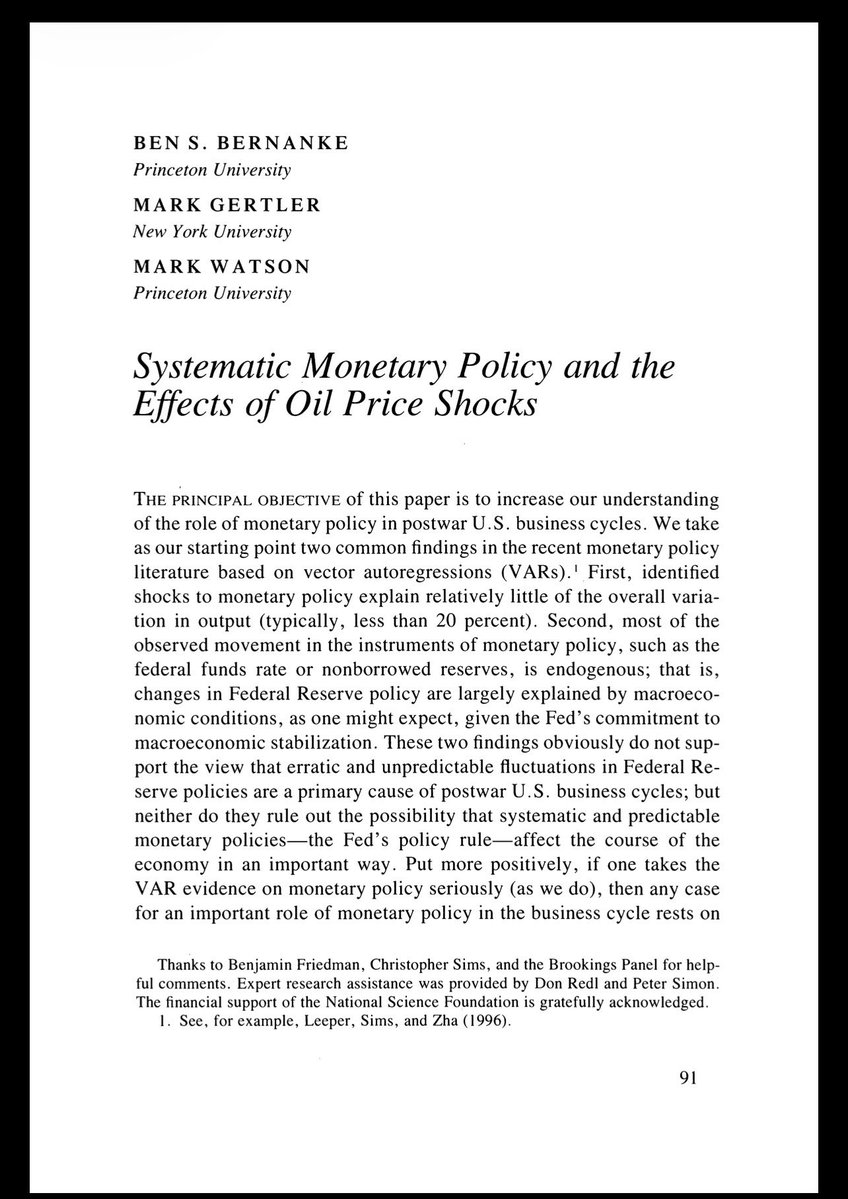
In their landmark 1997 paper, Ben Bernanke, Mark Gertler, and Mark Watson found that much of the economic damage following postwar oil-price shocks stemmed not from oil itself, but from the Fed’s systematic response higher interest rates. Oil was the trigger. Monetary tightening was the amplifier. Their work does not say that central banks should disregard inflation. It says they must distinguish an inflationary regime from a one-time jump in a key relative price.
That distinction is central today. A rise in energy costs can lift headline inflation and strain household budgets without producing a self-sustaining inflation process. The relevant questions are whether expectations are becoming unanchored, whether wage growth is accelerating in response, and whether price increases are spreading broadly through core services and goods.
If expectations remain anchored and there is no persuasive evidence of durable second- or third-round effects, a rate hike would be an act of economic vandalism. It would not lower the price of oil. It would simply add a credit shock to an energy shock.
Housing, commercial real estate, construction, autos, durable goods, and business investment have already borne the brunt of restrictive policy. These are not abstract lines on a Bloomberg terminal. They are the sectors where rate hikes become layoffs, cancelled projects, unaffordable homes, and weaker capital formation.
Warsh is as bad as Powell: both mistake a rigid response to headline inflation for credibility.
Warsh reacted to Wall St prediction market.
Warsh is making a policy decision based on what geopolitical events could be. Again classic mission creep.
Wall Street may cheer, of course. The Bloomberg bros crowd always admires the theater of a central banker promising resolve. But that is a Hall of Mirrors markets congratulating themselves for embracing a policy that may validate a fashionable narrative while weakening the underlying economy.
The test of a Fed leader is not whether he can raise rates. Anyone can raise rates. The test is whether he can change the reaction function when the facts demand it: recognize a supply shock, protect credibility without chasing oil prices, and avoid turning transitory inflation into a recession.
Warsh failed that test. Investors should take note.
https://t.co/nGq6qGsPgE
Unbelievable that Warsh came to the press conference saying the core CPI is "too high," and not a single reporter in the room held him accountable for saying that.
https://t.co/kN8GyB5umf
The Fed is about to repeat its worst mistake from 1973, and Wall Street is cheering it on:
- Brent just broke $100 for the first time since May. Diesel hit a record $6 a gallon. Both because the Iran war shut down the Strait of Hormuz.
- A quarter-point hike doesn't reopen that shipping lane. It doesn't refine a single gallon of fuel. Ending the war does this.
- The only thing it touches is demand, and the only way higher rates bring energy prices down is by beating the economy into submission until people stop spending (in 6 months.)
- In 1973, the Fed tried exactly this. Tightened into an oil shock expecting to look tough on inflation, and got a recession stacked on double-digit inflation instead.
- Nobody in Washington has figured out the difference between a supply problem and a demand problem in 50 years.
Raise rates now and you haven't fixed the oil shock. You've built a second one, and this one's homemade.
People seem to not understand this, so let me explain what rate hikes cannot do:
➡️ A rate hike cannot drill oil
➡️ A rate hike cannot end a war
➡️ A rate hike cannot manifest a house
If you live in a supply-constrained housing market that is not building, rate hikes won’t help, and likely make it worse.
We saw this from 2022-2025
Fewer people with locked in low rates move. Wealthy people with money to bid on the few existing listings are impervious to hikes. They simply adjust their portfolios based on the yields, and continue to obtain free money (passive income) on all their invested capital
US home prices continued to rise nominally during 1978-1984, despite 18% mortgage rates AND rolling recessions, because home prices don’t respond to high mortgage rates. Nor do they necessarily respond to recessions. They respond to supply and demand