Freshwater ecologist & river restoration specialist: interested in invertebrates and their habitats!
Work at Staffordshire Wildlife Trust... views my own.
Amazing day at Trentham Gardens. Not only did I catch up with the Lesser Emperor dragonfly but I found Staffordshire's first (I think) Norfolk Hawker! There were also 4 Black-tailed Skimmers and quite a few Red-eyed Damselflies.
Antherophagus pallens found yesterday on Dogwood (Cornus sanguinea) in Bengeo garden, scarce silken fungus beetle with interesting life cycle. #phoresis 1/2
Plagionotus detritus ♀ today in Bengeo garden, spectacular European longhorn beetle associated with Oak & Hornbeam with few UK records.
Previously recorded here in 2023 & appears now to have colonised local woodland. #saproxylic#attractedtolight
Look out for these tiny flies lurking around your bee hotel. Known as the Houdini Fly Cacoxenus indagator it lays an egg in a sealed mason bee tube, then escapes leaving its egg to develop into a cleptoparitic larva. Find out more here https://t.co/3RYrGa4taX @DipteristsForum
@ParkyBirder Don’t forget to check the bumblebees. I cover them in this report https://t.co/VhBWLb0PWg. Great Yellow and the Hebridean form of Moss Carder are the stars. Good populations at Balranald, Grenitote and machair with Kidney Vetch.
Alabonia geoffrella - probably my favourite micro moth. A small colony exists in a hedgerow just outside Wombourne. This week in May appears to be the best time to see them again. Gorgeous little moths.
1. For #WorldBeeDay I'm going to celebrate British PlastererBees, Colletes. Let's start with the largest & earliest-flying, Colletes cunicularius. It used to be confined to western dunes using Creeping Willow. But a new form using sallows has recently spread across southern UK.
Epistrophe grossulariae ♂ today in Bengeo garden, beautiful species identifiable by its almost straight black abdominal bands & habit of feeding at flowers without landing.
Never recorded this species in May before. #climatechange
4. In sandy parts of the W. Scottish and Irish coasts, you will find the very similar Colletes floralis. It forages on a greater variety of flowers and particularly likes umbellifers. Climate change may have eliminated it from Cumbria. New golf courses are another threat.
Black Darter are in decline in England. Cornwall Recorder Steve Jones is asking visitors and residents of East Cornwall to keep an eye out for the species, especially around Bodmin Moor. ID tips: https://t.co/oVvozne0cp Report sightings: https://t.co/7G6ZMjMxaX 📸 Pierre Bornand
The Green Forest Fly Caliprobola sp;eciosa, a large & rare hoverfly - one of the gems of the New Forest where it can be seen around the base of old trees & stumps. Get into the world of flies with our 'flyble' https://t.co/3RYrGa4taX @HantsIWWildlife@DipteristsForum
It’s #CreatureFeatureFriday! 🐆🐌
Meet the Leopard Slug, the spotted clean-up crew of the Peak District. They prefer fungi and rotting wood over your garden plants and even hunt other slugs! A true indicator of healthy ravine woodland. 🍄⛰️
#lifeprogramme#LIFEinRavines
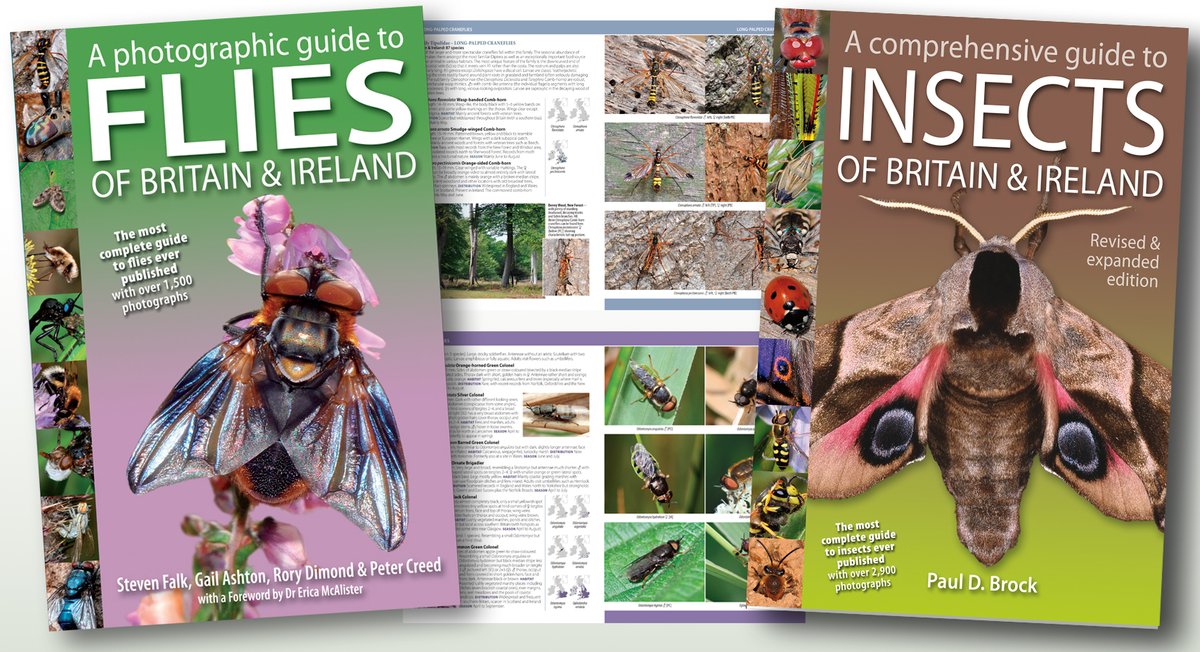
SPECIAL OFFER – Buy our best-selling Flies of Britain & Ireland and our Insects of Britain & Ireland TOGETHER and SAVE £15. Order here https://t.co/dwWoAhIBdT The offer ends 30 June 2026
1. Lets celebrate Britain's Osmia mason bees. 4 species can occur in gardens using bee hotels. O. bicornis and the recenty arrived O. cornuta use mud to create cell partitions and nest plugs whereas O. caerulescens and O. leaiana use chewed up leaves (pesto-like 'leaf mastic').
🐦✨ Amazing moment this morning while monitoring Pied Flycatcher nests, we caught a breeding female already carrying a ring from when she was ringed as a chick in 2025, just 9km away @RSPBCoombes
completing migration to and from West Africa to breed here in the UK 🌍💚
Tiny matt black male Callomyia amoena flat-footed fly (note the orange halteres) seen @BBOWT's Parsonage Moor, Cothill nr Abingdon (see our flies book https://t.co/3RYrGa4taX) The female has an orange-banded abdomen & silvery patches on the thorax @DipteristsForum
Fantastic new resource for European bees, hoverflies and butterflies from the Pollinator Academy https://t.co/GKfGlXmwgF. Invaluable for anybody involved preofessionally with pollinators or keen amateur recorders/researchers.
10/5/25 #Cumbria - There are few species with more charm than the Moonwort #Fern (Botrychium lunaria). Like many #orchids, it is dependent on mycoheterophy - that probably explains its decline and rarity across lowland regions, owing to agricultural practices #wildflowerhour