Sequencing bottlenecks and missed complexities can slow discovery and obscure critical insights.
To address this challenge, Plasmidsaurus utilizes the most innovative and powerful sequencing technologies with automated, integrated analysis to help researchers detect issues earlier.
In this “Teach Me In 10” episode hosted by Technology Networks, Nick Scales discusses how Plasmidsaurus’s approaches reduce troubleshooting time and accelerate discovery.
Watch here: https://t.co/lrwpVupucS
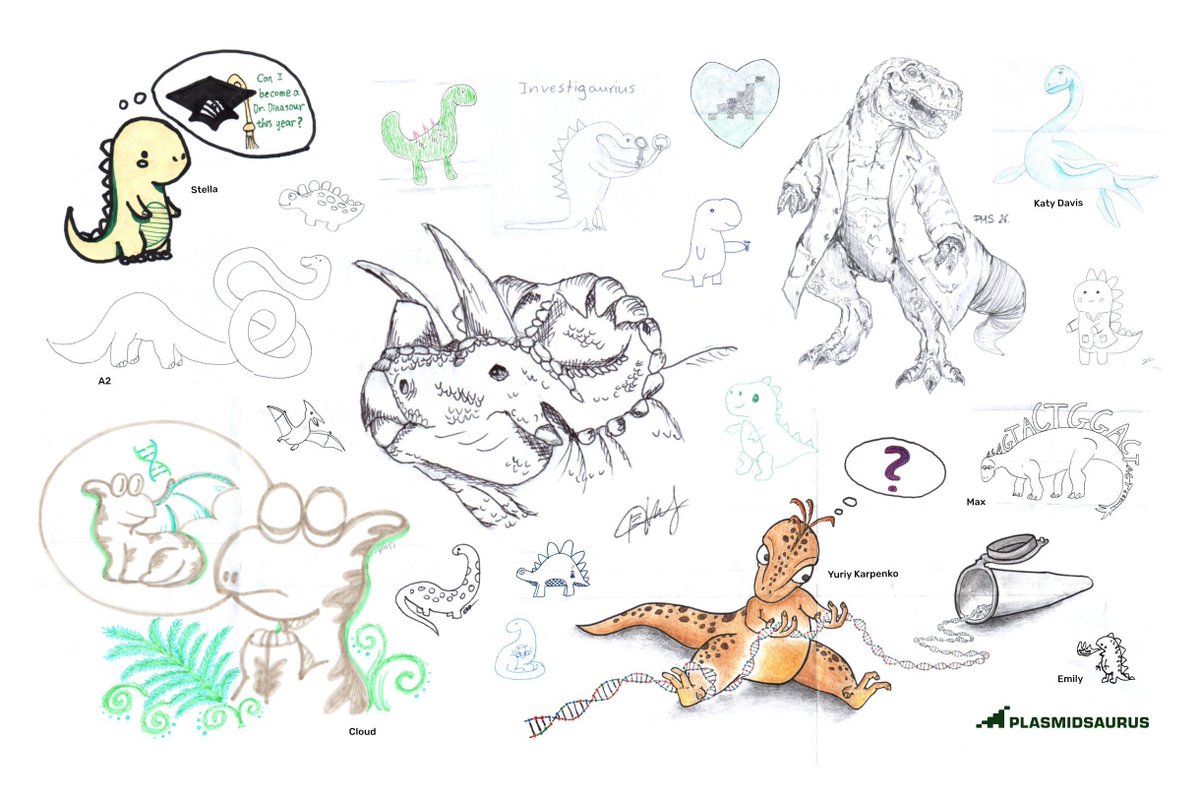
People ask us all the time: How did Plasmidsaurus get its name? And why are there dinosaurs everywhere?
We loved hearing your theories about how Plasmidsaurus got its name. Now it is time to set the record straight, once and for all.
The name brings together two things scientists tend to appreciate: the wonder of the living world and a good piece of wordplay.
Learn how the Plasmidsaurus brand came to life, why we believe rigorous science doesn’t have to be boring, and how a creature that went extinct millions of years ago became the face of a sequencing company.
Read the full story on our blog: https://t.co/XetYsxEF92
Getting actionable insights from your Linear/PCR sequencing data has never been easier. 🧬
In this short video tutorial, we walk through a real Linear/PCR sequencing order and demonstrate how to quickly validate your constructs within the Plasmidsaurus platform, making downstream analysis more efficient.
With results delivered the next day for just $15/sample, you can move from sequencing to decision-making faster than ever.
You'll learn how to:
• Navigate the Summary Report
• Identify perfect matches and mismatches at a glance
• Explore per-base sequencing results and amino acid predictions
• Interpret SNPs and other sequence variations
Find more tutorial videos here: https://t.co/8bh8wWpKnv
Sanger sequencing has been holding researchers back -- it struggles with GC-rich sequences, ITRs, mixed populations, and more.
For too long, researchers were stuck with 1970s sequencing methods that revealed only fragments of their DNA constructs, leading to invisible backbone errors, painful project failures, and weeks of wasted troubleshooting. Come learn how to overcome these hurdles and improve the quality of your research with faster, more complete results.
When: Tuesday, 28 October | 10:00–11:00 AM SGT
Register here: https://t.co/dDcD5A5lQN
🏆 ISME acknowledges Jennifer Martiny's groundbreaking work that significantly advanced our understanding of microbial diversity and its impact on ecosystem functioning with the Winogradsky Award.
🔗 https://t.co/tvb8B26Nf8
Congratulations to @kate_lagerstrom, @NickScales_, @LizHadly! Read more about their work below: "Impressive pan-genomic diversity of E. coli from a wild animal community near urban development reflects human impacts" in @iScience_CP
The last chapter of my dissertation describes E. coli diversity in wildlife @stanfordjrbp & offers insights into the role of humans in the occurrence of antibiotic resistant & pathogenic strains. Now @iScience_CP! 🎊
Thx @NickScales_ & @LizHadly 🙏
https://t.co/txKBXXZxDp
(1/8)
In summary, Curtobacterium is exceptionally good at surviving in extreme conditions. Moreover, the variation in both survival and mechanisms of survival add to the mounting evidence that within-genus diversity is a highly important consideration that must not be overlooked. 8/8
My latest paper has been published! When I first got to Southern California, I could barely endure the relentless summer sunshine. This led me to one of my first questions in grad school: how on earth could a little tiny bacterium survive around here? 1/8
https://t.co/92JhTX6USf
Mirroring the variation we saw in their survival, we likewise saw variation in their gene expression patterns. Despite their close phylogenetic relationship, Curtobacterium responded to the desiccation in a distinct manner, even when considering only genes which are shared. 7/8
If you're around I'd love to see you at my PhD defense in Irvine, California on Friday! thanks @KristinBarbour3 for the poster! Will climate change be the end of us all?? I guess you'll have to come along to find out! DM me for a Zoom link if you want to watch from afar ^.^
Don't miss Sarai Finks' dissertation defense "Ecological and evolutionary consequences of microbial community responses to environmental change" this Thurs July 7, 11am, 1114 Nat Sci 1, or via Zoom!
I am excited to share that my first, first-author #PhD paper has been published! Thank you to my advisor Jennifer Martiny and everyone involved who helped make this possible including @StevenDAllison! (1/6)
https://t.co/iQr1wR9yWb